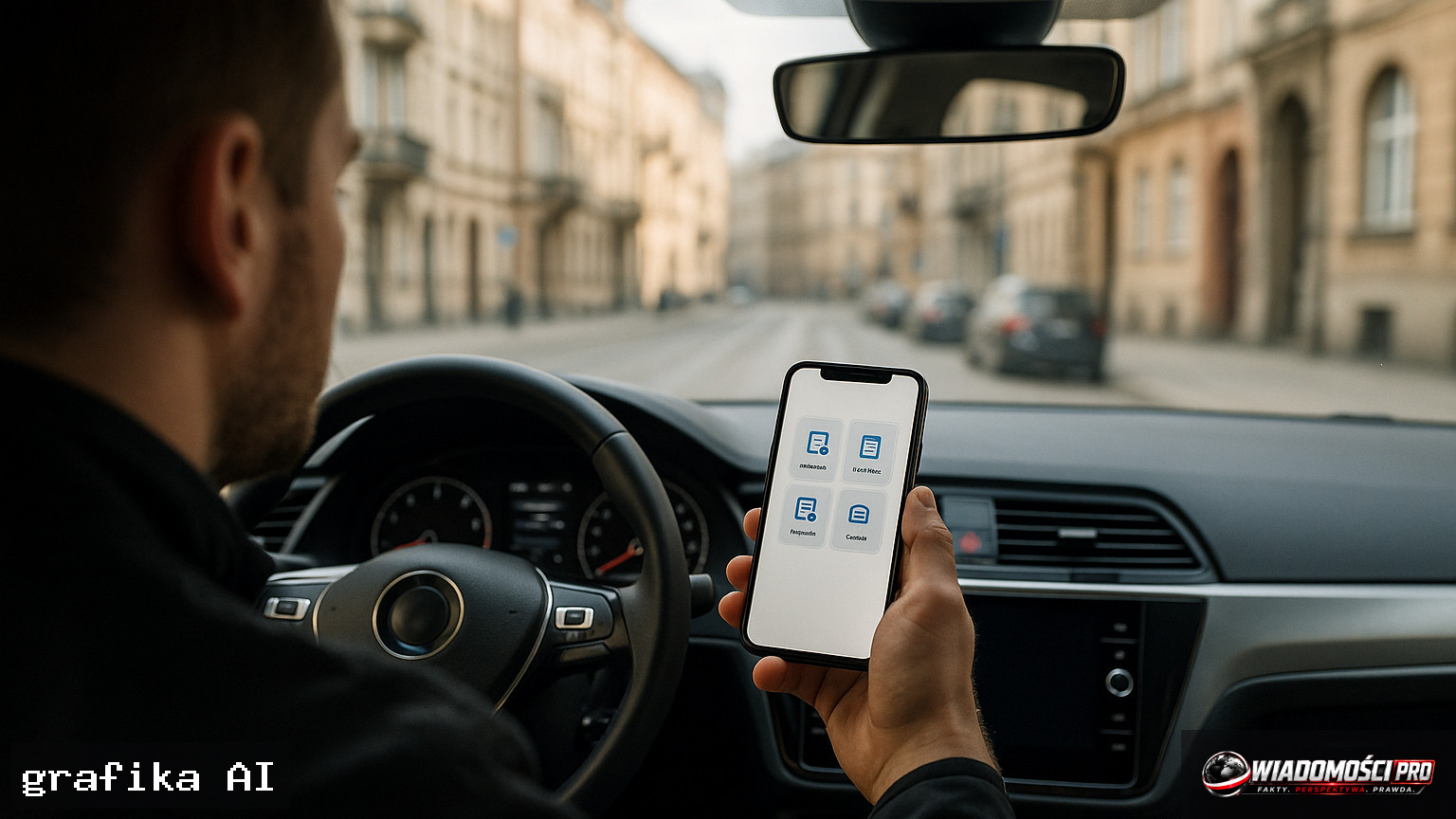
In brief
- Vehicle registration via the mObywatel app will launch on January 15, 2027.
- The procedure is designed to be smartphone-based: submit applications remotely, verify identity via Trusted Profile or e-ID, and pay fees via integrated payments without visiting a counter.
- Millions of cars are registered annually in Poland, so the success of this digital channel depends on solving the logistics of physical license plate delivery and the stability of local government servers.
Smartphone car registration starting mid-January 2027
The new e-service for car registration via the mObywatel app, which removes the need for office visits, is scheduled to be available to drivers on January 15, 2027. The procedure involves filling out a digital application, uploading purchase agreements or invoices, signing documents with a Trusted Profile or e-ID, and paying fees directly within the app's transaction module. Instead of booking appointments at a vehicle registration office, owners will handle the entire process on their phone screens, eliminating the burden of in-person visits to the county office.
This is a concrete change awaited by drivers and local officials struggling with overcrowded offices. According to announcements from the Ministry of Digital Affairs in October 2026, the platform will finally connect the central CEPiK registers with the record-keeping systems maintained by counties. In Poland, between several hundred thousand brand-new passenger cars and nearly three million total vehicles (including the secondary market and imports) are registered annually. The scale of the operation is massive. The current stationary service structure has long been struggling under the pressure of applicants, causing weeks-long backlogs in large cities.
Moving this volume of applications online raises immediate logistical questions. Government announcements highlight full automation of the procedure but remain silent on a key stage: the circulation of physical items. A car must have physical license plates and a legalized registration certificate. The Ministry of Digital Affairs has not yet specified whether a courier will deliver the plates, if drivers will collect them from parcel lockers, or if an exception will force them to visit government offices to pick up their "starter pack."
Another question mark concerns second-hand cars that already have Polish plates. Under current law, a new owner can keep existing plates if they match the current design and are legible. In such a configuration, the physical delivery problem disappears, making the mObywatel procedure fully self-service. The matter becomes dramatically more complicated when a vehicle requires new plates, the old set is damaged, or the transaction involves a car imported from abroad. In the latter cases, digital enthusiasm will clash with the realities of customs and tax controls.
How the in-app car registration process will work step-by-step
The electronic process is designed as a closed path within a single piece of software. Instead of downloading PDFs and manually filling out fields, the user will go through a standardized wizard.
The first stage is applicant authentication. After logging into the app, identity is automatically retrieved from the PESEL register. The owner selects the vehicle registration module, where the system asks for the car's status: purchase of a new vehicle from a dealership, acquisition of a vehicle already registered in the country, or import.
The second step involves entering vehicle identification data. This primarily concerns the VIN, the current registration number, and the date of first registration if the car is used. Based on this, the system queries the Central Vehicle Register (CEPiK) database and verifies the vehicle's technical history and legal status. If the car is listed as stolen, seized by a bailiff, or has technical parameter discrepancies, the application is immediately blocked from being sent.
The third stage is attachments. The driver takes scans or photos of the document confirming ownership. This could be a sales agreement, VAT invoice, deed of gift, or court ruling. The image must be legible, and the software is expected to verify the seller's and buyer's data. If the chain of previous owners' agreements is incomplete, the system will not allow the user to proceed to the next step, protecting offices from incomplete documentation.
The fourth step is authorization. The compiled application requires a qualified signature, for which the app's built-in Trusted Profile or a personal signature linked to an e-ID will be used. Anonymous submissions are not possible. Once approved, the form enters the queue at the vehicle registration office appropriate for the applicant's place of residence.
The fifth element of the procedure is payment. The standard cost of registering a passenger car in Poland is 160 PLN for new plates or 66.50 PLN if the owner decides to keep the existing ones with white plates featuring the EU flag. Previously, applicants had to run to the office cashier or attach bank transfer confirmations. In mObywatel, payment is intended to be handled via integrated payment gateways, including Blik and instant bank transfers, directly from within the app before the final submission of documents to the official.
This is the target scheme. However, the ministry has not provided guidelines on what happens when an official at the county office rejects the quality of a contract scan or notices discrepancies in numbers. The appeals procedure in a mobile environment remains a blank spot, and without clarification, drivers could get stuck in formal limbo.
Formal requirements and verification procedure
Access to the virtual window is subject to strict technical conditions. Applications cannot be sent by random individuals or intermediaries without appropriate digital power of attorney. The system requires an active mObywatel profile fully verified by a certificate. Anyone using the app in basic mode without identity confirmation via electronic banking or a verification point will not pass the initial authorization.
Detailed identity verification is a barrier against registration fraud. The database retrieves the PESEL number, registered address, or place of residence and automatically assigns the case to the appropriate county office or city with county rights. This eliminates errors regarding local jurisdiction, which in the paper-based mode resulted in application returns and the loss of many working days.
Another strict rule applies to co-owned vehicles. In the traditional mode, all owners listed in the agreement must appear at the office or present written authorizations subject to a 17 PLN stamp duty. Digital registration will force a countersignature mechanism. If two people are listed on the agreement, such as spouses or business partners, an application initiated by one of them will have to be displayed and signed in the app by the second co-owner before the case is formally sent to the office. Lack of acceptance from the co-owner will invalidate the process.
The matter becomes even more complex with cars imported from within or outside the European Union. Registering such a vehicle requires confirmation of excise tax payment or a document certifying that no such obligation exists, a certificate of a positive technical inspection, and a foreign registration certificate with a sworn translation, unless the foreign document contains standardized EU codes. The Ministry of Digital Affairs has not yet explained whether the system will connect directly to the Ministry of Finance's PUESC platform to automatically pull excise tax data, or if the driver will have to upload files downloaded from the tax office.
If the integration of tax and technical databases does not work at the service's launch in January 2027, the app will only handle the domestic market in its first phase. This would mean that hundreds of thousands of imported cars registered each year would remain under the old paper regime. Local governments are calling for clear guidelines, as it will be the local officials who have to explain to impatient drivers why their smartphone applications were rejected.
Where is the catch with home registration?
Moving the office into your pocket sounds attractive, but physical automotive reality creates barriers that computer code alone cannot solve. The primary friction concerns license plates. A car without physical plates cannot legally drive on public roads. If you buy a new car from a dealership, the plates must be physically embossed, affixed with legalization stickers, and handed to the owner.
Currently, the law requires that plates be mounted on the car at the moment it is put into traffic. If you submit an application on Friday evening via mObywatel, the car will not become roadworthy on Saturday morning unless the car dealer receives authorization to issue plates on behalf of the state. Such a variant was considered but requires deep legislative changes in road traffic law, not just a smartphone app update.
The second issue is returning old markings. Although the obligation to replace plates when buying a car from another county was abolished in 2022 (provided they are legible and comply with the Polish design), many cars still have damaged plates, black plates from the previous era, or plates with the Polish flag instead of EU stars. These vehicles absolutely must be replaced with the new design. Who and how will collect the old set of plates from an owner registering a vehicle from their couch? If offices demand they be sent via post or courier at the citizen's expense, the entire procedure will drag on and lose its "hassle-free" value.
It is worth noting that some former bureaucratic absurdities have already disappeared. Drivers do not need to worry about inspection stickers on the windshield. These were completely withdrawn in September 2022, which simplified the legal status, at least in this one point. There is no longer a need to scrape the windshield or wait for a holographic strip, which was a mandatory part of the registration kit for years.
The third catch is the issue of temporary permits, so-called "soft" registration certificates. In the standard path, a driver receives a temporary permit valid for 30 days while the Polish Security Printing Works (PWPW) prints the hard, permanent registration certificate. For years, the police have not required drivers to carry a registration certificate during checks in Poland, as officers check data in CEPiK.
However, traveling abroad without a physical document still risks a fine or having the car impounded in a foreign country, as other nations do not have access to Polish servers. If a driver registers a car via the app and decides to drive to Germany or the Czech Republic the next day, they risk serious trouble without a physical document. The state must provide a safe and fast distribution channel for finished laminated documents.
Comparison: Registration at the office vs. mObywatel
The differences between the current scheme and the procedure being prepared for January 2027 are fundamental. They concern not only the place of document submission but primarily the time and logistics on the driver's side.
Current stationary mode:
- Waiting time: necessity to book an appointment days in advance or stand in a morning queue for a ticket from the queuing system.
- Form of application: paper form filled out by hand with the necessity to attach original agreements, registration certificate, and vehicle card if issued.
- Payment: paid at the office cashier with a commission or via traditional transfer with the necessity to show a printed confirmation.
- Visits to the department: at least one to submit the application and collect the temporary permit, often a second one to collect the permanent registration certificate.
- Base cost: 160 PLN when replacing plates or 66.50 PLN when keeping the existing registration number.
New mode via mObywatel app from January 2027:
- Operation time: submitting an application at any time of day without standing in queues or adjusting to county office working hours.
- Form of application: interactive mobile form integrated with PESEL and CEPiK registers, supplemented with scans of documents.
- Signature: Trusted Profile or personal signature using an e-ID directly on the smartphone screen.
- Payment: instant cashless transaction from within the app via integrated payment systems.
- Physical contact with an official: reduced to zero at the formal stage, dependent on the chosen method of delivering finished plates and the certificate.
Digitization solves the problem of standing at the counter but places full responsibility on the driver for the accuracy of the entered data. An official at the counter verified errors on the spot, pointing out a missing signature on a sales agreement. In a computer system, a mistake in the VIN or an illegible invoice scan will generate a formal request to complete deficiencies, which will halt the case.
For local governments, this is a massive change. Instead of manually entering data from paper, employees of registration departments will become verifiers of digital packages. Theoretically, this should shorten the processing time for a single application from several minutes to several dozen seconds. In practice, the system's efficiency depends on the quality of the software integrating mObywatel with local government databases.
Implementation schedule and preparations for the 2027 launch
The date January 15, 2027, is not accidental. The beginning of the calendar year is the traditional moment for introducing changes in state teleinformatic registers. Implementation announcements published in the fall of 2026 give the government and local administration little more than a year for technical and legal preparation.
The first stage of work, conducted at the turn of 2026 and 2027, is adapting the central CEPiK register for two-way communication with the mobile app. Until now, mObywatel served mainly as a digital document wallet – allowing the display of driving licenses (mPrawo Jazdy) and vehicle data (mPojazd). The registration module is a qualitative leap: the app ceases to be a passive viewer and becomes an active submission point that triggers legal and financial consequences.
The second stage is integration with software operating in counties. There are nearly 380 counties and cities with county rights in Poland, using various teleinformatic platforms for vehicle registration. Ensuring a stable data bridge between the central app and local servers is the riskiest part of the entire project. If one of the counties does not modernize its infrastructure on time, residents of that region will be cut off from the digital path.
The third step lies on the legislative side. The government must amend regulations concerning the detailed actions of authorities in matters related to admitting a vehicle to traffic. The regulations must precisely define how to treat a digital application, how to invalidate existing registration certificates without them being physically cut by an official, and how to organize the shipment of new plates by post or courier.
Polish offices face a massive test of capacity. January is traditionally a period of increased traffic in registration departments, compounded by year-end transactions and corporate fleet settlements. Launching a new service at the peak of the season without a margin for error risks paralysis if the Ministry of Digital Affairs' servers cannot handle the traffic. On the other hand, a successful implementation will definitively close the era of paper-based automotive bureaucracy in Poland.
What this means for you
From January 15, 2027, you will save time and vacation days by registering your purchased car on your smartphone via mObywatel, provided you have a Trusted Profile or e-ID and a set of error-free digital documents. However, before you stop planning your day around a visit to the office, ensure how the issue of delivering new license plates has been resolved in your county and whether your transaction requires showing customs/tax documents, which may still keep the case in the traditional circulation.
Questions and answers
When exactly will car registration in mObywatel start?
The launch of the new e-service in the mObywatel app is scheduled for January 15, 2027.
Will any visit to the office be required for in-app car registration?
The project's premise is to completely eliminate the need for personal appearance at the registration office during the application submission stage, but the issue of collecting new license plates and the hard registration certificate depends on the finally implemented document distribution model.
What tools are required to sign an application on a phone?
To authorize the application, it is necessary to have an active Trusted Profile or a personal signature integrated with the electronic layer of the national ID card (e-ID).
How much will the registration fee in the app be, and how will it be collected?
The fee is 160 PLN when replacing plates or 66.50 PLN when keeping existing numbers, and payment will be made cashless directly in the mObywatel app before sending the form.
Sources
- Car registration in mObywatel. New service from 2027 - dobreprogramy
- A revolution is coming. Online car registration from January - Spider's Web
- A revolution awaits drivers in mObywatel. You will register your car without leaving home, but there is a catch - Bankier.pl
- You will register your car from home. mObywatel will help - Antyweb
- Another formality you will handle via the mObywatel app. Starting January 2027 - boop.pl
Article prepared with the help of artificial intelligence. The Wiadomości PRO newsroom is responsible for this publication.


Comments (0)
Loading comments...