In brief
- The "Desierto florido" phenomenon in Chile's Atacama Desert, specifically in the Copiapó and Huasco provinces, emerged in early October 2026 following unprecedented rainfall.
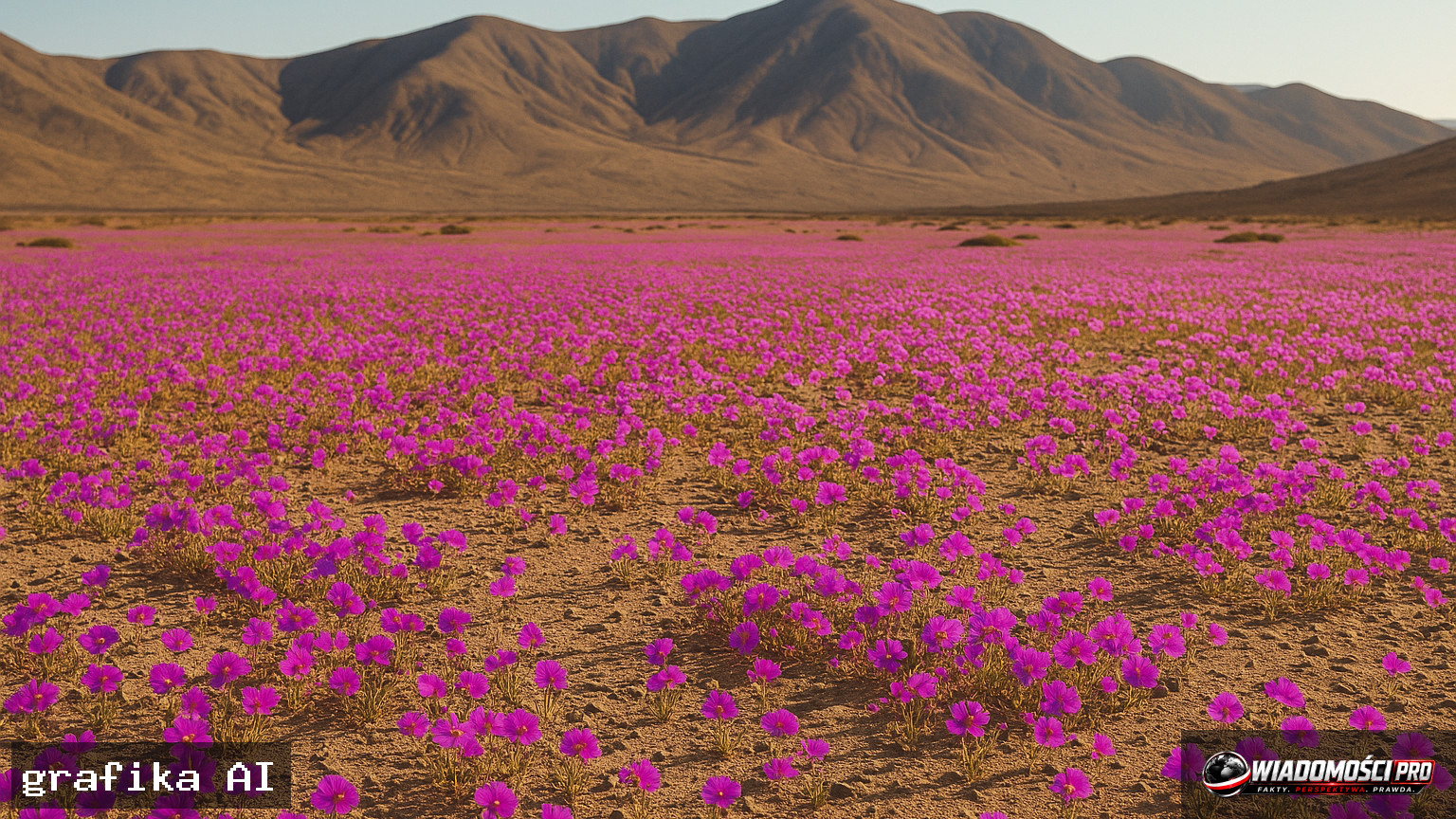
- The barren ground is now dominated by shades of purple, pink, and white, created by the mass blooming of endemic taxa, primarily Cistanthe longiscapa and species of the Nolana genus.
- The phenomenon is strictly ephemeral and poses an immediate threat of degradation to the unique seed bank due to uncontrolled vehicular and tourist traffic.
A surprising sight: Atacama turns into a sea of flowers
The Atacama Desert in Chile has transformed into a sea of flowers as a result of rare rainfall that awakened seeds dormant in the extremely dry soil. This phenomenon is documented in the latest reports from early October 2026. Officially classified as Desierto florido (flowering desert), the phenomenon manifests as a dominance of intense violet, purple, yellow, and white colors, caused by the mass emergence of endemic species, primarily Cistanthe longiscapa (known locally as pata de guanaco) and various forms of the Nolana genus (suspiros).
The areas of the Huasco and Copiapó provinces in the Atacama region are no longer barren wastelands. The previously dry sand and rocky gravel are now covered by dense patches of annual plants and geophytes. This is not a gradual biological process known from temperate zones; the transformation occurred rapidly. Moisture penetrated the top layer of the lithosphere, which within dozens of hours initiated enzymatic processes in embryos that had been in a multi-year lethargy.
While public discourse is dominated by admiration for the aesthetics of this event, from a botanical perspective, this is a critical reproductive moment. Plants must germinate, develop shoots, form inflorescences, and attract specialized entomofauna before the moisture is irrevocably sucked away by the extremely dry air. Time is running out. Desert ecosystems do not forgive delays. The arrival of thousands of tourists driving along the Pan-American Highway means the immediate crushing of delicate habitats by off-road vehicles, which prevents seed setting.
The climate paradox of the driest place on Earth
Reports published on October 3, 2026, by national-geographic.pl captured the peak of the phenomenon, which appears in this part of the world only during specific hydrological sequences. Northern Chile, and in particular the plateau stretching between the Coastal Range and the Andes, is a hyper-arid area. Average annual rainfall in many measuring points does not exceed 1–2 mm, and some meteorological stations have not recorded measurable rain for decades.
In such conditions, the classic cycle of organic matter is halted. Aridisol-type soils are characterized by minimal humus content, high salinity, and the presence of cemented gypsum and nitrate crusts. No traditional plant structure can exist in such a soil profile.
The evolutionary adaptation of Atacama's flora involves completely abandoning the maintenance of vegetative tissues during periods of drought. Instead, species such as Nolana paradoxa or Cistanthe celosioides invest resources in resilient seeds covered by hard seed coats saturated with germination inhibitors. These compounds are washed away only when the amount of water in the soil reaches a specific saturation threshold, guaranteeing at least a minimal chance of completing a full life cycle.
A short-term increase in relative humidity and soil soaking does not mean a permanent break in the prevailing climate regime. When the water evaporates, the scorching sun and constant wind from the Pacific will dry the shoots to a crisp in a few days. The landscape will return to monochromatic gray.
Weather anomalies as a catalyst for rare rainfall
The development of the Desierto florido phenomenon in October 2026 was made possible by a specific synoptic combination. Meteorological stations in the area of Vallenar, Freirina, and Copiapó recorded the passage of an atypical cold front combined with a cut-off low in the upper layers of the troposphere, which broke the stable thermal inversion generated by the cold Peru (Humboldt) Current and the constant South Pacific High.
Instead of the typical camanchaca advection fog, which only moistens the highest coastal elevations up to 800 meters, convective clouds carrying classic rain reached deep inland.
The total rainfall in this episode exceeded the critical threshold of 15 mm per square meter, which, according to hydrological models, is the minimum dose capable of seeping through the parched layer of dust and triggering physiological processes at a depth of several centimeters. On gravel surfaces, water soaked in instantly, protecting resources from immediate evaporation in the dry air.
The area covered by noticeable blooming is estimated at hundreds of square kilometers in a belt from the coast to the Andean foothills, with the greatest intensity in Llanos de Challe National Park and the Huasco River valley. The shift of moist air masses inland is a hydrological shock to the ecosystem. The desert absorbed the rain like a sponge, and the clearing of clouds and the rapid increase in insolation created greenhouse conditions in the ground zone itself.
The mechanism of dormant seeds: survival in the sand
The Atacama Desert in Chile transformed into a sea of flowers as a result of rare rainfall that awakened seeds dormant in the extremely dry soil. This phenomenon is documented in the latest reports from early October 2026. The physiological mechanisms responsible for this metamorphosis represent one of the most rigorous survival systems in the plant world.
The biology of Desierto florido is based on two fundamental strategies:
- Seeds of annual plants (ephemerophytes) contain strong chemical growth inhibitors, including abscisic acid, which block mitosis until the rainfall is intense enough to physically wash these substances out of the seed coat.
- Underground organs of geophytes, represented by tubers and bulbs of species such as Rhodophiala rhodolirion (añaña) or Leucocoryne, accumulate starch and water, vegetating in a state of cryptobiosis for decades under a layer of dried sediment.
Winter and early spring rainfall act as a precise trigger. When the concentration of inhibitors drops below a critical value, rapid water uptake by the seed occurs. Within 48 to 72 hours, the seed coat cracks and an embryonic root is produced.
The pace of vegetation is dizzying. In European conditions, this process takes weeks, whereas in the Atacama, plants go from the seedling phase to generative maturity in just over a dozen days. Plants must close their entire reproductive cycle before soil moisture drops to zero. If water resources are exhausted before seeds are set, the population loses an entire invested generation without renewing underground resources. It is an extremely dangerous evolutionary roulette.
A short-lived ecosystem full of endemic flora
The blooming landscape of the Atacama from the first days of October 2026 is not a homogeneous mass, but a mosaic of species with diverse habitat preferences. The dominant patches of violet and pink are the result of the blooming of Cistanthe longiscapa, which can cover the slopes of dunes and gravel beds in an almost monocultural carpet. It is accompanied by representatives of the nightshade family of the Nolana genus, producing chalice-shaped flowers in shades ranging from blue and violet to pure white, with characteristic yellow centers.
In the lower parts of the valleys, where a bit more moisture is retained, yellow carpets appear, created by various species of the Senna and Cristaria genera. Exceptionally valuable from a botanical point of view are the sites of Leontochir ovallei (lion's claw), an endemic plant with bright red, fleshy inflorescences, occurring in an extremely limited area in the coastal zone of the Huasco province.
The floristic structure of Desierto florido includes over two hundred species of vascular plants, of which more than 70 percent are endemics found only in this strip of northern Chile. Their presence is absolutely linked to local microclimates.
Along with the flora, the world of invertebrates becomes active. Pupae and larvae of insects wake up from a state of anabiosis, and hundreds of species of desert wasps, solitary bees, and beetles from the Tenebrionidae family appear. The vegetation also attracts rodents and lizards, which in this short time window gain access to fresh biomass and nectar. However, this entire complicated trophic pyramid exists on a hydrological credit that is depleted with every hour. With the arrival of stronger land winds and temperatures rising above 30 degrees Celsius, the vegetation will fade as quickly as it appeared.
Consequences and significance of the Atacama flowering phenomenon
The images of the Chilean desert recorded on October 3, 2026, by national-geographic.pl have caused understandable stir in global news agencies, but for local nature conservation institutions, including the Corporación Nacional Forestal (CONAF), they mean a state of highest alert. Thousands of private vehicles entering off-road areas outside designated trails are destroying the soil in an irreversible way. Crushing the delicate shoots of Cistanthe longiscapa before seeds are dispersed eliminates the possibility of population renewal in a given area for decades to come.
There is no doubt that the regional hospitality industry in Copiapó, Vallenar, or Caldera is seeing a sharp jump in revenue at such moments. Lodging and guide services are selling out instantly.
The ecological price of this surge, however, is very high. The parched desert crust, known as biological soil crust, forms over hundreds of years with the participation of lichens and cyanobacteria. The tire tracks of heavy SUVs cut through this layer, opening the way for wind erosion. The wind then blows away fine soil fractions along with the seeds resting in them, carrying them to areas completely unsuitable for vegetation.
An additional challenge remains the illegal collection of seeds and bulbs of rare geophytes by irresponsible collectors. Despite the tightening of Chilean regulations regarding the protection of natural heritage, patrolling hundreds of thousands of hectares of open desert is physically impossible. The Desierto florido phenomenon of October 2026 once again exposes the lack of sufficient buffer mechanisms between the commercial exploitation of the spectacle and the absolute necessity of protecting extremely unique genetic resources.
What this means for you
You have the opportunity to observe one of the most unique phytogeographic phenomena in the world, but when planning a trip, you must count on strict restrictions to move only on designated roads. By buying seeds of alleged desert plants on auction portals, you risk supporting botanical poaching that destroys protected endemics of northern Chile.
Questions and answers
Which species are responsible for the most intense colors during Desierto florido?
The main role is played by Cistanthe longiscapa, which creates vast violet-pink carpets, and various species of the Nolana genus, blooming in white and light blue. In the coastal zone, the rare, bright red Leontochir ovallei also appears.
In which regions of Chile is the flowering phenomenon most visible?
Ephemeral vegetation develops most intensely in the Atacama region, with particular emphasis on the Huasco and Copiapó provinces, as well as in the protected areas of Llanos de Challe National Park and in the area of the Pan-American Highway.
How much rainfall is needed for the desert to bloom?
To trigger mass germination of dormant seeds, the total rainfall must exceed a threshold of at least 15 mm during the winter or early spring. Lower rainfall only wets the top crust and does not activate the embryos hidden in the soil.
Sources
Article prepared with the help of artificial intelligence. Facts come from the sources listed above. The Wiadomości PRO newsroom is responsible for this publication.




Comments (0)
Loading comments...