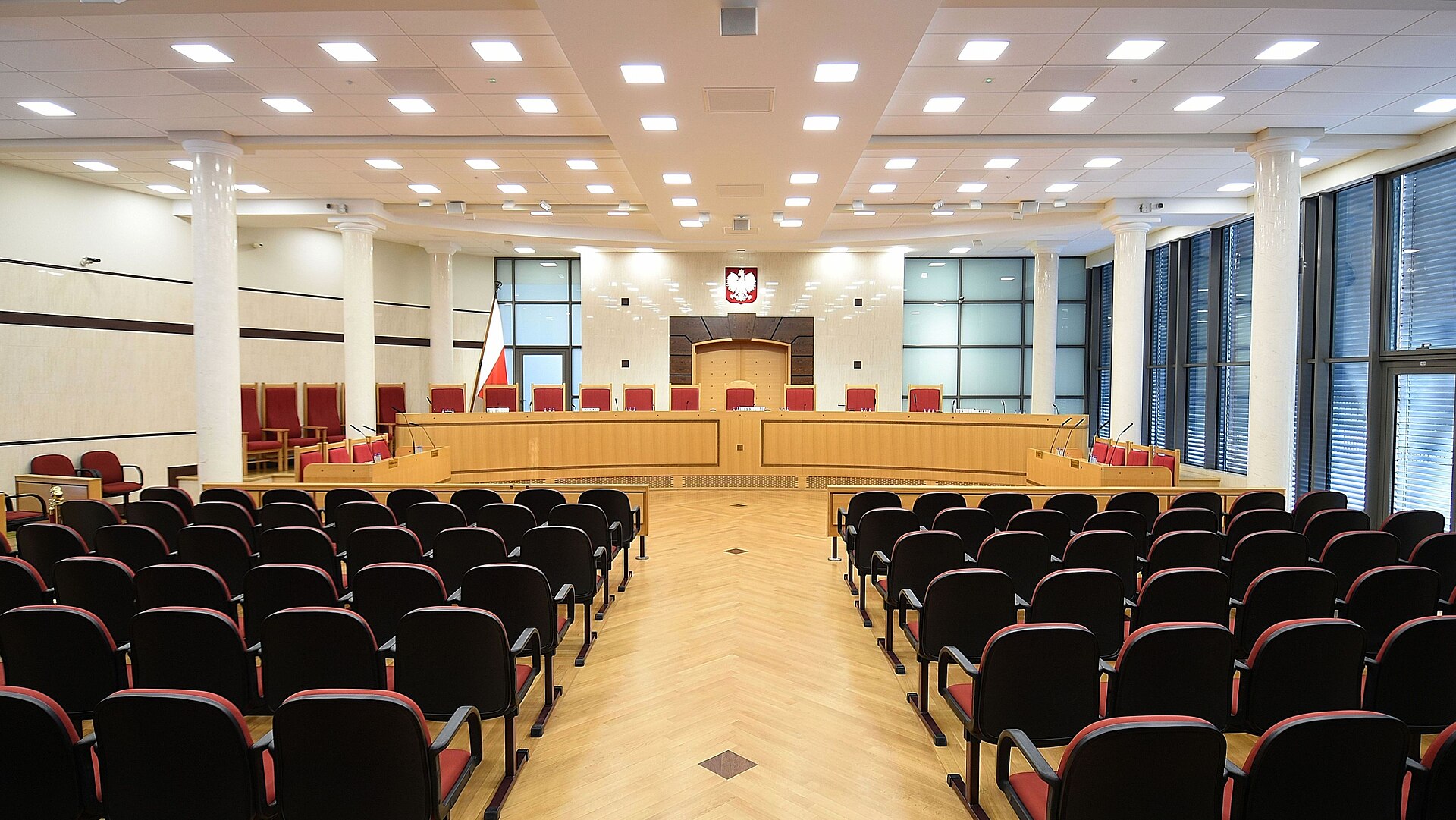
Since Friday, 30 October, Poland's Constitutional Tribunal has had, depending on whom you ask, two heads. One side points to Judge Anna Korwin-Piotrowska, the other to President Bogdan Swieczkowski. We explain what the dispute is about, without deciding which side is right.
The dispute in seven points
Who recognises whom. According to the judges elected by the current Sejm (announced by Maciej Taborowski, Magdalena Bentkowska and Maciej Berek), the Tribunal is headed by Anna Korwin-Piotrowska. The government supports this. According to the Tribunal's official X account, President Karol Nawrocki, PiS and Konfederacja, the Tribunal's president is still Bogdan Swieczkowski, with Bartlomiej Sochanski as vice-president.
On what basis the president was sidelined. The order of 30 October suspends Swieczkowski and Sochanski from their duties for up to a month, pending a resolution of the disciplinary court. It cites Article 130 of the Law on the System of Common Courts, applied accordingly. Korwin-Piotrowska took charge as the longest-serving judge. The reasons given include blocking the convening of a General Assembly with the judges elected by the Sejm and assigning cases to benches unlawfully (Polsat News).
Korwin-Piotrowska's status. The Sejm elected her as a Tribunal judge in March 2026. The President did not swear her in; she took her oath in the Sejm. The President holds that those who did not take the oath before him are not Tribunal judges. On the night of 30-31 October he told them: "You are not judges of the Constitutional Tribunal." The European Commission said the election of eight new judges "falls within the constitutional competences of the Sejm".
Swieczkowski's status. He considers that nobody has removed him. On Sunday, 1 November, he was again not let into the building. "I am the president, nobody has dismissed me from this post," he said, adding: "I will come here every day." In a statement of 31 October Korwin-Piotrowska ruled that he and Sochanski are not entitled to enter the building. According to Super Express, on Sunday Swieczkowski declared 3-6 November days off for Tribunal staff.
Immunity. Prosecutor General Waldemar Zurek has filed five motions to lift immunity: four concern Swieczkowski, one Sochanski. The immunity of a Tribunal judge is decided by the General Assembly of the Tribunal's judges. Swieczkowski and Sochanski are presumed innocent; no charges have been brought against them.
What lawyers say. Opinions are divided. Prof. Marcin Matczak believes the legal basis for sidelining the president is "in reality non-existent". Supreme Court judge Pawel Prusinowski called it "highly debatable", and Supreme Court judge Wlodzimierz Wrobel noted that the validity of the suspension "is decided by the disciplinary court" (TVN24). Four former Tribunal presidents, including Jerzy Stepien, backed the judges elected by the Sejm: "There is no other way to end the constitutional crisis." Prof. Ryszard Piotrowski said on WP that Korwin-Piotrowska "has not taken the oath and is not a judge".
What could settle the matter. Korwin-Piotrowska has convened a General Assembly of Tribunal judges for Tuesday, 3 November, among other things on the 2027 budget. Resolutions require at least 10 of the 15 judges. Swieczkowski says the judges he recognises will not take part. Prof. Matczak warns of the risk of resolutions being adopted without a quorum, which could prolong the dispute (Polsat News).
What is not known
As of Sunday, 1 November, it was not known how many judges had confirmed attendance at the assembly, or whether the President and the Prime Minister would meet over the Tribunal. Media give differing numbers of judges on each side, so we do not cite them.


Comments (0)
Loading comments...