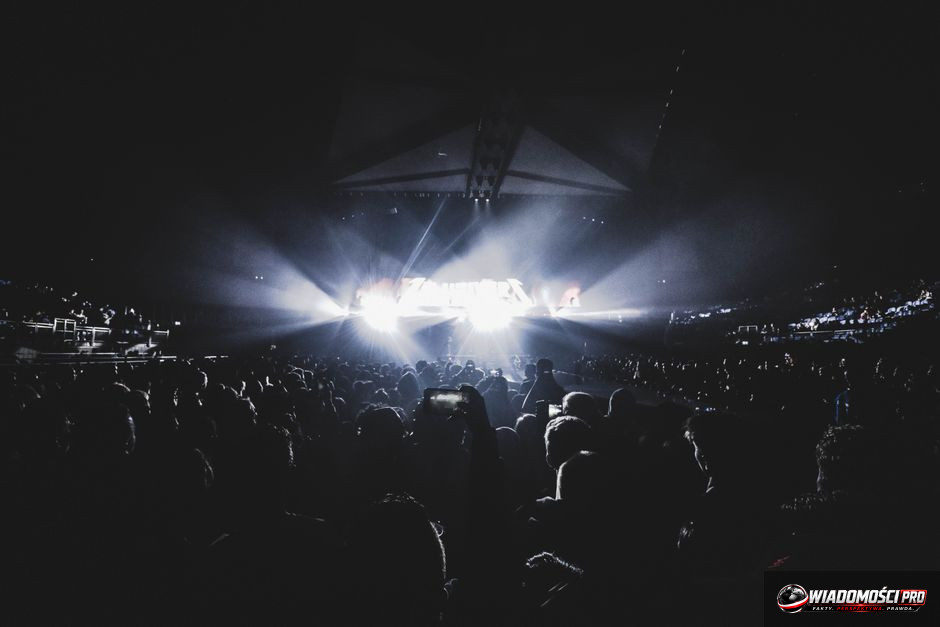
As part of the "Obrotowy Tour 2026," Dawid Podsiadło played concerts in five Polish cities, including double performances in Warsaw and Chorzów, and a final show in Gdańsk, which took place on June 21, 2026. The schedule for the entire tour spanned the first half of 2026, concluding with this spectacular event in the north of Poland. During this time, the artist successfully filled the country's largest sports venues, cementing his position as a leader in stadium entertainment.
Tour concert schedule
The following list reflects the structure of the tour. The organizers opted for the largest capacity stadiums in the country, which allowed for the accommodation of hundreds of thousands of spectators in just a few months.
| City | Venue | Date (2026) | Number of concerts |
| :--- | :--- | :--- | :--- |
| Warsaw | PGE Narodowy | May/June | 2 |
| Chorzów | Stadion Śląski | May/June | 2 |
| Gdańsk | Polsat Plus Arena | June 21 | 1 |
| Wrocław | Tarczyński Arena | Spring | 1 |
| Poznań | Enea Stadion | Spring | 1 |
The scale of the logistical operation in each of these cities exceeded the standards known from indoor concert tours. The choice of these five metropolitan areas was due to the availability of infrastructure capable of accommodating tens of thousands of people simultaneously. Such concentration allowed for minimizing the number of trips between cities, which, given the mass of equipment measured in tens of tons, is a decisive factor in the profitability of the entire undertaking. Transporting the stage, sound systems, and lighting required the involvement of dozens of semi-trucks, which moved to the rhythm dictated by the availability calendar of the stadiums.
Technical challenges at stadiums
Football stadiums are a hostile environment for music. The architecture of these facilities, designed with football in mind, generates uncontrolled sound reflections that, over long distances, turn into illegible reverberation. Podsiadło's technical crew had to implement distributed systems to avoid discomfort for listeners in the stands. The speakers were suspended in a way that directed sound directly at the sectors rather than at the concrete walls of the facility. Each subsequent location required engineers to recalibrate the system for the specific dimensions of the stadium. The Chorzów Stadion Śląski, due to its open construction and size, forced completely different amplifier settings than the largely roofed arena in Gdańsk.
The assembly of the stage structure began many days before the event itself. This required the coordination of hundreds of people – from local technical crews to visualization specialists and crane operators. The synchronization of these actions had to be perfect, as the time for setting up equipment was limited by league matches or other sporting events taking place on the same stadium pitches. Podsiadło, walking to the center of the stadium, had to rely on visual technology. Large-format LED screens served not only as displays but also as an element of scenography that brought the artist closer to viewers sitting in the last rows of the stands. The use of high-power lighting allowed for a clear image even in the early evening, when the sun had not yet set, which is crucial in the summer concert season.
Sales strategy and demand
Ticket distribution for the "Obrotowy Tour 2026" was not a one-time process. The artist's management opted for a gradual release of ticket pools, which allowed for gauging fan interest at every stage. The first information about stadium plans appeared as early as August 2025, which signaled to the market that a large-scale event was coming. The decision to add more dates, which took place in December 2025, was a direct response to the rapid sell-out of the first pools. The lack of a single release of all tickets protected sales systems from crashes and limited the scale of resale on auction sites, which is the bane of today's concert market.
The final deadline for the sale of the last pool of tickets, set for March 26, 2026, was a critical moment for fans. On this day, demand for tickets reached its maximum. The organizers knew that after this date, they would not be adding more concerts, which forced latecomers to make a quick decision. This strategy of building tension meant that the tour was almost one hundred percent sold out, which, for stadium venues with a capacity of 50-60 thousand people, is a feat on a national scale. Managing such a huge crowd required close cooperation with city authorities. Street closures, the organization of additional public transport after concerts, and medical security are operations whose scale resembles the logistics of large state-level mass events.
Gdańsk as a turning point
The final concert in Gdańsk on June 21, 2026, became the culmination of the tour. Industry media pointed to this performance as the final product, in which all elements – from sound to choreography – were already fully optimized. Viewers received a spectacle that differed from the inaugural performances in its greater fluidity and performance confidence. Gdańsk showed that a Polish performer is capable of filling a stadium not only through the power of their popularity but, above all, through the quality of the production itself. Shifting the emphasis from a "musical performance" to a "stadium show" has become a new standard that other Polish artists planning large tours will have to match.
Many observers emphasized that the Gdańsk concert was a symbol of market maturity. The artist, who just a few years ago was touring clubs and arenas, has now become a guarantor of quality in spaces previously reserved mainly for foreign stars of world format. This shift is the biggest change that the "Obrotowy Tour 2026" has introduced to Polish mass culture. The audience stopped treating the concert as an opportunity to hear songs live and began to perceive it as a comprehensive experience where every detail counts – from the quality of light to the clarity of sound in the stadium stands.
Impact on the Polish music market
The success of Dawid Podsiadło's tour forced the entire industry to re-evaluate its plans. Concert promoters in Poland realized that the audience is ready to pay higher prices as long as the quality of production is commensurate with the costs. However, a risk emerged for smaller artists. A stadium tour monopolizes the market in the summer season, engaging not only huge financial resources but also infrastructure and technical personnel. The competition must now face a bar set at a world-class level. Productions that were previously enough to attract an audience may now seem insufficient. This stimulates innovation but simultaneously increases the costs of market entry for new, less experienced performers.
The question of whether the Polish market can withstand more than one such tour per season remains open. Competition for dates at stadiums is fierce, and the availability of facilities is limited by national team matches and other mass events. Entertainment music in Poland has become a stable business where risk is mitigated by advanced data analytics. The organizers of the "Obrotowy Tour" knew exactly which cities fans were coming from, which allowed for precise targeting of promotional activities on social media. It was no coincidence that Gdańsk, Wrocław, Poznań, Warsaw, and Chorzów became stops on the tour – these are the centers that generate the highest demand for entertainment in the country.
Plans for the future: ZORZA 2027
The announcement of Dawid Podsiadło's participation in the ZORZA 2027 Festival at the Muchowiec Airport in Katowice, which took place on June 11, 2026, was a clear signal that the artist does not intend to slow down. Choosing an airport instead of a stadium is a paradigm shift. Open space gives more freedom in designing the stage but simultaneously shifts the burden of logistics to issues of access and securing a huge area. For the organizers of ZORZA 2027, Podsiadło's success in 2026 is a challenge. They must prove that they can transfer stadium quality to airport conditions. This requires creating from scratch infrastructure that is already present at stadiums: sanitary facilities, power systems, catering zones, and evacuation routes.
If this succeeds, it could open a new chapter in the organization of Polish festivals, where airports become the main arenas for the biggest musical events. Moving from air-conditioned stadium boxes or stands to an open airport field is a significant change in comfort for the fan. Dependence on weather conditions becomes much greater. Organizers must therefore place greater emphasis on logistics to avoid the chaos that often accompanies events in open spaces. The success of this event in 2027 will be the ultimate test for the new model of concert-going in Poland.
Are stadium standards sustainable?
Is the Polish market capable of maintaining such high quality in the coming years? The answer is not unambiguous. The costs of renting stadiums, technical support, and logistics are rising along with inflation and increasing expectations regarding safety. There is a fear that for many artists, the level of the "Obrotowy Tour" will become financially unattainable. The success of this tour is a signal that the Polish audience has matured to receive top-tier spectacles. Fans are no longer just looking for live music but a comprehensive experience. If the market does not provide such productions, listeners may more often choose to travel to foreign concerts, which would be a loss for the Polish event industry.
Podsiadło showed the way, but whether others follow it depends on their courage to invest in technology and logistics. Skeptics note that the long-term effects of such a "stadium offensive" could be burdensome for city infrastructure. Each concert is not only music but also tons of waste, noise, and traffic paralysis. Sustainable development of mass events is therefore becoming a challenge for future organizers. Podsiadło, by setting trends, must now face the question of how to maintain interest without exhausting resources – both the financial resources of fans and the logistical capabilities of cities.
Economic perspective
Analyzing costs and profits, one should pay attention to the ticket distribution model. The systematic release of ticket pools is a strategy that allows for revenue optimization. Organizers could observe how quickly tickets in individual price categories disappeared and adjust the offer to the real financial capabilities of buyers. The role of sponsors should also be mentioned. For such large tours, the contribution of external partners is essential. Thanks to them, it was possible to keep ticket prices at a level that did not exclude a wide range of recipients. Cooperation with commercial brands has become an integral part of the stadium tour, which is a dominant trend worldwide. Without this support, production at such a technological level would be impossible to bear through ticket sales alone.
Summary of logistical activities
"Obrotowy Tour 2026" went down in the history of Polish music as an example of success based on professionalism. From March 2026, when the last tickets went on sale, it was known that the tour would reach full attendance. This achievement would not have been possible without an efficient promotional machine that maintained media interest for many months. The most important lesson is the role of precision in planning. Every aspect – from transport to visual systems – was thought out. The attendance success in Warsaw, Chorzów, Gdańsk, Wrocław, and Poznań confirms that the Polish viewer expects high quality. But is this model repeatable? Time will tell if the year 2027 and the ZORZA festival will bring further proof that the Polish market is ready for an even larger scale.
Questions and answers
How many concerts did Dawid Podsiadło play as part of the tour in 2026?
The artist visited five cities, performing twice in Warsaw and Chorzów, which, together with the other locations, created a schedule of seven stadium spectacles.
When could the last tickets for the tour be purchased?
The last pool of tickets went on open sale on March 26, 2026, which was the final stage of the sales campaign.
Where will the artist perform after the end of the stadium tour?
The nearest confirmed event with the artist's participation is the ZORZA 2027 Festival, which will take place at the Muchowiec Airport in Katowice.
Which cities besides Warsaw, Chorzów, and Gdańsk were included in the tour?
The other two cities that hosted the "Obrotowy Tour 2026" were Wrocław and Poznań.
Was the tour a logistical experiment?
No, the tour was a precisely planned operation that focused on the largest metropolitan areas to ensure the highest technical quality of the spectacle.
The concert market in Poland is currently undergoing a fascinating transformation. Dawid Podsiadło is not only filling stadiums; he is defining what "quality" means for the Polish viewer. While a decade ago, success was sound-reinforcing a concert in a sports hall, today the standard is a production requiring months of engineering preparation. This is a huge change that sets a bar for every subsequent performer, the jumping of which requires not only musical talent but, above all, efficient logistics.
The costs generated by the "Obrotowy Tour 2026" are hidden in every detail – from LED screens to the complicated network of access routes for heavy equipment. The viewer, entering PGE Narodowy or Stadion Śląski, does not see engineers fighting reverberation; they only see a product that seems perfect. This illusion is the greatest success of the technical crew. However, if we look closer, we will see how complicated this machine is. Each concert is a separate project, a separate recalibration, and separate stress.
From a financial perspective, the model adopted by Podsiadło's management is proof that the Polish market is more predictable than previously thought. Thanks to data analytics used to target sales, waste of advertising resources was avoided. What was once an intuitive "organizing a concert" is today data management. It is this cold, analytical input that made the stadium tour such a success. Does this mean that in the future every major concert will look the same? Perhaps not, but certainly, everyone will have to go through the same rigor.
ZORZA 2027 is the next step. Muchowiec Airport is not a stadium. It is a space that forces organizers to think completely differently about safety and comfort. If Podsiadło succeeds there as well, he will prove that he is able to create his own rules of the game, regardless of the availability of urban infrastructure. The industry will watch this event with attention, because the success of ZORZA could become a new reference point for all festivals in this part of Europe.
For a music fan, these changes mean one thing – the necessity of paying more for higher quality. It is painful but inevitable. If we want to watch world-class productions, we must accept that the costs of these investments will be passed on to the recipient. Podsiadło, being where he is now, has the luxury of being a pioneer of these changes. The rest of the market will have to adapt or fall out of the game. This is a brutal but fair market mechanism that is happening right before our eyes.
Skeptics might argue that it is just music and it shouldn't be so complicated. However, in an era when the viewer's attention is distracted by hundreds of other stimuli, a concert must be more than just a performance. It must be an experience that will be remembered for years. And that is exactly what was achieved in 2026. Each of the cities – from Warsaw to Gdańsk – became a backdrop for a story that the artist built over many months. It was not just a tour; it was a show of strength by the entire Polish event sector, which proved that it can operate at full speed without errors.
Ultimately, the most important lesson of the "Obrotowy Tour" is not the fact that Podsiadło is popular. We knew that for a long time. The most important lesson is that the Polish viewer is ready for professionalism that does not forgive amateurism. Anyone thinking about entering a stadium in the coming years must be aware that the audience will not forgive a lack of attention to detail. And that is the best news for Polish musical culture that could have happened to us in 2026. Quality has become the new currency.
Sources
- Dawid Podsiadło for hundreds of thousands of fans. Two concerts each in Chorzów and Warsaw - Rzeczpospolita
- Dawid Podsiadło Obrotowy Tour 2026 – the biggest concert tour of the year - Kulturalne Media
- Dawid Podsiadło adds another stadium concert in 2026 [DATE, TICKETS] - Open FM
- Dawid Podsiadło released the last tickets for his stadium concerts - cgm.pl
- ZORZA 2027 Festival in Katowice – Dawid Podsiadło at Muchowiec Airport - Radio Piekary
- Dawid Podsiadło at stadiums in 2026. Get to know the dates and cities! - ebilet.pl
- Dawid Podsiadło returns to stadiums. "Obrotowy Tour" already in 2026 - Kultura Onet
- Dawid Podsiadło captivated crowds in Gdańsk. He showed how to do a world-class show - Trojmiasto.pl
Article prepared with the help of artificial intelligence. Facts come from the sources listed above. The Wiadomości PRO newsroom is responsible for this publication.


Comments (0)
Loading comments...