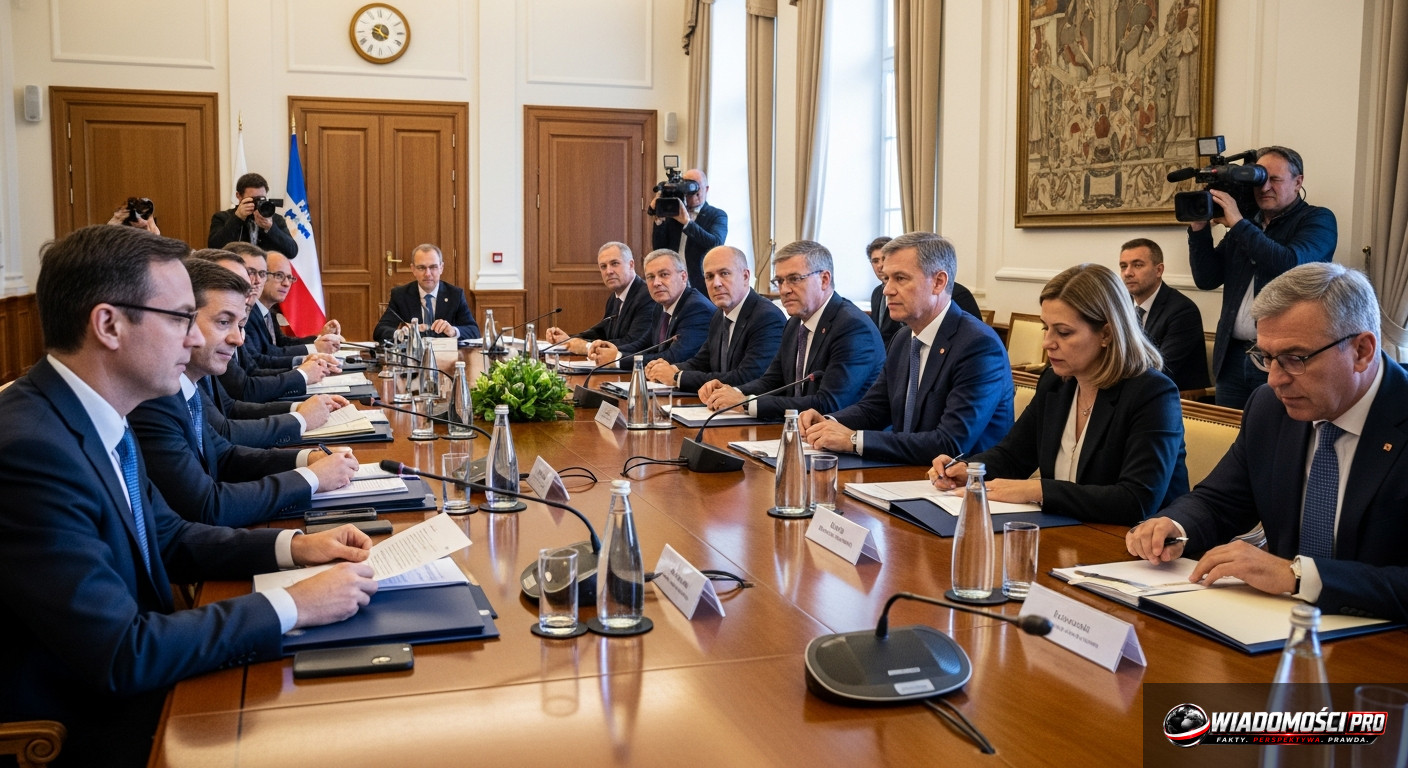
The government has adopted the draft budget act for 2025, which plans for a deficit of 289 billion zlotys. This document sets the financial framework for the state for the upcoming fiscal year, challenging ministries with expenditure discipline in the face of record borrowing needs. This scale forces the Ministry of Finance to manage liquidity precisely to maintain financial markets' confidence in Polish debt.
State financing mechanisms
The level of 289 billion zlotys is not merely the result of current operating expenses, but the effect of three key overlapping burdens. The first is the cost of servicing public debt, which in an era of high interest rates consumes a significant portion of tax revenues. The second element is financing the technical modernization of the Armed Forces, carried out largely outside the standard budget, which, however, ultimately burdens the State Treasury. The third factor is social obligations, including the indexation of benefits and family support programs, which are highly rigid and difficult to reduce in the short term.
The expenditure structure for 2025 shows that the state has entered a cycle of high external financing. The ratio of the deficit to Gross Domestic Product is becoming a key indicator monitored by rating agencies. At a time when debt servicing costs are rising and the dynamics of VAT and CIT revenue are slowing down, the government must balance stimulating the economy with maintaining credit credibility. A lack of flexibility in spending means that in the event of an economic slowdown, the only path remaining is to increase the issuance of treasury bonds.

Legislative path in the Sejm
After leaving the Council of Ministers, the draft act goes to parliament, where the process of readings and work in public finance committees begins. It is here that it will be decided whether the initial assumptions will survive the clash with the political demands of individual parties. The parliamentary rhythm of work on the budget is strictly defined by law, but in parliamentary practice, this debate often serves as a platform to verify support for the cabinet.
In previous budget cycles, the moment of voting on the act and the subsequent discharge for the government became turning points for the stability of the coalition. The parliamentary opposition, based on economic analyses, usually raises issues of exceeding safe debt limits, accusing the ruling party of lacking a long-term strategy for exiting the excessive deficit procedure. From a procedural perspective, the discharge constitutes political confirmation of the correctness of the budget execution, which in past years has sparked strong controversy. Critics have regularly used the rhetoric of "financial vandalism," arguing that excessive spending leads to permanent destabilization of public finances.
The role of the head of state in the budget process
The constitutional powers of the President of the Republic of Poland regarding the signing of the budget act are not limited to formal actions. The head of state has the option of referring the act to the Constitutional Tribunal for subsequent or preventive review, which in practice can freeze the expenditure implementation process. Analyses from 2025–2026 show that the budget has repeatedly become a field of institutional conflict.
In January 2026, the president publicly questioned expenditure priorities, pointing to the underfunding of healthcare as a "budget of collapse." Such a position does not remain without impact on financial markets. Institutional investors, analyzing the stability of the state, take into account the political risk associated with the lack of coherence between the government and the presidential center. If the head of state raises objections to the level of funding for key public services, the government is forced to renegotiate assumptions or seek compromises, which often lead to further increases in spending.
The tension between the government and the president is particularly visible in issues where social priorities clash with strict budgetary discipline. The history of disputes over the healthcare budget, with intense discussions in January 2026, confirms that any attempt at cuts or unequal distribution of funds is immediately used as an argument in the debate about mismanagement. For the government, this means the necessity of constantly justifying every billion-zloty item to the public, which limits the freedom of maneuver in crisis management.
Market dynamics and debt valuation
State finances do not function in a vacuum. The yield of Polish treasury bonds on the secondary market is a derivative not only of central bank decisions but primarily of confidence in the government's ability to service its debt. When speculation about personnel changes in financial institutions appears in the media, as was the case with Karol Nawrocki, investors react with increased volatility. Even if these decisions do not lead to a formal veto, the uncertainty itself affects the valuation of the zloty.
The stability of public finances is currently being tested by the high cost of debt financing. At a time when the market is pricing in the risk associated with the 289 billion zloty deficit level, any signal of a potential blocking of the budget by oversight bodies causes nervousness. Foreign investors, holding a significant portion of the debt in their portfolios, monitor not only the numbers but also the consistency of the communication coming from the government. If the public debate shifts toward accusations of financial vandalism, markets begin to discount a higher political risk premium.
It is worth analyzing whether the planned debt structure is sustainable. Increasing the deficit during periods of slowdown is standard counter-cyclical practice, but with a high level of public debt, the margin for error is minimal. Any deviation from the assumed plan, whether toward lower revenues or higher expenditures, immediately translates into the yield of ten-year bonds, which in the long term increases debt servicing costs for every taxpayer.
Healthcare as a flashpoint
The healthcare sector has become one of the main areas where budget mathematics meets social expectations. Systematic underfunding, raised in public discussions, has led to a situation where every budget zloty is calculated into specific medical services. Conflicts from the beginning of 2026 showed that the lack of a long-term financing strategy causes the system to function in a constant state of ad-hoc repairs.
Healthcare expenditures are rigid, and the rising labor costs of medical personnel and the prices of medical technology exert pressure on increasing outlays. The government, planning a deficit of 289 billion zlotys, must consider these costs as a priority to avoid the paralysis of healthcare facilities. However, as analyses from July 2026 after the government received its discharge indicate, simply surviving the budget debate does not solve structural problems. Hospitals and clinics continue to struggle with uncertainty regarding the level of contract funding, which affects the quality of services provided.
The politicization of health spending is a dangerous process for the stability of the sector. When the opposition points to management errors, using arguments about financial vandalism, the substantive discussion on expenditure efficiency is lost. Regardless of who is in power, the problem remains the lack of consensus on sources of healthcare financing outside the state budget. As a result, every budget act becomes a hostage to negotiations between ministries, and patients feel the effects of these disputes in the form of lengthening queues for specialists.

Consequences for the economy and the citizen
Adopting a budget draft with such a significant deficit carries a number of long-term consequences for the country's economic structure. First of all, the government is forced to absorb a significant portion of capital from the financial market for borrowing needs. This action limits access to financing for the private sector, which in economics is referred to as the crowding-out effect. Enterprises, having more difficult access to cheap capital, limit investments, which directly translates into lower GDP growth dynamics in subsequent years.
For the average citizen, the effects of such a high deficit are felt indirectly but permanently. Inflation, which is a derivative of excessive money supply in relation to economic growth, lowers the real purchasing power of wages. Additionally, the high level of public debt forces the central bank to keep interest rates at a level that does not allow for a rapid reduction in the costs of mortgage or consumer loans. As a result, citizens bear the costs of budget policy through higher loan installments and higher prices for goods and services.
One cannot ignore the issue of international credibility either. Poland, as a member of the European Union, is obliged to comply with fiscal rules that limit the general government deficit. Exceeding these limits can result in the country being placed under an excessive deficit procedure, which imposes an obligation on the government to implement recovery plans, often involving spending cuts or tax increases. Such a scenario is the most undesirable for those in power, as it involves a huge political cost.
An analysis of the 2025 budget shows that the government is opting for an expansionary policy, counting on the fact that economic growth in the future will allow for "growing into" the current level of debt. This is a risky strategy, especially in the face of an uncertain geopolitical situation, which affects energy and security costs. If GDP growth dynamics turn out to be lower than projected, the government will be forced to revise the budget during the year, which always generates additional social and political tensions.
It is worth noting that the parliamentary legislative process, although predictable in its form, in the current political conditions takes on the characteristics of a fight for the survival of each party. The opposition, using every opportunity for criticism, focuses on the points where the government is most vulnerable – namely, the level of the deficit and debt. Such an approach, while understandable within the framework of political struggle, does not favor building a stable foundation for the long-term development of the country.
In summary, the 2025 budget with a deficit of 289 billion zlotys is a document that reflects the current priorities of the state: security, maintaining social benefits, and an attempt to maintain investment in the face of high debt costs. Is it a balanced budget? From a purely economic perspective, the answer is negative. From a political perspective, it is a choice of a path intended to allow for the preservation of social cohesion while simultaneously managing enormous financial challenges. The coming months will show whether the government will be able to keep these assumptions in check or whether a correction of plans under the influence of external and internal pressures will be necessary.
Citizens should prepare for a period of increased debate on the efficiency of public spending. With such a scale of deficit, the question of whether we are spending money on growth-generating investments or merely on consumption will become a central point of discussion in the media and parliament. The credibility of the state, measured by bond yields, depends on the answer to this very question. In the near future, it will be crucial to observe decisions regarding the implementation of individual budget items, as these, and not the entries in the act themselves, will decide the financial condition of Poland in the coming years.
In the face of such large numbers, it is worth remembering that the economy is a system of connected vessels. Every zloty spent from the budget comes from either taxes or debt. If debt grows faster than the economy, in the long term, this leads to the necessity of radical changes in the tax or expenditure system. Poland is currently at a point where decisions made in 2025 will have effects felt for the entire decade. One should therefore expect the highest transparency from decision-makers in managing public funds, as the margin for error with such a high deficit practically does not exist.
Questions and answers
How much is the planned budget deficit for 2025?
The planned budget deficit in the draft adopted by the Council of Ministers is 289 billion zlotys.
Who will handle the draft act now?
The draft budget act goes to the Sejm, where it will undergo the legislative process, including readings in committees and plenary debates leading to votes.
Can the budget be vetoed by the President?
The President has the authority to evaluate the act, including the possibility of referring it to the Constitutional Tribunal, which in practice can pose a serious risk to the budget process and destabilize the situation in financial markets.
What are the main factors affecting the size of the deficit?
The size of the deficit is mainly influenced by the costs of servicing public debt, expenditures on the modernization of the Armed Forces, and rigid social obligations, which limit the state's budgetary flexibility.
Why are financial markets watching the budget so closely?
Investors monitor the budget because the scale of state debt directly affects the yield of treasury bonds and debt servicing costs, which in turn determines the stability of the currency and financing costs for the entire economic sector.
Are budget disputes something new in Polish politics?
The history of budget disputes shows that they are a regular element of the Polish political scene, often used by the opposition to undermine the government's legitimacy and challenge its fiscal policy in the context of the discharge.
Sources
- Government receives discharge. Opposition speaks of "financial vandalism" - Business Insider Polska
- Sejm has made a decision regarding the budget. Government received discharge - Polskie Radio 24
- Sejm voted on the budget. What about the discharge for the government? - Dziennik.pl
- President has made a decision regarding the budget. "This is a budget of collapse in healthcare" - Rynek Zdrowia
- President has made a decision regarding the healthcare budget - Niepelnosprawni.pl
- Budget in the hands of the president. Unexpected scenario on the table? - Money.pl
- Polish budget in the hands of Karol Nawrocki. The decision could shake markets even without a veto - wnp.pl
- Since it is the end of the year, it is time for a budget dispute. All options are on the table - including the Constitutional Tribunal - Wyborcza.biz
Article prepared by the Wiadomości PRO editorial team with the support of artificial intelligence. Facts are derived from the sources listed above.

Komentarze (0)
Ładowanie komentarzy...