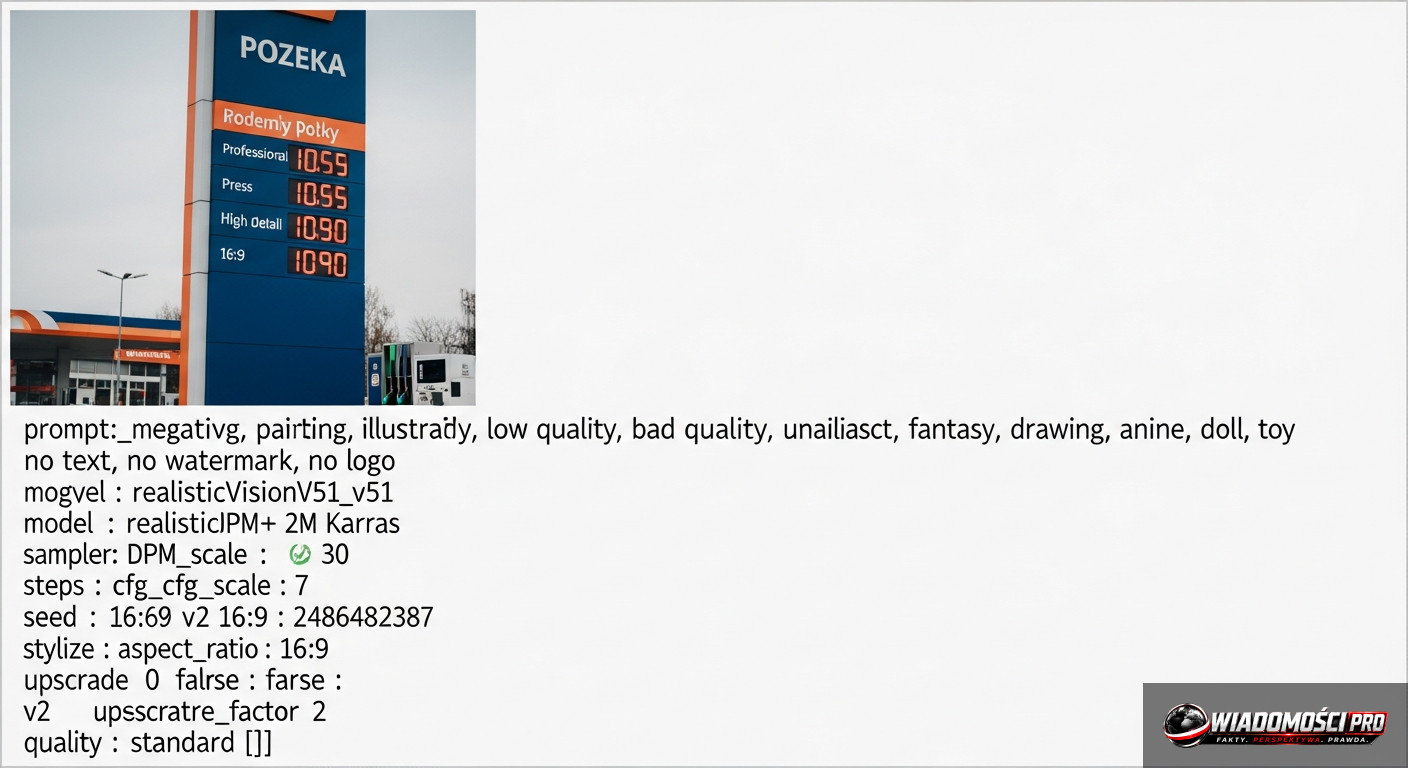
Out of 100 election promises, the coalition has fulfilled 15, including keeping fuel prices below 6 PLN, however, they broke the promise of reducing the administration, which has grown into the largest government in the history of the Third Polish Republic. According to a wnp.pl report from October 15, 2025, the balance sheet of the government after two years is based on ad-hoc interventions rather than systemic economic reforms. Data from April 2026 confirm that the interventionist maintenance of 95-octane gasoline prices at the level of 5.97 PLN came at the expense of the efficiency of the logistics sector, which had to deal with diesel prices at the level of 6.71 PLN.
Economic balance sheet: Table of findings
The scale of Donald Tusk's cabinet's actions requires a comparison of declarations with the facts that shaped the economic reality in the years 2024–2026. The table below presents the contrast between promises and the actual state.
| Area of action | Election promise | Status for 2024–2026 | Effect for the citizen |
| :--- | :--- | :--- | :--- |
| Fuel prices | Maintaining market prices | 5.97 PLN (Pb95) / 6.71 PLN (ON) | Maintaining the psychological barrier of 6 PLN |
| Administration | Slimming down the state apparatus | Largest government in the III RP | Increase in deficit by billions of PLN annually |
| Local management | Self-governance and independence | Commissioner in Krakow (May 2026) | Centralization of local oversight |
| Security policy | Quick settlement of PiS governments | Commission on influences (since May 2024) | Lack of breakthrough verdicts |
| Digital investments | Technological sovereignty | Partnership with Google (May 2024) | Dependence on external cloud |
The lack of publication of full reports on the state of public finances by the Ministry of Finance makes it difficult to precisely determine the opportunity costs. Budget analysts point out that every fuel intervention, although it temporarily calms moods, burdens the state budget's special reserves, which over two years translated into an increase in the deficit by billions of zlotys that could have otherwise fueled structural investments.
Fuel policy: Intervention as a political tool
The stabilization of fuel prices did not result from organic market processes, but from direct administrative decisions made in March 2026. The government, fearing an increase in social dissatisfaction, took unofficial actions to force fuel companies to keep 95-octane gasoline prices below the 6 PLN threshold. This move was a classic example of management by intervention.
The effect at the pumps was visible in April 2026, however, the diesel price of 6.71 PLN exposed the other side of the coin. The transport sector, being the lifeblood of the economy, had to absorb higher raw material costs, which naturally translated into product margins in stores. The government, focusing on passenger car drivers, created a disparity that in the long term weakens the competitiveness of Polish transport companies.
The financial cost of this operation remains hidden in budget structures. Maintaining prices below the market level required the involvement of financial instruments, the full scale of which has not been presented to the public. Instead of building market resilience to oil shocks, the Tusk cabinet chose the path of politically "buying peace," which in the future may result in the need for a drastic price adjustment at a moment when budget pressure becomes unbearable.
Expansion of the administration: The largest government of the III RP
In July 2025, statistics regarding the government structure raised serious controversies among economists. The number of ministerial positions, secretaries of state, and plenipotentiaries reached a level that analysts unanimously recognized as the largest in the history of the Third Republic. The promise to "slim down" the state apparatus was completely abandoned in favor of expanding party-bureaucratic structures.
The appointment of Stanisław Kracik as commissioner in Krakow in May 2026 was just one of many examples of this policy. The centralization of power by filling positions with trusted people from Warsaw has become a standard that stands in contradiction to the postulates of self-governance. The costs of maintaining such an expanded administration do not end with salaries – these are also the costs of bureaucratic support, office space rental, and representation expenses.
Every new department is another tax burden for the citizen. Compared to the economic results from October 2025, a clear trend is visible: instead of optimizing processes, the government opted for increasing employment in the public sector. This approach generates a constant increase in rigid budget expenditures, which limits the space for any pro-development investments. Instead of the savings promised by the coalition, we received a record-expensive state apparatus.
Commission on Russian influences: Between rhetoric and action
Clarifying Russian influences in Poland was one of the main slogans that was supposed to attract voters expecting a fair settlement of the previous authorities. On May 14, 2024, Donald Tusk announced the establishment of a government commission, promising a substantive approach. "There will be no hunting for PiS" – these words of the Prime Minister were meant to distinguish current actions from the methods used by his predecessors.
Reality, however, quickly verified these declarations. Instead of becoming an expert body, the commission quickly turned into an arena for political disputes. The lack of specific conclusions that could lead to court verdicts meant that this topic began to fade in social awareness, giving way to everyday economic problems.
The government's strategy consisted of avoiding accusations of retaliation, which, however, led to the decision-making paralysis of the commission. In the years 2024–2026, this body functioned more as a tool for controlling media narrative than as a real tool for cleaning up the state. The cost of the commission's operation, although difficult to isolate from the general expenses of the Prime Minister's office, burdens the state budget without bringing measurable results in the form of sealing state security.

Coalition relations: The end of "love" and preparations for the campaign
The foundation of the government's stability was supposed to be the partnership relations between Donald Tusk and Szymon Hołownia. However, December 12, 2024, was a turning point. Analyses of that period indicated that the political "love" was merely a tactical alliance that, under the influence of the upcoming campaign, began to crack at the seams.
Two years after the elections, the coalition resembles a collection of interests that constantly compete for influence. Every economic success, such as the aforementioned stabilization of fuel prices, is immediately used by individual factions to build their own image. The lack of programmatic unity leads to a situation where the government makes internally contradictory decisions to satisfy the electorate of each of the parties forming the coalition.
For the citizen, this means a state of permanent uncertainty. Public debate is dominated by political squabbling instead of a discussion about necessary systemic reforms. The government, instead of being a monolith, has become an arena of struggle where each partner tries to distance themselves from the mistakes of the others. The upcoming election campaign will be the final test for this construction, which, under the weight of internal conflicts, has lost the momentum necessary to manage the country in difficult times.
Cybersecurity: Strategy based on giants
In May 2024, Prime Minister Tusk met with the CEO of Google. This event was a signal that the government intends to base the state's digitalization on infrastructure outsourcing. Instead of building its own independent solutions, the cabinet opted for cooperation with global technology corporations.
Such an approach raises a number of questions about Poland's technological sovereignty. Although cooperation with Google brings quick results in terms of cybersecurity and e-service efficiency, it makes the state dependent on decisions made at headquarters in the USA. In a crisis situation, the government will not have full control over the infrastructure on which the functioning of offices relies.
The government's strategy is based on the assumption that without the presence of technological leaders, the modernization of Poland will get stuck. The balance sheet of these investments is not yet complete, but it is already clear that the government treats digitalization as a way to improve the image of a modern state, while avoiding difficult investments in domestic research and development potential. This is a shortcut that may prove to be a costly mistake in the future, especially in the context of the security of citizens' sensitive data.

Economic challenges: What's next?
After two years of rule, the picture of the economy is ambiguous. On one hand, we have successes in stabilizing fuel prices, which is confirmed by data from April 2026, when 95-octane gasoline cost a maximum of 5.97 PLN per liter. On the other hand, the rising costs of maintaining the administration, numerous intra-coalition disputes, and the lack of transparency in full macroeconomic data raise justified concerns about the future of public finances.
The government has opted for short-term pragmatism. Managing the state resembles putting out fires, where every intervention – whether fuel-related or personnel-related – is intended to calm current social emotions. However, there is a lack of a long-term vision that would go beyond the horizon of the next elections. Poles received price stabilization at the pumps, but paid for it with an increase in uncertainty about the direction in which the Polish economy is heading.
In the coming months, it will be crucial how the government handles budget pressure and whether it manages to maintain the growth rate in conditions of increasing political competition. The opposition, sensing the weakness of the coalition, will point out every mistake, and the lack of coherence within the ruling camp will only make this task easier for them. The two-year balance sheet is therefore a time of stabilization that may turn out to be only the calm before the storm.
Questions about the budget future remain unanswered. Will the government decide on cuts in the administration it expanded itself? Or will it rather look for new sources of financing the deficit, which may translate into an increase in tax burdens in the coming years? The answers to these questions will determine the real purchasing power of Poles in 2027.
It seems that the Tusk government is stuck in the trap of its own promises. On one hand, it promised modernity and transparency, on the other – it followed the path of centralization and expansion of structures, which is contrary to the declarations from the 2023 campaign. Such a policy requires constant "buying time" through price interventions, which is unsustainable in the long run.
In the context of upcoming geopolitical challenges, Poland needs a strong economy, not ad-hoc actions aimed at polling numbers. The lack of transparency of macroeconomic data suggests that the government fears the full picture of the situation, which in itself is a worrying signal for financial markets and foreign investors.
Will Poland maintain its growth rate, or will it fall into stagnation caused by the excessive growth of the public sector? We will know the answer to this question in the coming months, when current budget reserves are exhausted and deep structural reforms, which have been avoided so far, become necessary.
Questions and answers
How much does fuel cost in 2026?
In April 2026, the maximum price of 95-octane gasoline was 5.97 PLN, and diesel was 6.71 PLN.
Who became the commissioner in Krakow?
Prime Minister Donald Tusk appointed Stanisław Kracik to this position in May 2026.
Will the commission on Russian influences prosecute PiS politicians?
Prime Minister Tusk announced in May 2024 that the commission is to serve to clarify influences, not to "hunt for PiS."
What are the main accusations against the government regarding administration?
Critics point out that the government is the largest in the history of the Third Polish Republic, which generates high costs of maintaining the administration with questionable effectiveness of changes.
What is the main goal of the government's fuel policy?
The goal was to stabilize fuel prices below the psychological barrier of 6 PLN per liter of 95-octane gasoline, which was intended to calm social moods before the elections.
Does the government cooperate with the Big Tech sector?
Yes, one of the elements of the strategy is cooperation with global giants, an example of which was the Prime Minister's meeting with the CEO of Google in May 2024 to strengthen cybersecurity.
What marks the end of the "love" between Tusk and Hołownia?
According to analyses from December 2024, growing differences in programmatic and personnel priorities led to the exhaustion of the political agreement between the leaders of PO and Polska 2050.
Why is the economic balance sheet difficult to fully assess?
The lack of transparency regarding full macroeconomic data and the avoidance of publishing detailed partial reports by the government make it difficult to reliably assess the condition of state finances.
What strategy did the government adopt regarding settlements with the previous authorities?
The government decided to establish a government commission instead of a statutory investigative commission, arguing this with the need for a cool explanation of matters, not political retaliation.
What are the risks associated with the digitalization of administration?
The main risk is the state's dependence on external cloud technology providers, which may affect the sovereignty of decisions in crisis situations.
Was diesel covered by the same stabilization as gasoline?
No, in April 2026, diesel cost 6.71 PLN, which meant a significantly higher burden for the transport and logistics sector than in the case of passenger car owners.
Why is the appointment of a commissioner in Krakow important?
This decision fits into a broader pattern of the government's personnel policy, consisting of filling key positions in local governments, which, according to critics, testifies to tendencies toward the centralization of power.
Does the opposition have room to attack the government?
Yes, the expansion of the state apparatus, administrative costs, and growing conflicts within the coalition give the opposition strong arguments in the public debate before the upcoming election campaign.
What was the main conclusion of the wnp.pl report from October 2025?
The report indicated that the assessment of the coalition's two-year achievements must be linked to real economic indicators, where fuel price stabilization was one of the few points of reference for the average Pole.
Does the government have a coherent vision of the economic future?
Available data shows that the government focuses on ad-hoc interventions, which suggests a lack of a long-term, coherent economic vision that would go beyond current crisis management.
Considering all the above facts, one must ask about the future of the Polish economy after 2026. Will the government be able to maintain this course, or will drastic changes in fiscal policy be necessary? The current situation, characterized by high uncertainty and lack of transparency, prompts caution. Investors are watching every move of the government, and the situation within the coalition does not facilitate making long-term decisions.
Fuel price stabilization, although appreciated by drivers, is only one side of the coin. The true cost of this stabilization will only be revealed in future state financial reports. It is already clear that public debt is growing, and the expanded administration is consuming funds that could have been invested in the development of modern technologies or energy infrastructure.
All these actions create an image of a government that is more concerned with maintaining support than with actually solving structural problems. Will voters appreciate this pragmatism, or will they turn toward the opposition in the face of rising living costs? The election campaign, which is approaching rapidly, will be a verification of these actions.
Ultimately, the two-year balance sheet is a time when politics took precedence over economics. Instead of focusing on sustainable development, the government chose the path of intervention, which gives a temporary sense of security but does not solve any of the key problems of the Polish economy. Is this a path to success, or a straight path to a crisis? We will know the answer when we collide with budget constraints that can no longer be pushed into the future.
All these issues show that the Polish economy needs a serious debate about the future and a departure from ad-hoc actions. Is the Tusk government capable of initiating such a debate? Given the actions taken so far, this seems unlikely. We are therefore left to observe further developments and draw conclusions from every subsequent decision made by the cabinet in Warsaw.
Many economists point out that the current model of state management is highly risky. Focusing on short-term political gains at the expense of long-term stability always ends the same way – with the need for painful corrections. Is the government aware of this? Perhaps, but political priorities seem more important at the moment than the country's financial stability.
One cannot forget the role that relations with international institutions play in this process. Poland, as a member of the European Union, must follow certain fiscal rules. Are the government's current actions consistent with them? This is another question we will have to answer in the near future.
In summary, two years of rule is a time when Poland has become a country full of uncertainty about the direction in which the economy is heading. On one hand, we have stable fuel prices, and on the other – a growing deficit and an expanded administration. This is a balance sheet that does not inspire optimism, especially in the face of the upcoming election campaign. Will voters trust the coalition once again? We will find out soon.
Any attempts to hide the full scale of the problems from the public are doomed to failure from the start. Sooner or later, macroeconomic data will see the light of day, and then it will turn out how much the interventionist policy has burdened the state budget. Then, too, will come the time for the final settlement of the current government's actions.
Will Poland come out of this unscathed? That depends on many factors, but above all on whether the government will be able to learn from past mistakes and change course to a more responsible one. For now, however, there is no indication of this, and the Polish economy is drifting in a direction that none of us can fully predict.
From the perspective of two years, the balance sheet of Donald Tusk's government is a time of lost opportunities for thorough reforms. Instead of building strong foundations for future growth, the government focused on current crisis management, which in the long run may prove dangerous for the stability of the entire state. Time will tell if this was the right strategy, or the beginning of the end for the current coalition.
Finally, it must be emphasized that the economy does not like uncertainty. And what is currently happening in Poland cannot be described otherwise. Lack of coherence, ad-hoc interventions, and the fight for influence are a recipe for problems that may become our share in the coming years. Is this how managing a country in the 21st century should look? The answer seems obvious.
Nevertheless, the government still enjoys the support of part of society, which shows how effective actions aimed at short-term electoral gains can be. But will this strategy stand the test of time? This is a question to which we will know the answer soon, when the time for elections comes and voters will have to make a decision that cannot be undone.
All the presented data indicate that Poland faces many challenges that the current government must face. How will it do it? Will it bet on responsibility, or will it continue the policy of ad-hoc interventions? Time will tell, but one thing is certain: very interesting and difficult months await us.
We can only hope that the government finally understands that the economy is more than just fuel prices or filling positions. It is, above all, stability, predictability, and responsibility for future generations. Will we understand this before it is too late? No one knows.
All these facts prompt reflection on whether we are indeed heading in the right direction. Is the current economic situation all we can afford? Can we afford more? These are questions we should ask ourselves every day, analyzing subsequent decisions made by those in power.
I believe that Poles deserve more than just ad-hoc interventions and uncertainty about the future. They deserve an economy that will develop based on solid foundations, not political games. Will the government be able to provide this? The upcoming elections will answer this question.
Ultimately, it is the voters who will decide whether the current course is what they expect. Will they bet on stability, or on risky experiments? This is a decision that will affect our lives for many years to come. That is why it is so important that we are aware of what is really happening in our economy.
All data, facts, and analyses lead to one conclusion: Poland faces many challenges, and the current government is not able to answer all of them in a satisfactory way. Does this mean we have to accept the current situation? Absolutely not. We must demand more from those we have chosen to manage our country.
Two years of rule is a time when much has happened, but much is also ahead of us. Will we be able to learn from the past and build a better future? That depends on all of us. That is why it is so important that we actively follow the government's actions and are not afraid to ask difficult questions.
In summary, the balance sheet of two years of rule is a time when Poland has become a country full of challenges. Will we be able to meet them? Time will tell. But one thing is certain: the future of our country depends on the decisions we make today. Are we ready for what awaits us? This is a question that each of us must answer for ourselves.
Sources
- Today a liter of 95 gasoline is to cost no more than 5.97 PLN, and diesel 6.71 PLN - Rzeczpospolita
- Unofficial: there is a government decision on fuels - Money.pl
- Tusk: Stanisław Kracik will be the commissioner in Krakow - Do Rzeczy
- Cybersecurity and investments – conversation between the Prime Minister and the CEO of Google - Gov.pl
- Does the true face of Donald Tusk's government reveal the numbers? Here are the economic results 2 years after the elections - wnp.pl
- The time of "love" between Tusk and Hołownia is coming to an end. A fierce campaign is ahead of us - Interia Wydarzenia
- The largest government of the III RP? - TVN24
- Donald Tusk: A government commission will deal with clarifying Russian influences. "There will be no hunting for PiS" - Wyborcza.pl
Article prepared by the Wiadomości PRO editorial team with the support of artificial intelligence. Facts come from the sources listed above.
Komentarze (0)
Ładowanie komentarzy...