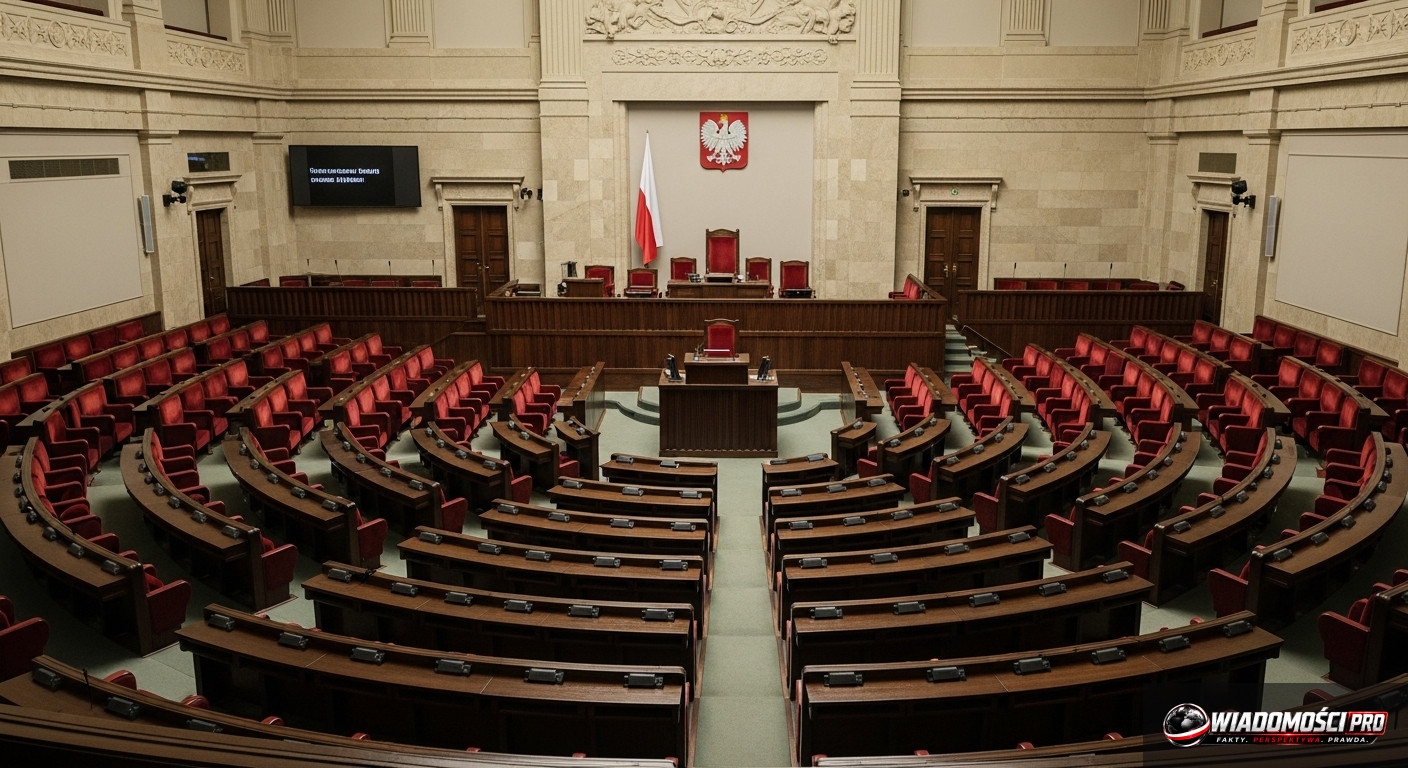
On August 6, 2026, the Senate adopted amendments tightening judicial oversight procedures over the activities of special services, introducing a rigorous evidentiary requirement for every surveillance request. The amendment prohibits services from arbitrarily expanding the scope of operational control without prior court approval, which is intended to definitively end the practice of "creeping" wiretapping of third parties. These changes are a direct response to long-standing allegations regarding the lack of real verification of operational activities by the judiciary and excessive freedom in violating citizens' privacy.
The vote, which took place in the upper house, concluded with sixty votes in favor of adopting the package of amendments. Senators thus rejected the concept in which the court serves merely as an institution confirming decisions made previously within intelligence or counter-intelligence structures. From the moment these provisions enter into force, every request for operational control must contain a precise catalog of evidence that makes the commission of a crime probable. This is a paradigm shift: an officer will no longer be able to rely on vague assumptions or general premises of state security. A judge, when analyzing a request, will receive a statutory mandate to question the evidentiary value of the arguments presented. If the materials provided prove insufficient, the court will be obligated to reject the request.
The issue of prohibiting the expansion of surveillance without a new court decision is, meanwhile, a direct blow to operational techniques that until now allowed for so-called "escalation" of wiretaps. In practice, this meant that services, having obtained permission to monitor one person or one communication channel, would gradually include additional devices and associated persons in the circle of surveillance, often without the need to appear before a judge again. The new law cuts off these practices. Every additional phone, email address, or other digital identifier will require separate authorization. This solution is intended to eliminate the phenomenon of mass data collection on bystanders who happened to be in the orbit of the services' interests.
Control mechanisms: A new standard of oversight
The introduction of stricter judicial control forces special services to deeply reorganize their internal legal departments. Until now, preparing requests for operational control was an almost routine process, formalized to a level where the judge became merely a "notary" of operational activities. The amended provisions mean that every officer requesting surveillance will be held accountable for the quality of the evidence presented. If a request proves unjustified, the judge will have the option to refer the matter for internal control within the given service.
This system also changes the relationship between the "services" and the "court." The previous dominance of an approach where state security automatically invalidated the right to privacy is being balanced. Judges are gaining tools they previously lacked: the ability to demand access to raw data upon which the thesis of a threat was built. This not only increases the difficulty level of operational work but, above all, restores to the courts the role of guarantor of constitutional freedoms.
Experts point to one more aspect of these changes. Previous surveillance statistics in Poland were alarming. In periods of the highest intensity of operational activities, the number of requests accepted by courts hovered between 98-99 percent. This nearly one-hundred-percent approval rate had been pointed out by non-governmental organizations for years as proof of the superficiality of judicial control. The new amendments are intended to realistically lower this result. If courts begin to reject even one in ten requests, it will be a signal that the system has begun to function in a critical, rather than automatic, manner.
It is worth noting the burden on the courts. Introducing such restrictive procedures means that judges will need more time to analyze each request. If the Ministry of Justice does not provide adequate staff and tools for the secure processing of operational materials, there is a risk that the system will become blocked. In urgent situations requiring a lightning-fast response from services, judicial bureaucracy could become a bottleneck. However, this is a price the legislator decided to pay in exchange for protecting citizens' privacy.
The government's position vs. the upper house
The Senate's decision of August 6, 2026, is an expression of a deep political rift. The ruling camp, which for months had pushed a vision of special services as a "rapid response" tool, met with resistance in the upper house. For the government, the Senate amendments are not only an obstacle in daily operational work but a political challenge thrown at the services. In parliamentary corridors, it is said openly that the government will attempt to reject the Senate amendments during the vote in the Sejm, arguing this is necessary to maintain intelligence efficiency in times of international unrest.
This dispute does not concern only the technical aspects of surveillance. It is a fight over whether the state has the right to unlimited insight into a citizen's life, or whether its actions must be legitimized each time before an independent body. The Senate, by adopting the amendments, has positioned itself as a defender of civil rights, which in the current political configuration is a clear signal of distancing itself from the legislative line of the power ministries.
The government's narrative about the "paralysis of services" is, however, countered by senators with data. In the justification for the amendments, it was argued that operational effectiveness is not measured by the quantity of wiretaps, but by their quality and accuracy. If services possess reliable information, they do not need thousands of hours of recordings of bystanders. This approach suggests that the current leadership of the power ministries is unable to manage information effectively, preferring to "flood" the system with data, of which only a fraction has investigative value.
The question arises about the future of the act. The Sejm, where the government holds a majority, may ignore the Senate's proposals. However, in the face of growing social pressure and media interest, every vote against tightening control over the services will have its political price. Observers note that the Senate has, in recent months, exceptionally often become a place where the most controversial government projects are "diluted." What the government wanted to push through in an urgent mode turns into a months-long debate in the Senate.
Historical context: From the CBA to today's regulations
The history of control over special services in Poland is full of failed reform attempts. The example of the Central Anti-Corruption Bureau (CBA) is the most striking here. In April 2026, when Forsal.pl reported on the planned liquidation of the CBA, the Senate also submitted amendments that were intended to prevent the transfer of the service's operational competencies to other bodies without proper oversight. At that time, two visions also clashed: one assuming full freedom of action for services under political tutelage, and the other requiring strong legal safeguards.
The memory of January 2022 and the attempt to establish a surveillance committee is even more instructive. Marek Pęk, representing PiS at the time, clearly declared that his faction would not participate in the work of such a committee. This is an attitude that has dominated the Polish parliament for years: special services are treated as "sacred cows" whose activities are not subject to parliamentary control. Every attempt to civilize this sphere ends in a boycott by those who, at a given moment, have influence over the power apparatus.
The current amendments of August 6, 2026, are an attempt to break this vicious circle. Instead of building political committees, which are intended to be an arena for disputes, the Senate decided on an institutional path – by strengthening the courts. This is a safer path because judges, unlike politicians, are bound by procedure, not a party program.
However, history also teaches us that even the best law can become a dead letter if there is no political will to enforce it. Services always look for paths of circumvention. In the past, it happened that instead of requesting operational control, so-called "obtaining information in an informal mode" from telecommunications service providers was used. If the new act does not also close these loopholes, the amendments will remain merely a cosmetic procedure for public opinion.
Legislative path and future clashes
The conclusion of the vote in the Senate on August 6, 2026, does not end the legislative process. The act now returns to the Sejm, where another round of political negotiations will begin. According to Article 121 of the Constitution, the Sejm has the right to reject the Senate's amendments by an absolute majority of votes. This is a key moment, as it will show how strong the divisions within the ruling coalition are and whether there will be votes among MPs supporting Senate discipline on the issue of civil rights.
The procedure looks as follows:
1. Referral of the act to the appropriate Sejm committee, which will prepare a report on the Senate amendments.
2. Plenary debate, during which MPs will have to declare themselves for or against tightening oversight.
3. A vote, which will decide the final shape of the provisions.
If the Sejm adopts the amendments, the act will go to the president. The president has three options: signing, vetoing, or referring it to the Constitutional Tribunal. Given the current political situation, the president may use this act as a bargaining chip in relations with the government. A potential referral of the act to the Constitutional Tribunal could suspend the process for further months, which in practice would mean maintaining the status quo – that is, a state where services have too much freedom.
For observers, this process is a fascinating study of Polish politics. On one hand, we have the state apparatus striving to maximize its powers, and on the other – the legislature trying to impose legal frameworks. This clash is not resolved. Each new day brings new information that complicates the picture. Such as the situation with the IPN, where on August 6 the Senate blocked the candidacy of Mateusz Szpytma for president, showing that the government is losing control over key state institutions. These two decisions – regarding the services and the IPN – share one common denominator: the desire to limit the influence of the current authorities on areas that were previously their domain.
Impact on citizens: Will privacy become a real value?
For the average Pole, these changes may seem distant, almost academic. Who among us thinks about the procedure for requesting a wiretap until they themselves become the subject of the services' interest? However, on a macro scale, it is about the legal security of each of us. If the law does not guarantee that our data is protected against unlawful surveillance, then the entire concept of the rule of law becomes a fiction.
Increasing the role of the courts means that a "third element" appears in the surveillance process. A judge, who is not part of the investigative structure, becomes the last line of defense. If this system works, citizens may feel slightly safer in their daily communication. The fear that every word spoken over the phone or every email sent could become the basis for actions by services that have no real justification in evidence will disappear.
However, one must remain realistic. Special services are institutions that in every country possess advanced technologies. Even the most restrictive law will be tested by technical capabilities. In a world where data is the most valuable currency, protecting privacy becomes a constant battle between surveillance technology and the right to anonymity. The amendments of August 6 are a significant step, but certainly not the last.
It is also worth asking oneself: what about people who were wrongly surveilled in the past? The new act does not give them a path for retroactive verification. It is a "pro futuro" law, looking to the future but ignoring the mistakes of past years. This is a gap that perhaps human rights organizations will address in the future, demanding audits of operational activities from previous years. For now, however, the priority is to stop the "creeping" process of expanding operational control, which the Senate amendments do in the most direct way.
Managing state security requires balance. Currently, this balance is disturbed. The Senate is trying to restore it, but whether it succeeds depends on many factors: the attitude of judges, the determination of MPs in the Sejm, and public opinion, which cannot allow this topic to disappear from the agenda in the thicket of current political disputes. Services do not like daylight, and every debate about their activities is a form of uncomfortable pressure for them. It is this pressure that we, as citizens, must maintain if we want the amendments of August 6 not to become just another dead provision.
Observing the development of events, it is impossible not to get the impression that we are at a turning point. Special services in Poland have for years built their independence from parliamentary and judicial control. Now, for the first time in a very long time, this independence is being realistically questioned. Not by street protests, but by tedious, legislative work in the upper house of parliament. This is proof that state institutions – if they only want to – can act in accordance with their constitutional role.
Questions and answers
When exactly did the Senate adopt the amendments tightening control over the services?
The Senate adopted the amendments on August 6, 2026, during a plenary session.
What is the key change in the approach to surveillance after August 6?
The key change is the introduction of a rigorous evidentiary requirement for every surveillance request and a prohibition on expanding operational control to other persons or communication channels without renewed court consent.
Why do the Senate amendments spark such controversy in the ruling camp?
The government believes that the new provisions limit the efficiency of special services' operational activities in crisis situations, while senators argue that the changes are necessary for the protection of civil rights.
What impact did earlier debates about the CBA have on the Senate's decision?
Debates surrounding the liquidation of the CBA in April 2026 showed senators how much the services need real oversight, which became the foundation for the current changes in the act on the control of services.
Can the president block the new provisions?
Yes, the president has the option of signing the act, vetoing it, or referring it to the Constitutional Tribunal, which could halt the entry of the provisions into force.
What are the chances of the Sejm rejecting the amendments?
The Sejm, where the government holds a majority, can reject the Senate amendments, which in practice would restore the original, less restrictive version of the act.
Are judges prepared for the new tasks resulting from the act?
There is a fear that an increase in the number of requests requiring detailed analysis could lead to backlogs in the courts if adequate human resources are not provided.
Do the amendments apply to retroactive surveillance?
No, these provisions refer to future operational activities and do not provide for automatic verification of requests submitted before August 6, 2026.
Sources
- Senate amendments to the act on judicial oversight of citizen surveillance - Wyborcza.pl
- Senate decided: Mateusz Szpytma will not be president of the IPN - OKO.press
- Senate amended the act on the control of services - OKO.press
- Thousands of dead fish in the Bóbr Valley. RDOŚ notifies the prosecutor's office - OKO.press
- Trump on Patriot missiles for Ukraine: "We need them too" - OKO.press
- What next for the CBA? Senate wants amendments to the act liquidating the Central Anti-Corruption Bureau - Forsal.pl
- Senate wants to appoint a surveillance committee. Marek Pęk: PiS will not submit a representative - Polskie Radio 24
- Trump on Patriot missiles for Ukraine: "We need them too" - OKO.press
Article prepared by the Wiadomości PRO editorial team with the support of artificial intelligence. Facts are derived from the sources provided above.



Komentarze (0)
Ładowanie komentarzy...