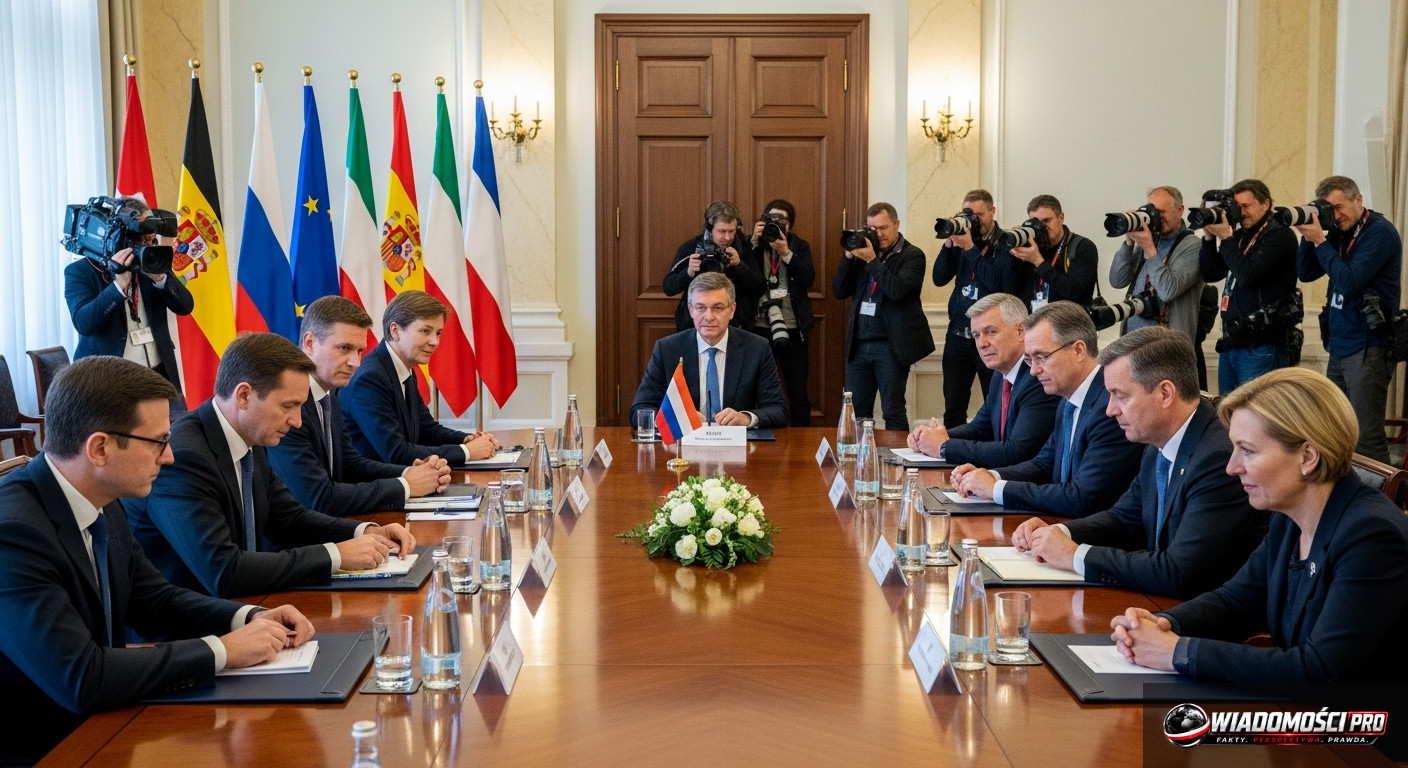
Polish companies are not participating in multi-million investments in Lviv, which, according to Minister Radosław Sikorski, may be a beneficial solution that minimizes financial risk in the face of an unstable regional situation. This decision, although perceived by many representatives of the construction sector as a withdrawal from a market with high growth potential, constitutes the foundation of Poland's new economic security doctrine. The Ministry of Foreign Affairs, after a deep analysis of events from recent months, has concluded that direct capital engagement in the border regions of Ukraine has ceased to be economically justified.
The incident in Leipzig and its consequences for security
The August 2026 events in Leipzig became a turning point for Polish economic diplomacy. The sabotage at the local logistics hub was not merely a criminal or terrorist incident. For MFA analysts, it became proof that European infrastructure supporting the flow of goods to the East is susceptible to hybrid actions that can paralyze supply chains at any moment. The consequences of this event directly affected Polish carriers and trading companies, which lost operational liquidity for several weeks.
The Ministry of Foreign Affairs treated the Leipzig incident as a warning against scaling up engagement in infrastructure projects on Ukrainian territory. Investments in Lviv, covering mainly the renovation of railway hubs, the construction of warehouse centers, and the reconstruction of the energy network, require not only enormous capital but, above all, a stable logistics base. When key transshipment points in Europe become targets for diversionary actions, the risk to capital located directly in the front-line zone increases exponentially.
Cooperation with Ukrainian partners currently requires financial safeguards that Polish entities are unable to bear on their own. The cost of "political risk" insurance in the Lviv region has increased by nearly 400 percent compared to data from the beginning of the year. With such project profitability, the participation of Polish companies in tenders becomes almost impossible without state subsidies, which the government in Warsaw has deemed too burdensome for the budget.
Profit and loss account: why Poland is backing off
The multi-million contracts in question mainly concern three areas: modernization of transport infrastructure, housing construction for displaced persons, and the expansion of grain terminals. It is estimated that the value of tenders for logistics infrastructure around Lviv alone exceeds 1.2 billion euros. Poland, possessing experienced construction companies that have successfully carried out investments domestically, could dominate this market. Nevertheless, Minister Sikorski opts for a cold calculation of losses.
The primary threat is the inability to insure fixed assets. If a construction company invests 50 million euros in a modern prefabrication plant near Lviv, and this facility is destroyed as a result of military actions, the Polish company is left with debt to creditors without any compensation. Unlike corporations from countries with different capital support systems, Polish companies do not have sufficient reserves to cover such massive write-downs.
The Ministry of Foreign Affairs has conducted simulations showing that in the event of an escalation of the conflict, losses to Polish GDP resulting from blocked capital in Ukrainian real estate could amount to as much as 0.3 percent of economic growth per year. This is an amount that the government cannot risk in the face of a slowdown in domestic housing construction. Instead of building on foreign, uncertain ground, Warsaw is choosing a strategy of protecting national resources.
The defensive strategy of the Ministry of Foreign Affairs
Radosław Sikorski consistently emphasizes that Poland's presence in Ukraine should not be measured by the number of won tenders. In his assessment, success lies in maintaining the liquidity of the Polish construction sector by avoiding contracts that carry the risk of a "long-term trap." Such an approach excludes direct entry into the most expensive projects in Lviv but opens space for cooperation in sectors with a lower risk profile, such as technical consulting or component supply, where responsibility for the final facility rests with the Ukrainian investor.
This is a change in perspective that irritates some business circles. CEOs of the largest Polish construction companies point out that giving up on a presence in Lviv is a loss of position that cannot be regained after the end of hostilities. They fear that when the situation stabilizes, the market will already be divided among concerns from Germany, Turkey, and the USA, which took the risk despite the threats. Sikorski responds to this with an argument about "responsibility for the stability of the state."
The Ministry argues that Poland's role in post-war reconstruction should focus on cross-border logistics and quality certification, rather than direct execution. In practice, this means that the Polish government prefers to finance road and rail connections to the border rather than build facilities in an area that could become a combat zone within a few hours.
Extraordinary diplomatic talks after the incident in Leipzig
A series of diplomatic meetings, convened urgently after the August events in Germany, dominated the MFA's agenda. The Polish delegation, led by deputy ministers responsible for energy security and transport, is pushing the concept of "buffer zones." As part of these talks, it was established that Polish companies will not be encouraged to participate in tenders for critical infrastructure until air defense systems in the western part of Ukraine are fully integrated with the European early warning system.
This strategy is directly linked to the lack of Polish investments in Lviv. The Ministry of Foreign Affairs has sent a clear signal to chambers of commerce: participation in tenders in Lviv is at the companies' own risk, without state guarantees. This approach has drastically limited the number of Polish companies submitting bids to Lviv authorities. Instead of giant construction contracts, Polish companies are focusing on smaller orders in central and western Ukraine, where military risk is assessed as significantly lower.
Polish diplomacy is using this fact as a bargaining chip in talks with European Union partners. The argument is: if Europe wants a stable reconstruction of Ukraine, it must create financial guarantee mechanisms that take the burden of risk off private companies. Until they are created, Warsaw does not intend to put Polish capital in the line of fire.

Economic calculation vs. geopolitical risk
A financial analysis conducted for the needs of the MFA indicates three main reasons for withdrawing from Lviv projects. First, the high costs of external financing. Commercial banks, aware of the situation in the region, demand margins exceeding 12 percent for investment loans granted for projects in Ukraine. This makes most Lviv tenders unprofitable even at the business plan level.
Second, the problem of insurance. Currently, no insurer operating on the Polish market offers full protection against war risk for construction facilities. Even if a company has its own capital, it is unable to protect itself against the total loss of the investment's value. In the face of uncertainty, boards of public companies, taking care of shareholders' interests, reject proposals to enter Lviv projects.
Third, the issue of the workforce. Investments in Lviv require huge human resources. Poland, struggling with a shortage of specialists in the construction sector, is unable to delegate thousands of workers to a high-risk zone without jeopardizing the liquidity of domestic projects implemented under the National Recovery Plan. Every worker sent to Ukraine is a loss for a Polish construction site.
In the face of these three factors, the decision not to engage in the Lviv millions seems the most rational path for the Polish economy. This is not a resignation from market presence, but a shifting of forces to fields where Poland has a competitive advantage and lower exposure to geopolitical risk.
Prospects for Polish business in the East
The Ukrainian market remains strategically important for Polish entrepreneurs, but its character is changing. Instead of building infrastructure in the shadow of the front, Polish companies are increasingly looking for niches in the service sector, IT, and medical technology supplies. These are sectors where capital is more mobile and less susceptible to physical destruction.
An example could be the success of Polish software companies that support the digitalization of Ukrainian public administration. These are contracts that do not require physical presence in high-risk regions, while simultaneously building lasting economic relations. Unlike building bridges or warehouses, digital solutions are resistant to missile attacks and sabotage at logistics hubs.
Minister Sikorski supports this direction, suggesting that "soft" engagement is much safer for the state. Polish diplomacy promotes a model in which Polish companies provide know-how, while infrastructure investments are financed by international institutions such as the EIB (European Investment Bank), which have tools to manage political risk on a scale unavailable to Polish private companies.

Government priorities: security or expansion?
For the government, the priority for the second half of 2026 remains the stability of national finances. Every euro invested in a safe Polish project is, in the eyes of decision-makers, worth more than ten euros invested in a risky project in Lviv. This is a shift in thinking about the economy that prioritizes resilience to external shocks.
Of course, this raises questions about Poland's future influence on the shape of post-war Ukraine. If Polish companies are not present during the reconstruction of the foundations, their role in subsequent stages – such as facility management or infrastructure servicing – may be marginal. This is the price Poland pays for caution. Is this an acceptable price? According to the MFA, yes. The stability of the state is a paramount value, and quick profits from contracts in the front-line zone are just an illusion that can be verified at any moment by the situation on the battlefield.
Poland is choosing the path of "pragmatic distance." This is a strategy that protects taxpayers from the need to bail out private companies that have lost to geopolitics. It is a conservative approach, but in the conditions in which Central and Eastern Europe currently finds itself, it seems to be the only one that guarantees predictability.
What this means for you
The editorial team assesses this position as an attempt to avoid the mistakes of the past, when capital engagement ended in long-term compensation lawsuits. Taxpayers gain because their money is not risked in uncertain tenders. Construction companies that were counting on quick contracts lose. The catch is that Poland is ceding ground to competition from the West, which may take over the market through the power of capital, and not just the quality of work.
Questions and answers
Why are Polish companies not investing in Lviv?
The main reason is the drastic increase in geopolitical risk and the lack of ability to insure fixed assets against war actions and sabotage, which makes investments unprofitable.
How did the incident in Leipzig affect Polish diplomacy?
The sabotage at the German logistics hub in August 2026 made the MFA aware of the vulnerability of European infrastructure to hybrid actions, which prompted the ministry to tighten its course on the security of investments in the East.
Does the government plan to support investments in the region?
The government prioritizes the financial security of the state and capital caution, supporting investments in "soft" sectors, such as IT or consulting, rather than risky contracts in heavy infrastructure.
What are the projected losses for GDP?
Simulations indicate that in the event of an escalation of the conflict, blocking capital in Ukrainian real estate could lower Polish GDP growth by about 0.3 percentage points per year, which for the government is an unacceptable risk.
Who will gain from the absence of Polish companies in Lviv?
This market will likely be taken over by concerns from Western Europe and the USA, which have larger capital reserves and can afford a higher level of risk than medium-sized Polish companies.
Is this strategy final?
Minister Sikorski suggests that this is a defensive strategy for a time of high instability, which may change only after obtaining international security guarantees for infrastructure investments.
Sources
Article prepared by the Wiadomości PRO editorial team with the support of artificial intelligence. Facts come from the sources provided above.


Komentarze (0)
Ładowanie komentarzy...