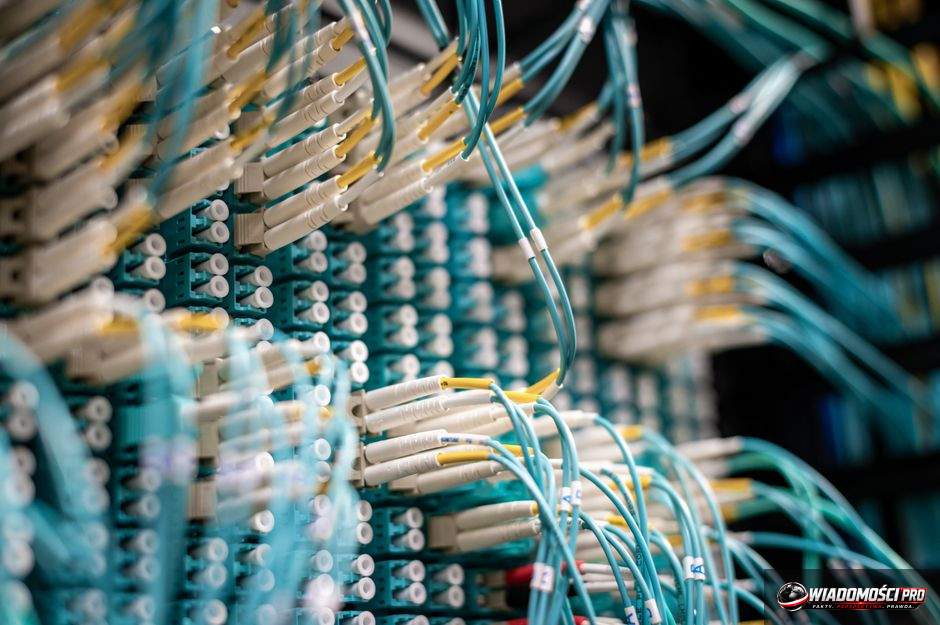
Fibrain will invest 280 million PLN in the expansion of its factory in Zaczernie, which will allow for an increase in fiber optic production capacity and support the development of the drone sector, cementing the export of products to 80 countries around the world. This decision, spearheaded by the company's management board led by CEO Rafał Kalisz, represents an attempt to transition from the role of a component supplier to that of a comprehensive integrator of technological solutions. Initial construction work at the plant site has already begun, although the company has not yet published a detailed schedule for the operational commissioning of individual halls.
Finance: 280 million PLN as a shield against market volatility
An investment budget of 280 million PLN places Fibrain in a select group of companies from the Podkarpacie region that are opting for such large-scale expansion of production capacity. This capital will not be allocated solely to increasing the number of machines. The board plans full automation of the lines, which is intended to reduce unit production costs in the face of rising electricity expenses. In the fiber optic cable manufacturing industry, processes such as fiber drawing or the application of polymer coatings are extremely energy-intensive. Modernizing the machinery park is the only way to maintain the profitability of international contracts.
Fibrain's strategy is based on the idea of vertical integration. Possessing a full production chain – from semi-finished products to the final cable – allows the company to become independent of price fluctuations in the raw materials market, such as quartz preforms. In conditions of international competition, where suppliers from Asia dominate in terms of price, the only advantage for a European manufacturer remains quality control and the speed of response to specific customer requirements. The board has not provided a breakdown of the budget for individual stages of the investment. It is only known that a significant portion of the funds will go toward MES (Manufacturing Execution System) class production management systems, which monitor the efficiency of each line in real time.
An investment of this scale requires the company to maintain financial liquidity throughout the construction period. In the telecommunications sector, margins are under pressure due to the saturation of the FTTH (Fiber to the Home) services market. Fibrain must therefore generate higher margins on specialized products to finance the development of its production base. Operational risk is high. Delays in machine deliveries, which are currently a plague for industrial projects in Europe, could affect the timeliness of contract fulfillment with foreign contractors. Every day of downtime at the Zaczernie factory generates opportunity costs that the company cannot ignore.
Technology: Fiber optics in the service of unmanned aerial vehicles
The unmanned aerial vehicle (UAV) sector is becoming a new sales market for Fibrain. Optical components used in drones must meet completely different standards than those used in ground infrastructure. In the case of military and logistics drones, resistance to overload, vibration, and variable weather conditions is crucial. A standard fiber optic cable, laid in the ground, is not exposed to electromagnetic interference to the same extent as a cable suspended under a drone or integrated with control systems.
Fibrain is designing specialized coatings intended to protect fibers from interference generated by drone engines. Data transmission in "tethered drone" systems, where the drone is powered and controlled via a cable, requires minimal latency. The manufacturer is targeting customers in the defense and logistics sectors, where drones are used for monitoring critical infrastructure. In these applications, link stability determines the success of the mission. If the optical link fails, the operator loses control of the device in real time.
Technical directors at Fibrain must reconcile aviation requirements with mass production. Implementing a line for drones is a process that requires certification under aviation regimes. However, the company has not disclosed whether it has already signed framework agreements with specific drone manufacturers. The process of certifying components in the defense industry usually takes from 12 to 24 months. This means that the expenditures incurred on the new production line will pay off with a delay. This investment is a bet on the future of the drone market, which in Europe is still struggling with legal and logistical barriers.
Labor market: A challenge for Podkarpacie
Attracting qualified engineers in the Rzeszów area is becoming increasingly difficult. The Aviation Valley absorbs most specialists in the fields of automation, robotics, and materials science. Fibrain, by expanding its factory in Zaczernie, is entering into direct competition for employees with aviation giants. The requirements for candidates are high. Operating modern production lines requires knowledge at the intersection of optics and mechatronics.
The company has not provided the number of new jobs that will be created as a result of the investment. However, the automation of processes points to a change in the employment structure. Instead of hiring workers for simple manual tasks, Fibrain will need operators of numerically controlled systems and process engineers. Training such staff within the company is inevitable, which increases operational costs. The lack of available workers could become a bottleneck for the investment.
Local officials from Zaczernie are counting on tax revenues to boost the local budget. However, for local residents, the investment means an increase in truck traffic. The transport of components to 80 countries takes place by land and air, which, with the growing number of plants in this part of Podkarpacie, creates communication challenges. Access roads to the Jasionka airport, despite modernization, can be inefficient during peak hours. Fibrain's investment is another element increasing the pressure on this infrastructure.
Global network: Logistics for 80 countries
Exporting to 80 countries places an obligation on Fibrain to conduct advanced logistics. Many of these markets have different technical and certification standards. Every batch of goods leaving Zaczernie must comply with local norms – from American building standards to Asian requirements regarding resistance to humidity and high temperatures. The factory expansion aims to increase production flexibility, which will allow for the fulfillment of smaller but more diverse orders.
Logistics for 80 countries also means managing currency and political risk. Fibrain, as a Polish exporter, must hedge contracts in various currencies. Production stability in Zaczernie is crucial for maintaining its position in export markets. Customers who have opted for technology from Poland expect delivery guarantees. In the telecommunications sector, where a cable failure means service outages for thousands of subscribers, loyalty to a supplier depends on the reliability of logistics.
The company's board must manage inventory in a way that minimizes the risk of downtime for end customers. In an era of broken supply chains, having one's own production capacity in Europe is a significant marketing asset. Fibrain promotes itself as a stable supplier, unlike importers relying solely on Asian factories. But will the price of products from Zaczernie allow it to maintain an advantage over cheaper competition? This question remains open. The telecommunications market is a relationship-based market, where product quality often outweighs pure unit cost, provided that deliveries are on time.
Risk analysis: Will it pay off?
The 280 million PLN investment carries risks that cannot be fully eliminated. The first is the economic climate in the telecommunications sector. If operators in Europe and America halt plans for 5G or fiber optic network expansion, demand for Fibrain's products could fall. The company is trying to diversify revenue through the drone sector, but this is a market with completely different order characteristics.
The second risk is the cost of energy. Fiber optic production requires furnaces to operate at high temperatures, which makes the process very sensitive to electricity prices in Poland. If Poland's energy mix maintains high energy prices compared to the rest of Europe, Fibrain's margins could erode. The board assures that the modernization of the machinery park takes energy efficiency into account, but these devices are more expensive to purchase and require specific maintenance.
The third factor is the lack of an investment schedule. In construction projects, the lack of publicly announced completion dates often indicates uncertainty regarding the availability of building materials or subcontractors. If construction is delayed by a year, costs could rise drastically due to inflation. Fibrain is playing for high stakes. If the project is not completed within the assumed time, the company could be overtaken by competitors who implement similar solutions in the drone sector faster.
Regional context: Podkarpacie technology hub
Zaczernie has become a focal point for high-tech industry in Podkarpacie. The proximity of the Jasionka airport facilitates the export of products that require fast transport. Fibrain, by investing here, benefits from the synergy effect with other companies in the aviation and technology industries. Cooperation with local partners allows for faster machine servicing and the acquisition of specialized services.
The factory expansion is a signal to the region that high-tech industry in Podkarpacie has a future. However, the success of this venture depends on infrastructure. Overloaded roads around the airport pose a real threat to the timeliness of deliveries. If local officials do not take care of transport capacity, even the most modern factory could be cut off from the world during peak hours. Fibrain's investment is a test for local authorities as to whether they can keep up with the pace of private business development.
For residents of the region, this investment is an opportunity for stable employment. However, for those in the industry, it is also a test of human resource management skills in a region where the demand for specialists has exceeded supply for years. Fibrain must offer competitive wage conditions to retain engineers who might otherwise choose to work in the aviation sector, where earnings are among the highest in the province.
Future: What happens after the expansion is finished?
When the expansion is complete, Fibrain will have one of the most modern plants in Europe. The question of the board's next steps remains open. Will the company decide on further acquisitions, or will it focus on process optimization? It can be assumed that after such a large expenditure, a period of consolidation and paying off financial obligations will follow.
Much depends on how quickly the drone sector becomes profitable. If Fibrain hits a niche with components featuring unique parameters, it could gain a strong market position. The unmanned aerial vehicle market is in the formative stage, which provides an opportunity to take a leadership position in terms of data transmission. This is a field for the Polish engineers from Zaczernie to show their skills. If they manage to create a standard that is accepted by European drone manufacturers, the 280 million PLN investment could pay off faster than the most pessimistic scenarios assume.
Finally, it is worth mentioning intellectual property. Fibrain has focused on its own design solutions for years. The factory expansion is an opportunity to create a research and development center that will allow for faster implementation of innovations. If the company combines production capacity with innovation, it will be able to set trends in fiber optics for industry for the next decade. This is a scenario in which a Polish company is genuinely shaping the European technology market, rather than just following existing trends.
Questions and answers
What exactly will the 280 million PLN be spent on?
The funds will be invested in the expansion of the factory in Zaczernie, which includes modernizing the machinery park, increasing fiber optic production capacity, and implementing technological lines dedicated to components used in the drone sector.
What challenges does the company face in connection with the investment?
The main challenge is attracting qualified engineering staff in the local market, ensuring supply continuity in the face of global fluctuations, and maintaining price competitiveness against manufacturers from Asia.
Why is the drone sector so important for Fibrain?
This sector represents a new market niche that allows for revenue diversification beyond traditional telecommunications infrastructure. Fiber optic components are essential for ensuring stable and interference-resistant data transmission in unmanned aerial vehicles.
Is the completion date of the factory expansion known?
The manufacturer has not provided an official schedule for the completion of construction work or a date for launching the full production capacity of the new lines, which leaves a certain degree of uncertainty regarding the pace of the investment.
What is the company's export reach?
Currently, Fibrain conducts export activities covering 80 countries around the world, and the investment in Zaczernie aims to consolidate this position by increasing operational efficiency and supply stability.
Sources
Article prepared by the Wiadomości PRO editorial team with the support of artificial intelligence. Facts are derived from the sources provided above.



Komentarze (0)
Ładowanie komentarzy...