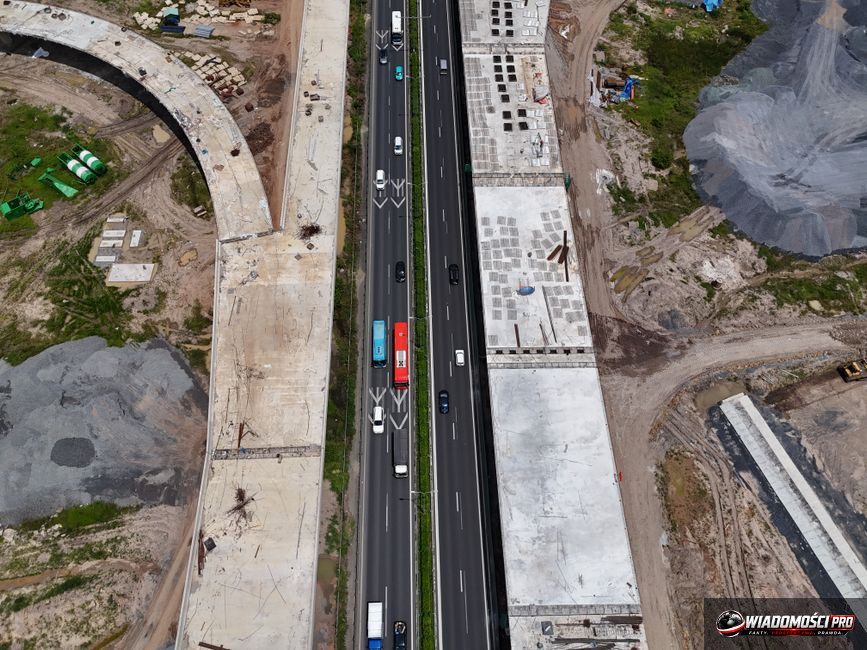
GDDKiA has signed 66 indexation annexes with a total value of 2 billion PLN, which will go to 21 consortia to secure the liquidity of key road projects against the effects of inflation. This process, finalized in July 2026, concludes the stage of negotiations conducted since June, aimed at making contracts concluded under completely different macroeconomic conditions realistic. The state investor adopted a strategy of direct recapitalization of contractors to avoid paralysis at construction sites, where price pressure on materials and labor costs exceeded initial cost estimates.
Financial mechanics of the 66 annexes
The disbursement of 2 billion PLN is not a discretionary act, but the result of a meticulous recalculation of inflation indicators, which over the last dozen or so months have deviated drastically from the forecasts contained in the contracts. GDDKiA, represented by the General Directorate, faced a choice: either accept higher costs or face a wave of contractor bankruptcies. The verification process covered 21 consortia that demonstrated the real impact of rising prices of bitumen, reinforcing steel, and fuels on the profitability of their work. Each of the 66 annexes had to pass through a dense sieve of financial control, which excluded the possibility of arbitrary demands for additional payments by entities implementing the investments.
From the point of view of the state budget, this expenditure is treated as an investment in infrastructure continuity. Terminating contracts with contractors who have lost liquidity generates costs much higher than those resulting from indexation. Inventorying abandoned construction sites, securing sites, and organizing new tenders are operations that take years. In this context, the billions of zlotys transferred to the accounts of 21 consortia are the price for avoiding multi-year delays. The Ministry of Infrastructure points out that thanks to this solution, it was possible to protect strategic communication routes, which are essential for logistics and international transport, from downtime.
Investments under protection: from S7 to A2
GDDKiA's actions are not an abstract accounting operation, but real support for construction sites where thousands of people and hundreds of machines work every day. Among the investments covered by the support are key sections of expressways and motorways. Examples include sections of the S7 road implemented in difficult terrain conditions, where the need to stabilize costs allowed for maintaining the pace of work on engineering structures. A similar mechanism secured liquidity at the construction site of the missing sections of the A2 motorway, which constitutes the backbone of the Polish transport system on the east-west axis.
Another area covered by the annexes is work on the S19 expressway, which is part of the international Via Carpatia route. Contracts on these sections, often implemented by consortia with a diverse capital structure, required rapid intervention due to complex geology and tight deadlines for commissioning. Each annex was tailored to the individual specifics of the project, which means that the support amounts varied depending on the degree of progress of the work and the type of materials used. Contractors received a signal that the state investor is monitoring the market and will not allow machines to stop for purely financial reasons resulting from external factors over which companies had no control.
Strategic savings of the ministry
The Ministry of Infrastructure estimates that thanks to efficient indexation, it was possible to save an amount of around one billion PLN in the state budget. This calculation is based on comparing the costs of the paid annexes with the hypothetical losses that would be associated with the need to launch new tender procedures in an environment of rising prices. If contractors left the construction sites, new offers in tenders would be 30 to 40 percent higher than current prices, including indexation. This is simple mathematics that officials could not ignore.
The decision to increase the indexation level by 25 percent became a new benchmark for the entire construction sector. Representatives of the ministry, while signing the annexes, emphasized that this is an action aimed at stabilizing the market, not artificially inflating it. Construction companies gained space to plan material purchases in advance, which is crucial for maintaining operational liquidity in conditions of high price volatility. In this relationship, the state acts as a guarantor that takes on part of the market risk, which in return allows it to require contractors to meet new, updated investment completion dates.
Consequences for the construction industry
The construction sector has gone through a series of shocks in recent years, from broken supply chains to a sharp rise in energy raw material prices. The signing of 66 annexes is a signal to many companies that the period of extreme uncertainty is coming to an end. Consortia that received support can now focus on finishing road and bridge works instead of analyzing bankruptcy scenarios. However, this stability has its price. Companies were subjected to rigorous control, and their financial results are analyzed by GDDKiA auditors for the validity of applications for additional payments.
It cannot be ignored that for smaller subcontractors, often invisible in press releases, these annexes are a matter of survival. Financial liquidity flowing from the top, from the leaders of the consortia, to the executing companies, is crucial for maintaining the pace of work at the very bottom of the construction pyramid. GDDKiA, through its actions, indirectly forces the leaders of the consortia to fairly distribute the indexation funds. This is a mechanism designed to prevent payment bottlenecks throughout the supply chain, which is currently the biggest threat to the infrastructure sector.
GDDKiA's role in overseeing the process
The contract annexing process was supervised by the GDDKiA management in close cooperation with the Ministry of Infrastructure. Those responsible for signing the documents had to balance the public interest with the real needs of the private sector. On one hand, the pressure for timely delivery of routes, on the other – the need to account for public money in a transparent manner. Each annex had a detailed justification based on reports on material price changes published by independent institutions monitoring the raw materials market.
GDDKiA officials opted for pragmatism. It was understood that in the face of global economic changes, rigidly sticking to contract provisions from years ago leads to disaster. Changing the approach to a more flexible one allowed for avoiding investment paralysis, which in the past, during other crises, led to the multi-year freezing of large road projects. Now, every contract has built-in fuses that should work in the event of further price fluctuations, which is ultimately intended to eliminate the need for such massive contract annexing in the future.
Driver's perspective: what does this mean on the road?
For the average driver, the information about indexation annexes is a signal that the timeliness of delivering new roads is a priority. If not for these 2 billion PLN, many projects would have stalled, which in practice would mean driving on detours for years to come. The investments that were saved in this way are not just numbers in Excel tables, but a real reduction in travel time and increased road safety.
The stabilization provided by GDDKiA translates into specific dates in the schedules for opening routes to traffic. Drivers who struggle with traffic jams on national roads every day can count on the fact that the promised completion dates are now much more realistic. Of course, there are still delays resulting from design errors or problems with obtaining environmental decisions, but the contractor's financial liquidity problem has been largely eliminated as a cause of downtime. This means that infrastructure is being built at a pace allowed by technological limitations, not by gaps in the contractor's cash register.
Dilemmas of the state investor
Managing such a huge budget in inflationary conditions requires decision-making courage. GDDKiA had to demonstrate negotiation skills so as not to overpay, but at the same time not lead to the collapse of construction companies. This tightrope walking has become the standard for officials' work. Critics point out that such an approach may accustom the market to constant expectations of support from the state. Entrepreneurs may start assuming that every market risk will ultimately be covered by the central budget.
On the other hand, supporters of GDDKiA's actions argue that in an industry with such a high degree of complexity, it is impossible to eliminate risk completely. Building a road is a process that often lasts from three to five years. In such a long period, it is impossible to predict the behavior of energy or raw material prices. Therefore, the indexation mechanism should be a permanent element of every contract, not an ad-hoc action. The current annexes are a step towards modernizing the way the state cooperates with contractors, shifting the burden from rigid valuations to flexible contract management.
Summary: a new reality at construction sites
As of July 23, 2026, GDDKiA closed a process that was a stress test for the construction industry. The balance sheet of 66 annexes and 2 billion PLN in support is a fact. These funds allowed for maintaining the work front on 21 key contracts, which is a logistical and financial success. Now the burden of responsibility shifts to the contractors who have received the funds to complete the tasks. The lack of financial excuses means that the eyes of all market observers will be focused on the pace of work at construction sites.
The future will show whether the standards developed in July will become the foundation for a more predictable model of public investment implementation. The industry needs clear rules of the game, not constant negotiations over additional payments. GDDKiA has shown that it can react to crisis situations, but the real test will now be the quality of the roads delivered and the reliability of final settlements. Billions of zlotys is capital that must bring tangible results in the form of a safe and modern road network, and not just be absorbed by the operating costs of construction companies.
Questions and answers
Why did GDDKiA have to sign the annexes?
The rise in material and labor prices caused by inflation meant that the original contract budgets were no longer realistic, which threatened to stop work at construction sites.
How many consortia received support?
Financial support as part of 66 annexes went to 21 construction consortia implementing strategic investments.
Does this mean increased costs for taxpayers?
Yes, indexation is an additional expense, but the ministry emphasizes that thanks to it, more expensive tender procedures and multi-year downtime at construction sites were avoided.
What amount was allocated for indexation?
The total value of the signed annexes is 2 billion PLN.
When was the indexation process finalized?
This process was formally completed in July 2026, after months of negotiations conducted since June.
Could all construction companies count on help?
No, support was targeted at consortia that demonstrated the real impact of inflation on the profitability of their contracts and where there was the greatest risk of work stoppage.
What will happen if material prices continue to rise?
GDDKiA announces further cooperation with contractors based on the developed new indexation rules, which is intended to cushion future economic turbulence.
Do the annexes only concern large motorways?
No, the annexes cover diverse projects, including sections of expressways that are key to the national transport network.
Who supervised the process of signing the annexes?
The process was supervised by the GDDKiA management in cooperation with the Ministry of Infrastructure.
What was the main criterion for granting funds?
The key criterion was the need to ensure the financial liquidity of the investment to avoid the risk of contract termination and the need to announce new tenders.
Did contractors have to prove cost increases?
Yes, each of the 66 annexes went through a financial verification path, which excluded the possibility of arbitrary demands for additional payments by construction companies.
Is 2 billion PLN the final support amount?
This is the amount resulting from the closed contract annexing process, which was finalized in July 2026.
What is the impact of these annexes on drivers?
Thanks to the support for contractors, downtime was avoided, which allows for meeting the deadlines for opening key routes to public use.
Is this solution considered standard?
The Ministry of Infrastructure describes this decision as unprecedented, taken under exceptional economic circumstances to protect the state's interest.
What about subcontractors in this process?
Consortium leaders, upon receiving funds, are obliged to maintain liquidity throughout the supply chain, which also protects smaller subcontracting companies.
Will GDDKiA recover some of this money?
The Ministry of Infrastructure points to "a billion in savings" resulting from avoiding costly tenders to finish construction, which is a form of indirect profit for the state budget.
Was the process open to all companies in the sector?
The process was aimed at contractors implementing investments that were affected by the effects of inflation to a degree that threatened the continuation of work.
Are similar additional payments planned in the future?
GDDKiA aims to implement mechanisms that will systematically respond to market changes, limiting the need for individual interventions.
Do the annexes also cover labor issues?
Yes, indexation takes into account the rise in costs of both construction materials and labor, which were key factors influencing the increase in cost estimates.
What is the risk for contractors after signing the annexes?
The margin of error in final settlements has become narrow, and contractors are obliged to bring the investment to the finish line by the set deadlines under penalty of contractual fines.
Sources
- Road construction with a larger budget. GDDKiA signs annexes worth 2 billion PLN - Bankier.pl
- GDDKiA finishes annexing contracts. 2 billion PLN from higher indexation will go to 21 consortia - stockwatch.pl
- Two billion for companies, a billion stays in the pocket. The ministry talks about an unprecedented decision - wnp.pl
- Contract indexation level will increase by approx. 2 billion PLN - Inwestycje.pl
- We care about the stability of the industry. Another GDDKiA contract indexation - Gov.pl
- Together on investment implementation - Gov.pl
- Another indexation starts – up to 25 percent! First annex signed - Rynek Infrastruktury
- GDDKiA: contract indexation will increase by 2 billion PLN - stockwatch.pl
Article prepared by the Wiadomości PRO editorial team with the support of artificial intelligence. Facts come from the sources listed above.

Komentarze (0)
Ładowanie komentarzy...