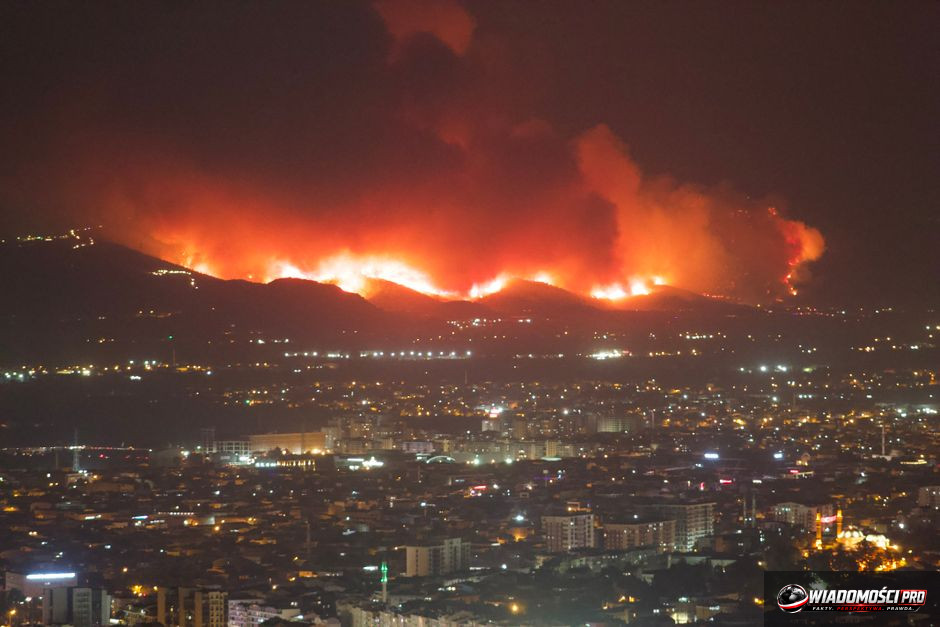
The situation is currently critical in the vicinity of Omiš, where the fire has reached buildings; it is imperative to strictly follow the announcements of the Polish embassy and local emergency services, which are managing the evacuation. These institutions possess the only reliable operational data that allows for a safe departure from the threatened region. Any attempts to determine escape routes on one's own are fraught with enormous risk, as local road closures and the changing activity of fire fronts can lead to the return route being cut off at the most unexpected moment.
Threat in the Omiš area: Risk analysis for tourists
The city of Omiš, being one of the most popular points on the map of the Croatian coast, became the epicenter of rescue operations in mid-August 2026. The fire, which spiraled out of control from the morning hours of August 14, is no longer limited to forest areas or wasteland. The flames have reached the urban fabric itself, directly threatening residential buildings and tourist infrastructure. Thousands of foreigners, including many Poles, have found themselves in a situation that requires an immediate response in accordance with the guidelines of the Croatian fire department.
The scale of the phenomenon goes beyond standard safety procedures. A total of 200 fire outbreaks have been recorded across the country, making the current state the largest natural disaster in the history of modern Croatia. The dispersion of rescue forces, which must operate simultaneously in so many points, means that help does not always arrive in real-time where it is needed. Therefore, the responsibility for safety shifts largely to the tourists themselves. Reaching the assembly points designated by local authorities is currently the only effective way to avoid direct contact with the elements.
It is worth rejecting any attempts to downplay the threat. The fire in this region is characterized by unpredictability, resulting from the terrain and specific air currents typical of the Dalmatian coast. Smoke limits visibility to a few meters, which makes it impossible to drive safely on local roads. Anyone planning to move within a radius of several dozen kilometers from Omiš should assume that roads may be impassable. Verification of route passability is possible only through the official channels of the Croatian Automobile Club HAK (Hrvatski autoklub), which updates maps of blocked road sections on an ongoing basis.
Evacuation mechanisms: How not to become a victim of chaos
An efficient evacuation in disaster conditions depends on two factors: the speed of decision-making and access to reliable information. Croatian rescue services, including fire units (vatrogasci), have the authority to force the immediate evacuation of a facility. If you receive such an order, do not pack all your belongings. Focus on documents, medicines, and essential financial resources. Other items, even those of high value, cannot be a reason for you to remain in the danger zone.
The official source of information for Polish citizens is the profile of the Polish Embassy in Zagreb. Monitoring this channel allows for receiving announcements prepared in Polish, which in stressful situations is crucial for avoiding misinterpretations of instructions issued in Croatian or English. It is equally important to listen to local radio stations (e.g., HRT – Hrvatski radio), which broadcast announcements about potential escape routes in a loop during crisis situations.
During evacuation, one should mainly follow main roads and avoid shortcuts through wooded and forest areas, which can instantly burst into flames in the event of a sudden gust of wind. Remember that there are designated assembly points in Croatia. If hotel staff or the apartment owner orders an evacuation to a specific location, do not look for alternatives on your own. The services managing the operation have a full view of the fire spread map, which the average tourist is unable to reconstruct on their own.
Scale of the cataclysm: Why is this an unprecedented event?
The events of mid-August 2026 represent the culmination of a wave of threats that had been growing in Croatia since the beginning of the summer. As early as July 12, 2026, tragic fires were recorded on the islands, which, however, compared to the current number of 200 fire outbreaks across the country, seem only a warning of what followed. Data on dozens of injured people, reported by sources at naTemat.pl, clearly indicate that the civil protection system is working at the limit of its capacity.
Why is the situation so difficult? First of all, due to the enormous material losses, which are inevitable in the case of such an extensive fire front. Tourist infrastructure, often located in close proximity to forests, is exceptionally vulnerable to the rapid spread of flames. Unlike fires of the past, the current element does not bypass city centers. In Omiš, the fire reached buildings, which turns the previous protection strategy, which assumed primarily the defense of non-urbanized areas, upside down.
It is worth paying attention to rescue logistics. Firefighters in Croatia are receiving support from across the country, but with 200 fire outbreaks, no forces are able to handle every threatened building simultaneously. This forces services to prioritize actions, which for a tourist in a specific hotel means that they must be ready to act on their own in the first phase of the threat. Avoiding panic, having a charged phone with internet access, and following official announcements are the only tools you have at your disposal when professional help has not yet arrived.
Travel insurance: What to look for in the policy?
Many Polish tourists, facing the necessity of cutting their vacation short due to fires, make the mistake of assuming that every travel policy will cover the costs of evacuation or a refund for an unused stay. The catch lies in the clauses regarding "force majeure" and the definition of "random events." Many standard travel insurance policies contain exclusions regarding natural disasters if they have been declared as a state of emergency by the authorities of a given country.
Before making a decision about an early return, read your policy carefully regarding the "trip interruption" point. Look for a clause about "insurer's liability in the event of extreme phenomena." If your policy is limited only to medical expenses, you will not receive a refund for accommodation that you have to leave in a hurry. It is also worth checking if the insurance covers transport costs in a situation where return roads are blocked and an alternative means of transport is required.
Another issue is verifying whether the insurer requires an official certificate from Croatian services about the impossibility of staying in a given place. Such a document, issued by the police or fire department, is key evidence in the claims process. Without confirmation from the scene, insurance companies very often reject claims for compensation, classifying the evacuation as a "tourist's own decision." Do not be misled by assurances that the mere fact of a fire occurring in the region is enough – you must prove that your place of stay was in the direct danger zone.
Questions and answers
Is it currently safe to travel to Omiš?
No, the situation in the vicinity of Omiš is critical. The fire has reached buildings, and access roads may be blocked by rescue services. All travel to this region is advised against until the Croatian authorities issue an announcement that the threat has been extinguished.
Where to look for information about exit routes and evacuation?
The primary source is the website of the Croatian Automobile Club HAK, where current information about closed roads is published. Furthermore, one should monitor announcements published on the profile of the Polish Embassy in Zagreb and listen to local radio stations (HRT), which provide instructions for the public in real-time.
How many fire outbreaks have been recorded in Croatia?
According to data from August 14, 2026, 200 fire outbreaks have been identified across the country.
What to do first when I smell smoke or see fire?
The priority is to leave the danger zone immediately. Do not waste time packing luggage – take only documents, a phone, and essential medicines. Follow the instructions of uniformed services. If there are no services on site, head towards the coast or designated assembly points, avoiding forest and unpaved roads.
Can the Polish embassy cover the costs of my evacuation?
The Polish Embassy in Zagreb provides information and consular support, but it is not an entity that covers the costs of private travel or accommodation. The tourist themselves is responsible for financial issues related to the evacuation, which is why it is so important to have appropriate insurance that covers the costs of trip interruption due to natural disasters.
Are fires in Croatia a new phenomenon?
Fires in Croatia occur cyclically, however, the scale of this year's events, with 200 fire outbreaks and a direct threat to city centers, is described by services as the largest disaster in the country's history. Previous events from July 12, 2026, were only a prelude to the current, much more serious wave of threats that affected tourist regions in mid-August.
Sources
- Urgent warning for Poles in Croatia. Massive fire approaching buildings - Wiadomości Onet
- Urgent warning for Poles in Croatia. Fire has spiraled out of control - Polskie Radio 24
- Fire in a "Polish" city in Croatia. Fire approaching the center, embassy alerts - naTemat.pl
- [UPDATE] Largest fire in the history of Croatia. Fire reached Omiš - wrzuc.info
- Massive fire in Croatia. Residents and tourists evacuated - Podróże Onet
- Fire in Croatia had 200 outbreaks. Dozens injured, huge losses - naTemat.pl
- [UPDATE] Dangerous fire in the vicinity of Omiš - Croatia. Residents and tourists evacuated - wrzuc.info
- Tragic fire in Croatia. Fire consumes tourist island - WP Wiadomości


Komentarze (0)
Ładowanie komentarzy...