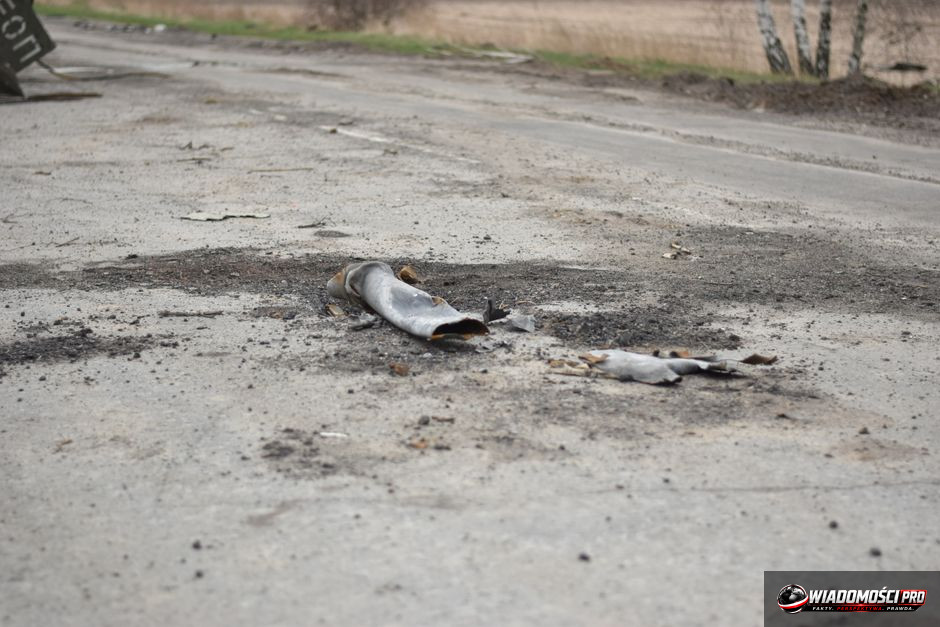
A Russian Kh-101 cruise missile fell in Tarnawa-Kolonia; it contained explosives and, according to Deputy Minister Cezary Tomczyk, is capable of carrying nuclear warheads. This object was one of 20 missiles directed toward the Polish border on July 30, 2026, as part of a massive aerial attack. Technical analysis indicates that the presence of this type of weaponry on the territory of a NATO state represents a significant shift in the assessment of operational risk on the eastern flank.
The Ministry of National Defense confirmed that Tarnawa-Kolonia was within the range of a shockwave, the primary targets of which were likely facilities in Ukraine. Radar system records showed that 20 Kh-101 units approached Polish airspace, which forced the operational command to implement high-readiness procedures. The fall of one of the missiles on Polish soil was not a random piece of debris, but the result of a violation of sovereignty by a fully functional weapon system. Deputy Minister Cezary Tomczyk, referring to the discovery, emphasized that the Kh-101 type missile has the capability to carry nuclear payloads, which gives the incident a political dimension extending beyond standard airspace violations.
The design of the Kh-101 missile, known in NATO nomenclature as the AS-23A Kodiak, is oriented toward minimizing its effective radar cross-section. The missile reaches a cruising speed of 700–900 kilometers per hour, which, combined with the ability to fly at a very low altitude – often below 50 meters above ground level – makes it a difficult target for ground-based air defense systems. The operational range of this missile exceeds 2,500, and according to some estimates, even 5,000 kilometers, which allows for striking targets deep within the continent while maintaining high precision. The guidance system consists of a combination of an inertial reference system, GLONASS satellite support, and an optoelectronic terrain correlation system (TERCOM), which allows for automatic course correction in the final phase of flight.
Comparing this technical data with information about the presence of explosives in the warhead of the missile that fell near Lublin indicates a destructive potential that cannot be underestimated. Even if the Russian doctrine for the use of this weapon in this specific attack assumed the use of a conventional payload weighing approximately 400 kilograms, the platform itself is designed to carry warheads with a yield of 200 to 250 kilotons. The fact that the missile passed through Polish monitoring systems and struck in Tarnawa-Kolonia undermines the previous belief in the tightness of the air umbrella over the eastern border.
In the public debate that erupted immediately after the details were revealed by the Ministry of Defense, two trends are clashing. On one hand, we have official government statements reassuring the public with assurances of full control over the situation and the operational readiness of the military. On the other hand, skepticism is growing, fueled by the lack of transparency in the first hours after the event. Jarosław Kaczyński and opposition representatives point out in their statements that this incident is not an isolated navigation error, but an element of a broader strategy of destabilization, in which Russia is testing the limits of the North Atlantic Alliance's reaction.
The Fronda portal raised the issue of the ambiguity of government explanations, which illustrates a deep divide in the assessment of the threat. Critics accuse the administration of delaying the release of key information about the type of missile for too long, which could have led to disinformation. In the face of information about 20 missiles flying toward the border, residents of the region expect a clear answer to the question about procedures that are supposed to prevent similar events in the future. Polish diplomacy faces the task of balancing a firm reaction within NATO with avoiding an escalation that could be used by the Kremlin as a pretext for further offensive actions.
The international reception of the incident in Tarnawa-Kolonia confirms that the matter has exceeded a local dimension. Foreign media, citing analyses by military experts, point to the risk of a NATO-Russia confrontation if similar violations become a permanent element of war tactics. The PolsatNews.pl service notes that the presence of armed cruise missiles over Alliance territory is brinkmanship that forces a revision of the existing rules of engagement for air forces in peacetime. For NATO command structures, the problem is not just the fall of the missile itself, but above all the lack of a clear protocol that would define at what point an "alien" object should be neutralized using kinetic means.
In the face of the conflict in Ukraine, where the Kh-101 is regularly used for attacks on critical infrastructure, Polish authorities must answer the question of whether the current defense system is adapted to intercept missiles with stealth features. The effectiveness of air defense depends on reaction time, and in the case of cruise missiles flying at low altitudes, the time window for making a decision to shoot them down is extremely short. Poland is in a situation where any error in the guidance system on the Russian side can turn into a tragic event with consequences extending beyond the borders of a single county.
Analysts point out that the destabilization of the region by systematically sending missiles into the proximity of allied borders is an element of Russia's "gray zone" strategy. The goal is to induce decision-making paralysis among NATO politicians and weaken the trust of citizens in their own security structures. If the government in Warsaw does not develop a coherent information and operational strategy, incidents like the one in Tarnawa-Kolonia will continue to be used to polarize public debate. The question remains whether, in the face of such an advanced threat as missiles capable of carrying nuclear warheads, current defensive measures are sufficient to ensure the safety of citizens.
Conclusions from the missile fall in Tarnawa-Kolonia point to the need to accelerate the modernization of early warning systems and increase the density of air defense batteries along the eastern border. Without these actions, every subsequent wave of Russian missiles will carry the same risk that materialized on July 30, 2026. The matter remains open, and the coming days will likely bring further questions about the real effectiveness of Polish procedures in a clash with Russian cruise missile technology.
Was the missile in Tarnawa-Kolonia armed?
Yes, new information confirms that the Kh-101 type missile contained explosives.
Can this type of missile be dangerous for Poland on a broader scale?
Deputy Minister Tomczyk emphasized that Kh-101 missiles have the capability to carry nuclear warheads, which significantly raises the level of the threat in the event of another airspace violation.
How did Polish politicians react?
The government declares operational readiness, while opposition representatives and the media point to the need for deeper explanations regarding the effectiveness of the air defense system and response procedures.
Sources
- Tomczyk confirms: it is a Russian Kh-101 missile - Fakt
- New information about the missile near Lublin. "It contained explosives" - Wiadomości Onet
- Missile fell in Poland. There is a comment from Kaczyński - WP Wiadomości
- "Risk of NATO confrontation with Russia". Foreign media on the missile in Poland - PolsatNews.pl
- Russian Kh-101 missile in Poland. Tomczyk: it can even carry nuclear warheads - Business Insider Polska
- MON: 20 Russian missiles were flying toward Poland. One fell in Tarnawa-Kolonia - Gazeta
- Missile fell in Poland, government speaks of "readiness". Ambiguous explanations - Fronda.pl
- Russian missile fell in Poland. Everything you need to know [SUMMARY] - Wiadomości Onet



Komentarze (0)
Ładowanie komentarzy...