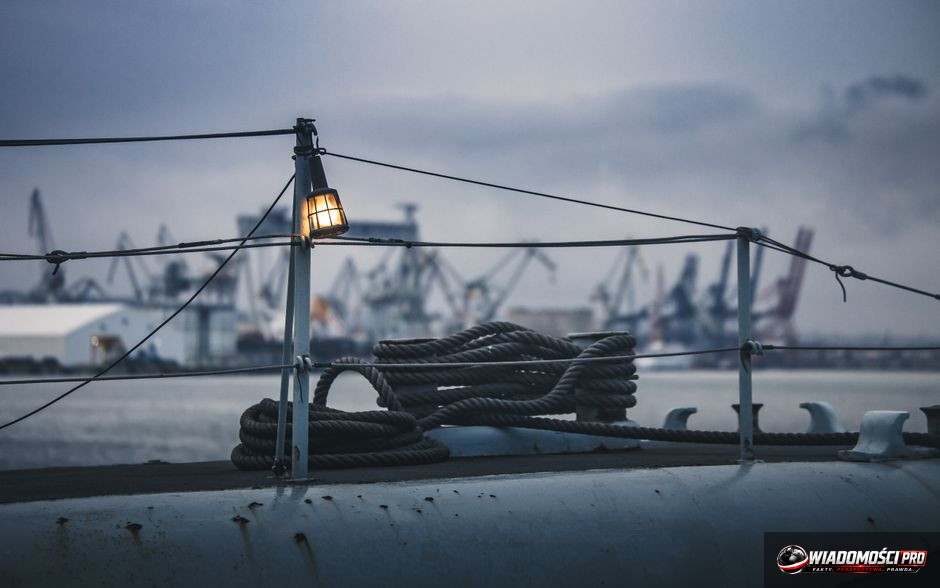
Karol Nawrocki called the program "a sign of responsibility, not weakness," to which Donald Tusk replied pointedly: "You know what I'm talking about." This brief exchange, which took place on August 12, 2026, in Gdynia, defines the state of relations between the two most important centers of power in Poland in the face of the largest armaments program in the history of the Navy. The event, which should have been a purely technical act of launching the ORP Wicher frigate, instantly transformed into a demonstration of political strength.
The frigate ORP Wicher is the most expensive ship ever built for the Polish naval forces. The entire Miecznik program, covering three units of this type, will consume over 15 billion zlotys from the state budget. These enormous financial resources, flowing through Polish shipyards, represent not only a cash injection for the industry but also a massive reputational risk for each side of the political divide. When Nawrocki emphasizes responsibility, he is appealing to a narrative of state continuity. Tusk's response, however, is a signal that the Prime Minister does not intend to allow the presidential camp to claim exclusive credit for successes, especially in the context of costs that are becoming increasingly noticeable to the state budget.
The Miecznik program is not just steel, hulls, and advanced weapons systems. It is, above all, an attempt to rebuild operational capabilities in the Baltic, where the Polish fleet had for decades remained in the shadow of the modernization ambitions of the land forces. ORP Wicher, as the first of three planned Arrowhead 140-type units, is intended to become the foundation of a new air and naval defense system. The cost of one frigate, estimated at over 5 billion zlotys, includes not only the floating platform itself but, above all, an integrated combat system that must be compatible with NATO standards. In the face of rising military spending, every zloty spent on the Miecznik is being scrutinized by the opposition and financial markets.
Karol Nawrocki, speaking in Gdynia, emphasized that this investment goes beyond the standard framework of military procurement. In his view, it is an impulse for the Polish shipbuilding industry, which for years had not received orders of this scale. The President points to the necessity of building competency potential within the country. From the perspective of his political camp, every subsequent hull section leaving the production hall is proof of the effectiveness of earlier strategic decisions. Such rhetoric is intended to convince voters that this project is not just an expense, but an investment in security and technology.
Donald Tusk, although present on the podium, adopted a strategy of cool restraint. His enigmatic "You know what I'm talking about" suggests there is more to the story. It could refer to financial audits that the government is conducting on armaments programs, or to attempts to renegotiate schedules, which in the case of such complex units often undergo delays. The Prime Minister, as head of government, is responsible for balancing the budget, which in the face of inflation and defense costs is an extremely difficult task. His distanced attitude toward the President indicates a deep lack of trust regarding how this project was managed in previous years.
From the perspective of the shipyard workers, the situation is simple: they need stability and continuity of funding. Building a frigate is a process stretched over years, requiring precise coordination of thousands of subcontractors. Ceremonies like the one in Gdynia are a moment of engineering triumph for them, but for politicians, it is just another stage of a campaign. Frequent changes in decision-making positions in defense companies do not help maintain the pace of work. Any pause in funding directly impacts the launch schedule of subsequent units.
The construction of the ORP Wicher itself is based on a British design, which was one of the most debated technical decisions. This choice was supposed to guarantee a relatively fast pace of construction, but the realities of the Polish shipbuilding industry have verified these assumptions. The Polish Navy has for years struggled with a shortage of modern long-range anti-aircraft defense systems. The Miecznik-class frigates are intended to fill this gap, becoming mobile command centers at sea. Their armament, including anti-aircraft and anti-ship missiles as well as advanced sonars, makes them units with significance extending beyond standard coastal protection.
However, despite President Nawrocki's enthusiasm, military specialists point to the challenges associated with system integration. Every modern ship is, in practice, a floating computer whose software must cooperate with other NATO units in real time. It is precisely the costs of licenses, system integration, and crew training that make up a significant portion of those billions mentioned in official communiqués. The lack of transparency in these costs raises questions about whether Poland is paying a market price or perhaps a premium for the political haste that accompanied the beginnings of this program.
The political tug-of-war in Gdynia shows how much defense issues have been harnessed into the current fight for the electorate. President Nawrocki is not backing down, positioning himself as the patron of naval modernization. Prime Minister Tusk, meanwhile, is trying to limit the President's image gains by emphasizing the government's role in overseeing expenditures. For the citizen, this exchange is a clear message: the Miecznik program is not free from political tensions, and its future depends on the stability of the government, which in Poland can be fragile.
It is worth noting that in the history of the Polish Navy, similar projects often ended in failure. The case of the Gawron corvette, whose construction dragged on for years only to be ultimately abandoned, is still fresh in the memory of decision-makers. ORP Wicher is intended to be proof that the state has learned from those mistakes. However, for this success to be lasting, cooperation across party lines is essential, which was clearly lacking in Gdynia on August 12. Instead of a united front, the audience saw two leaders who, even at such a momentous time, could not move beyond the rhetoric of mutual dislike.
What does this mean for the future of the program? Above all, it is a signal that every subsequent tranche of funding will be the subject of sharp parliamentary debate. Prime Minister Tusk, holding the budget in his hands, will use financial issues as a tool to discipline the President and his circle. Nawrocki, on the other hand, lacking the tools of executive power, will use every opportunity to show that his vision of modernization is the correct one. Such a state of affairs means that the Miecznik program may become a hostage to political dispute for years to come.
For the sailors who are to operate this ship in the future, combat readiness is what matters most. Combat systems, crew training, and logistics are elements that are not subject to political negotiations. The frigate must be operational, regardless of who wins the next election. However, observing the events in Gdynia, it is hard to shake the impression that the technical aspects of the ship's construction are taking a back seat. Rhetoric and the way a given politician can react to an opponent's words have become more important.
In summary, the christening of the ORP Wicher will be remembered not only as the launching of a ship, but as a moment when Polish politics collided with the realities of major armaments. The most expensive ship in Poland's history has become a symbol around which narratives of responsibility and weakness are built. Will these billions of zlotys translate into real security in the Baltic? This question remains relevant, and we will not find the answers in the speeches delivered on the honorary podiums. The answer lies in the delivery schedule, the efficiency of the missile systems, and whether the program will not be subjected to a deep revision again after the next elections.
Questions and answers
Why did Nawrocki talk about responsibility?
The President wanted to emphasize that the construction of the ORP Wicher frigate is an expression of responsibility for the state's security, not a sign of weakness.
What exactly did Donald Tusk reply?
The Prime Minister replied laconically: "You know what I'm talking about," which was interpreted as an allusion to disputes over the shape of the armaments program and financial management.
Is ORP Wicher actually the most expensive ship?
Yes, ORP Wicher is the most expensive unit ever ordered by the Polish Navy, and the total cost of the three Miecznik-class units is estimated at over 15 billion zlotys.
What is the political context of this exchange?
The exchange reflects the rivalry between the presidential and government centers over the right to claim credit for the army's modernization successes and over how to oversee massive defense spending.
Does the Miecznik program have guaranteed funding?
Funding is included in budget plans; however, in the face of the current economic and political situation, each tranche may be subject to audits and political discussions.
Sources
- Christening of the frigate ORP Wicher. Karol Nawrocki: something exceptional and a breakthrough is happening - TVN24
- "A sign of responsibility, not weakness." Nawrocki addressed Tusk - PolsatNews.pl
- Christening and launching of ORP Wicher. Ceremonies in Gdynia [VIDEO] - Polish Press Agency SA
- Poland's most expensive ship. This is what the christening of ORP Wicher looked like - WP Wiadomości
- Donald Tusk addressed Karol Nawrocki in Gdynia. "You know what I'm talking about" - Onet News
- Gdynia. Christening and launching of ORP Wicher. President Nawrocki: The Miecznik project is a milestone - Wprost
- Christening of ORP Wicher. President: "This is a milestone" - Radio Gdańsk
- Christening of ORP Wicher. President: this program was an impulse for the Polish shipbuilding industry - xyz.pl

Komentarze (0)
Ładowanie komentarzy...