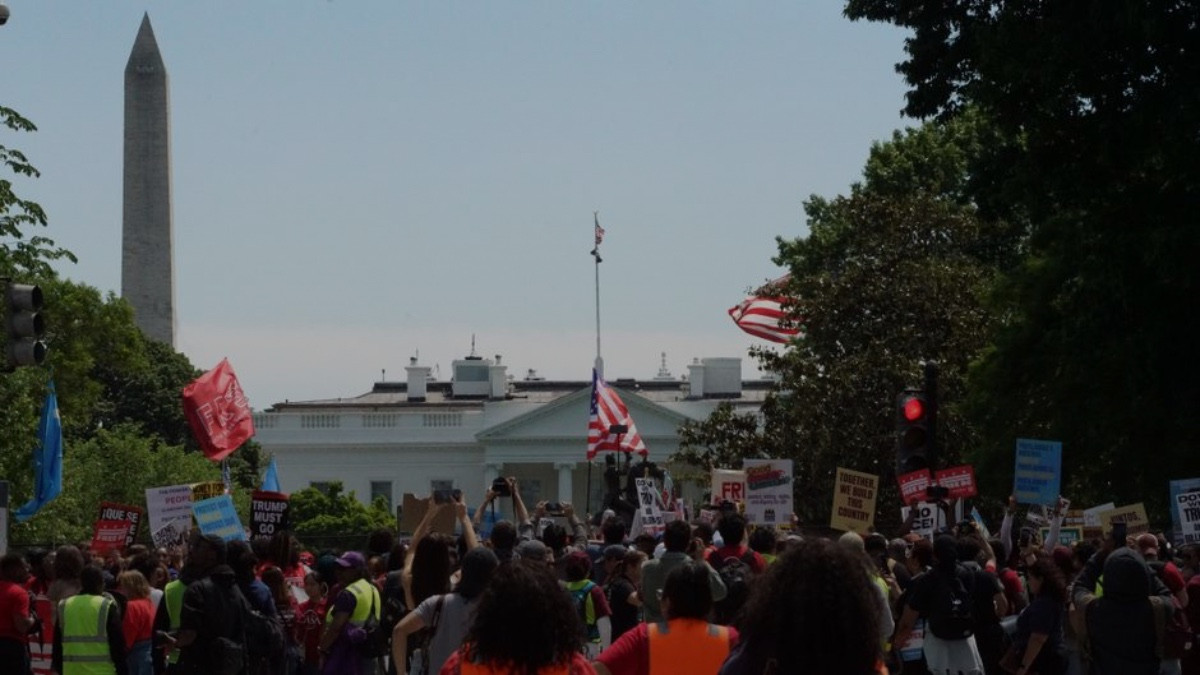
According to Tucker Carlson, Israel has an exceptionally short window of time to draw the United States into a direct armed conflict, as sentiments among young Americans are changing rapidly, becoming increasingly critical of Tel Aviv's policies. This trend, observed in public opinion polls, is not merely a temporary fluctuation but a profound generational shift that permanently limits Washington's ability to pursue traditional Middle East policy. Decision-makers in Israel must reckon with the fact that American support, once unconditional, is becoming an increasing electoral burden for politicians there.
Changing sentiments in hard numbers
Carlson's diagnosis is reflected in studies by organizations such as Gallup and the Pew Research Center, which document a systematic retreat of young Americans from the pro-Israel narrative. Data from Gallup published in February 2024 shows that for the first time in the history of the measurements, more Democrats sympathize with the Palestinians (49%) than with the Israelis (38%). For comparison, back in 2013, support for Israel among the same group of voters was 53%, with only 19% for the Palestinians.
This shift in the structure of the Democratic Party's electorate translates directly into dynamics in Congress. Generation Z, i.e., people born after 1996, shows the highest rate of skepticism toward spending on foreign aid for Tel Aviv. While older voters, raised in the spirit of Cold War security guarantees, still perceive Israel as a strategic pillar of the American presence in the region, young citizens more often question the legitimacy of these expenditures. Pew Research statistics show that among Americans under 30, the percentage of people claiming that US support for Israel is "too much" has increased by nearly 15 percentage points over the last two years. For a politician seeking reelection in districts dominated by young voters, ignoring these indicators means the risk of defeat in the primaries.
Factions in Washington: between loyalty and electoral fear
Inside the US Congress, the division no longer runs along party lines, but within the groups themselves. On one hand, we have the progressive faction, represented by figures such as Alexandria Ocasio-Cortez or Ilhan Omar, who openly demand a revision of the terms of cooperation with Israel. On the other hand, there remains the Republican establishment, with leaders like Mitch McConnell or Mike Johnson, who maintain the rhetoric of full military support. Carlson notes that this fracture makes American foreign policy inconsistent and predictable only in the short term.
The real threat to Israel, however, is not the opposition itself, but the decision-making paralysis resulting from fear of the electoral base's reaction. Politicians from both parties, observing poll data, are beginning to calculate every aid package in terms of image losses. In Congress, debates over the defense budget have ceased to be a formality. Every dollar allocated for military support for Tel Aviv is now subject to intense analysis on social media, where the anti-Israel narrative dominates the news channels consumed by the youngest groups of voters. Carlson argues that the elites in Tel Aviv are aware of this process and are trying to accelerate their strategic goals before the American state apparatus becomes a hostage to its own public opinion.
Geopolitical risk and lack of hard evidence of escalation
Carlson's analysis is based on the observation of political trends, not on access to classified cables from the Pentagon. The commentator does not present evidence of specific, secret Pentagon plans assuming the direct involvement of American forces in a conflict in the Middle East. There is also a lack of official confirmation from the Department of Defense that the US is changing its operational doctrine in this region. All actions taken so far, such as the rotational redeployment of aircraft carrier strike groups, fall within the framework of standard deterrence procedures, not preparations for a full-scale war.
Nevertheless, Carlson's diagnosis of a "closing window" is important for understanding the mechanism by which modern diplomacy is shaped. If American society solidifies its skepticism, every subsequent president, regardless of party affiliation, will have an increasingly narrow field of maneuver regarding support for Israel's actions. In crisis situations where a quick decision on logistical or military support would be necessary, Washington could get stuck in an internal debate, which for Tel Aviv would mean a catastrophic weakening of its negotiating position. Carlson suggests that this potential paralysis is the greatest challenge for Israel, forcing it to seek alternative alliances, even if their effectiveness is questionable.
American foreign policy: facade or change of course?
As of September 1, 2026, the administration in Washington officially maintains its existing alliance commitments. No strategic document has been published that would officially limit military support for Tel Aviv. Nevertheless, observers of the political scene point to a noticeable change in the language used by State Department officials. Unambiguous declarations are avoided, and in the corridors, there is talk of the need to "balance" relations, which for traditional pro-Israel lobbyists is an alarm signal.
This caution does not stem from a sudden moral enlightenment, but from pure electoral arithmetic. Democrats, desperately needing the votes of young voters in key states, cannot afford to ignore their demands. Republicans, in turn, despite a more conservative electorate, must also face a growing wave of isolationism among their supporters, inspired by, among other things, Carlson's rhetoric. As a result, US foreign policy regarding Israel is becoming a hostage to internal disputes, which makes it impossible to develop a long-term strategy.
Consequences for the reader: is this the end of the era of alliances?
For an outside observer, this situation carries important conclusions. First of all, the time of unreflective support, in which the interests of the US and Israel were considered identical, has come to an end. The reader should note that Carlson's rhetoric is a tool aimed not only at describing reality but also at shaping it. By highlighting the reluctance of young Americans, the commentator legitimizes their skepticism, making it a mainstream part of public debate.
From an editorial perspective, the greatest threat here is polarization. If the debate about Israel becomes an element of the "culture wars" within the US, then the issue of that country's security will cease to be treated as a matter of state interest and will become a subject of partisan bidding. Who will gain from this? Certainly groups promoting isolationism, which seek to limit the US presence in foreign conflicts. Who will lose? Traditional lobbying groups that have built their position on a bipartisan consensus for decades. In this game of interests, Israel – despite its military power – becomes just one of many pieces on a chessboard where the main stake is the sentiment of the American voter.
Questions and answers
Are Tucker Carlson's words the official position of the US?
No. Tucker Carlson is a political commentator, not a representative of the American administration. His statements reflect the views of a portion of American society, but they do not constitute guidelines for the foreign policy of the White House or the State Department.
Which generation currently shows the greatest skepticism toward Israel?
Generation Z and young adults under 30 are the most critical of Israel's policies. Polling data indicates that for this group, historical arguments for an alliance with Israel have less significance than current images of conflicts reaching them via social media.
Is the US actually planning to enter a war in the Middle East?
As of September 1, 2026, there is no official information or confirmed evidence that the United States is planning direct military involvement in a conflict in the Middle East. All American actions in the region are limited to routine deterrence missions and logistical support, in accordance with the official doctrine of the Department of Defense.
Why does Carlson claim that the "window of opportunity" is closing?
According to the columnist, demographic processes and ideological changes within the American electorate make support for Israel an increasing electoral risk for politicians. Carlson suggests that the current moment is the last chance for Israeli elites to obtain full US engagement before social pressure in America permanently limits the ability of those in power in Washington to make such decisions.



Komentarze (0)
Ładowanie komentarzy...