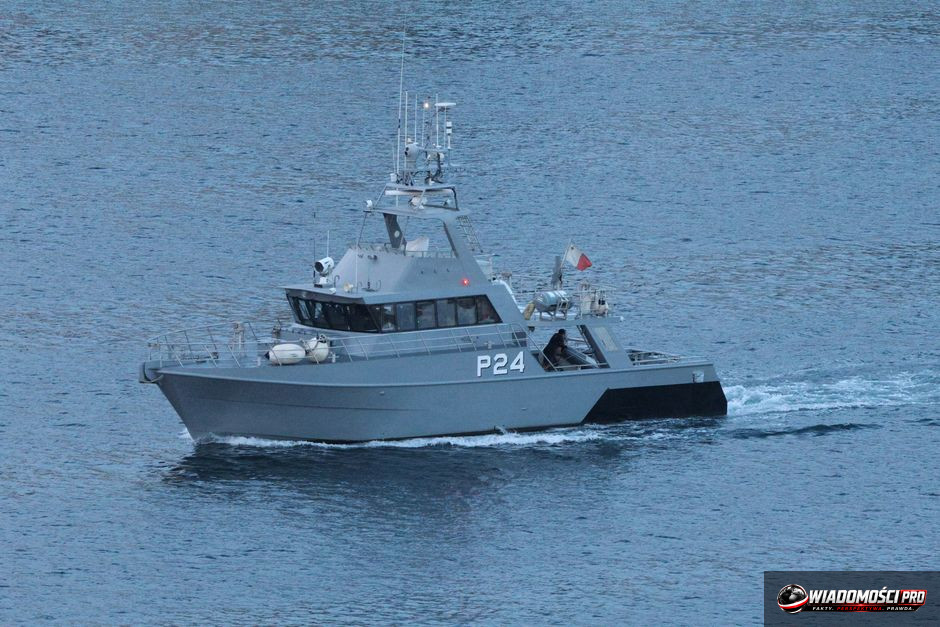
The situation is highly unstable, as confirmed by the US attacks on targets in Iran in July and the earlier exchange of fire in the Strait of Hormuz, despite attempts to initiate a dialogue at the end of July 2026. The probability of a full-scale war breaking out in August is currently estimated at about 30 percent, which stems from the lack of reliable communication channels between Washington and Tehran. Commands on both sides are operating in a state of full combat readiness, treating every move by the opponent not as an element of diplomatic blackmail, but as preparation for a direct military strike.
The military mechanics of escalation
Events from May 8, 2026, in the Strait of Hormuz have ceased to be treated by analysts as an isolated incident, especially after the American air force struck targets inside Iran in July. The exchange of fire in the strait was merely a prelude to a new security architecture in which the line between a "show of force" and open war has become blurred. On July 7, 2026, when sirens wailed in the region, it became clear that the American strategy had shifted from containment to the active degradation of Iranian defensive capabilities.
Available source materials indicate that there is a lack of disclosed names of key decision-makers on both the American and Iranian sides who would be responsible for direct orders. This state of affairs—a lack of transparency in command structures—deepens uncertainty and means that financial markets, as well as international institutions, have no reference point for assessing the intentions of either side. The situation resembles the state of affairs on June 27, 2026, when Tehran issued a statement announcing a "reaction to violence." At that time, there was still hope for de-escalation, but subsequent strikes on July 12, 2026, confirmed that the theory of self-regulating conflict was flawed.
Washington's strategy focuses on precision strikes against selected infrastructure points, intended to force Tehran into concessions without the need to commit ground troops to a long-term invasion. In turn, the Iranian response, based on asymmetric warfare methods, focuses on maintaining control over maritime routes and destabilizing the situation in the region. Every US air operation conducted in July was interpreted by Tehran as an act of aggression requiring a military response. Such feedback loops preclude traditional diplomacy.
It is worth noting that the lack of names of politicians making decisions during these days suggests that military staffs have taken the helm. Civilians, both in the White House and in Iranian ministries, have been sidelined or are serving only propaganda functions. This means that decisions are being made based on the current tactical situation rather than long-term political plans. In this context, the attempts at dialogue made on July 29, 2026, look like a feigned action intended only to calm international public opinion, while preparations for further incidents continue unabated.
Economy in the shadow of tankers
The oil market has stopped reacting to traditional supply and demand data. Since April 14, 2026, when the first reports of threats to tankers in the Strait of Hormuz began reaching investors, commodity prices have been shaped solely by geopolitical risk. During that period, a barrel of Brent crude, the benchmark for the global market, fluctuated in a range that made stable budget planning impossible for importers. After the May incidents, including the exchange of fire on May 8, the market entered a "fear premium" phase.
May 4, 2026, became the date when tensions with Iran completely dominated the market narrative. Analysts note that every subsequent attack, like those on July 7 or 12, causes an immediate price jump, even if the physical flow of oil has not yet been halted. Investors are pricing in not what is happening today, but what might happen tomorrow. If the Strait of Hormuz, through which a significant portion of the world's oil exports passes, is closed or blockaded, prices could rise sharply, exceeding historical highs.
For the end-user, the average fuel consumer, this means the end of an era of predictable costs. Shipping companies operating in the region must pay astronomical insurance rates, which translates directly into the final price of the product. Even reports of dialogue on July 29, 2026, did not bring lasting relief. Markets are skeptical because every declaration of talks is confronted with images of burning installations or reports of further exchanges of fire.
In this arrangement, oil producers from outside the Middle East stand to gain, as they can dictate their own terms without fearing for the safety of their transport routes. However, in global terms, the instability of the region hits every participant in the economy. We are not dealing with a temporary price spike caused by a breakdown, but with a permanent state of elevated risk. This makes cost-push inflation, driven by energy prices, a permanent element of the economic landscape for the second half of 2026.
Regime dynamics in the face of external pressure
The frequently repeated thesis about the possible collapse of the regime in Tehran under the influence of American attacks seems to have no basis in fact. Experts as early as April 28, 2026, on polskieradio.pl pointed out that external military pressure usually leads to consolidation, not the disintegration of power structures. In the face of a threat, Iran's security apparatus gains legitimacy to harden its stance against internal opposition, which makes the regime even more impenetrable.
Understanding this mechanism is crucial for assessing the chances of a change in the situation. The attacks of July 2026, despite their intensity, did not shake the foundations of power in Tehran. On the contrary, they allowed for the unification of society around the narrative of an external enemy. Washington, when making decisions about strikes, seems to ignore this sociological aspect of the confrontation. Instead of weakening the opponent, these actions may, in the long run, solidify the current balance of power in Iran.
It is worth emphasizing that the stability of the regime is a matter of survival for Iran, which is why every attempt at destabilization will be met with maximum resistance. The authorities in Tehran are prepared for a long-term conflict, as confirmed by their reactions to the incidents in May and June. The lack of visible signs of cracks in the command structures testifies to the high degree of control exercised by the state leadership. For the US, this means that the military path will not lead to quick success, but only to the prolongation of a state of uncertainty.
Political analysis indicates that the current impasse will last as long as neither side concludes that the costs of further confrontation outweigh the potential gains. For now, both sides believe that time is on their side—Washington is counting on the exhaustion of Iran's resources, while Tehran is counting on the fatigue of the American public and the distraction of attention from the region. In this game of interests, patience becomes the most valuable currency, which is, however, lacking in the face of daily military incidents.
Prospects for August and the coming months
August 2026 will be a month of verification for July's actions. If the escalation maintains its pace, one should expect further incidents that may go beyond the current exchange of fire in the Strait of Hormuz. Observers point out that the margin of error has practically ceased to exist. Any misunderstanding, any misinterpretation of the movement of a naval or air unit, could trigger a chain reaction.
The dialogue reported at the end of July remains in the realm of wishful thinking. There are no concrete arrangements that would allow for the cooling of emotions. Instead, we are dealing with "crisis management," which consists only of attempts to prevent an open total war while simultaneously maintaining military pressure. This is a very risky game. It requires precision that is often lacking in wartime conditions.
For the reader, this means that we must get used to being part of this puzzle. Energy prices, the costs of transporting goods, and the general level of anxiety in the markets—all of this will depend on what happens in the coming weeks in the Middle East. The absence of a "black swan," i.e., an unforeseen, catastrophic event, does not mean that the situation is safe. We are dealing with "permanent grayness," a state of tension that is exhausting, costly, and, above all, dangerous.
Is there any chance of breaking this impasse? Only if both sides recognize that the costs of further confrontation have become unacceptable. For now, however, there is no indication of this. Tehran will not withdraw from the rhetoric of "violence for violence," and Washington will not give up on protecting its interests in the region by force. We therefore have a period ahead of us in which diplomacy will be merely a backdrop for military actions, rather than their main regulator.
Questions and answers
Is this already a full war?
The current state is an escalation of military actions and a direct exchange of fire, which, despite the lack of a formal declaration of war, realistically destabilizes the region and forces both sides to maintain constant combat readiness.
How does this affect fuel prices?
Tensions in the Strait of Hormuz, which have persisted since April 2026, exert constant pressure on oil prices, increasing risk premiums on global stock exchanges and making stable energy cost forecasting difficult.
Why is Iran not collapsing despite sanctions and attacks?
Experts assess that external pressure has led to the consolidation of the regime, which makes it more resistant to internal changes and allows the authorities to effectively unite society around an external threat.
What is known about the July talks?
Attempts at dialogue made at the end of July 2026 are assessed by observers as courteous gestures, which, in the face of attacks continuing since the beginning of July, do not translate into a real de-escalation of the conflict.
What can we expect in August?
August will be a month of verifying the current strategy, where the margin of error is minimal, and any further escalation could lead to an uncontrolled expansion of hostilities in the Persian Gulf.
Do sources provide the names of decision-makers?
Available sources of information do not mention the names of specific commanders or politicians responsible for making decisions on either side, which may indicate a high level of secrecy in decision-making channels in the current crisis.
How do markets react to incidents?
Financial markets have been living in a state of permanent tension since May 2026, where the narrative of conflict with Iran has completely overshadowed macroeconomic indicators, creating an environment of high price uncertainty.
Does diplomacy still have a chance?
In the current balance of power, diplomacy acts only as a "safety valve," which is unable to stop military pressure as long as both sides treat every action as an element of confrontation rather than a platform for talks.
What is the significance of the Strait of Hormuz in this conflict?
The strait is a strategic bottleneck for global oil transport, which is why any exchange of fire in this area hits global supply chains much faster than any report on raw material production.
Is the consolidation of the regime permanent?
Experts point out that in the short term, external pressure strengthens the regime, but the lack of prospects for resolving the crisis could in the future lead to the exhaustion of state resources, which is a critical point for Iran's stability.
Sources
- USA attacks targets in Iran again. The scale of actions is escalating - Business Insider Polska
- Tension rises after overnight US attacks. Iran accuses, sirens wailed in the region - Interia Wydarzenia
- Tension on the US-Iran line. "Violence will be the reaction to violence" - Wiadomości Onet
- USA and Iran establish dialogue, but tensions in the Middle East continue to cast a shadow over oil markets. - Vietnam.vn
- Iran in a state of tension. Expert: consolidation of the regime more likely than its collapse - polskieradio.pl
- US-Iran clashes. Exchange of fire took place in the Strait of Hormuz - Polskie Radio 24
- Market situation on May 4 - tensions with Iran may again dominate the market narrative - Parkiet
- This could hit wallets. Tankers are sailing, oil prices under pressure - Super Biznes

Komentarze (0)
Ładowanie komentarzy...