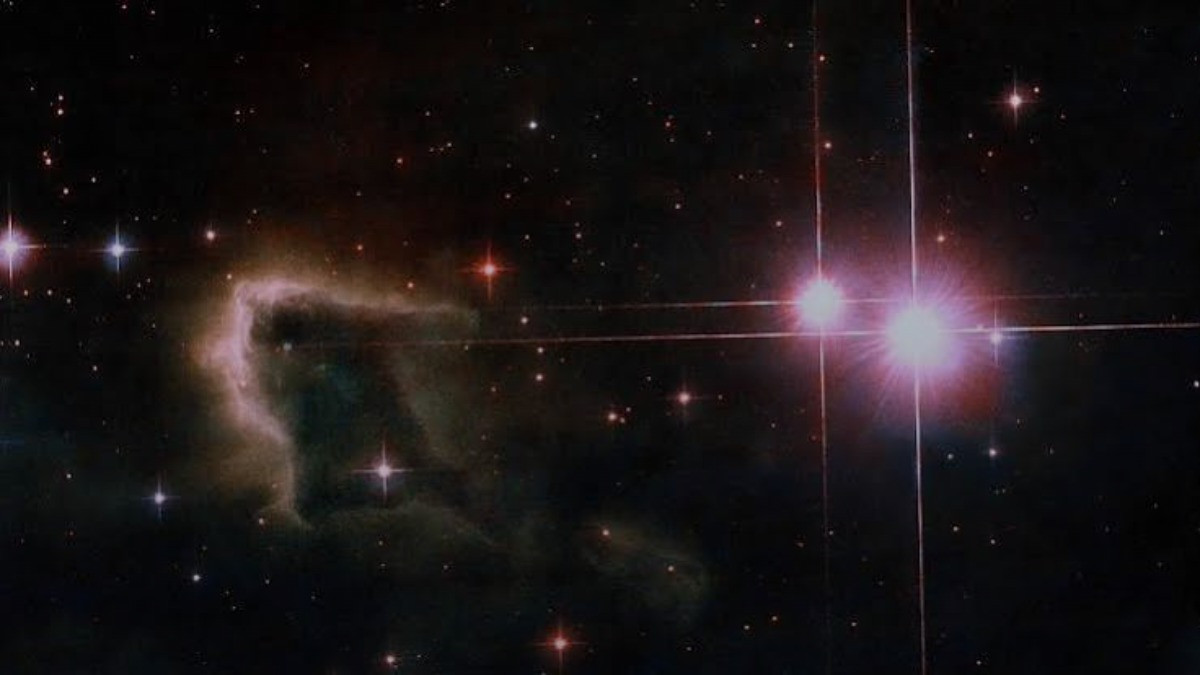
Dark stars are hypothetical objects powered by dark matter, whose existence is supported by data from the JWST telescope, while the "electric universe" theory remains on the fringes of science, lacking confirmation in observations. Modern astrophysics faces a challenge imposed by the furthest corners of the cosmos. Observations made by the James Webb Space Telescope (JWST) force a verification of models regarding the formation of the first galaxies.
Dark stars: A new era in cosmology
The concept of dark stars goes beyond standard stellar astrophysics. Katherine Freese and her team proposed a mechanism as early as 2007 in which dense clusters of dark matter inside protostars undergo annihilation. WIMPs, or weakly interacting massive particles, would be the fuel for these giants. Under normal conditions, a main-sequence star draws energy from the fusion of hydrogen into helium. A dark star is powered by the process of dark matter particle annihilation, which changes its internal structure and energy emission scale.
If these calculations reflect reality, we obtain objects significantly larger and brighter than classical suns. Theoretically, dark stars could reach masses on the order of millions of solar masses while maintaining a lower surface temperature than traditional Population III stars. This would explain why the JWST telescope records such bright points at the dawn of the universe. These structures do not need billions of years to evolve because their "fuel" is available from the moment dark matter condenses in the initial phase of cosmic structure formation.
One must maintain a cool distance. JWST observations fit the predictions of Freese's model, but they do not constitute definitive proof. Science requires more than just fitting data to a model. There is a lack of direct spectroscopic confirmation that WIMP annihilation is occurring inside these objects. Astronomers are constantly eliminating other possibilities, such as an extremely rapid rate of galaxy formation or the presence of supermassive black holes that could mimic the signature of dark stars in telescope data.
The difference between this hypothesis and the so-called electric universe is fundamental and methodological. Proponents of the electric theory ignore the basic principles of Newtonian dynamics and classical electrodynamics, creating a narrative that does not withstand collision with any reliable observational data. Dark stars respect the existing mathematical apparatus of cosmology. They attempt to supplement it, not overthrow it. This is an honest research approach. If further analysis of telescope data confirms that these bright objects do not possess standard stellar spectra, we will have to recognize the existence of a completely new class of celestial bodies. Currently, we remain in the realm of a fascinating but still not fully verified theory. We are waiting for more hard evidence rather than declaring the triumph of new physics.
The role of the JWST telescope in searching for the pioneers of the universe
The James Webb Space Telescope has disrupted the peace of astrophysicists by providing evidence for the existence of galaxies that theoretically should not exist in that region of spacetime. The device has detected objects with a redshift exceeding ten. For standard cosmological models, this is a serious problem. According to current knowledge, such early and massive clusters of matter had no way to form in such a short time after the Big Bang.
Among these record-breaking findings, the object JADES-GS-z13-0 stands out. It is one of the most distant points observed in human history. Data flowing from Webb's instruments are precise, but their interpretation is a minefield for modern physics. We have two main interpretive paths. On one hand, there is standard stellar evolution, which in light of new data seems too slow. On the other, we have the dark star hypothesis. These are theoretical objects where the energy source is not thermonuclear synthesis, but dark matter annihilation.
Spectral analysis of the radiation reaching the JWST allows researchers to attempt to distinguish light coming from classical stars from the hypothetical signal generated by dark stars. This is not a matter of belief, but of photons and mathematics. If the signature of particle annihilation can be isolated in the spectrum of JADES-GS-z13-0 or similar structures, we will gain the first hard evidence for the nature of dark matter. For now, it is a promising clue, not a certainty.
While astrophysicists analyze spectra in search of traces of exotic physics, the electric universe theory remains on the margins. Its supporters suggest that electromagnetic forces, not gravity, dominate on a cosmic scale. The problem is that there is no confirmation of these assumptions in the data provided by JWST. Observations of redshift and matter distribution, which JWST provides with unprecedented accuracy, fully align with the gravitational model, not the electric one.
Science does not work through voting or the enthusiasm of internet forums. It works through evidence, which in the case of the electric universe theory is simply lacking. JWST telescope data could ultimately confirm the existence of dark stars if other sources of emission can be ruled out. This is a tedious process where every registered photon counts. At this stage of observation, it is dark matter, not electric discharges, that remains the only logical explanation for anomalies of the early universe that cannot be explained by classical astrophysics.
What is the electric universe theory?
While standard cosmology relies on gravity as the main architect of the cosmos, the electric universe theory proposes a diametrically different vision. Its supporters suggest that it is not mass and the curvature of spacetime, but electromagnetic phenomena that dictate the development of galaxies and stellar systems. This rejection of the Einsteinian model stirs emotions in non-scientific circles, but in the world of professional astrophysics, it encounters a total barrier.
In this model, the universe is perceived as a giant electrical circuit. The proposed concept assumes that ionized gas, i.e., plasma filling outer space, acts as a conductor for powerful currents. Gravity is pushed to the margins in this narrative, giving way to plasma physics as the force shaping the structure of matter.
The main assumptions of this movement include:
- Dominance of electromagnetic forces: The theory assumes that it is electromagnetism, not gravity, that is the main factor controlling the structure of the universe at every scale.
- Birkeland current networks: The foundation of cosmic architecture is said to be huge filaments of electric currents – named after Kristian Birkeland – that connect galaxies and nebulae, allowing energy to flow through a vacuum.
Here arises a fundamental problem for any reader looking for reliable data. This theory does not exist in the academic mainstream. Searching the archives of prestigious scientific journals such as Nature or Science yields no results in the form of peer-reviewed publications supporting these theses. There is a lack of mathematical models that have passed the verification process by independent teams of astrophysicists.
The scientific community treats these concepts as pseudoscience. This is not due to a lack of interest, but a lack of empirical evidence. While the existence of dark stars, powered by dark matter, finds its basis in concrete observations provided by the JWST telescope, the electric universe theory remains a purely speculative construction. It lacks mechanisms that could withstand the rigorous tests of modern observational methods. As a result, this theory drifts on the margins of debate, cut off from the hard data that drive today's understanding of cosmic mechanics. The reader should treat it as a curiosity, not an alternative to the accepted cosmological model.
Gravity vs. Electromagnetism: A clash of foundations
The Lambda-CDM model, based on gravity, dominates astrophysics for a reason. Its predictability is relentless. Orbital calculations of planets, moons, or even telecommunications satellites use Einstein's and Newton's equations, resulting in millimeter-level precision on the scale of the Solar System. The phenomenon of gravitational lensing, i.e., the bending of light by massive objects, constitutes hard evidence that gravity dictates the conditions in the cosmos. JWST telescope observations provide further premises that dark matter is not just a mathematical filler, but a physical reality in which hypothetical dark stars can be born. These are objects powered by dark matter annihilation, not nuclear fusion.
The electric universe theory attempts to challenge this order by betting on electromagnetism as the main architect of galactic structures. The problem is that plasma physics is inexorable. On a cosmic scale, plasma is quasi-neutral, which means that positive and negative charges almost perfectly balance each other out. There is a phenomenon here called Debye shielding, which in practice makes electric interactions impossible at galactic distances. Proponents of the electric model omit this fundamental fact, which is why their theory cannot explain either the large-scale structure of the cosmos or its evolution.
The gravitational model offers a coherent description of the evolution of the universe, including the cosmic microwave background radiation. This is the microwave echo of the Big Bang, which the electric theory cannot credibly describe within the framework of known laws of physics. Observational data are key here.
— Precision of planetary orbit predictions in the gravitational model — very high (NASA/JPL data)
— Range of electrostatic interactions in cosmic plasma — very short due to shielding (plasma physics standard data)
— Confirmation of the existence of gravitational lensing — direct observations (Hubble and JWST telescope data)
— Confirmation of the existence of the electric universe theory in peer-reviewed academic publications — none (NASA ADS bibliographic database data)
The discrepancy between these approaches is a methodological abyss. On one hand, we have the gravitational model, which undergoes verification with every rocket launch and every observation of the deep universe. On the other – an electric vision that, when faced with hard data about charge shielding in plasma, simply fades away. This is not a matter of interpretation, but of a mathematical description of reality in which electric forces lose their range at interstellar distances. Dark stars remain a fascinating hypothesis, while the electric universe functions only as an alternative narrative, devoid of support in astronomical observations.
Evidence analysis: What is verifiable?
Evidence analysis in astrophysics requires rigor that is missing in proponents of the electric universe theory. Modern science is based on the mathematical Lambda-CDM model, which describes the evolution of the cosmos with great precision, from the Big Bang to the structure of today's galaxies. The dark star hypothesis, powered by dark matter annihilation, fits into this model, offering concrete anchor points for the JWST telescope.
The verifiability of dark stars is based on spectral analysis. If such objects actually exist in the young universe, their signature will be drastically different from standard Population III stars. Key evidence is expected to be the lack of absorption lines typical for helium or hydrogen, which result from thermonuclear fusion. Instead, JWST detectors should record a unique spectrum resulting from processes occurring in the cores of dark stars. This is a concrete prediction that can be confirmed or refuted by reviewing deep-field data.
The situation of the electric universe theory looks completely different. Its supporters have still not presented a mathematical formalism that could compete with the Lambda-CDM model. Instead of quantitative predictions on which a statistical test can be performed, we mainly receive visual modeling. Images and simulations, although suggestive, do not constitute scientific proof because they do not explain why gravity — the dominant force in the cosmic processes we know — would be replaced or dominated by electromagnetic forces on a galactic scale.
The lack of verifiability of the electric universe pushes it to the margins of serious debate. Astrophysics does not exclude new phenomena, but it requires mechanisms that can be calculated and checked in observations. Dark stars, although still hypothetical, have a logical foundation within standard cosmology. If the JWST telescope does not find traces of their unique spectrum in the coming years, this hypothesis will be abandoned in accordance with scientific consensus. The electric universe, in turn, for now, remains in the realm of speculation that does not withstand rigorous tests. This is the fundamental difference between science and cosmological fantasy. No device or measurement has been confirmed that would make the electric model a useful research tool. It remains a curiosity for enthusiasts of alternative explanations, not a serious competitor to the standard models on which we build our knowledge of the universe.
Weak points of the electric universe hypothesis
Proponents of the electric universe theory have for years been pushing a vision of the cosmos dominated by electromagnetic forces, pushing gravity to the sidelines. In the academic environment, this approach is treated with distance, or even as a pseudoscientific curiosity, because its foundations crumble when confronted with hard observational data. While the JWST telescope provides us with premises about the existence of dark stars – hypothetical objects powered by dark matter annihilation – the electric theory cannot explain the basic mechanisms governing the cosmos.
Scientific criticism focuses on three fundamental areas that supporters of this theory consistently avoid in their publications. The lack of consistency with the mathematical description of reality disqualifies this model in the eyes of physicists.
- The electric mechanism does not explain the phenomenon of the expansion of the universe, which contradicts Hubble-Lemaître's law. The observed redshift, which is a pillar of modern cosmology, would require in the electric model complicated and unconfirmed ad hoc assumptions that are not reflected in plasma physics.
- This theory fails completely in the face of primordial nucleosynthesis. Calculations regarding the abundance of helium and deuterium in the young universe fit the Big Bang model perfectly. The electric model offers no alternative, mathematically correct method that would allow predicting these proportions in a way consistent with spectroscopic measurements.
- Supporters of the electric universe ignore the influence of Einstein's general theory of relativity in areas of strong gravitational fields. Phenomena such as gravitational lensing or the precession of Mercury's orbit are precisely predicted by Einstein's equations. In the electric theory, these observations remain unexplained, and attempts to interpret them resemble fitting facts to a pre-assumed thesis, not the other way around.
The problem with the electric universe is that it is not a falsifiable theory in the sense of Karl Popper. Every new piece of evidence contradicting their assumptions is dismissed or ignored. Science, unlike this concept, is based on the elimination of errors. If the JWST telescope shows us objects whose light properties suggest the presence of dark matter, physicists look for explanations within the Standard Model. They do not create alternative physics that would require throwing away all existing knowledge about gravity into the trash. The electric universe therefore remains on the margins of debate, with no chance of inclusion in the mainstream until its proponents present at least one mathematical proof that survives experimental verification. Currently, there is a lack of any confirmed data that would make this hypothesis even worth discussing in peer-reviewed journals.
Why do dark stars fit the Lambda-CDM model?
The emergence of the dark star hypothesis is not an attack on the foundations of modern cosmology, but an attempt to refine the mechanisms operating in the young universe. Unlike the electric universe theory, which ignores established principles of physics, the concept of dark stars remains in close relation to the Lambda-CDM model. We are not dealing here with overthrowing gravity or the laws of thermodynamics. Dark stars simply add a completely new, exotic source of energy to the known scheme of stellar evolution.
This model assumes that dark matter particle annihilation occurs inside protostars. It is this process – not standard thermonuclear synthesis – that would provide the fuel needed to maintain the structure of the object in the early stages of cosmic formation. Data flowing from the JWST telescope since 2022 suggest that galaxies in the very early universe are significantly more massive and brighter than classical simulations predicted. Instead of rejecting the standard Lambda-CDM model, astrophysicists propose adding dark stars to it as the missing link.
The most important benefit of adopting this model is solving the problem of supermassive black holes. Webb telescope observations show objects that formed just a few hundred million years after the Big Bang, which in the classical model of growth by matter accretion is difficult to explain in such a short time. Dark stars, as huge and stable structures, could constitute the perfect seed for such giants. Their collapse directly into a black hole with a large initial mass eliminates the need for laboriously building mass over billions of years.
This is not a revolutionary negation of physics, but its elegant extension. While proponents of the electric universe, claiming that electromagnetic forces rule the cosmos, have still not presented any evidence in the form of consistent observations, dark stars fit into the existing mathematical apparatus. Physics does not need new laws here, only the recognition that dark matter is not just passive glue holding galaxies together. It may be an active fuel.
However, the issue of verification remains. Although the mathematical model is consistent, no dark star has yet been directly observed. Currently, we only have an interpretation of light from distant galaxies, which may come from this type of object, but this is not definitive proof. Scientists are still working on distinguishing the signature of a dark star from the light of typical star clusters. This is an honest way of putting it: we have an elegant theory that solves a specific problem, but we are still waiting for direct observational confirmation. Everything else remains in the realm of hypotheses, not facts.
Dynamics of the universe and the limits of knowledge
Understanding why dark stars are taken seriously requires an analysis of how science deals with gaps in knowledge. The Lambda-CDM model is not a dogma, but the most effective tool available describing the history of cosmic expansion. When data from the JWST telescope showed galaxies too massive for their age, scientists began looking for solutions within the system, not outside it. A dark star is exactly such a solution. It is an object that uses gravity to concentrate matter, but uses exotic fuel to survive in the specific conditions of the early universe.
In contrast, electric universe theorists try to impose low-energy physics on a cosmic scale, where it has no application. They ignore Debye shielding, which in cosmic plasma almost completely extinguishes electric fields at distances greater than a few meters. For the electric model to work, we would have to accept the existence of forces that simply do not exist within the framework of the laws of physics we know. This is not an alternative to gravity. It is an attempt to replace a precise model with something that lacks the ability to predict anything.
It is worth asking why these two theories are juxtaposed in public debate. The answer lies in the aesthetics of argumentation. The electric universe offers simple, visual explanations that sound intuitive to people who have no contact with advanced physics. Dark stars require an understanding of particle physics, quantum mechanics, and gas dynamics under extreme conditions. They are difficult, require mathematics, and do not give easy answers. It is this difficulty that makes dark stars an element of science, and the electric universe an element of pop-culture speculation.
For an astrophysicist working with JWST data, every observation night is a race against their own expectations. We are looking for signatures that will confirm or refute the existence of dark stars. If we do not find traces of annihilation processes in the spectra of galaxies with a redshift above 10, Freese's theory will be considered incorrect. This is precisely the strength of science. In the electric universe, there is no room for such tests because there are no concrete predictions that could be checked.
Research methodology in the face of anomalies
When we encounter an anomaly in data – such as a galaxy that is too bright – we have three options. The first is to assume that our measuring instruments are poorly calibrated. The second is to attempt to fit the existing model to the data by introducing new parameters, such as dark stars. The third is to reject the entire body of physics and look for explanations in alternative theories. Professional science usually chooses the second path. It is the most parsimonious in its assumptions because it does not require building new physics from scratch.
Dark stars fit perfectly into this paradigm. They do not require changing the gravitational constant or rejecting the general theory of relativity. They only require acknowledging that dark matter, which constitutes a significant part of the mass of galaxies, can participate in energy processes inside stars. This is a logical conclusion, resulting from the nature of particles that we already include in cosmological simulations. In contrast, the electric theory would require us to accept that all our orbital measurements, gravitational lensing, and cosmic microwave background radiation are wrong or misinterpreted.
It is worth noting the role of technology. Without the JWST telescope, which allows us to look into the past of the universe, the dark star hypothesis would only be a mathematical curiosity written in old publications. Thanks to the precision of Webb's mirrors, we can now verify these concepts in practice. Every pixel in a deep-field photo is a potential source of data about the nature of dark matter. This is science in practice – a constant process of verifying hypotheses using increasingly sensitive instruments.
There is no room for sentiment here. If it turns out that dark stars do not exist, astrophysicists will not mourn this theory. They will simply move on to the next model that will allow explaining the mass of galaxies in the early universe. Science is not attached to its theories. It is attached to the consistency of the model with reality. This distinguishes it from pseudoscientific narratives that build their identity on resistance to the mainstream.
Verdict: What explains more?
Modern astrophysics does not resemble a political debate where every opinion has equal weight. The difference between the concept of dark stars and the electric universe theory is fundamental and concerns the research methodology itself. The first proposal fits perfectly into the framework of particle physics and cosmology, offering a logical solution to the problem of the early formation of stellar objects. Observations provided by the James Webb Space Telescope provide us with data that, although not yet definitive proof, provide grounds for further analysis of this phenomenon. Dark stars, powered by dark matter annihilation, are hypothetical but mathematically consistent constructions.
On the other side of the barricade stands the electric universe. It is a descriptive model that loses to reality on one, most important point: it lacks predictive power. Science does not need a theory that only tries to fit existing photos while ignoring the foundations of celestial mechanics. The electric universe remains on the margins of scientific debate because it lacks confirmation in reliable observations. We will not find it in peer-reviewed publications in leading journals such as Nature or Science.
The choice between these two paths is simple. The academic community always chooses the model that has greater explanatory power. Dark stars allow predicting specific signatures in the light spectrum that future instruments may detect. The electric universe, on the other hand, does not offer tools for falsification. It is a closed model that does not evolve with new data flowing from outer space.
For the reader, this means one thing: it is worth distinguishing scientific hypotheses from pseudoscientific narratives. The catch lies in how easily an attractive-sounding theory can replace laborious research work. In the case of dark stars, we are dealing with an attempt to extend the standard cosmological model. In the case of the electric universe, we are dealing with an attempt to replace it without offering any alternative that would withstand confrontation with the laws of physics. Science does not look for truth that looks nice on a monitor screen. It looks for a model that best describes reality, even if it requires accepting the existence of invisible dark matter, the nature of which we still do not fully understand. The lack of confirmation for the electric universe theory is not an oversight by scientists. It is the result of a lack of evidence.
What this means for you
For the reader, this means that it is worth distinguishing hypotheses that are an extension of accepted physics from pseudoscientific theories that have no confirmation in telescope data. Understanding why dark stars are a subject of research allows one to better see the difference between the evolution of science and its negation.
Questions and answers
Are dark stars the same as black holes?
No, dark stars are hypothetical stellar objects powered by dark matter, which may eventually collapse into black holes after exhausting their resources.
Is the universe electric in any way?
The cosmos is filled with ionized plasma that conducts electricity, but gravitational forces dominate over electromagnetic ones on a macroscopic scale due to the Debye shielding phenomenon.
Where can I find the latest data on dark stars?
The latest publications regarding dark star candidates can be found in the arXiv.org archive and on the official NASA and ESA websites dedicated to the JWST telescope mission.
Why is the electric universe theory not published in scientific journals?
This theory does not possess mathematical models that would pass the verification process by independent teams of astrophysicists and does not offer the possibility of falsification, which disqualifies it in the eyes of the scientific community.



Komentarze (0)
Ładowanie komentarzy...