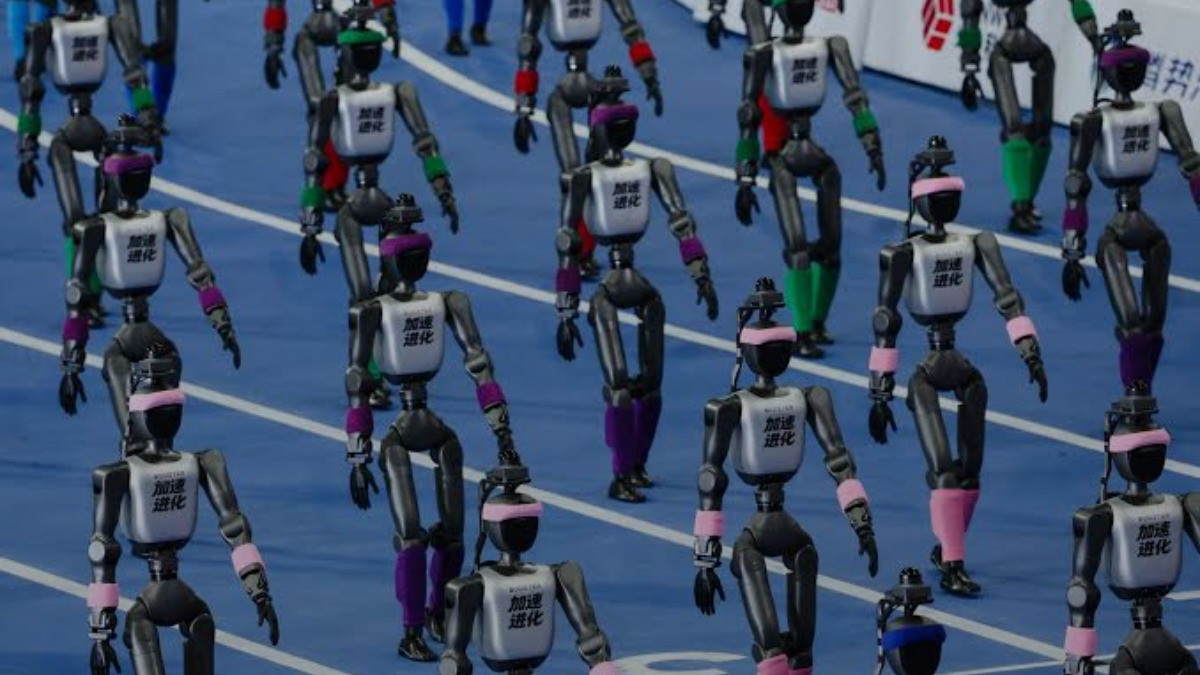
China currently controls 97% of the global humanoid robot market, and mass deployments of these machines into homes will be finalized in 2027. This schedule, based on strategies announced on August 12, 2025, assumes that full integration of robots into factory production lines will occur in 2026. The data regarding the 97 percent market share, cited by the BitHub.pl portal, reflects the scale of the success of Chinese engineers in the race for technological dominance.
The implementation strategy has been divided into two key stages. The first, focused on industry, began with intensive testing of units in factory conditions. According to the assumptions from August 12, 2025, humanoids were to replace humans in repetitive and dangerous tasks where precision exceeding human capabilities is required in an eight-hour cycle. In the third and fourth quarters of 2026, Chinese assembly lines, particularly in the electronics industry, switched to an almost fully automated operating mode.
Market dominance did not come from a vacuum. It is the result of a decade of consistent investment in hardware, which materialized on August 20, 2026. On that day, the stock market giant, Unitree Robotics, became the central point of interest for global financial markets when its share value rose by 600% during a single session. This rapid jump in valuation confirmed that investment capital had stopped treating humanoid robotics as a costly research project and began to perceive it as the foundation of a new manufacturing economy in Shenzhen and Shanghai.
The infrastructure needed for mass scale is ready, while European and American corporations continue to struggle with prototype optimization and supply chain disruptions. Chinese factories have switched to a continuous operation system, which makes humanoids tools rather than exhibits. The state financing system, based on aggressively subsidizing final unit costs, makes competition from other regions of the world economically unjustifiable. The Chinese business model is not based on selling individual units, but on taking over entire production ecosystems.
For Western boards of directors, the information about China's 97 percent market share is a warning signal that many industry leaders have ignored for too long. This dominance means that technological standards, communication protocols, and control software are being created based on Chinese legal requirements and data security standards. The issue of privacy for devices that are set to enter homes in 2027 remains a major point of contention in trade relations between Beijing and the rest of the world.
During the 2026 World Robot Conference in Beijing, it was proven that Chinese engineering has definitively overcome the balance problem. Control systems, integrated directly with neural networks, allow robots to work in unstructured environments. Until recently, humanoids required specially prepared halls with perfectly flat floors and no obstacles. Current machines, presented by Chinese engineers, handle chaotic pallet layouts, loose cables on the floor, and variable lighting, which is standard in a typical factory.
Integrated neural networks controlling each actuator in real-time represent the most important engineering advancement of recent years. Instead of separate decision-making software that sent signals to motors with millisecond delays, a unified operating system was used. The machine feels movement through feedback in every joint. Thanks to this, the fluidity of the humanoids' work resembles human motor skills. For industry, this means the end of the era of rigid robotic arms capable of performing only one programmed task. The time of flexible machines is coming, which, after a cloud software update, can perform a completely different task the next day.
The cost of implementing such technology, spread over thousands of units produced in Shenzhen, makes buying a Chinese humanoid cheaper for many European factories than maintaining an old, worn-out automated line. This is a forced restructuring of the entire manufacturing sector. Companies that do not adapt to this standard within the next 18 months will lose price competitiveness in the global market.
The impact of this change on the global supply chain is already a fact. The shift of the center of gravity to Asia has caused Europe and the United States, which set trends just a decade ago, to now play the role of observers. A 97 percent share of the global market, confirmed by BitHub.pl analysts, translates into concrete power over the economy. If only one entity is the producer of key robotic components, it decides on prices, availability of spare parts, and software development.
Factories that were previously associated only with smartphone assembly have become research and development centers where the durability of humanoids is tested under extreme conditions. Dependence on Chinese technology is a double-edged sword for Western economies. On one hand, we get access to cheap labor in the form of machines, which will allow for lower prices of goods. On the other – we are handing over control of critical infrastructure.
If the deployments announced for 2026 and 2027 proceed as planned, Western manufacturers will be forced into aggressive reindustrialization. This is a process that will take years, while Chinese machines are already working on production lines. Investors have priced in this scenario, which is visible in stock market reactions. Now it is time for a market verification of whether Western societies are ready for such deep integration with technology they do not control.
For the consumer, this dominance means the need to change their thinking about technology. It is no longer just a question of owning a newer smartphone or computer. This is an entry into an era in which human-like machines become part of the home ecosystem. Companies that implement these solutions in their processes the fastest will benefit, saving on labor costs. Those who remain faithful to traditional methods, ignoring the Chinese standard, will lose.
In 2027, a full consumer phase is planned. The robot is to become support in daily duties, acting as a personal assistant. This is the realization of a schedule in which home robots become another household appliance. If this strategy holds, 2027 will be the time when the global robotics market ceases to be an international field of cooperation and becomes a Chinese monopoly. The rest of the world faces the question of whether it will accept this standard without having a real technological alternative.
The market is currently in a transition phase. Mass deployments to factories, according to the August 2025 schedule, are already being implemented, while availability for the individual customer is expected in 2027. The six-fold increase in share value in one trading session in August 2026 was a direct reaction of investors to the confirmation of market dominance and the success of technological demonstrations at the Beijing conference, which proved the machines' readiness to work in real-world conditions. The conference sets the pace for technological change and confirms that robots in homes are ceasing to be a literary vision and are becoming a market product. Currently, the chances for rapid competition with the Chinese monopoly are slim due to the scale of production and state subsidies. Western companies would have to decide on a costly and long-term reindustrialization to create their own independent humanoid robotics standards.
The geopolitical catch is that access to the most advanced robotic components will likely be subject to political conditions, which may limit the independence of companies using these solutions. The boards of the largest technology companies in Silicon Valley and Berlin are currently analyzing the risk of total dependence on the Asian supply chain. The lack of their own production capacities in the area of advanced robotics puts these companies in the position of a petitioner toward Chinese suppliers.
The issue of national security in the context of home robotization is becoming a subject of debate in technology committees. Robots equipped with advanced sensors, cameras, and machine learning systems, collecting data inside private homes, require appropriate legal regulations. Chinese manufacturers assure full compliance with standards, but Western intelligence agencies point to the risk of data transmission to central servers in Asia. This tension will define the coming years in trade relations between China and the rest of the world.
The development of humanoid technology in China has outpaced analysts' forecasts by at least five years. Until recently, it was believed that overcoming the barrier of interaction with an unstructured environment would take more time. Today, thanks to the integration of neural networks with actuators, these machines are able to learn the environment on the fly. This means that each subsequent generation of robots will be significantly more efficient than the previous one, which compounds the advantage of Chinese companies over the competition.
Recent market data from 2026 indicates that the 97 percent share of the humanoid robot market is not just a statistic, but an expression of total dominance. Chinese enterprises, supported by state funds, have taken control of key patents regarding drives and control software. The rest of the world, including the most developed Western economies, has been pushed into the role of recipients of ready-made solutions.
In the perspective of 2027, when humanoid robots hit mass home sales, the structure of the labor market in service sectors will change. Personal assistants will be capable of performing housework, caring for the elderly, and broadly defined logistics within apartments. This is a challenge for which Western social systems are not fully prepared. China's dominance in this area means that this is where the majority of innovation will be generated, and the profits from this revolution will flow directly to the Chinese budget and corporations.
For long-term investors, this situation is a signal to revalue portfolios. Companies that have not diversified their technology sources risk marginalization. In turn, entities that decided to cooperate with Chinese robotics suppliers early on may gain a competitive advantage in their industries. However, this is a zero-sum game in which technological independence is becoming a scarce commodity.
Summarizing the current state of affairs, it must be stated that global robotics has entered a phase where the rules of the game are set by one side. Thanks to the concentration of resources, aggressive pricing policy, and progress in the field of artificial intelligence, China has effectively blocked the possibility of emerging alternative standards in the coming decade. The year 2027 will be a turning point in which humanoid technology will cease to be a novelty for the few and will become an omnipresent element of everyday life. Will Western countries manage to react and build their own competencies in this field, or will they be left only with the role of users of Chinese machines? We will know the answer to this question within the next dozen or so months, which will be decisive for the future of the global economy.



Komentarze (0)
Ładowanie komentarzy...