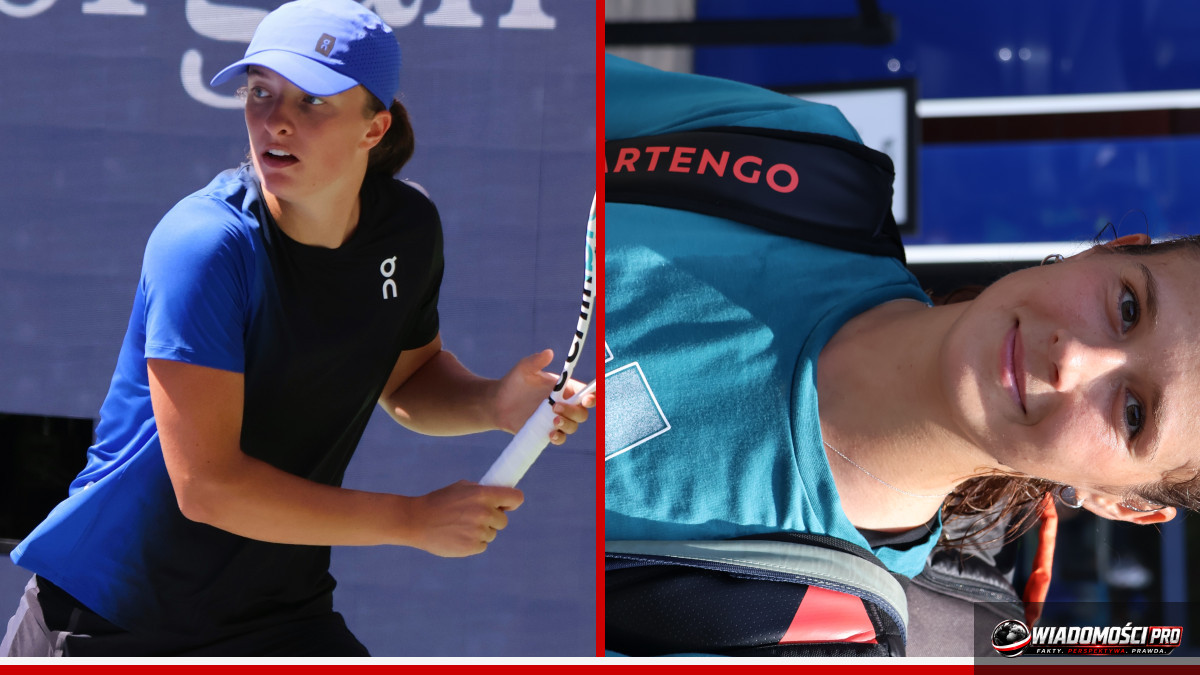
For her victory over Daria Kasatkina in the group stage of the WTA Finals in Riyadh, Iga Świątek collected a $350,000 bonus and added 200 ranking points to her account. This result formed the foundation of her further path in the tournament, allowing her to take the initiative in the group. This success not only improved the Pole's financial situation but, above all, stabilized her position in the table after a demanding group stage, in which the margin for error was minimal.
Dominance on the court in Riyadh: the course of the match against Kasatkina
The match against Daria Kasatkina in Riyadh was a lesson in discipline for Świątek, which she had lacked in several key moments of the ongoing 2026 season. The Pole imposed her style of play from the beginning, not allowing the Russian to spread her wings in rallies from the back of the court. Kasatkina, known for her ability to break her opponents' rhythm, this time did not have time to prepare her technical shots. Świątek shortened the rallies, looking for finishing shots after just a few strokes.
Service stability was crucial in Riyadh. Unlike in previous tournaments, where her serve often failed in decisive games, in Saudi Arabia, the Pole maintained high repeatability of her first serve. This allowed her to take control of the rally from the first ball. Kasatkina was forced to run from line to line, which exhausted her physically by the middle of the second set. Świątek showed calculation, rarely taking unnecessary risks, which in such a prestigious tournament is the only right way to win.
Financial aspects of the WTA Finals 2026: how much is a win worth?
The prize structure in Riyadh reflects the current realities of women's tennis, where every group match is treated as a separate sporting event. The bonus system this year was constructed in a way that forces full commitment in every match, regardless of whether the player has already secured advancement. $350,000 for a single victory in the group stage is an amount that shifts the focus from prestige alone to real, hard numbers.
For the world's top rackets, such as Świątek, these funds are only one side of the coin. Much more important is the points mathematics, which directly affects seeding in next year's Grand Slam tournaments. 200 ranking points for the victory over Kasatkina is an injection that allows her to maintain distance from Aryna Sabalenka or Elena Rybakina, who are chasing her in the ranking. In 2026, every such gain is worth its weight in gold, especially considering how often the ranking leaders lost points during the summer hard-court season.
The competition in Riyadh also showed that financial gratifications are closely linked to physical resilience. In Riyadh, there is no room for energy calculation. Every game costs. The organizers created conditions where a cool head must cooperate with aggressive tennis. Whoever does not take risks in rallies gives up ground to the opponent, which in practice means losing checks for won matches.
WTA Ranking after Riyadh: Świątek's point gains
The ranking system in 2026 has become exceptionally sensitive to any stumbles in 1000-level tournaments and higher. After the match against Kasatkina, Świątek strengthened her position, which is important in the context of the stabilization she lacked after the US Open. At that time, after a series of intense matches, the ratings of the top players fluctuated significantly, and the impact of individual matches on the final shape of the table was the number one topic in industry media.
Analyzing this year's ratings, it is clear how difficult it was to maintain a high place in the ranking after the August tournament in Cincinnati. Back then, clashes with Jessica Pegula or Elena Rybakina exposed weaknesses in the Pole's physical preparation, leading to point losses that had to be made up in the following months. Riyadh became the final test of whether this year's correction in the coaching staff brought the expected result.
The 200 points earned are a safeguard for Świątek against attacks from rivals who, in 2026, proved they could play on equal terms with the Pole. The situation in the ranking after the Sabalenka – Rybakina final on September 13 showed how close the best tennis players are to each other. Every match in Riyadh is therefore not only a fight for a trophy, but above all for a mathematical "to be or not to be" in the world elite. The Pole needs this stabilization to enter the next season with a clean slate.
Road to Riyadh: comparison with 2026 season results
The 2026 season for Iga Świątek was a period of extreme contrasts. An analysis of her results from the current year shows a clear tendency for problems closing out key matches, which she managed to break in Riyadh.
In Rome, on May 14, 2026, the Pole had to acknowledge the superiority of Elina Svitolina in the semifinals. This clash was a warning signal that showed that on clay, Świątek is no longer as undisputed a favorite as in previous seasons. Problems with concentration at the end of sets became the norm then.
The later summer on hard courts in North America only deepened these concerns. The semifinal in Cincinnati on August 22, 2026, lost to Jessica Pegula, was a painful lesson. Analysis of this match pointed to difficulties in maintaining the pace of play under the opponent's aggressive pressing. Earlier, on August 21, Świątek faced Elena Rybakina, where the final result forced the Pole's staff to conduct a deep analysis of her backhand technique.
During the US Open, the situation became even more tense. The match against Wang Xiyu on August 31, 2026, was a struggle that cost the ranking leader a lot of strength. The next meeting, on September 7, 2026, against Qinwen Zheng, ended with a result that was a disappointment for many experts, given Świątek's ambitions. The WTA ranking from September 1, 2026, published just after the night match in New York, showed how brutally the tour verifies every mistake.
All these events form a picture of a player who spent the entire season looking for her optimal rhythm. Riyadh, unlike Cincinnati or Rome, became a place where these lessons were translated into a concrete result. In Saudi Arabia, Świątek showed that she can draw conclusions from defeats against Pegula or Svitolina, which is the most important conclusion from her journey to the finals this year.
Situation in the group: who is next to Świątek in the semifinals?
The competition in Riyadh was marked by a balanced fight from the beginning, where nuances decided about advancement. After three group matches, the situation in the table became clear, although the road to this moment was full of emotions.
Iga Świątek finished the group stage with a 2-1 record, which ensured her advancement from first place. This is a key achievement because it allowed her to avoid the theoretically strongest rival from the second group in the semifinal clash. The second player from the group also advanced with a 2-1 record, but a worse set difference meant she had to settle for second position. The other two participants in the group, with a 1-2 record, had to say goodbye to the tournament at this stage.
Taking the position of group leader is not only prestige but, above all, a strategic advantage. In the knockout bracket, where every match means "to be or not to be," the ability to choose one's path in the bracket is invaluable. Fans watching the matches in Riyadh could notice that the Pole felt more and more confident on the court in each subsequent meeting. The first match, although full of hesitation, was only a warm-up for what we saw in the clash against Kasatkina. Now, as the knockout phase begins, every ball has a dimension that decides the fate of the entire tournament.
Perspectives before the semifinals of the tournament in Riyadh
The tournament semifinals, scheduled for September 21, are the most important point of the program for the remaining four players. For Świątek, the upcoming match is a test of character, combined with the need to maintain the form from the group stage. The Pole's coaching staff is intensively analyzing potential clashes with Aryna Sabalenka or Elena Rybakina, who dominated conversations about form in mid-September, especially after the US Open final.
The aforementioned players are rivals with whom Świątek fought the most fierce battles in 2026. We remember their clashes from Cincinnati or earlier tournaments, where every rally was fought on the edge of risk. Now, in Riyadh, the stakes are much higher. It is not just a fight for a check, but for a prestigious trophy that closes the season.
The margin for error in Saturday's semifinal basically does not exist. The Pole must impose her rhythm of play from the first game, not allowing the opponent to take the initiative. Regardless of the opponent's name, the required level of tennis must be higher than what we watched in the group stage. If Świątek wants to think about winning, she must eliminate the fluctuations in form that accompanied her during her performances in the USA. Only flawless execution of the tactical plan counts. Any mistake on the serve or overly conservative play in defense can be ruthlessly exploited by experienced rivals who feel just as confident in Riyadh as the Pole.
What this means for you
Świątek's victory in Riyadh is a signal to tennis observers that the Pole is emerging from the crisis that plagued her game for most of the 2026 season. The win over Kasatkina stabilizes the player's financial situation, but above all, it gives her the necessary self-confidence before the most important matches of the season. What happens in the semifinal will decide whether this year will be remembered as a transitional period or as the beginning of a return to full dominance on the tour.
Questions and answers
How many points did Iga Świątek receive for the victory over Kasatkina?
For every victory in the WTA Finals group stage, a player adds 200 ranking points to her total.
What is the financial bonus for winning a group match in Riyadh?
A victory in a single group stage match of the WTA Finals tournament in Riyadh is rewarded with an amount of $350,000.
Did Iga Świątek secure a place in the tournament semifinals?
Yes, thanks to the win over Daria Kasatkina and a favorable match record, the Pole advanced to the knockout phase of the tournament in Riyadh from first place in the group.
Which tournaments had the greatest impact on Świątek's form in 2026?
Crucial for the Pole's performance were her starts in Rome (semifinal), Cincinnati (semifinal), and her appearances in the US Open, which forced changes in tactical preparation before the end of the season in Riyadh.
Who is Świątek's main rival in the fight for the final in Riyadh?
The main candidates to face Świątek in the semifinal are Aryna Sabalenka and Elena Rybakina, who presented high form in the last part of the 2026 season.
Sources
- Iga Świątek – Wang Xiyu. See who won the US Open match. Live score - Przegląd Sportowy
- Iga Świątek – Qinwen Zheng. See who won the match at the US Open. Live score - Przegląd Sportowy
- Iga Świątek – Jessica Pegula. See who won the semifinal in Cincinnati. Live score - Przegląd Sportowy
- Changes. Here is the WTA ranking after Iga Świątek's night match at the US Open - Przegląd Sportowy
- Here is Iga Świątek's new place. WTA ranking after the Aryna Sabalenka – Elena Rybakina final - Przegląd Sportowy
- Iga Świątek — Elena Rybakina. Check who won the semifinal in Rome. Live match result - Przegląd Sportowy
- Change. This is what the WTA ranking looks like after Iga Świątek's match in Cincinnati - Przegląd Sportowy
- Iga Świątek - Elena Rybakina. Check the match result - Przegląd Sportowy
Article prepared by the Wiadomości PRO editorial team with the support of artificial intelligence. Facts come from the sources provided above.
Komentarze (0)
Ładowanie komentarzy...