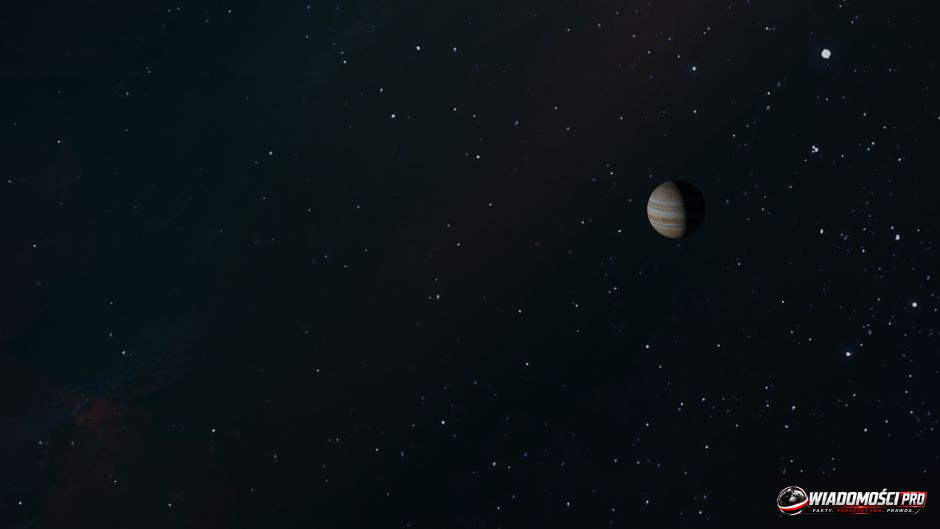
The budget for the Europa Clipper mission was approximately 5 billion dollars, and the probe was sent to check whether the conditions necessary to sustain life exist beneath the icy crust of Jupiter's moon. This endeavor represents NASA's most advanced approach to date for studying habitable environments in the outer Solar System. Instead of looking for microorganisms themselves, engineers focused on identifying biological "ingredients" – water, energy, and the right chemistry – that could enable life processes in Jupiter's extreme environment.
Secrets of the hidden ocean
Europa is not a dead lump of ice, but a dynamic world. Data obtained during flybys of the Galileo probe in the 1990s suggested that a global ocean of saltwater exists beneath an icy crust between 15 and 25 kilometers thick. Scientists estimate that the volume of this reservoir could be twice that of all Earth's oceans combined. The Europa Clipper probe was designed to confirm these assumptions and assess the depth and salinity of this body of water.
The research strategy involves 49 close flybys of the moon's surface. The probe will not enter orbit around Europa itself due to Jupiter's destructive radiation, which would lead to electronic system failure in a short time. Instead, the unit will orbit Jupiter, performing regular "dives" toward the moon. Each approach is an opportunity to collect data. Arrival at the Jovian system is scheduled for 2030. After entering the gas giant's sphere of influence, the probe will begin a multi-year measurement campaign, during which it will check whether material erupting from the interior contains organic compounds.
The question of habitability comes down to physics and chemistry. Europa is subjected to strong tidal forces, caused by the gravity of Jupiter and neighboring moons such as Io and Ganymede. This process generates heat, which keeps the ocean in a liquid state. Astrobiologists ask a simple question: does this water come into contact with the moon's rocky core? If so, the interaction between minerals and water could create hydrothermal vents, similar to those on Earth that support life in complete darkness.
Financing big science
Managing such an expensive project required unprecedented discipline from NASA in expenditure planning. Funding comes entirely from the federal budget, making the mission one of the most important items on the American space agency's agenda. The decision to direct such large resources toward studying Jupiter's moon sparked a debate in the scientific community regarding priorities. Some researchers advocated for increased spending on projects related to studying climate change on Earth, while proponents of space exploration argued that answering the question of the uniqueness of life in the cosmos is a fundamental need of human curiosity.
The agency adopted a management model in which the entire operation is carried out under the strict supervision of the Jet Propulsion Laboratory. Costs include not only the construction of the probe itself, but also the development of radiation shielding technology, the construction of ground infrastructure, and the multi-year maintenance of scientific teams analyzing the data. Critics point out that in the era of digitalization and miniaturization, similar goals could be achieved for a smaller amount by using swarms of smaller satellites. However, the specific nature of Jupiter's environment, with its powerful magnetosphere, requires equipment with a high degree of reliability that cannot be achieved in the standard of "cheap" commercial missions.
Responsibility for success is spread across thousands of engineers and scientists. Every dollar spent on this project is audited, and progress is subject to regular reports to the US Congress. For the taxpayer, this is a long-term investment where the profit is not money, but knowledge about planetary evolution. If the mission proves that Europa has the conditions for life, it will become a milestone that will permanently change the way we design future landers capable of breaking through ice.
Research instruments on board
The success of this mission depends on a set of instruments designed to work in extreme conditions. The probe is equipped with the REASON radar (Radar for Europa Assessment and Sounding: Ocean to Near-surface). This device uses radio waves to penetrate the icy crust, which will allow scientists to create a three-dimensional map of Europa's internal structure. REASON is crucial for understanding whether the ice is uniform or if it contains pockets of water close to the surface.
Another key instrument is MISE (Mapping Imaging Spectrometer for Europa). It is used to map the chemical composition of the surface. Thanks to it, we will find out exactly where salts, organic matter, and other chemical compounds necessary for the development of life are located. MISE analyzes light reflected from the surface, which allows for precise identification of chemical molecules without the need to touch the ice.
EIS (Europa Imaging System) is a set of two high-resolution cameras that will take pictures of the surface with unprecedented accuracy. They will allow for the identification of geological structures, such as cracks, ridges, or areas where ice may have recently been melted by internal heat. These images will be crucial for selecting sites where exploration robots could land in the future.
In addition to those mentioned, on board are:
- SUDA (Surface Dust Analyzer) – used to analyze dust particles ejected from the moon's surface as a result of micrometeorite impacts.
- PIMS (Plasma Instrument for Magnetic Sounding) – measures the magnetic field induced by the ocean inside Europa, which is direct evidence of the presence of saltwater.
- ECM (Europa Clipper Magnetometer) – studies the moon's interactions with Jupiter's magnetic field.
These devices work in close synergy. While the radar examines the interior, the spectrometer checks the surface, and the magnetometer confirms the presence of the ocean. The lack of even one of these instruments would drastically reduce the scientific value of the mission.
Schedule and flight trajectory
The probe's launch in October 2024 began a complex sequence of maneuvers. Instead of flying directly toward Jupiter, which would require an unimaginable amount of fuel, Europa Clipper uses gravity assists. First, the probe passed Mars, and then headed back toward Earth to gain additional speed. Such "bouncing" off planets allows for an increase in the probe's payload mass, which was necessary to carry heavy research instruments and radiation shields.
The journey to the Jovian system will take a total of six years. After arriving at its destination in 2030, the probe will perform a braking maneuver to be captured by Jupiter's gravity. Then it will begin the process of gradually lowering its orbit until the start of the series of 49 planned flybys. The mission schedule is tight. Each flyby window is calculated to the second, because the probe's speed relative to Europa must be optimal for collecting high-quality data.
In the meantime, scientists on Earth will be busy calibrating the instruments. Even though the probe is on its way, its onboard software can be updated to improve data transmission efficiency. Communication takes place via the Deep Space Network, a network of huge radio antennas located on different continents. Data transmitted from a distance of hundreds of millions of kilometers will reach Earth with a multi-minute delay, which rules out "live" control and forces a high degree of autonomy for the device.
Challenges in the shadow of Jupiter
Jupiter is not only the largest planet, but also the most hostile environment for electronics in our planetary system. The Europa Clipper probe enters an area where ionizing radiation is thousands of times stronger than that received by satellites in Earth orbit. Even with the use of state-of-the-art materials, semiconductors undergo gradual degradation. To counteract this, the heart of the probe – the onboard computer and the most sensitive instruments – has been enclosed in a special "vault".
The walls of this bunker are made of titanium and aluminum nearly a centimeter thick. This construction is intended to stop most high-energy particles that could permanently damage RAM or processors. Engineers conducted thousands of tests in radiation chambers, simulating years of radiation exposure, to ensure that the probe will survive all planned flybys.
Navigation in such a strong magnetic field is another challenge. The probe's movements are disturbed by Jupiter's non-uniform magnetic field, which requires the control systems to constantly correct the trajectory using thrusters. Every gram of fuel is precious, so optimizing energy consumption is a priority. The probe must not only protect itself from radiation, but also decide for itself which data is most important to send to Earth when the communication window is open.
A message in a bottle for future generations
Beyond hard scientific data, the mission carries a symbolic load. NASA, continuing the tradition of the Voyager probes, placed a plate on board with the engraved names of millions of people from around the world. This campaign was intended to engage public opinion in a project that is inherently distant from everyday problems. The plate also features a poem by Ada Limón, dedicated to Europa and human fascination with the cosmos.
Modern space exploration is not free of sentiment. Although the main goal remains science, space agencies increasingly use social media and "send your name to space" campaigns to build public support for their budgets. In the case of such an expensive mission, a sense of community with people from all over the world becomes an element of the project's identity.
What does this mean for the average person? First and foremost, a change in perspective. Finding traces of life on Europa, even in the form of simple organic molecules, would undermine our current belief in the uniqueness of Earth. If life could arise in the dark, icy ocean of Jupiter's moon, the probability that the universe is full of biological processes increases exponentially. This mission does not end with just research – it lays the foundations for subsequent, perhaps more daring projects that in the future may allow for direct exploration of Europa's ocean floor by autonomous submarines.
Questions and answers
How much did the Europa Clipper mission cost?
The total cost of construction, launch, and research operations is estimated at approximately 5 billion dollars.
When did the probe launch toward Jupiter?
The mission launched in October 2024.
What is the main goal of this expedition?
The main goal is to investigate whether conditions conducive to sustaining life, such as liquid water and the right chemistry, exist beneath the icy crust of the moon Europa.
How many flybys of Europa will the probe perform?
49 close flybys of the moon's surface are planned during the mission.
When will the probe reach its destination?
The probe is scheduled to reach the Jovian system in 2030.
Why will the probe not enter orbit around Europa?
Due to the destructive radiation near the moon, the probe will orbit Jupiter, performing only periodic flybys of Europa to protect its electronics from permanent damage.
Which research instruments are key to the mission?
The most important instruments are the REASON radar for studying the ice interior, the MISE spectrometer for analyzing the chemical composition of the surface, and the EIS cameras for creating geological maps.
Is the probe looking for "aliens"?
The probe is not equipped with detectors capable of directly detecting living organisms. Its task is to assess the habitability of the environment, i.e., to check whether the conditions necessary to sustain life exist there.
How will the probe survive Jupiter's radiation?
Key electronic systems are protected by special armor made of titanium and aluminum, called a "vault," which blocks most of the high-energy particles emitted by the planet's magnetosphere.
Is this project the only one of its kind?
Europa Clipper is currently the most advanced mission dedicated to studying the habitability of a specific moon in the Solar System, representing a continuation of research previously conducted by the Galileo probe.
Sources
- Europa Clipper probe to search for life on Europa - Urania - Polish Astronomical Portal
- Europa Clipper mission launch [BROADCAST]. Americans to outpace Europeans in search for life on Europa - Wyborcza.pl
- Beginning of the Europa Clipper mission - kosmonauta.net
- Europa Clipper has launched. Will investigate if there are conditions for life on Jupiter's moon - polskieradio24.pl
- NASA sends probe to Europa. Europa Clipper mission has launched - WP Tech
- Searching for life in the Solar System beyond Earth. NASA sends mission - Geekweek Interia
- Flying to search for life. NASA mission launch in just three weeks - Antyweb
- NASA sends a "message in a bottle" into space. You can sign it! - Radio ESKA
Article prepared by the Wiadomości PRO editorial team with the support of artificial intelligence. Facts come from the sources listed above.


Komentarze (0)
Ładowanie komentarzy...