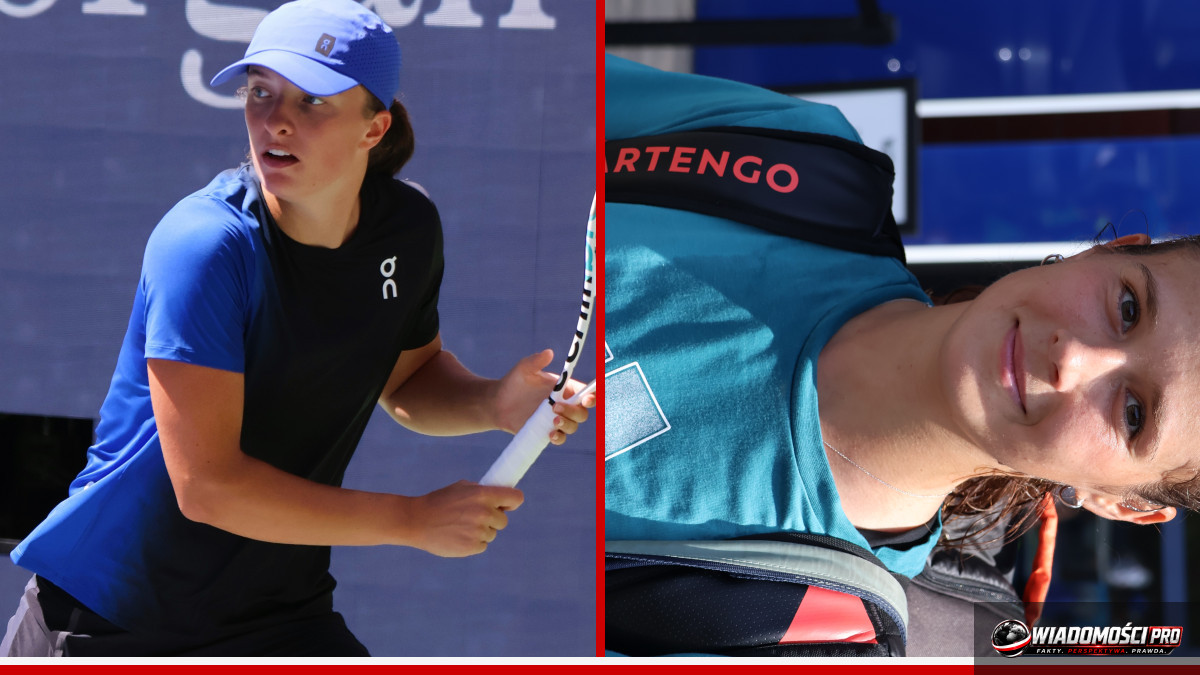
Yes, Iga Świątek defeated Daria Kasatkina in her final group stage match in Riyadh, which, thanks to a favorable set record, secures her advancement to the tournament semifinals. The Pole closed this chapter of the competition by demonstrating a higher level of concentration in baseline rallies. While Kasatkina tried to impose a slower rhythm, hoping for forced errors, Świątek maintained the aggressive attitude that has become a hallmark of her style since August 2026.
Tactical analysis of the Riyadh clash
The duel with Daria Kasatkina in Saudi Arabia exposed the differences in the physical preparation of both players. Świątek, building on her experience from the tournament in Toronto, decided to shorten the rallies. The Pole avoided long, monotonous shots to the center of the court, which is Kasatkina's favorite comfort zone. Instead, Świątek consistently sent balls deep to the baseline, forcing her opponent into a defensive lob or a short backhand, which she then ruthlessly finished with an aggressive forehand strike.
Match statistics indicate that the key to success was the effectiveness of her first serve in high-pressure situations during break points. Świątek served with higher rotation, which, given the specific surface in Riyadh, allowed her to take the initiative as early as the second shot. Compared to the match against Qinwen Zheng during the US Open, where the Pole had difficulty finding a rhythm against her opponent's serve, this time she was the one dictating the terms. Kasatkina, despite attempts to change shot angles, could not find an answer to the intensity with which Świątek attacked her second serve.
This victory was a necessary piece of the puzzle that allowed her to avoid an early end to the season. In the WTA Finals group stage, every game matters, and the set record often becomes the only determinant of the hierarchy in the table. Świątek, aware of the need to win in a specific number of sets, did not allow herself a moment of distraction even when the result seemed safe. This approach differs from her attitude in August, when she was seeking proper stability in Cincinnati, often conceding the initiative at key moments of the match against Jessica Pegula.
Toronto as the foundation of championship form
August 2026 went down in fans' memories as the moment when Iga Świątek regained full control over her tennis. The tournament in Toronto was not just another stop on the calendar, but a testing ground for new tactical solutions. The victory in Canada, sealed on August 14, became a reference point for all of the Pole's subsequent performances.
The road to the title in Toronto was demanding. On August 10, Świątek faced Diana Shnaider in the quarterfinals. This clash showed that the Pole can emerge from trouble when her opponent imposes a physical style of play. Świątek not only survived Shnaider's pressure but took control in the third set, winning key games on her own serve. This match was a prelude to the final against Elena Rybakina, which took place on August 13.
In the Toronto final, Świątek showed that she could stand up to Rybakina's firepower. The Kazakh, known for her powerful serve and short, fast rallies, was drawn into a war of attrition. Świątek forced Rybakina to run, using every short ball to attack the corners of the court. This success confirmed that working on shortening rallies and better reading the opponent's game brings tangible results. After winning in Toronto, Świątek stopped looking for confirmation of her own skills and began focusing on executing her tactical plan in every subsequent tournament.
WTA Ranking: Dynamics of changes at the top
The current position in the WTA ranking, recorded on September 14, 2026, shows how incredibly tight the competition at the very top has become. Świątek occupies a spot that obliges her to fight for every point, and the point differences between the top three players are marginal. This ranking reflects the volatility of a season in which every defeat in a WTA 1000 or Grand Slam tournament causes shuffling in the table.
It is worth noting the state of the ranking after the Aryna Sabalenka – Elena Rybakina final on September 13, 2026. This result directly influenced the balance of power before the finals in Riyadh. Sabalenka, thanks to her consistency in the final phase of the season, became Świątek's main rival in the fight for the top spots. The Pole must carefully monitor her opponents' actions, as every change in the ranking affects the seeding in subsequent Grand Slam tournaments.
Świątek's position in 2026 can be described as a process of continuous adaptation to the changing field. After the tournament in Cincinnati, which ended on August 22 with a semifinal defeat to Jessica Pegula, there was a correction in the points system that forced the Pole's coaching staff to change their approach to physical preparation. It was then, at the end of August, that Świątek began to select her workloads more selectively, which resulted in better freshness during the competition in Riyadh. The ranking is not just a number; it is a reflection of the level of stress a player must face in every match.
Rivalry with Sabalenka and Rybakina
Women's tennis in 2026 has become dominated by the rivalry between Świątek, Sabalenka, and Rybakina. These are three different styles of play that generate huge emotions in direct clashes. Sabalenka relies on power and aggression, Rybakina on precision and serve, while Świątek on versatility and tactical preparation for every shot.
The Cincinnati semifinal on August 22, 2026, against Jessica Pegula was a good example of how difficult matches against players with an established position in the ranking are. Pegula, playing flat and fast, knocked Świątek out of her rhythm, which resulted in the Pole's unforced errors. This match, although lost, provided valuable data on how Świątek reacts to players who do not give her time to prepare her forehand. Drawing conclusions from that defeat was the direct reason why Świątek handled the pressure imposed by Kasatkina so effectively in Riyadh.
Observing the development of events since mid-August, one can see how Świątek has evolved. In Toronto, she was able to dominate Rybakina, which at the time was a surprise to many, given the Kazakh's earlier serving problems. Today, Świątek knows that in matches against Sabalenka or Rybakina, she cannot rely solely on defense. She must attack, change the rhythm, and above all, remain calm in situations where the score is close. Each of these matches builds her confidence, which is essential for winning at the most important moments of the season.
US Open: A lesson learned from defeat
The September US Open tournament was one of the biggest challenges for Świątek this year. The match against Qinwen Zheng (September 7, 2026) was a warning signal that the young generation of players does not respect the hierarchy established in the ranking. Zheng, playing with great courage and risk, forced Świątek into a defensive position from which the Pole could not always effectively break free.
The defeat at the US Open became a catalyst for change for Świątek. Analyzing this match allowed her to understand that in hard-court play, you cannot give up the center of the court. After the US Open, in a short period, the Pole managed to optimize her footwork, which was visible in Riyadh during every drop shot or aggressive attack at the net. What was a source of frustration in New York became an element of strategy in Saudi Arabia.
There is no doubt that successes like the victory in Toronto were interspersed with difficult moments. It is this swing of moods that shapes the current image of Świątek. She is no longer a player who dominates every opponent in every set, but a tennis player who can survive crises and return to the game at the most important moments. This is a more mature approach to tennis. Riyadh is the best proof of this. Advancing to the semifinals after beating Kasatkina confirms that the Pole can learn from mistakes made just a few weeks earlier.
Physicality and mentality in Riyadh
The tournament in Riyadh takes place under specific conditions that require iron conditioning from the players. Świątek, considering the number of matches played since August, must manage her strength in a very thoughtful way. The win over Kasatkina was not only a tactical success but also a physical one. The Pole endured rallies that, in other conditions, might have exhausted her before the later stages of the tournament.
Świątek's mentality at the end of the 2026 season has changed. There is greater calmness on her own serve. There are no more nervous racket movements or clear signs of irritation after a lost point. This is the result of work on sports psychology, which this year has become just as important as training on the court. Świątek has understood that in tennis, where the margin for error is almost zero, emotional stability is just as important as hitting technique.
Is this enough to reach for the trophy in Riyadh? The opponents in the semifinals will present an even higher level of intensity than Kasatkina. However, Świątek has the experience from Toronto, where she proved in the final against Rybakina that she can win under the greatest possible pressure. This tournament, despite the fatigue of the season, is a chance for her to seal her position in the world hierarchy.
Prospects for the end of the year
Advancing to the WTA Finals semifinals is, above all, confirmation for Iga Świątek that her tennis is effective on every surface. After a difficult August in Cincinnati, where the semifinal with Pegula (August 22) exposed certain deficiencies in defensive preparation, the Pole did titanic work. The results from Riyadh are the fruit of those weeks spent on the court and in the training room.
For fans, the most important thing is that Świątek remains at the very top. Maja Chwalińska and other Polish players certainly draw from her example, but Iga remains the only tennis player capable of regularly winning against the best in the world. The ranking from September 14, 2026, is the best proof of this. Despite the fierce rivalry with Aryna Sabalenka and Elena Rybakina, Świątek still dictates the terms in the most important tournaments.
The end of the year will be a test of stability for her. Riyadh is not just a fight for points; it is also a fight for the right to call herself the best player of the 2026 season. If Świątek maintains the concentration she showed in the match against Kasatkina, the chances of triumph are very high. Her opponents know that the Pole has returned to her optimal form, which changes the dynamics of every subsequent match. Now it is no longer about whether Świątek will win, but how much she will dominate her opponents with her tactical preparation.
What this means for you
Iga Świątek's success in Riyadh means that Polish tennis remains in the global spotlight. For fans, it is a signal that the crisis from the US Open period has been resolved. Świątek, thanks to hard work on technique and mental preparation, proves that she can adapt to the conditions posed by her most dangerous opponents. Getting out of the group is the foundation upon which the Pole can build her victory in the entire tournament.
Questions and answers
Does the victory over Kasatkina guarantee Iga a spot out of the group?
Yes, winning the final group stage match in Riyadh secures the Pole's advancement to the WTA Finals semifinals thanks to a favorable set record.
What was Świątek's most important success before the 2026 WTA Finals?
The most important achievement was the victory in the WTA tournament in Toronto, where the Pole defeated Elena Rybakina in the final on August 13, 2026, which became the foundation of her current form.
What is Iga Świątek's position in the WTA ranking before the semifinal?
According to the WTA ranking update from September 14, 2026, Świątek remains at the very top, which is the result of her regular performances in the most important tournaments of the season, including Toronto and Cincinnati.
What challenges awaited Świątek on the road to Riyadh?
The Pole had to face demanding matches in Toronto against Diana Shnaider and Elena Rybakina, a semifinal in Cincinnati against Jessica Pegula, and a clash with Qinwen Zheng during the US Open, which allowed her to draw tactical conclusions before the final tournament.
Sources
- WTA Ranking 2026 – a summary of the best tennis players. What place are Iga Świątek and Maja Chwalińska in? (update 14.09.2026) - sport.tvp.pl
- Here is Iga Świątek's new position. WTA ranking after the Aryna Sabalenka – Elena Rybakina final - przegladsportowy.onet.pl
- Return to the winning path. Iga Świątek won the WTA tournament in Toronto - www.polsatsport.pl
- Iga Świątek – Qinwen Zheng. See who won the match at the US Open. Live score - przegladsportowy.onet.pl
- Iga Świątek – Diana Shnaider. See who won the quarterfinal in Toronto. Live score - przegladsportowy.onet.pl
- Iga Świątek – Elena Rybakina. See who won the final in Toronto. Live score - przegladsportowy.onet.pl
- Iga Świątek has a new position in the WTA ranking. Key change in Cincinnati - przegladsportowy.onet.pl
- Iga Świątek – Jessica Pegula. See who won the semifinal in Cincinnati. Live score - przegladsportowy.onet.pl
Article prepared by the Wiadomości PRO editorial team with the support of artificial intelligence. Facts come from the sources provided above.

Komentarze (0)
Ładowanie komentarzy...