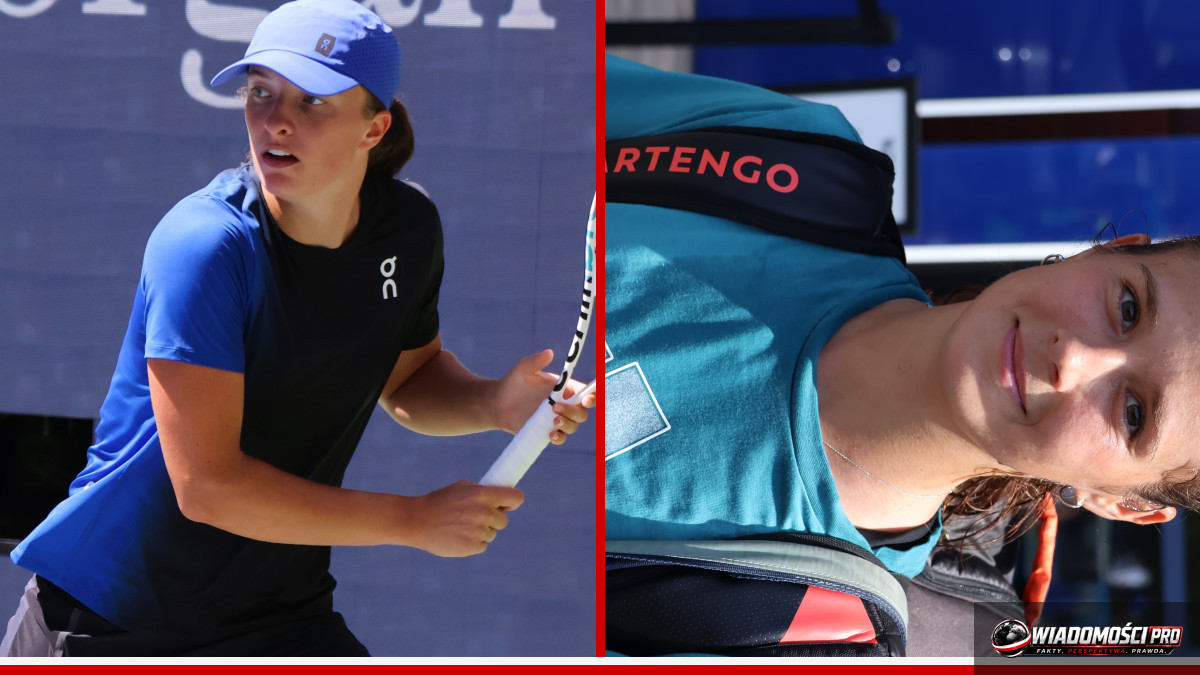
Iga Świątek defeated Daria Kasatkina 6:1, 6:0 in her final group stage match, putting her in an excellent position regarding advancement to the semifinals of the WTA Finals in Riyadh. However, advancement is not yet mathematically certain, as it depends on the set balance and the results of the remaining matches in the group. The Pole must carefully follow the results of other tennis players, as in the case of favorable table arrangements, her advantage from the direct clash with Kasatkina will prove decisive in the fight for a place in the top four.
The 6:1, 6:0 result is undoubtedly Świątek's most one-sided clash in this year's finals. The Pole set a pace that Kasatkina was unable to match for even a moment. The Russian tried to change the ball's rotation, playing higher over the net, which was supposed to take Świątek out of her rhythm. This plan fell apart in the very second game. Świątek took the initiative on her opponent's serve, forcing her to run all over the court. Every attempt by Kasatkina to shorten the rally ended with an aggressive, flat return from the Pole. Świątek's defense was airtight in this match, and the errors forced upon the Russian testified to the immense pressure the world number one exerted with every stroke.
The surface in Riyadh forced Świątek to adjust her footwork. In the August hard-court tournaments, including matches in Toronto and New York, the Pole had problems with body balance during baseline strokes. In the clash with Kasatkina, this balance was exemplary. Świątek did not look for finishing shots at all costs. She patiently built up rallies, operating with the court's geometry to ultimately attack her opponent's forehand side. This approach eliminated the risk of unnecessary mistakes that often appeared in her game before the tournament in Riyadh.
The 2026 season has been a sine wave of form for Świątek. The starting point for analyzing her performance remains the tournament in Toronto, where the Pole won the entire event on August 14, 2026. This victory gave hope for stabilizing her form before the US Open Grand Slam. In Canada, Świątek displayed a freedom that allowed her to control rallies against the most dangerous opponents. However, the move to New York disrupted this rhythm. The defeat to Qinwen Zheng, recorded on September 7, 2026, became the turning point of the entire summer season. This match showed that under high-pressure conditions, the coaching staff had not developed an effective strategy in case of an opponent's aggressive play. Zheng dominated Świątek with physical strength and reaction speed, exposing gaps in her defensive preparation.
It is worth returning to the dates preceding the US Open. As early as August 21, 2026, during the match against Elena Rybakina, the first signs of difficulty in maintaining concentration in clashes with players possessing a powerful serve were visible. The meeting with Diane Parry, played on August 19, 2026, also abounded in moments of hesitation, despite the Pole's eventual victory. Problems with adapting to the playing styles of specific opponents did not appear suddenly at the US Open. They were present throughout the American summer, which affected the player's ranking position.
Świątek's current position in the WTA ranking, published on September 14, 2026, is a direct reflection of the results from the last four weeks. The drop in the classification after the defeat to Zheng in New York was painful but mathematically justified. The WTA ranking does not reward past merits, only current achievements. This list shows the distance separating Świątek from the players who are presenting their best form in Riyadh. The consequences of the September results hit the Pole's point budget severely. The tournament in Riyadh has therefore become the last chance to correct her standing before the end of the year. Every victory in the group stage has double significance here: financial and prestigious. The win over Kasatkina brings Świątek closer to returning to a path that will allow her to realistically think about the leader position before the start of the 2027 season.
Analyzing reports from September 8, 2026, just after being eliminated from the US Open, the diagnosis was clear: the big tournament got away. It was not about a lack of skills, but a rigid game plan at a moment when the main strategy stopped working. In New York, Iga Świątek could not switch to a different type of rally. When Qinwen Zheng exerted pressure, the Pole stuck to a scheme that was failing. The coaching staff, praised after the triumph in Toronto for their tactical preparation, found themselves under fire. The 6:1, 6:0 result against Kasatkina suggests that lessons have been learned. The Pole played in Riyadh with greater composure, not forcing the pace where it was not necessary. This is proof that the process of learning from one's own mistakes is happening, although it is a painful and costly process in terms of ranking points.
The Aryna Sabalenka – Elena Rybakina final from September 13, 2026, was a match that sets the bar for the entire WTA top tier. Świątek, observing this duel, must have drawn conclusions regarding modern tennis at the highest level. Both Sabalenka and Rybakina base their tennis on the serve and shortened rallies. If Świątek wants to compete for the title in Riyadh, she must be able to neutralize such firepower. The victory over Kasatkina is only the first step. The Russian plays completely different tennis than Sabalenka or Rybakina. She is much more defensive, relying on consistency and patience. The real test of the Pole's form will come in the semifinals, where opponents will have much greater hitting power. Świątek will have to show that she can withstand rallies with tennis players who will not concede ground without a fight. What worked against Kasatkina may prove insufficient in a clash with offensive-profile players.
The pressure Świątek faces in Riyadh is different from that in New York. At the US Open, the fans' expectations were overwhelming. Here, after a series of form fluctuations, the Pole has stepped into the role of a player who must prove her worth anew. Such a role often serves athletes well. The lack of being the clear favorite in every match allows for greater freedom in making decisions on the court. This was visible in the way Świątek celebrated won games in the match against Kasatkina. It was a subdued joy, full of focus, without unnecessary exaltation. This is a signal that the Pole is focusing on the next points, not on the final result. If she manages to maintain this state of mind, the semifinal could be the beginning of a winning streak for her. However, if the demons from the US Open come to the fore again, every failed shot could become an unbearable burden.
The tournament in Riyadh is a challenge for tennis players not only in terms of sports but also logistics. The climate in Saudi Arabia and the specifics of the closed hall affect the behavior of the ball. Świątek, accustomed to playing on open courts, had to adjust to playing indoors in a short time. In the match against Kasatkina, it was clear that the Pole perfectly sensed the speed of the surface. The strain on the body after such an intense season is enormous. Travel between Toronto, the USA, and Riyadh means thousands of kilometers and the need for constant acclimatization. Świątek, despite her young age, has hundreds of hours of play in her legs. Material fatigue is a real factor that can affect the result of the semifinal. That is why ending the match with Kasatkina quickly was so important. Saving energy in this clash may prove to be the deciding factor in the match for the final.
The question about Świątek's future in the 2026 season remains open. Is the result from Riyadh just a flash in the pan, or a signal of a permanent change? We will know the answer in the coming days. At this moment, the Pole has shown that her tennis still has the potential to crush opponents. However, women's tennis in 2026 has become exceptionally balanced. The lack of a clear hegemon means that every player from the top ten of the ranking can beat anyone if they hit their form for the day. Świątek must prove that she can maintain the level presented in the match against Kasatkina for a longer period. A one-time burst of form is not enough to dominate the end of the season. Consistency is needed, which was so lacking in August. If she manages to achieve it, the end of the year could bring fans many positive emotions. If, however, the fluctuations in performance return, the tournament in Riyadh will be remembered as the last, very uneven chord of the 2026 season.
Advancement to the semifinal is the minimum plan for Świątek. As a player aspiring to be the best in the world, she cannot be satisfied with just getting out of the group. In the semifinal, she faces a clash with someone from the group of the best who will come out of the second group. There will be no room for mistakes there. Every game will require maximum focus, and every ball will be worth its weight in gold. Experiences from the matches with Rybakina or Parry from August show that Świątek can win even in difficult conditions. However, in the WTA Finals semifinal, the difficulty level will be several degrees higher. The Pole must be ready for the fact that her opponent will be able to respond to her attacks. In such a clash, physical preparation will prove key, allowing for maintaining a high pace of rallies for over two hours of play.
Looking at Iga Świątek's situation, one must remember the broader context. Polish tennis players need the leader's successes to drive interest in the discipline in the country. Świątek is the locomotive pulling all of Polish tennis behind her. Every one of her victories translates into greater support for young players and the development of infrastructure. That is why the result from Riyadh is so important for the entire environment. The 6:1, 6:0 victory is not just a digit in the table. It is confirmation that Polish tennis is still a significant player on the world map. Fans who followed the rankings with anxiety after September 7 can now breathe a sigh of relief. Świątek is back in the game and has a real chance to close the year in great style. However, the most difficult stage of the tournament is ahead of her, in which every mistake will be mercilessly exploited by her opponents.
A technical analysis of the match against Kasatkina confirms that Świątek has regained control over her forehand. In August, especially before August 14, this shot was too often inaccurate. Now the ball returns with deep rotation, which forces opponents to retreat. Kasatkina in Riyadh was unable to find an answer to this scheme. Świątek also served much more confidently, which was an Achilles' heel in the matches on August 19 and 21. A stable serve is the basis for winning games on one's own serve indoors, which is particularly noticeable in Riyadh. If this element of the game is maintained in the semifinal, the Pole will become an extremely difficult opponent for any player from the second group.
A key element of the tournament remains regeneration. After the match against Kasatkina, Świątek's staff must focus on physiotherapy and muscle preparation. The intense calendar, from Toronto to Riyadh, does not give any leeway. Świątek played at high speeds all summer. Now every day of rest between matches is a chance to regain full strength before the knockout phase. Saving time on the court in the group stage is an additional asset that can tip the scales of victory in a three-set semifinal battle. Is Świątek ready for this? Her attitude in Riyadh suggests yes.
It is worth noting how Świątek handles the pressure of expectations. After September 7, when the media wrote about the loss of dominance, the Pole withdrew from the media turmoil. It was a good decision. Focusing solely on training in Riyadh allowed her to clear her head. The 6:1, 6:0 result is not just a matter of physical form, it is primarily a matter of mental peace. If the player maintains this state, the tournament in Riyadh could become the foundation for a new era in her career. Otherwise, she faces a long road of rebuilding during winter preparations.
In summary, Iga Świątek is at a turning point. The victory over Kasatkina gives hope, but the semifinal will be the ultimate test. Opponents will not make the mistakes that the Russian forced so easily. They will play aggressively, aiming at the Pole's weaker points. However, Świątek has shown that she can draw conclusions from the defeats at the US Open. If she uses the lesson from September 7 and combines it with her current form, she has a chance for a final triumph. Every match in Riyadh is a lesson in humility, which the Pole is completing with due diligence.
Questions and answers
Is Iga Świątek already in the WTA Finals semifinal?
The 6:1, 6:0 victory over Daria Kasatkina (09/14/2026) significantly brings Świątek closer to advancement, however, the final composition of the semifinalists depends on the set balance and the results of the remaining matches in the group.
When did Iga Świątek last win a big tournament before the WTA Finals?
Iga Świątek's last significant triumph took place on August 14, 2026, during the WTA tournament in Toronto.
How did the defeat at the US Open affect Świątek's ranking?
The defeat to Qinwen Zheng (09/07/2026) caused a point drop and the need to fight to regain her position in the top of the WTA ranking, which is confirmed by the standings from September 14, 2026.
Who did Świątek face in August before the US Open?
In August 2026, Świątek played important matches, including against Elena Rybakina (08/21/2026) and Diane Parry (08/19/2026), which was an element of preparation for the final phase of the season.
What significance for the ranking did the September results have?
The September tournaments, including the Sabalenka-Rybakina final (09/13/2026), rearranged the hierarchy in the world ranking, forcing Świątek to fight for points in Riyadh.
Sources
- WTA Ranking 2026 – a summary of the best tennis players. What place are Iga Świątek and Maja Chwalińska in? (update 09/14/2026) - sport.tvp.pl
- Here is Iga Świątek's new place. WTA ranking after the Aryna Sabalenka – Elena Rybakina final - Przegląd Sportowy
- Bad news. This is what the WTA ranking looks like after Iga Świątek's defeat at the US Open - Przegląd Sportowy
- Return to the winning path. Iga Świątek won the WTA tournament in Toronto - www.polsatsport.pl
- Iga Świątek – Qinwen Zheng. See who won the US Open match. Live score - Przegląd Sportowy
- Here are the consequences of Świątek's defeat at the US Open. The big tournament is slipping away - Przegląd Sportowy
- Iga Świątek - Elena Rybakina. Check the match result - Przegląd Sportowy
- What time is the Iga Świątek - Diane Parry match today? Where to watch? - Przegląd Sportowy
Article prepared by the Wiadomości PRO editorial team with the support of artificial intelligence. Facts come from the sources listed above.
Komentarze (0)
Ładowanie komentarzy...