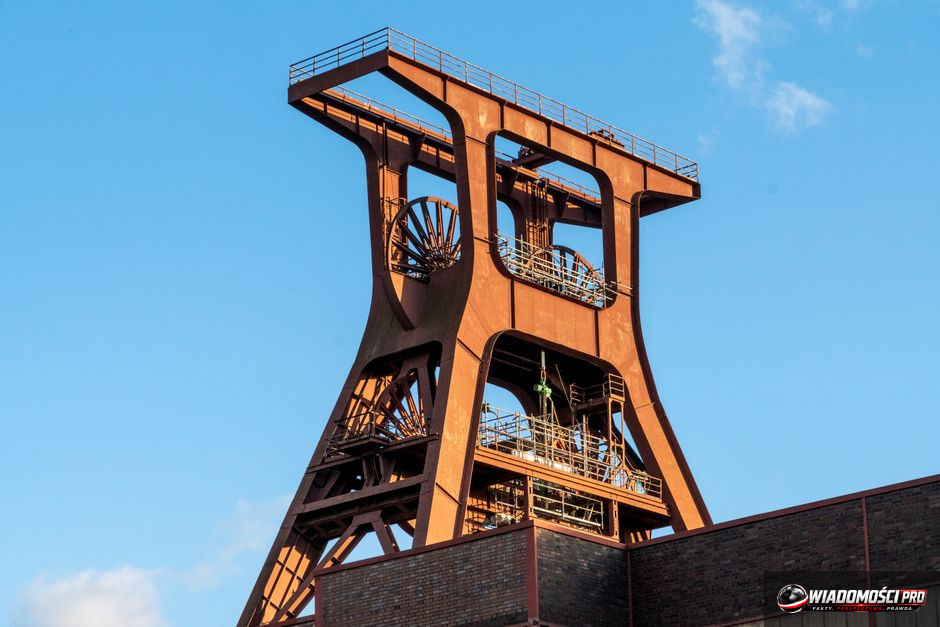
China plans to transform 12,000 abandoned mines into gravity storage facilities, which will allow for the stabilization of RES grids at operating costs significantly lower than those of lithium-ion batteries. This technology uses the potential energy of heavy blocks lowered into mine shafts, offering an efficiency of 80-85% in charging and discharging cycles. This solution represents an attempt to bypass the raw material and cost constraints that accompany conventional energy storage, transforming relics of the coal industry into the foundation of a new energy sector.
Mechanics of underground accumulation
The engineering behind this project is based on a simple law of physics, but its implementation on the scale of thousands of shafts requires precision not found in standard mining. The system uses the vertical space of excavations to work with the mass of ballast blocks. When national power grids record a surplus of electricity from wind farms or photovoltaic installations, this power feeds the electric motors of the hoists. These, in turn, pull blocks weighing hundreds of tons to higher levels of the shafts. At this point, electrical energy is converted into gravitational potential energy.
In the discharge phase, when the supply of energy from the sun and wind drops, the process is reversed. The blocks are controlled as they are lowered deep into the mine. The momentum of the descending mass sets generators in motion, which feed electricity back into the grid. Unlike the chemical reactions occurring in lithium-ion cells, there is no risk of uncontrolled temperature rise or electrolyte degradation here. The mechanics remain unchanged for decades, provided that the support cables and braking systems undergo regular maintenance.
However, the challenge lies in matching the mass of the blocks to the specific geometry of the shaft. Not every mine has a perfectly vertical and stable excavation. Chinese engineers from institutes such as the Energy Research Institute at the Chinese Academy of Sciences must develop modular block systems that can be transported through existing corridors. Any deviation from the vertical axis during lowering threatens to jam the system, which, in deep-shaft conditions, makes troubleshooting an extremely expensive logistical undertaking.
Infrastructure as a long-term asset
Beijing is not building energy storage from scratch, which allows for massive savings in capital costs. Each mine shaft is a ready-made vertical infrastructure with access to power, ventilation systems, and high-voltage transmission lines that once supported coal extraction. Adapting these sites eliminates the need to purchase land and build new steel towers or concrete foundations, which, in the case of surface-based gravity storage, constitutes a significant portion of the costs.
Regions such as Shanxi or Shaanxi province, the historical heart of Chinese mining, already have a dense energy network designed to export huge amounts of power. Connecting gravity storage facilities to them allows for the immediate balancing of local wind farms without the need for costly long-distance transmission line expansion. This approach makes mines, which were a symbol of pollution for decades, an asset supporting the country's energy transition.
The strategic importance of this move also stems from independence from global supply chains for critical raw materials. Producing lithium-ion batteries on the scale China needs requires huge amounts of lithium, cobalt, and nickel. Importing these metals is fraught with geopolitical risk and price volatility. Gravity does not require rare elements – it requires steel, concrete, and efficient control systems, which Beijing is capable of producing on its own.
Economy of scale: gravity vs. chemistry
The cost of adapting a single mine shaft into a gravity energy storage facility is difficult to estimate in a standardized way, as it depends on the depth and technical condition of the excavation. Nevertheless, estimates indicate that the cost of installing a 100 MW gravity storage facility is competitive with battery systems in the long term. Lithium-ion batteries require a full cell replacement after about 10-12 years of intensive use, while mechanical gravity systems are designed for 30-40 years of operation.
The difference lies in operating costs and durability. In the case of batteries, chemical degradation is an irreversible process, accelerated by deep charge and discharge cycles. In a gravity storage facility, the main components that wear out are the steel cables and hoist bearings. Their replacement cost is a fraction of the price of battery modules. Additionally, the disposal of used lithium cells is a growing environmental problem, which simply does not exist in the case of ballast blocks.
Despite these advantages, investors must take into account the long payback period. Adapting a mine is an infrastructure project, not a consumer one. It requires securing shafts against groundwater inflow, which in many cases may require costly insulation. If the cycle efficiency truly remains at the declared 80-85% level, these systems will become the cheapest way to store energy long-term. However, if the costs of engineering work inside the shafts exceed the assumed limits, the project could become an economic burden.
Engineering challenges in the depths of the earth
Adapting 12,000 mines is an operation on the living organism of former mining. Many of these facilities have remained without maintenance for years, which means that shaft linings may be weakened by corrosion and the pressure of rock layers. Engineers must conduct a geological audit of each of these sites to avoid the risk of collapse during operation. Costly revitalization of underground infrastructure may negate the economic benefits of cheap storage technology, unless the state develops a reinforcement standard for all types of shafts.
Another technical threshold is the block movement control systems. Operating multi-ton loads in the tight space of a shaft requires precision not found in standard mining. The mechanisms must withstand thousands of cycles of operation, braking, and acceleration, which generates enormous material loads. Even a minimal deviation from the vertical axis while lowering a block can lead to the system jamming, immobilizing the storage facility for weeks. Achieving the declared efficiency of 80-85% depends on minimizing mechanical resistance in these systems, which, at the current state of technology, is an engineering challenge of the highest order.
The most difficult stage, however, is integration with local power grids. Most abandoned mines are located in regions where transmission infrastructure is not adapted to receive such large amounts of power in a short time. Transforming a mine into an energy storage facility requires expanding transformer stations and modernizing distribution lines, which generates additional costs and investment time. Chinese grid operators will have to manage these points, balancing between unstable RES production and rigid energy security requirements. The question is whether the cost of this modernization will not exceed the profits from cheap energy storage that enthusiasts of the project talk about so readily.
Impact on the Chinese energy mix
China is striving to achieve carbon neutrality, and energy storage is the missing link in this plan. Gravity storage facilities allow for the smooth absorption of surplus energy from RES during periods of high production, without the need to disconnect farms. Currently, when wind farms produce too much electricity, the grid is often unable to take it, which leads to a waste of resources. Gravity storage facilities in mines act as a safety valve that allows this energy to be "frozen" in time.
Reducing dependence on coal-fired power plants during peak demand is a key goal for Beijing. Traditionally, coal plants had to operate in "on-demand" mode, which is inefficient and expensive. Replacing this role with energy storage allows for limiting coal combustion to the absolute minimum. The scale of the project, covering thousands of shafts, is unprecedented in the history of global energy. No other country has such a number of ready-made underground infrastructures, which allows China to rapidly scale the technology without the need to build new, expensive surface structures.
The catch lies in the pace of adaptation. Skeptics point out that the physics of the process is trivially simple, but the logistics are a challenge. The durability of cables and braking systems under such huge loads is still being tested in laboratory conditions, not in daily work at full load. However, if Beijing maintains the pace of work, coal in Chinese mines will cease to be the main export commodity, giving way to the energy accumulated inside them. This is a strategic shift that changes the rules of the game in the region.
Performance forecasts and the future of technology
The storage potential in this system is calculated in thousands of gigawatt-hours. These are numbers at which today's battery farms seem like mere laboratory experiments. Engineers point out that the system's response time is calculated in seconds, making it an almost ideal tool for quickly balancing sudden spikes in energy production from the sun or wind. The power grid gains stability that is difficult to achieve with variable renewable sources.
However, there is no shortage of question marks. Scaling power in this model depends on the number of blocks and the depth of the shafts themselves. Each mine has a different geometry, different geological conditions, and different engineering challenges. Will 12,000 facilities be successfully integrated into one energy management system? This is the biggest unknown of the project. If Beijing succeeds in this operation, it will gain a powerful energy policy tool that will make the country independent of rare metal imports. If, however, gravity systems get stuck at the prototype stage in selected locations, China will be left with thousands of dangerous, water-filled holes in the ground and billions of yuan frozen in concrete. At this moment, the technology looks promising, but its mass implementation remains a giant test of logistics and material durability.
What this means for you
This project changes the rules of the game in the energy sector: RES producers and the state gain, while suppliers of expensive raw materials for batteries lose. The catch remains the huge initial cost of adapting the shafts and the need to ensure the geological safety of old mines. For the global market, this means pressure on battery metal prices – if gravity technology succeeds, demand for lithium and cobalt may not grow as rapidly as predicted. From the consumer's perspective, this could mean more stable energy prices in the long term, provided that the investment costs are not entirely passed on to end-users.
Questions and answers
Are gravity storage facilities safer than lithium-ion ones?
Yes, because they do not carry the risk of chemical fire and do not degrade over time, which makes them a more durable solution for the power grid. The lack of chemical reaction excludes the phenomenon of so-called thermal runaway, which is the main threat to large-scale battery storage facilities.
How quickly can such a storage facility release energy?
Gravity systems offer a very fast response time, allowing for grid stabilization in a time calculated in seconds from the occurrence of demand, which is crucial during sudden drops in RES generation.
Will this technology work in every mine?
No, it requires sufficiently deep and stable shafts, which is why selection from among 12,000 facilities is a key stage of the project. Many mines may require structural adaptation that is too expensive for the project to be profitable.
Who is funding this research in China?
The project is supported by Chinese state-owned enterprises and research institutes, such as the Chinese Academy of Sciences, as part of the national plan to modernize the energy sector and strive for climate neutrality.
Are other countries also testing this solution?
Yes, similar projects are being implemented in Europe and the USA by companies such as Energy Vault, however, the Chinese scale remains unrivaled due to the unique infrastructure base in the form of thousands of inactive excavations.
Won't groundwater damage the mechanisms?
This is one of the main threats. Every mine must undergo a process of drying and constant monitoring of water levels, which generates constant maintenance costs that battery storage facilities do not have.
What is the biggest barrier to this project?
In addition to technical challenges, the barrier is the logistics of managing thousands of distributed storage points within one integrated power grid, which requires advanced AI-based control systems.
Is gravity more efficient than pumped-storage hydroelectricity?
Both technologies are based on gravity, however, shaft storage facilities are more flexible in terms of location, as they do not require access to large water reservoirs, which makes them more universal in regions with limited water resources.
In the event of a failure, can the system block the shaft permanently?
Yes, mechanical jamming of the load inside the shaft is one of the project risks that could lead to the complete decommissioning of a given facility until expensive repair work is carried out.
What metals are needed to build a gravity storage facility?
Mainly structural steel for cables, ballast blocks (often made of concrete or mining waste), and copper necessary for building generators and control systems, which makes the project much less dependent on the import of rare earth metals.
Is this solution environmentally friendly?
On a local scale, it involves engineering work inside mines, but on a global scale, it allows for the reduction of CO2 emissions by stabilizing RES and reducing the demand for coal-fired power plants, which makes the ecological balance positive.
What is the service life of steel cables in such a system?
These cables work in difficult humidity conditions, so their service life is strictly monitored and requires replacement every few years, which is included in the operating costs of the entire system.
Can such storage facilities work in extreme temperatures?
Yes, because the main mechanical part is located underground, where stable thermal conditions prevail, which eliminates problems related to the overheating of chemical cells on hot days.
Does China plan to export this technology?
For now, Beijing is focusing on its own market, but success in this project could make China a global leader in mechanical energy storage, which will pave the way for licensing the technology in countries with a similar mining history.
What happens if the system does not achieve the expected 80-85% efficiency?
In such a scenario, the investment would become inefficient compared to other energy storage methods, which would force Chinese planners to reorient funds to other technologies, such as hydrogen energy storage or advanced battery systems.
Sources
Article prepared by the Wiadomości PRO editorial team with the support of artificial intelligence. Facts come from the sources provided above.


Komentarze (0)
Ładowanie komentarzy...