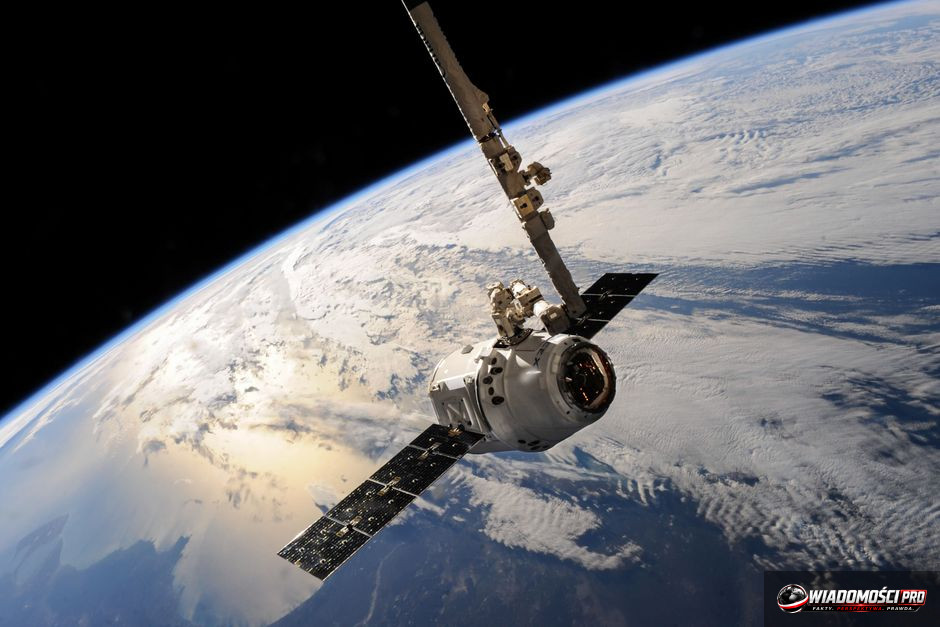
The Europa Clipper mission cost approximately 5 billion dollars and aims to investigate whether conditions favorable to life exist beneath Europa's icy shell. The probe launched in October 2024 and is currently on its way to the Jovian system. It is the most expensive research project in the history of the American space agency focused on a single non-planetary object.
Engineering in the shadow of radiation
The probe's design does not resemble standard vehicles sent to Mars. Europa is located within Jupiter's powerful magnetic field, which accelerates charged particles to enormous energies. This environment is lethal to standard silicon electronics. NASA engineers had to design a special "vault" made of titanium and aluminum with wall thicknesses of up to 9 millimeters. It protects the most sensitive components of the onboard computer from degradation caused by ionizing radiation. The mass of this shield significantly influenced the total cost of the project, forcing the use of advanced techniques to balance the mass of the entire device.
The probe has a solar panel wingspan exceeding 30 meters. This is a necessity because, in the Jovian system, the intensity of sunlight is only 4 percent of what reaches Earth's orbit. Using solar energy instead of radioisotope thermoelectric generators was a technical choice that influenced the architecture of the entire spacecraft, imposing rigorous savings in energy consumption by research instruments.
Research instruments: The probe's eyes and ears
Europa Clipper does not have a lander, so all scientific work is done from a distance during 49 planned flybys. A key tool is the EIS (Europa Imaging System). It is a set of wide-angle and narrow-angle cameras that will allow for mapping the moon's surface with a resolution of up to 50 centimeters per pixel. EIS is tasked with recording changes in ice texture, identifying cracks, ridges, and areas where material from the ocean may have been pushed to the surface.
Another instrument is MISE (Mapping Imaging Spectrometer for Europa). It is used to map the chemical composition of the surface in the infrared. MISE is intended to identify the distribution of salts, organic compounds, and water ice. Scientists want to understand whether materials ejected from the moon's interior contain complex chemical compounds necessary for the emergence of life. Understanding the surface's chemical composition is a direct indicator of what is in the ocean hidden beneath it.
The third research pillar is REASON (Radar for Europa Assessment and Sounding: Ocean to Near-surface). It is an ice-penetrating radar operating in two frequency bands. Its task is to "X-ray" the icy shell, which is estimated to be between several and over a dozen kilometers thick. REASON is to detect the presence of water pockets within the ice and precisely determine where the solid shell ends and the liquid ocean begins. Without this instrument, it would be impossible to verify the hypothesis about the habitability of this moon.
Additionally, on board are the ECM (Europa Clipper Magnetometer) and a dust analysis system (SUDA – Surface Dust Analyzer). The ECM will measure Europa's induced magnetic field, which will allow for determining the depth and salinity of the ocean. SUDA, in turn, will analyze dust and ice particles ejected from the surface by micro-impacts, which will allow for "in situ" sampling without a physical landing.
Scientific goals and ocean physics
The main goal is not to find "aliens," but to analyze the physicochemical parameters that define life in the earthly sense. Scientists must confirm whether there is indeed an ocean of liquid water under the shell. If so, how deep is it located, and does it have contact with the rocky floor? Contact between the ocean and rock is necessary for geochemical processes that could provide the energy needed to sustain the metabolism of potential microorganisms.
The thickness of the ice is the biggest unknown. If the shell is too thick and isolated from the surface, gas and chemical exchange between the ocean and the moon's atmosphere does not occur. Europa Clipper is to check if there are so-called plumes – geysers ejecting water from the ocean into space. If they are observed, the probe will be able to fly through their cloud, analyzing the chemical composition of the water in real time.
The salinity of the ocean also remains an open question. The probe will measure electrical conductivity, which is directly related to the salt content in the water. High salinity can be lethal to most forms of life known to us, while moderate salinity is essential for the stability of biological processes. All these measurements will be performed from orbit around Jupiter, which requires extreme precision in maneuvering.
The economics of big science
The 5 billion dollar funding raises questions about the cost-effectiveness of the mission. Unlike commercial missions, where the priority is return on investment, Europa Clipper is a "big science" project. These expenditures include not only the construction of the probe itself but also decades of research into radiation-resistant technologies, tests in vacuum chambers simulating Jupiter's conditions, and the construction of a dedicated Deep Space Network, which must handle data transmission from distances of hundreds of millions of kilometers.
Critics point out that NASA could have funded ten smaller Discovery-class missions for the equivalent of this one project. Supporters, however, argue that only a large, integrated probe is capable of bringing a breakthrough in astrobiology. Breaking the instruments into several smaller units would mean a lack of consistency in the collected data. The Europa Clipper probe performs measurements with many instruments simultaneously during each flyby, which allows for correlating the radar image with the chemical map and the magnetic field measurement at the same point in space.
Operational costs after launch are also not low. Maintaining the flight control team and scientists analyzing the incoming data is a continuous process lasting years. Every billion-dollar investment in the space sector is audited by the US Congress, which forces the agency to manage risk rigorously. A mission failure would mean not only a financial loss but also a political one, which could block funding for future exploration projects of the outer Solar System for years.
The race for scientific priority
The competition to explore Jupiter's moons is not limited to financial issues. It is also a fight for technological prestige. By sending Clipper, the Americans wanted to secure their position as a leader in astrobiological research. In Europe, the JUICE (JUpiter ICy moons Explorer) mission is being carried out, which also studies Jupiter's moons, although with a different emphasis on individual objects and a different orbit.
The American advantage lies in a dedicated approach to Europa itself. While JUICE focuses on the Jovian system as a whole, Europa Clipper is a "surgical" tool aimed at a specific target. Such specialization allows for the use of instruments with greater sensitivity, which in theory gives a better chance of detecting traces of life. This race stimulates innovation in materials engineering, especially in the area of radiation protection and autonomous navigation systems that can correct flight trajectories without intervention from an operator on Earth.
This rivalry is driven by the desire to answer the question that has defined astrobiology for generations: is life a terrestrial phenomenon, or a common occurrence in the universe? In this context, 5 billion dollars becomes the price for obtaining data that could change our understanding of humanity's place in the cosmos. If it turns out that Europa is dead, science will gain knowledge about the limits of life. If, however, biosignatures are found, it will be the most important discovery in human history.
Schedule and flight progress
The probe is not heading directly to Jupiter. Due to the vehicle's mass and fuel limitations, the flight trajectory is complex. The probe uses gravity assists, flying near Mars and Earth to gain the appropriate speed. This is a maneuver requiring precision on the order of millimeters per kilometer traveled. Any deviation from the planned orbit during these flybys could cause the probe to miss its target or fail to enter orbit around Jupiter at the correct speed.
Upon reaching the Jovian system, Europa Clipper will begin the braking process, using the gravity of the planet itself and its moons. This is the riskiest phase of the mission. The probe will repeatedly fly past Europa, each time changing its trajectory to study a different part of the moon's surface. This way of operating allows for safely moving away from Jupiter after each flyby, which gives the electronics time to "rest" from the extreme radiation.
The mission schedule is planned for many years. After the flyby phase, there is an operational phase that will last at least four years. During this time, the probe will perform dozens of close approaches. Each flyby is a giant leap in the amount of collected data. Due to the enormous distance from Earth, the speed of information transmission is limited, which means that scientists will receive results with a delay of even several dozen minutes.
Currently, the probe is in a long transfer phase. This is a time when engineers test onboard systems in deep space conditions. Each instrument is checked for calibration to ensure that upon arrival at the destination, all sensors will work flawlessly. This is the calm before the storm – a time of preparation that is just as critical as the scientific phase itself.
What does this mean for the future?
The success of this mission will define NASA's strategy for the coming decades. If Europa Clipper confirms the existence of an ocean with a chemical composition favorable to life, the next step will be to send a lander that could take samples directly from the surface or drill through the ice. Such a mission would be even more expensive and technically difficult, but the foundations for it will be laid precisely by Clipper.
For the general public, this success may seem distant. The results of the research will not bring photos of alien civilizations, but data tables, spectrometric charts, and topographic maps. However, it is precisely this data that constitutes hard scientific evidence. Unlike speculation, measurements made by MISE or REASON will form the basis upon which astrobiologists will build their theoretical models.
The question of whether it is "worth" spending such large sums on space research will always return on the occasion of projects of this scale. NASA argues that the development of technologies needed to survive in such a hostile environment as the vicinity of Jupiter has applications "on Earth" – from advanced miniaturization of electronics, through interference-resistant systems, to modern data processing algorithms in high-noise conditions. The investment in Europa is therefore not only a search for life but also technological development that drives the high-tech economy.
In the face of the challenges facing modern science, Europa Clipper is a symbol of ambition. It is a project that does not accept compromises regarding the quality of equipment and the precision of calculations. The probe, which launched in 2024, is today an ambassador of human curiosity in the farthest corners of the planetary system we have reached.
Questions and answers
Will the probe land on the surface of Europa?
No, Europa Clipper was designed exclusively for multiple flybys near the moon. Landing would require much heavier equipment and a different power system, which would exceed the budget and technical capabilities of the current mission.
How long will the probe's journey take?
The journey to the Jovian system will take several years. This is the result of the chosen trajectory with gravity assists, which allows for fuel savings but extends the time to reach the destination compared to a direct trajectory.
Why are we looking for life on Europa specifically?
Europa has an ocean of liquid water hidden under an icy shell. It is believed that this ocean has contact with the moon's rocky bottom, which provides access to minerals and energy sources necessary for the emergence and maintenance of life, making it one of the most promising places in the Solar System.
Can Jupiter's radiation damage the probe?
Yes, the radiation around Jupiter is extreme. That is why the probe has been equipped with a titanium-aluminum "vault" for electronics, and its orbit has been planned so that the probe spends as little time as possible in the planet's strongest radiation belts.
What happens if the probe does not detect conditions for life?
This will also be a valuable scientific result. It will allow us to understand the limits of habitability in the Solar System and exclude Europa as a potential place of residence, which will allow scientists to redirect funds to other objects, such as Enceladus or Titan.
What is the most important instrument on board?
It is difficult to point to one, because the mission relies on the integration of data from many sources. However, the REASON radar is key to understanding the structure of the icy shell, which is a necessary condition for assessing whether the ocean is accessible to biological processes.
Sources
- Start of the Europa Clipper mission to Europa - astronet.pl
- Europa Clipper probe to search for life on Europa - Urania - Polish Astronomical Portal
- Start of the Europa Clipper mission [BROADCAST]. Americans to outpace Europeans in the search for life on Europa - Wyborcza.pl
- Beginning of the Europa Clipper mission - Kosmonauta.net
- Europa Clipper has launched. It will investigate whether there are conditions for life on Jupiter's moon - Polskie Radio 24
- Searching for life in the Solar System beyond Earth. NASA sends a mission - Geekweek Interia
- NASA sends a probe to Europa. Europa Clipper mission has launched - WP Tech
- Flying to search for life. NASA mission launch in just three weeks - Antyweb
Article prepared by the Wiadomości PRO editorial team with the support of artificial intelligence. Facts come from the sources provided above.
Komentarze (0)
Ładowanie komentarzy...