
Over 3,000 customers are already waiting for the new Mitsubishi Pajero 2027, even though the model has not yet reached official showrooms. This interest goes beyond the usual anticipation for a new product, signaling a retreat from urban crossovers toward vehicles with ladder-frame construction. The Japanese manufacturer is targeting a group of buyers who demand real off-road capability rather than an imitation of it. The first test units have appeared on public roads, which means the prototype phase has come to an end.
A return to the technical roots of motoring
The decision by Mitsubishi engineers to use a classic ladder frame is an ideological statement. Ladder-frame construction, while generating a higher curb weight than unibody solutions, provides torsional rigidity unattainable for most SUVs. When overcoming deep ruts or steep inclines, the frame absorbs the twisting forces, which protects the body from stress. For the buyer, this means vehicle durability, which is a fundamental parameter in the utility vehicle segment.
The drivetrain, based on an advanced 4x4 system, is the model's main differentiator. Mitsubishi is abandoning simple electronic assists, which often operate with a delay in difficult conditions. The use of mechanical differential locks and a low-range transfer case allows for precise torque distribution to each wheel. The manufacturer has not yet revealed the final engine specifications, however, the vehicle's curb weight necessitates the use of high-torque engines optimized for heavy-duty operation.
Compared to the new Toyota Land Cruiser, the Pajero must face a performance challenge. The Land Cruiser uses large-displacement turbocharged diesel units that offer an adequate power reserve at low RPMs. Mitsubishi faces a similar challenge. To match its Japanese rival, the engines in the Pajero must be characterized not only by power but, above all, by resistance to long-term operation in difficult conditions. The curb weight of the ladder-frame construction determines fuel demand, which is becoming the main barrier to entry in the European market.
Functional aesthetics as a response to generic design
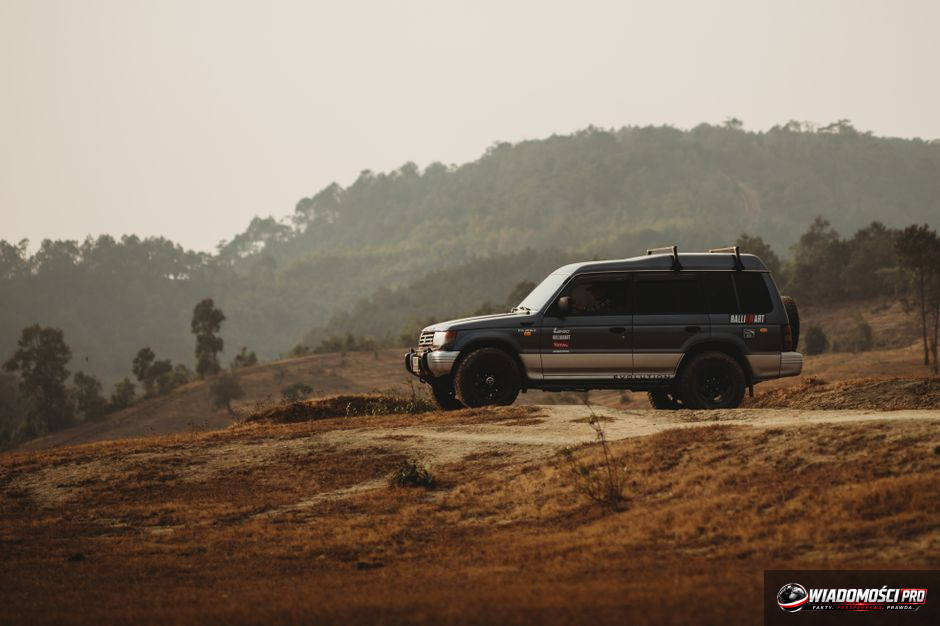
The silhouette of the Pajero 2027 rejects the aerodynamic roundness that makes modern cars look alike. Designers opted for an angular form resulting from functional requirements. A high hood line, vertical windshield, and short front and rear overhangs are parameters that improve approach and departure angles. The car not only looks like an off-roader, but it actually possesses the physical predispositions for driving in difficult terrain.
Massive wheel arches were designed to accommodate wheels with long suspension travel. The interior, as indicated by video materials released after the June 2026 presentations, is subordinated to ergonomics. Instead of huge sheets of touch glass, which are unreadable in the field, the focus was on physical switches. This is a nod to users operating vehicle functions while wearing gloves or driving over rough terrain. Such an interior design philosophy is a rarity in the passenger car segment, making the Pajero a machine for a specific customer for whom the car is a work tool or an expedition companion.
The biggest losers with this model will be buyers who were looking for a prestigious, urban SUV from Mitsubishi with low fuel consumption and a soft suspension. The Pajero 2027 is not a compromise product. People accustomed to the comfort typical of crossovers will feel the difference in suspension stiffness and the characteristics of the steering system, which in a ladder-frame car must be more direct and resistant to wheel impacts from off-road obstacles. The Pajero becomes a machine that is unforgiving to a user who expects nothing but comfort.
Legal barriers and the European market
The European premiere of the model remains a matter of debate. The main obstacle is strict emission standards, including Euro 6e and the upcoming Euro 7 regulations. Large-displacement engines, necessary to efficiently power a heavy construction, generate high CO2 emission levels, which directly affects the manufacturer's fleet average. In the European Union, every gram of CO2 above the limit means severe financial penalties.
The Pajero, with its weight and engine characteristics, is difficult to fit into European ecological frameworks without thorough hybridization. However, adding heavy batteries to a ladder-frame construction reduces the vehicle's payload, which may be disqualifying for many users. Mitsubishi faces a challenge: either limit the engine range to weaker units, which could kill the car's off-road character, or risk introducing the model as a niche, high-priced product. Currently, the priority for the brand remains the Asian markets and Japan, where legal conditions are less restrictive in the context of typical off-road vehicles.
Introducing the model to the European market would require huge outlays to adapt the powertrains, which, given the current demand in Asia, is not very profitable for Mitsubishi. The manufacturer may decide to introduce a limited series to avoid emission penalties, which, however, would make the Pajero a collector's car rather than a mass-market one. This approach means that the chance of seeing a Pajero in a European showroom at a price affordable for the average buyer is minimal.
Key dates and project milestones
The process of implementing the model into production is strictly controlled. In July 2026, closed presentations were held for selected owners in Japan, aimed at gauging market reaction and building prestige around the brand. This was the moment when the first concrete opinions about interior build quality reached the media. September reports from public roads confirmed that the Pajero had left the sterile factory conditions and is undergoing durability tests in real-world road conditions.
The market debut is planned for the first quarter of 2027. This timeline allows the manufacturer to refine the calibration of the drivetrain assistance systems and finalize the suspension tuning. Customers who have already declared their interest in purchasing are being informed about expected delivery dates, although the industry points to possible delays resulting from global supply chain issues for electronic components. For Mitsubishi, this is a logistical test – they must manage huge demand without losing control over assembly quality, which must be at the highest level for a ladder-frame model.
Competition analysis: Is it enough?
The Mitsubishi Pajero 2027 enters a market dominated by well-established players. The Toyota Land Cruiser is the benchmark for reliability, with which the Pajero must compete directly. The difference lies in the approach to technology – Mitsubishi focuses on a more utilitarian style, while Toyota is increasingly turning toward luxury. Another competitor is the Ineos Grenadier, which references the classic Defender, offering simplicity and almost military-grade durability.
The question is whether the Pajero will offer something that rivals do not. It could be the price – if Mitsubishi manages to keep it lower than the competition with a British label, success is almost guaranteed. On the other hand, if the car turns out to be too expensive due to emission reduction technologies, it may become solely a collector's item. The brand must balance these proportions so as not to lose touch with its core audience, i.e., off-road enthusiasts who are looking for a solid vehicle for expeditions, not another gadget on four wheels.
The rivalry with the Land Cruiser is not just about technical parameters, but also the service network. Toyota has an infrastructure that allows for servicing cars in the furthest corners of the world. Mitsubishi, after years of focusing on urban SUVs, must rebuild a service network specializing in the maintenance of ladder-frame off-road vehicles. Without this, even the best car will not convince users who require certainty in the field.
Interior: Durability over digitization
The interior of the Pajero 2027 is proof that manufacturers are beginning to listen to criticism regarding the overloading of cabins with electronics. The Pajero features clear analog gauges supported by a small central display. The finishing materials are intended to be scratch-resistant and easy to wash after a day spent in the mud.
This approach builds trust among users. The Pajero does not pretend to be a limousine. Every piece of interior equipment has its justification in utility. The door handles are massive, the seats have reinforced bolsters, and the floor is lined with materials with increased moisture resistance. This is a space intended to serve for years, not just for the duration of a lease. For the 3,000 waiting customers, this pragmatism is more important than the number of available applications in the multimedia system.
The 2027 perspective: What does success mean for Mitsubishi?
For Mitsubishi, the success of the Pajero is the foundation for rebuilding the brand's image as a manufacturer of cars with character. Over the last decade, the brand was identified mainly with urban SUVs and plug-in hybrids, which diluted its identity. The return of the Pajero is a clear message: we can build cars that survive everything.
If the 2027 model proves reliable, Mitsubishi will regain the loyalty of fans from the 90s and early 2000s. This is a very valuable group that will be willing to buy other models of the brand in the future, trusting in its engineering reliability. From a business perspective, the Pajero can act as a halo car – a model that does not have to generate the biggest profits, but attracts attention to showrooms and raises the value of the entire product range. This is a strategy successfully used by premium brands, and now, in a slightly more raw version, Mitsubishi wants to adapt it.
However, the market success of the Pajero will not be measured only by the number of units sold. For Mitsubishi, it is crucial whether this model will allow a return to the segment that the brand voluntarily abandoned. If the Pajero 2027 gains recognition in the field, Mitsubishi may once again become a reference point for pick-up and off-road vehicle manufacturers. However, if the car turns out to be prone to failure or too expensive, the brand could lose credibility in the 4x4 segment for years.
Logistics and service support
Introducing a ladder-frame off-road model to global markets involves the need to train the service network. Ladder-frame construction requires different maintenance than unibody crossovers. The need for chassis maintenance, the specifics of servicing 4x4 drives, and access to original spare parts are challenges that dealers must face even before the first deliveries. Mitsubishi is implementing training programs to ensure that the Pajero will not be an exotic guest in the service center, but a car whose repair will be predictable and relatively fast.
This is extremely important for customers who plan to use the vehicle in difficult conditions. A breakdown in remote terrain is a real risk, which is why the availability of service and parts is just as important as the engine's technical parameters. If the manufacturer provides efficient after-sales support, the Pajero has a chance to become a leader in its class, outperforming the competition in terms of maintenance costs. This is an often overlooked but key aspect of purchasing decisions in this segment.
Service support is not just about warranty repairs, but also the availability of spare parts after years of operation. Mitsubishi must guarantee that parts for the Pajero 2027 will be available for at least a decade. In the off-road vehicle segment, it is the availability of parts that determines the residual value of the vehicle. If the owner is sure that in the event of a breakdown on the other side of the world they will receive the necessary component, the Pajero will become the first choice for travelers.
Impact on the used car market
The appearance of the new Pajero will affect the used car market. Owners of older, legendary generations of the Pajero, who have been delaying replacing their car for years, will finally receive an alternative. A high level of loyalty is expected – customers who once drove a Mitsubishi will be more likely to return to the brand, confident that the new generation is not a neutered version of the original.
On the other hand, the stability of the model's value on the secondary market will depend on its durability. If it turns out that the Pajero 2027 is indeed as solid as the first materials suggest, its depreciation will be very low. This will also attract investors who treat off-road vehicles as a capital investment. Mitsubishi must therefore take care of every assembly detail so as not to spoil the reputation the brand has been building for decades.
The used car market often verifies manufacturers' claims about durability. In the case of previous generations of the Pajero, high prices on the secondary market resulted from their legendary reliability. The new model must prove that in a world of electronics and complex assistance systems, it is still possible to build a car that will stand the test of time. If the Pajero 2027 becomes as sought-after as its predecessors, Mitsubishi will gain a huge image asset.
Conclusions for a potential buyer
For someone considering the purchase of a new Pajero 2027, it is crucial to understand that this car is not a compromise. It is a conscious choice of capability over comfort. Before purchasing, it is worth checking whether local emission regulations will affect future vehicle ownership taxes. In many European countries, high CO2 emissions mean annual fees, which over a few years can significantly increase the total cost of ownership.
For enthusiasts for whom the field is their natural environment, the Pajero remains one of the few chances to buy a real car in a world dominated by digital prosthetics. The patience required by the waiting process may be rewarded with a machine that will not only take us anywhere but will do so with the grace expected of a legend.
The final purchasing decision should be preceded by verification of whether a given unit has full off-road equipment, such as differential locks. Mitsubishi offers various configuration variants, which allows for adjusting the car to individual needs, from expeditionary to utility. The Pajero 2027 is a car that requires skill from the driver, but in return offers a freedom that no urban crossover can provide.
Q&A
Does the new Mitsubishi Pajero 2027 have a frame?
Yes, the manufacturer has officially confirmed the use of a classic ladder-frame, which is the structural foundation of this model and guarantees high rigidity in the field.
How many people are already waiting to buy this model?
There are over 3,000 customers on the waiting list, which confirms the immense interest in the return of the legendary model to the market.
Is the car already available for sale?
The model has not yet reached official showrooms. It is currently in the road testing phase, and the market debut is expected in 2027.
Will the Pajero be available in Poland?
Official information regarding distribution in Poland has not yet been confirmed. The manufacturer is prioritizing Asian markets, and European plans are dependent on emission issues and management decisions.
Why is Mitsubishi opting for such a construction in this day and age?
The manufacturer is responding to clear demand for cars with a raw, off-road character, breaking away from the trend of urban crossovers, which is intended to restore the brand's image as a manufacturer of durable off-road machines.
Will the Pajero 2027 compete with the Toyota Land Cruiser?
Yes, the Pajero is intended to be a direct alternative to the Land Cruiser, focusing on similar ladder-frame durability, but with a greater emphasis on a raw, utilitarian form and operational ergonomics.
What are the biggest challenges for this model in Europe?
The biggest challenge is the strict Euro 7 emission standards, which require costly hybridization, which, with a heavy ladder-frame construction, could negatively affect the vehicle's payload and price.
What makes the interior of the Pajero different from typical SUVs?
The interior of the Pajero 2027 focuses on physical switches and durable, easy-to-clean materials, rejecting the fashion for huge touchscreens, which can be unreadable in difficult off-road conditions.
What is the main goal of Mitsubishi introducing this model?
The goal is to rebuild the brand's image as a manufacturer of durable off-road cars and attract loyal customers who in recent years turned away from Mitsubishi due to the lack of expedition-oriented cars.
Will the car be suitable for everyday driving?
The Pajero 2027 is designed as an off-road vehicle, so in everyday urban use, it may be less comfortable than typical crossovers, requiring more driver engagement in handling.
Sources
- The new Mitsubishi Pajero returns. It has a frame and real 4x4 - drivemode.pl
- The iconic Mitsubishi model returns. Will it also appear in Polish showrooms? - motoryzacja.interia.pl
- Mitsubishi Pajero 2027 has not yet reached showrooms, and over 3,000 customers are waiting for it impatiently. - Vietnam.vn
- Mitsubishi Pajero 2027 has really hit the road. The legend has returned and looks spectacular! - autoGALERIA
- The new Mitsubishi Pajero has been enjoying customer interest since its premiere. - Vietnam.vn
- Mitsubishi Pajero 2027 shown to owners in Japan - MotoGuru.pl
- The new Mitsubishi Pajero is coming. An important interior detail revealed [VIDEO] - Francuskie.pl
- XPENG will show the L03 in Munich. We still have to wait for European prices - Autohled.cz
Article prepared by the Wiadomości PRO editorial team with the support of artificial intelligence. Facts come from the sources listed above.

Komentarze (0)
Ładowanie komentarzy...