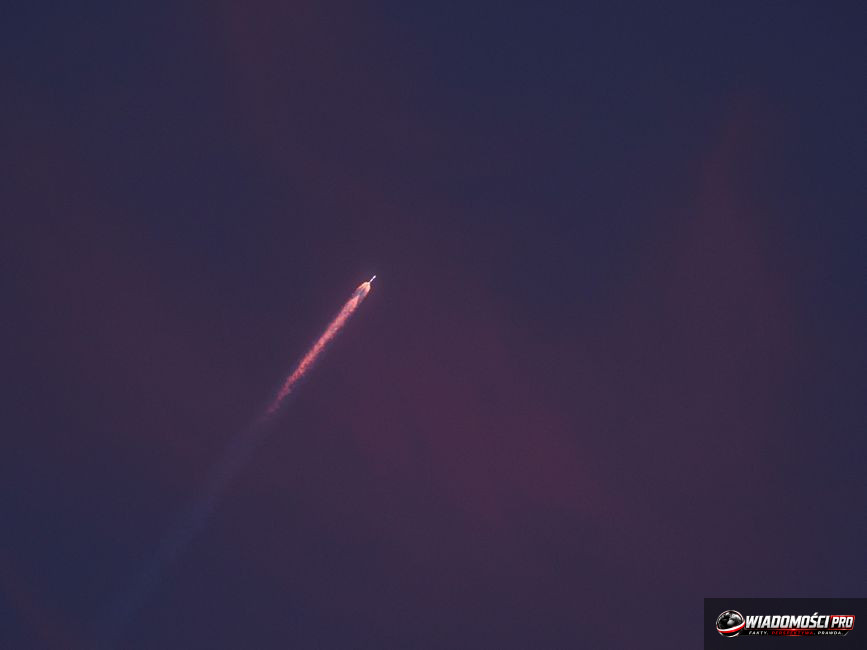
The Europa Clipper probe launched on October 14, 2024, following a delay caused by Hurricane Milton, with the goal of investigating the potential for life on Jupiter's moon. It is the largest spacecraft NASA has ever constructed for a planetary mission. The entire project cost approximately 5.2 billion dollars, making it one of the most expensive investments in the history of Solar System exploration.
Logistics in the face of the elements
Planning a mission launch of this scale is like putting together a puzzle where every piece must fit to the millimeter. When Hurricane Milton approached Florida, the operational schedule at the Kennedy Space Center became obsolete. NASA had to retract the probe into the hangar to protect the electronics from wind and moisture. Shifting the launch window by just a few days involved the necessity of re-verifying all onboard systems. Engineers conducted a full diagnostic after securing the machine against the destructive force of nature.
Work in the space sector does not forgive haste. Every screw, every memory module, and every solar cell had to pass tests for resistance to the harsh atmospheric conditions that occurred at Cape Canaveral. As soon as meteorologists confirmed the threat had passed, technical teams immediately began preparing the Falcon Heavy rocket for launch. It was a critical moment. The probe was placed atop the powerful carrier, which was to lift it beyond the reach of Earth's gravity. Waiting for the launch was a test of nerves for the thousands of people involved in the program. Now that the probe is on the correct trajectory, emotions are giving way to a cold analysis of telemetry data.
Research instruments on board
Europa Clipper is not just a "space messenger." It is a flying laboratory packed with equipment designed to scan the moon's icy shell. Among the key instruments is REASON (Radar for Europa Assessment and Sounding: Ocean to Near-surface). This is a dual-frequency radar that will allow scientists to look beneath Europa's surface. Thanks to it, we will learn how thick the ice layer is and whether its structure contains reservoirs of liquid water that could be active geological pockets.
Another extremely important tool is MISE (Mapping Imaging Spectrometer for Europa). This imaging spectrometer is tasked with mapping the chemical composition of the moon's surface. Scientists will look for traces of salts, organic molecules, and other chemical substances that could indicate what is happening in the depths of the ocean. If an environment capable of supporting life truly exists under the ice, the chemical components ejected to the surface by geological processes will be the only clues we can detect from orbit.
Complementing this set is the EIS (Europa Imaging System). This is a system of high-resolution cameras that will create topographic maps with extraordinary precision. Understanding Europa's geology—its cracks, ridges, and craters—is essential for interpreting radar data. Without terrain visualization, chemical analysis would be like reading a book without a table of contents. Each of these instruments works in extreme conditions, bombarded by radiation from Jupiter's strong magnetic field, which poses a huge challenge for the durability of the electronics.
Europa as target number one
Jupiter's moon, Europa, has fascinated planetary scientists for decades. Observations made by the Voyager and Galileo probes suggested that a global ocean of liquid water might exist beneath a thick shell of ice. The amount of this water could be twice as much as in all of Earth's oceans combined. It is this fact that makes Europa the most important target in the search for environments conducive to life in our planetary system.
However, the research does not involve landing. Europa Clipper will perform a series of 49 close flybys over the moon's surface. During each one, the probe will approach to an altitude of 25 to 100 kilometers above the surface, collecting dust and gas samples, analyzing the magnetic field, and taking photos. It is like a very fast flight over unknown terrain, during which one must record as many details as possible before moving back into the safer regions of Jupiter's orbit.
Skeptics remind us that the presence of water is not the same as the presence of life. Water also needs energy sources and appropriate chemical elements for biological processes to start at all. Europa Clipper is to check whether these three factors—water, energy, and chemistry—occur in the same place and time. This is a search for so-called habitability, i.e., the ability of an environment to support organisms, rather than the discovery of microbes themselves.
Rivalry or synergy?
In the public sphere, voices often appear regarding the rivalry of space powers. In the context of Europa, however, it is worth looking at the map of research activities more broadly. The European Space Agency (ESA) sent the JUICE (JUpiter ICy moons Explorer) probe in 2023. This mission focuses on studying Jupiter and its icy moons, including Europa, although with a different configuration of instruments and slightly different scientific priorities.
The thesis of NASA's "dominance" in this race is a simplification that ignores the fact that both missions are complementary. JUICE will spend more time studying Ganymede and Callisto, while Europa Clipper will focus exclusively on Europa. Cooperation between NASA and ESA is a fact—scientists from both agencies exchange data and jointly plan observation strategies. The rivalry concerns more of an engineering race over who will deliver higher-resolution data faster, but in the scientific dimension, each of the missions builds a knowledge base that benefits all of humanity.
The fact that the Americans sent their probe later than planned does not change the fact that this is the most technologically advanced project dedicated specifically to this one moon. Europa Clipper was designed to survive in the deadly environment of Jupiter, where the radiation dose is extremely high. Each of these probes, both American and European, is a separate chapter in the history of astrobiology. Instead of talking about a race, it is better to view it as a joint, multi-year effort spread across different research platforms.
Travel schedule until 2030
The journey to Jupiter does not take place in a straight line. The probe must perform a series of gravity assist maneuvers to gain the appropriate speed. In 2025, Europa Clipper will fly past Mars, and in 2026, it will pass Earth again. Using planetary gravity is a standard procedure in long-range missions, allowing for fuel savings, the mass of which is a critical limitation for any launch vehicle.
If everything goes according to plan, the probe will reach the vicinity of Jupiter in 2030. After entering the orbit of the gas giant, the most intensive phase of the mission will begin. Before that happens, however, engineers must monitor the state of the probe during its long flight through the vacuum of space. Each month is a period of system maintenance, software updates, and preparations for the first maneuvers in the Jovian system.
For observers on Earth, this is a period of long waiting. The probe is on its way, and we must show patience that the creators of science-fiction films do not allow themselves. In interplanetary reality, distances are vast, and the data transmission time back to Earth will be measured in tens of minutes. In 2030, when Europa Clipper begins sending the first photos, we will find out if our mathematical models regarding the moon's interior were accurate. This is the moment when theoretical astrobiology will collide with hard data from sensors.
Technical challenges in the Jovian environment
Jupiter is a powerful planet with an extremely strong magnetic field. This field creates radiation belts that are deadly to silicon electronics. NASA engineers had to design a special, thick-walled "vault" for the electronics for Europa Clipper, made of titanium and aluminum. It protects the onboard computer and instruments from radiation that would otherwise destroy the device's memory within a few weeks of operation.
Powering the probe at such a great distance from the Sun also poses a challenge. Europa Clipper has some of the largest solar panels ever mounted on a planetary probe. Their span exceeds 30 meters. Solar energy in the vicinity of Jupiter is much weaker than near Earth—it amounts to only about 4 percent of what reaches us. The panels must be huge to keep all systems running, especially the REASON radar, which consumes a lot of energy while scanning.
The probe was designed with modularity in mind. Every component was tested in vacuum chambers simulating the conditions prevailing in the vicinity of Jupiter. Despite this, the risk of failure remains high. Even minor software glitches can ruin years of preparation. Managing the mission is balancing on the edge of humanity's technical capabilities. The cost of 5.2 billion dollars is not just the price of equipment; it is also the cost of thousands of hours of work by engineers who anticipated thousands of emergency scenarios.
What will science gain from this mission?
The main goal is to understand the dynamics of the icy shell. Scientists want to know if the ice is stationary or if it undergoes constant convection processes, similar to tectonic plates on Earth. If the ice moves, it means that heat from the moon's interior is being transported upward, which facilitates the mixing of chemical components. This mixing is the key to the emergence of life.
Analyzing the salinity of the subsurface ocean will allow us to determine if the water is a chemically "living" environment. Salt in the ocean means that the water has had contact with the moon's rocky core, which is necessary for leaching minerals. Without these minerals, the ocean would be a barren, dead liquid. Europa Clipper will provide us with a map of "surface chemistry," which will be the best approximation of what is inside.
For the scientific community, the success of the mission means a paradigm shift. If we confirm that conditions conducive to life exist on Europa, our search in space will accelerate. If, however, it turns out that Europa is dead, this will be equally important information. We will then learn that the presence of water is not enough for life to be born. Such knowledge will allow us to better aim our next missions toward Enceladus or Titan.
Expectations vs. reality
Many people hope that Europa Clipper will "find life." This approach, however, is risky for the reputation of the space agency itself. The mission is not equipped with microscopes capable of observing organisms, nor with DNA analyzers. Its task is to describe the physicochemical environment. If the probe detects complex organic compounds, it will be a sensation, but it still will not be proof of the existence of life.
Skepticism is advisable here. Most space missions provide data that require decades of analysis. The first photos from the flybys will be exciting, but the real scientific conclusions will only appear after years of work on data from the radar and spectrometer. This is a project for the patient. Investing billions of dollars in a distant object is an expression of determination to check the limits of our knowledge.
Will Europa Clipper change the rules of the game? It will certainly change our understanding of how unique or common liquid water is in the Solar System. From the taxpayer's perspective, spending such huge amounts on research that does not provide an immediate return may seem controversial. However, history shows that the development of technology needed to survive in deep space always results in innovations that find their way into everyday use. From power systems to advanced electronics—all of this finds application on Earth.
Questions and answers
When exactly will the probe reach Jupiter?
The probe is expected to reach the vicinity of Jupiter in 2030, after performing several gravity assist maneuvers within the Solar System.
Will Europa Clipper land on the moon's surface?
No, the Europa Clipper mission does not involve a landing. The probe will study the moon exclusively during a series of close orbital flybys.
What was the main reason for the launch delay in October 2024?
The main reason was the arrival of Hurricane Milton in Florida, which forced NASA to suspend work at the Kennedy Space Center for the safety of personnel and equipment.
Why was Europa chosen, and not another moon of Jupiter?
Europa is considered the most promising object due to evidence suggesting the existence of a global ocean of liquid water beneath a relatively thin icy shell.
Which instruments are most important for the success of the mission?
Key instruments are the REASON radar for studying the moon's interior and the MISE spectrometer, which will allow for the analysis of the surface's chemical composition.
Is Europa Clipper the only mission studying this region?
No, the European Space Agency is conducting the JUICE mission, which is also studying the Jovian system, which provides a valuable complement to NASA's research goals.
What is the total cost of the Europa Clipper mission?
The estimated cost of the entire program is approximately 5.2 billion dollars, which includes the construction of the probe, instruments, and flight operations.
Is the probe at risk of being destroyed by radiation?
Yes, the environment around Jupiter is extremely radioactive, which is why the probe has been equipped with a special titanium-aluminum shield protecting key electronic components.
What will happen if the instruments fail after arriving at the destination?
Each of the instruments has redundancy systems, but a critical failure after years of travel would be a serious blow to the mission, which is why the systems underwent rigorous testing before launch.
What is the ultimate goal, if it is not the direct discovery of aliens?
The ultimate goal is to determine the habitability of the moon—that is, to check whether the water, energy, and chemistry occurring on Europa could theoretically support life.
Sources
- Start of the Europa Clipper mission to Europa - AstroNET – Polish Astronomical Portal
- Europa Clipper probe to search for life on Europa - Urania - Polish Astronomical Portal
- Start of the Europa Clipper mission [BROADCAST]. Americans will outpace Europeans in the search for life on Europa - wyborcza.pl
- Beginning of the Europa Clipper mission - Kosmonauta.net
- Searching for life in the Solar System beyond Earth. NASA sends a mission - Geekweek Interia
- Hurricane Milton delays the launch of NASA's largest space probe, Europa Clipper, to October 14 - Notebookcheck.pl
- NASA sends a probe to Europa. The Europa Clipper mission has launched - WP Tech
- Flying to search for life. NASA mission launch in just three weeks - Antyweb
Article prepared by the Wiadomości PRO editorial team with the support of artificial intelligence. Facts are derived from the sources listed above.

Komentarze (0)
Ładowanie komentarzy...