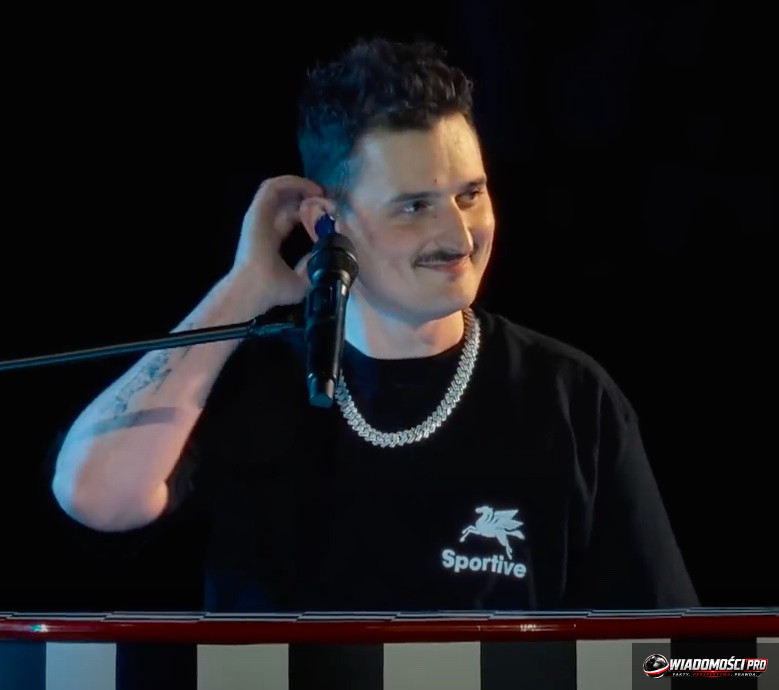
Dawid Podsiadło sold out seven stadium concerts in June 2024, and in 2026, he gathered a record-breaking audience of 90,000 people during a performance in Chorzów. This achievement was made possible through rigorous logistical planning, innovative use of stadium space, and a transition to a curatorial model that goes beyond a standard concert tour. This strategy allowed the artist to dominate the Polish mass event market while pushing the technical boundaries of sports facilities.
The mathematics of success: From seven stadiums to the record in Chorzów
June 2024 marked a transition to a higher operational level for the Polish concert industry. Seven stadium concerts sold out in a single month were not just a marketing success, but the result of precise ticket supply planning. The artist and his production team utilized a "condensed tour" model, which maximized venue occupancy in a short timeframe. Each of these seven concerts required distinct logistics – from assembling stage structures and managing human traffic at the gates to ensuring power continuity for sound systems.
Two years later, in 2026, the scale of the events changed. The performance in Chorzów attracted 90,000 people. This number exceeds standard limits for most stadiums in Central Europe. Increasing capacity required organizers to abandon traditional stage construction in favor of a layout that allowed for the use of the full perimeter of the stands and the stadium pitch. This is a mathematical approach: more seats mean a lower unit production cost per viewer, but at the same time, an exponential increase in the difficulty of managing pedestrian traffic and visibility.
Data analysis shows that Podsiadło shifted the focus from being a "performer" to being a "nodal point." In June 2026, nearly 100,000 fans sang "Happy Birthday" to the artist, which statistically confirms the reach generated by an image built consistently since 2024. This number is not accidental – it results from the successive scaling up of venues, starting from the 2024 tour, all the way to the announcement of the "Obrotowy Tour 2026" in September 2025.
Large-scale logistics: Managing a stadium colossus
Organizing a concert for 90,000 people is an engineering operation that cannot be compared to any other entertainment event in Poland. The biggest challenge for Podsiadło's staff was throughput. With such a large number of participants, security checkpoints and catering zones become the narrowest bottlenecks. To handle 90,000 people, it was necessary to implement procedures usually applied at major championship-level sporting events.
The rotating concert model, announced on September 1, 2025, forced a change in the method of sound distribution. Instead of a classic front-of-stage setup, distributed systems were used to evenly cover the entire pitch and stands. The logistics of transporting equipment between cities became a marathon. This required hundreds of trucks, tens of kilometers of cables, and the involvement of technical crews working in rotating shifts. The success of this format does not come by chance, but from ruthless optimization of working time. The assembly and disassembly schedule for the set design is calculated with an accuracy of a few hours, which eliminates the risk of downtime but leaves no margin for error.
It is worth noting the way subsequent dates were announced. Podsiadło uses a "tension building" strategy. Instead of announcing the entire tour a year in advance, the market receives successive announcements that maintain the interest of the media and fans. This is a business model where demand is stimulated by the limited availability of tickets in specific cities. As a result, when the "Obrotowy Tour 2026" was announced, demand had already been pre-generated by successes from previous years.
Technical problems: When the physics of sound wins over ambition
Despite attendance successes, the 2026 performances in Chorzów exposed the weakness of stadium gigantism. Reports of sound quality issues faced by half the audience point to a physical barrier that cannot be overcome by sound power alone. Stadiums are not designed for musical acoustics, and at such a massive scale – 90,000 people – the phenomenon of reverberation becomes inevitable.
Sound propagating in an open space undergoes distortions that, with 90,000 people, become noticeable to anyone not in the "listening zone." Organizers had to face the fact that the larger the audience, the less control there is over audio parameters. Some fans pointed out that in the most distant sectors, the music resembled a rumble, which is a disappointment for ticket-paying recipients. This is a technical challenge currently faced by the entire global stadium market.
Podsiadło fills stadiums flawlessly, but technology does not always keep up with the scale of his popularity. In 2026, the concert industry in Poland faced the question of whether it is possible to reconcile attendance records with high sound fidelity. Experiences from Chorzów suggest that with current technical solutions, the answer is "no." Gigantism forces compromises that are accepted by the crowd but criticized by the demanding part of the audience. For organizers, this is a lesson in humility toward the laws of physics, which cannot be bypassed by adding more speakers.
ZORZA as an escape toward new quality
In February 2025, the creation of the ZORZA festival was announced. This venture is a direct response to the exhaustion of the "stadium marathon" formula. By building his own festival brand, Podsiadło gains control over the environment in which he performs. Instead of just being a "guest" at a stadium who must adapt to the facility's infrastructure, the artist creates his own controlled conditions.
This festival is an attempt to diversify risk. Stadium gigantism, while profitable, is extremely demanding technically and logistically. ZORZA allows for a more intimate approach to production, offering fans something more than just a concert – it offers a curatorial experience. This is a move intended to secure the artist's career against stadium saturation. If the market begins to feel weary of attendance records, Podsiadło will have a ready-made alternative that positions him not as a record-breaking machine, but as the creator of his own musical ecosystem.
The scale of interest that Podsiadło achieved in 2024 and 2026 puts him in a position where he can dictate the terms of cooperation with the largest facilities in Poland. ZORZA is an expression of that power. He is no longer just an artist selling tickets, but an entrepreneur managing his own festival, which is a natural stage of evolution for a musician with such massive reach.
Conclusions: The music market after the stadium era
Podsiadło's dominance has put pressure on the rest of the Polish concert industry. The standards he set in June 2024 have become a benchmark against which every other performer is compared. The mass event market in Poland has ceased to be niche – it has become heavy industry. However, the price of this success is high.
On one hand, we have attendance records that command the admiration of investors and promoters. On the other hand, technical problems cast a shadow over the artistic quality of the performances. For the reader and fan, two conclusions follow. First: Podsiadło has proven that a Polish artist can be more profitable than A-list foreign stars. Second: stadium gigantism has its limits, beyond which sound quality ceases to be a priority and becomes a hostage to statistics.
The further development of the artist's career will depend on how quickly he can balance fan expectations with the technical capabilities of stadiums. If future tours head toward even larger numbers of viewers, acoustic problems will grow. However, if he manages to shift the center of gravity toward original formats like ZORZA, Podsiadło may avoid the material fatigue that affects many stadium stars. The music market has gained a new leader, but at a price that may have to be paid in coming seasons – the necessity of constantly proving that high-quality musical delivery still stands behind the record numbers.
Questions and answers
How many stadium concerts did Dawid Podsiadło sell out in June 2024?
Dawid Podsiadło sold out a total of seven stadium concerts in June 2024.
What was the attendance at the concert in Chorzów in 2026?
During the performance in Chorzów in 2026, a record-breaking audience of 90,000 people was gathered.
When was the Obrotowy Tour 2026 announced?
The official announcement of the Obrotowy Tour 2026 took place on September 1, 2025.
What technical problems accompanied the Chorzów concert?
Part of the audience reported problems with sound quality and acoustics, which was a direct result of the huge scale of the facility and technical limitations in amplifying a 90,000-person crowd.
What is the ZORZA festival?
ZORZA is Dawid Podsiadło's original festival venture, announced on February 11, 2025, aimed at expanding the artist's concert activities beyond the framework of stadium tours.
What was the "Obrotowy Tour" model based on?
This model assumed an innovative use of stadium space, including the likely use of a rotating stage, which allowed for increased facility capacity while simultaneously attempting to optimize visibility for viewers in the stands.
Did Podsiadło's attendance success affect the Polish concert industry?
Yes, the artist's successes pushed the boundaries of the Polish music market, forcing organizers to raise logistical and production standards, but also exposing the technical limitations of Poland's largest sports facilities.
Was the sound quality satisfactory for all participants of the concert in Chorzów?
No, reports after the concert indicated significant acoustic problems, especially for people located in sectors far from the stage, which became one of the main points of criticism for an event of such scale.
What was the role of June 2024 in the artist's career?
June 2024 was a turning point in which Podsiadło proved he could independently fill seven stadiums in a short time, which created the foundation for the business model of his future large-scale concert tours.
When did the event take place where 100,000 fans sang "Happy Birthday"?
This event took place in June 2026, which was a symbolic confirmation of the scale of the artist's popularity at the peak of his stadium activity.
What strategy did the artist adopt in response to stadium challenges?
The artist focused on diversifying formats, combining large-scale stadium tours with original festival projects, such as ZORZA, which allows him greater control over event production.
Why is stadium concert logistics so demanding?
It requires the coordination of thousands of people, advanced stage assembly, and the management of tens of thousands of fans, which at such a large scale leaves no margin for operational errors.
What is the biggest barrier for current stadium concerts in Poland?
The biggest barrier is the physical limitation of stadiums in the context of acoustics, which with 90,000 viewers becomes a challenge almost impossible to solve using standard sound reinforcement methods.
What is the significance of Podsiadło's success for the industry?
This success professionalizes the Polish market, but at the same time poses a difficult challenge for smaller organizers to compete with gigantic productions that dominate the media and sales space.
Can we talk about stadium "saturation" in Podsiadło's case?
Although attendance remains record-breaking, voices of criticism regarding technical quality suggest that viewers are becoming more demanding, which in the future may force the artist to move away from exclusively stadium formats toward more selective events.
Sources
- Nearly one hundred thousand fans of Dawid Podsiadło sang "Happy Birthday" to her. How Maja Chwalińska reacted - cgm.pl
- Dawid Podsiadło and his stadiums. By the numbers - Red Bull
- Podsiadło put on a show in Chorzów for 90,000 people. It's a pity that half of them couldn't hear him - naTemat.pl
- Dawid Podsiadło returns to stadiums in 2026. Where and when will he play? - 4FUN.TV
- Dawid Podsiadło returns to stadiums. He announced Obrotowy Tour 2026 - Spider's Web
- Dawid Podsiadło returns to stadiums. "Obrotowy Tour" already in 2026 - Kultura Onet
- Dawid Podsiadło announces seventh stadium concert on the tour! "I doubt that ever in my life, such a month as June 2024 will await me" - Tarczyński Arena Wrocław
- ZORZA - Dawid Podsiadło and his own festival. Know the dates and cities - eBilet
Article prepared by the Wiadomości PRO editorial team with the support of artificial intelligence. Facts come from the sources provided above.


Komentarze (0)
Ładowanie komentarzy...