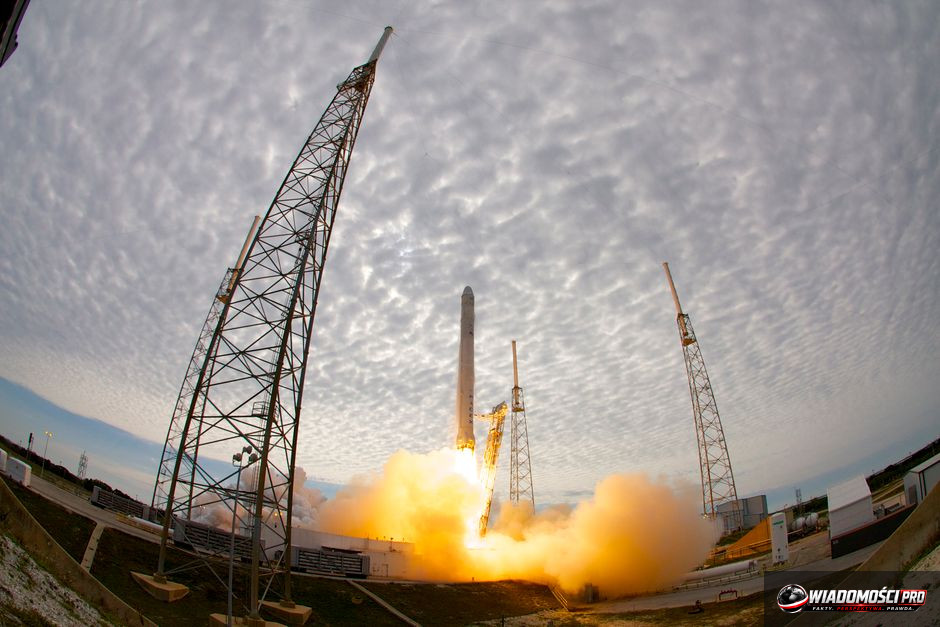
The Europa Clipper mission launched on October 14, 2024, following a delay caused by Hurricane Milton, and its primary task is to investigate conditions favorable for life on Jupiter's icy moon. The probe left Cape Canaveral atop a Falcon Heavy rocket, beginning a multi-year journey deep into the Solar System. It is the largest spacecraft ever built by NASA for planetary exploration, and its design had to be prepared for the extreme physical challenges present within the giant's gravitational and magnetic field.
Research instruments: The probe's eyes and ears
The effectiveness of Europa Clipper depends on a suite of nine advanced scientific instruments tasked with scanning Europa with unprecedented accuracy. The MISE (Mapping Imaging Spectrometer for Europa) instrument plays a major role in the geological and chemical analysis of the surface. It is an imaging spectrometer that maps the distribution of various substances on the moon's surface. The device identifies salts, organic compounds, and acid hydrates, allowing scientists to understand whether materials from the interior ocean are brought to the surface by geological processes. Without this insight into the chemical composition of the ice, we would be unable to determine if the water beneath the surface contains the ingredients necessary to sustain biological processes.
No less important is the REASON radar (Radar for Europa Assessment and Sounding: Ocean to Near-surface). This tool operates in two frequency bands and is designed specifically to "X-ray" the moon's icy shell. This radar is tasked with detecting the presence of liquid water pockets within the ice and precisely measuring the thickness of the shell, which is estimated to be between a few and several dozen kilometers. Understanding the dynamics of this shell is essential because it is through this layer that the exchange of substances between the surface and the depths becomes possible. If REASON detects the existence of active plumes or cracks from which water escapes, Europa Clipper will be able to fly through these streams and perform a direct chemical analysis.
Another key element is the EIS (Europa Imaging System) camera suite. These wide-angle and narrow-angle cameras provide high-resolution images, allowing for the creation of digital terrain models. Thanks to them, the mission team can identify geological formations such as ridges, bands, and chaos terrain, which indicate past or present tectonic activity. EIS works in tandem with the E-THEMIS instrument, which measures surface temperature. Temperature differences allow for the detection of places where heat from the moon's interior penetrates the ice, which could be a signal of active hydrothermal vents on the ocean floor.
The challenge of Jupiter: Radiation and energy
The Europa Clipper probe was not sent into a calm environment. Jupiter possesses one of the strongest magnetospheres in the Solar System, which accelerates charged particles to enormous speeds. This radiation bombardment is lethal to delicate electronics. NASA engineers had to apply a unique approach to protecting the onboard systems. Instead of building one heavy shield for the entire craft, which would drastically increase its mass and launch cost, they decided to place the most important computers and key electronic modules inside a special "vault." The walls of this vault are made of titanium and aluminum nearly a centimeter thick. Such a barrier effectively reduces the radiation dose received by the components, extending their lifespan during the multi-year mission.
Powering such an advanced laboratory 778 million kilometers from the Sun presents another challenge. Europa Clipper is equipped with gigantic solar panels that, when deployed, have a total span of over 30 meters. At such a great distance from the star, the intensity of sunlight is many times weaker than near Earth, so every section of photovoltaic cells must operate with the highest possible efficiency. Engineers had to design an energy management system that allows for the simultaneous operation of instruments during flybys, and in the periods between them – for charging batteries and transmitting data to Earth.
The very shape of the probe results from the need for precise maneuvering. Europa Clipper will not orbit Europa directly, because staying constantly within the range of the moon's radiation would destroy it in a short time. Instead, the probe performs a series of flybys near the moon, changing its trajectory each time under the influence of the gravity of other objects. It is a complex orbital game in which every move must be calculated with an accuracy of a fraction of a second and a meter.
Journey and tests: Flyby of Mars
In August 2025, the probe passed an important technical test. During a flyby near Mars, engineers performed a calibration of the measuring equipment. This test confirmed that the communication systems and scientific instruments are fully functional after leaving Earth's orbit. Although the flyby of the Red Planet was a trajectory-assisting maneuver, it also became an opportunity for remote diagnostics of the entire craft in deep space conditions.
Each of these tests is necessary because, after reaching the Jovian system, repairing any component will be impossible. The probe must be autonomous. The onboard software has been programmed to independently detect anomalies and switch to backup systems in the event of a failure. Telemetry data transmitted from the probe after the Mars flyby showed that energy consumption is within the assumed parameters and the craft's orientation in space is stable.
The analysis of data from 2025 also allowed for the refinement of the schedule for future observations. Thanks to the tests, engineers were able to check how the instruments react to temperature changes and background radiation. These results were used to create algorithms that will be used during key flybys over Europa. What was merely a design on paper in 2024 is now becoming an operational reality, where every byte of transmitted data brings us closer to understanding whether Europa's ocean is a place where biology could develop.
Strategic importance of the mission
Europa Clipper is an investment that goes beyond pure planetary science. It is a technological test of NASA's ability to conduct missions in extreme radiation conditions. The success of this endeavor will define standards for future missions that could eventually send landers directly to the surface of icy moons. The United States, by funding such a costly project, is betting on gaining an advantage in astrobiological research.
International cooperation on this project is visible mainly at the scientific level, where teams from different countries analyze data, but the USA holds exclusive rights to manage the mission and operate the probe. Such a concentration of resources means that the interpretation of results, at least in the initial phase, will be based on analyses conducted by American laboratories. This builds a leadership position in the exploration of the outer regions of the Solar System.
Skeptics note, however, that the high cost of the mission, measured in billions of dollars, puts immense pressure on NASA for results. Any instrument failure or loss of communication would be seen as a PR failure. Nevertheless, from a scientific point of view, gathering a full geological picture of Europa is a step that cannot be skipped. If conditions for life truly exist beneath the surface of this moon, Europa Clipper will be the first machine to provide hard evidence of it.
Ocean analysis: What is under the ice?
The central point of the research is the ocean, which, according to theoretical models, is located under the icy shell. It is estimated to contain twice as much liquid water as all of Earth's oceans combined. Moreover, it is a salty ocean, which means that the compounds dissolved in it may come from the contact of water with the moon's rocky mantle. Such contact is a necessary condition for the existence of life as we know it on Earth, because it enables chemical exchange that can provide energy for the metabolism of hypothetical organisms.
The mission is not looking for life directly, but for biosignatures. Instruments like MISE will look for specific patterns in the chemical composition of the ice that might suggest that water from the ocean has been pushed to the surface. If traces of amino acids or other complex organic molecules can be detected, it will be strong evidence that chemical processes inside Europa are much more advanced than previously thought.
A threat to this research is the very nature of the icy shell. Its surface is bombarded by radiation that can destroy organic compounds. Therefore, the probe will focus on younger geological areas, where fresh ice from the depths has recently been pushed to the surface. It is there that the chances of finding intact biological traces are the greatest. Every Europa Clipper flyby is an opportunity to create a map that will allow for the identification of sites for potential future landers.
Flight logistics: Schedule and trajectory
The journey to Jupiter is not linear. The probe must use the gravity of Earth and Mars to accelerate to the speed required to reach the outer system. These maneuvers, known as gravity assists, allow for saving huge amounts of fuel that would otherwise have to be carried on board at the expense of research equipment. The use of Mars in August 2025 was the first in a series of such maneuvers that precisely direct the probe toward Jupiter.
Each stage of this journey is strictly monitored by the Deep Space Network, a network of radio telescopes distributed around the world that ensures constant contact with the probe. The launch delay from October 2024 did not negatively affect the trajectory, as NASA engineers had backup flight scenarios. The choice of launch date was dictated by a transfer window that minimizes travel time, but the safety of the equipment was always paramount to the schedule.
Upon reaching the Jovian system, which is planned for 2030, the probe will enter a phase of intensive flybys. That is when the real challenge will begin: performing 49 close flybys over the moon's surface. Each of them will last only a few hours, during which the probe will have to collect gigabytes of data, orient its antennas toward Earth, and simultaneously protect its systems from radiation. This will be the most demanding part of the mission, testing the limits of engineering endurance.
What this means for you
The Europa Clipper mission is one of the most important research projects of the 21st century. For the average person, it means broadening the horizons of our knowledge about how common conditions favorable for life might be in the universe. If it turns out that even in such an unfriendly environment as Jupiter's icy moon there can be liquid water and the right chemistry, the definition of a "habitable zone" in the Solar System will change radically. This is not, however, a quick gratification. The research results will be analyzed for years, and we will only learn the answers to the most important questions toward the end of the current decade. The cost of this research is enormous, but the knowledge of whether we are alone in the universe is a value that cannot be converted into budget calculations.
Questions and answers
When exactly did the Europa Clipper probe launch?
The mission launch took place on October 14, 2024, from Cape Canaveral.
What was the main reason for the launch delay in October 2024?
The direct cause of the delay was the arrival of Hurricane Milton, which forced the evacuation of personnel and the securing of the probe in hangars to protect the equipment from destruction.
Has the probe already performed its first tests in space?
Yes, on August 6, 2025, the probe successfully conducted tests of its onboard systems and scientific instruments during a flyby near Mars.
Why will the probe not orbit Europa directly?
Due to the extremely high level of radiation in Jupiter's environment, staying constantly in orbit around Europa would lead to the rapid destruction of the probe's electronics. Instead, the probe will perform a series of close flybys.
What is the main task performed by the REASON instrument?
The REASON instrument is a radar used to study the structure of Europa's icy shell, including detecting potential pockets of liquid water and measuring ice thickness.
What is the "vault" inside the probe?
It is a reinforced titanium-aluminum housing in which the probe's most sensitive electronic components are placed to protect them from the harmful effects of ionizing radiation in the Jovian system.
Will Europa Clipper land on the moon's surface?
No, the mission was designed as a flyby probe. It does not have a lander and will conduct all research from a safe distance during a series of orbital maneuvers.
Sources
- Europa Clipper mission launch to Europa - AstroNET – Polish Astronomical Portal
- Europa Clipper launches. A key task ahead - Geekweek Interia
- Europa Clipper probe performed a test while passing Mars - Science in Poland
- Europa Clipper mission launch [BROADCAST]. Americans to overtake Europeans in the search for life on Europa - Wyborcza.pl
- Beginning of the Europa Clipper mission - Kosmonauta.net
- Europa Clipper probe to search for life on Jupiter's moon, Europa - Wszystko co najważniejsze
- Hurricane Milton delays launch of NASA's largest space probe, Europa Clipper, to October 14 - Notebookcheck.pl
- NASA sends probe to Europa. Europa Clipper mission has launched - WP Tech
Article prepared by the Wiadomości PRO editorial team with the support of artificial intelligence. Facts are derived from the sources provided above.


Komentarze (0)
Ładowanie komentarzy...