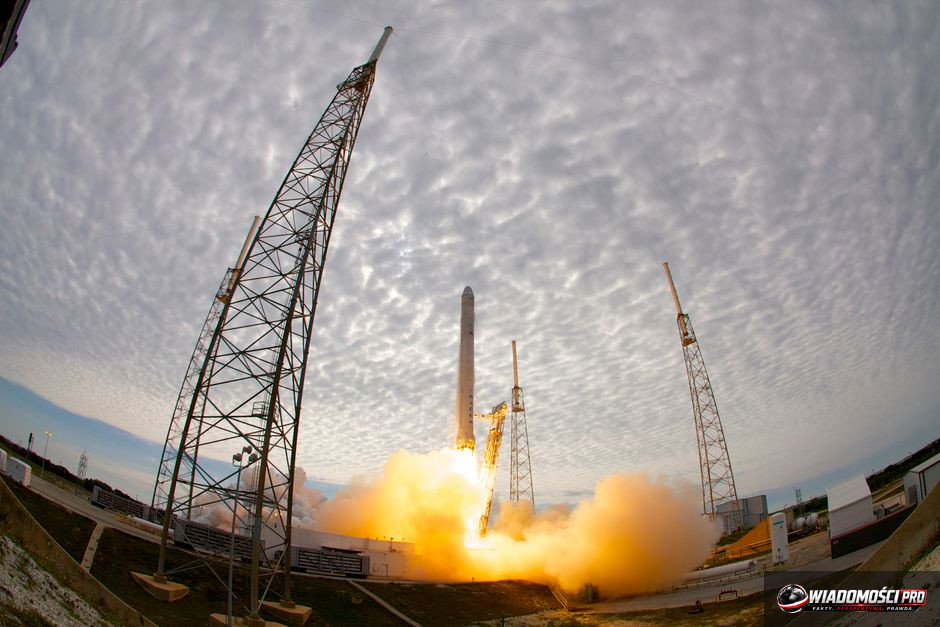
NASA has sent the Europa Clipper probe to investigate whether conditions favorable for sustaining biological life exist beneath the thick, icy shell of Jupiter's moon, Europa. The mission, with a total budget of approximately 5 billion USD, aims to conduct a detailed analysis of the chemical composition of the ocean hidden beneath the ice and a rigorous assessment of the satellite's geological activity. The probe is tasked with verifying whether Europa's environment possesses the energy and chemical resources necessary for the development of biological processes.
In brief
- The mission launched on October 14, 2024, using a Falcon Heavy rocket from the Kennedy Space Center in Florida.
- The original operational schedule was disrupted by Hurricane Milton, which forced NASA to delay the launch by several days to protect ground infrastructure.
- The Europa Clipper probe is the largest spacecraft in the history of the American agency built for the purpose of exploring celestial bodies in the Solar System.
- The primary scientific objective is to study the thickness of the icy shell and the characteristics of the salty ocean that scientists believe lies beneath the moon's surface.
Launch chronology: From hurricane to success
The Europa Clipper probe left Earth on October 14, 2024, beginning its multi-year journey toward the Jovian system. The success of the launch was not a matter of chance, but the result of precise operational coordination by NASA. The preparation schedule was brutally tested by Hurricane Milton, which passed over Florida in the immediate vicinity of the launch complex. The decision to delay the mission was dictated by the need to protect the research equipment and ground support systems. Engineers had to secure the probe in a hangar, which halted preparatory processes but eliminated the risk of physical damage to the ship from destructive winds.
Once meteorological conditions stabilized, the agency decided to resume the countdown. The launch using SpaceX's Falcon Heavy rocket proceeded according to the new guidelines. The choice of this specific launch vehicle was dictated by the mass of the probe, which, including fuel, exceeds 6 tons. After reaching Earth orbit, Europa Clipper began the maneuvers necessary to gain the speed required to reach the Jovian system. The entire operation was monitored by teams at the Jet Propulsion Laboratory, where every stage of the launch was subject to strict quality control.
The success of October 14 is proof that in the face of extreme weather phenomena, safety procedures take priority over timeliness. The 5 billion USD investment necessitated an approach based on risk minimization. Every hour of delay was the price paid for protecting equipment that will have to function in the extreme conditions of outer space for years to come. Now that the probe is on its cruise trajectory, engineers are focusing on keeping the equipment's life support systems in optimal condition, preparing for a series of gravity-assist maneuvers near Earth and Mars that will allow the probe to gain the necessary speed.
Scientific goal: Does Europa hide an ocean?
Europa has been an object of fascination for astrobiologists since data from the Galileo mission suggested the existence of a global, salty ocean hidden beneath an icy cover 15 to 25 kilometers thick. Europa Clipper does not have a lander and will not collect samples directly from the surface. Instead, the probe will perform 49 close flybys of the moon, using a suite of remote sensing instruments to study the satellite's interior.
A key research problem is the interaction between the rocky core and the ocean. If water is in contact with the seafloor, chemical processes similar to those observed in Earth's hydrothermal vents may occur. Scientists are looking for evidence of organic compounds and energy that could power potential life forms. Instruments such as a magnetometer and mass spectrometer will analyze particles ejected into space in the form of geysers or water vapor, allowing for an assessment of the chemical composition of subsurface fluids without the need to drill into the ice.
Research also focuses on ice tectonics. Europa's surface is covered by a network of cracks and ridges, suggesting that the shell is dynamic and reacts to powerful tidal forces generated by Jupiter's gravity. Analysis of these structures will determine how often material is exchanged between the surface and the deep ocean. It is this exchange that is considered a mechanism that could provide the oxidants needed to sustain life in the dark, deep waters of the moon.
Doubts remain, however, regarding the stability of this environment. Even if the ocean is chemically rich, we must understand whether geological processes are sustainable on a scale of millions of years. If Europa Clipper shows that the ocean is isolated from mineral sources by a layer of ice that is too thick, hopes of finding life may prove premature. Therefore, the mission is designed not to leave room for interpretation – the data must be unambiguous so that more invasive research expeditions can be planned in the future.
NASA's largest space probe
Europa Clipper is a spacecraft the size of a tennis court when considering the span of its solar panels. Powering it at a distance of 780 million kilometers from the Sun presents a huge engineering challenge. The probe uses large-area photovoltaic cells that must generate enough electricity despite sunlight being five times weaker than on Earth. The entire structure was designed at the Jet Propulsion Laboratory in Pasadena, with the participation of specialists from the Applied Physics Laboratory at Johns Hopkins University.
Inside the craft is advanced equipment, including the EIS (Europa Imaging System) camera system, which will provide high-resolution images of the surface, allowing for geological mapping with precision unavailable to older missions. The MISE (Mapping Imaging Spectrometer for Europa) instrument will, in turn, search for traces of organic matter, salts, and ice in various states of matter. Data from these instruments will be transmitted to Earth using a high-gain antenna system, which, given the vast distances, requires extraordinary efficiency of telecommunications systems.
Managing such an expensive project, whose 5 billion USD budget is one of the largest in the history of NASA's planetary sciences, required the implementation of rigorous quality control standards. Each component had to pass tests in vacuum chambers simulating conditions in open space. Engineers had to anticipate failures that cannot be repaired during the mission – unlike missions to low Earth orbit, here every malfunction could mean the end of the chance to obtain a complete set of data.
Skeptics often ask about the sense of such high financial outlays for a mission that will not bring immediate economic profits. NASA's answer is simple: knowledge of whether we are alone in the universe is priceless. Europa Clipper represents the culmination of decades of technological development and is the only chance to answer the question of the habitability of Jupiter's moons in the current century. The 5 billion USD cost, spread over years of construction and preparation, is the price humanity pays for expanding the boundaries of its knowledge.
Technical challenges of the journey to Jupiter
The flight to Jupiter requires precise trajectory planning. The probe does not fly in a straight line, but uses gravity-assist maneuvers, flying past Earth in 2026 and Mars in 2027 to gain the speed necessary to reach the outer parts of the Solar System. This multi-year "speeding up" process is crucial for saving fuel, which the probe will need to enter Jupiter's orbit in 2030 and for subsequent maneuvering near the moon.
The greatest technical challenge of the mission remains Jupiter's extreme radiation environment. This planet has a powerful magnetosphere that accelerates charged particles to enormous speeds, creating radiation belts that destroy electronics. To protect sensitive instruments, the probe has been equipped with a special "vault" – a thick-walled, titanium-aluminum armor that houses the most important components of the onboard computer and measurement equipment. This shield is designed to reduce the radiation dose to a level that will allow the probe to survive dozens of flybys near Europa without permanent damage to the systems.
Communication with the probe also presents a challenge. Due to the distance, a radio signal takes about 45 minutes to cover the distance between Europa and Earth. This means that any remote control in emergency situations is impossible in real-time. The probe must have highly advanced autonomous systems that will independently diagnose faults and switch to backup systems in a fraction of a second, without waiting for instructions from mission control. It is this balancing on the edge of the risk of failure and scientific discovery that defines modern space engineering.
Research schedule: What to expect in the coming years?
Currently, Europa Clipper is in the cruise phase. This is a time when the main task is checking systems and preparing the equipment to work in deep space conditions. The mission team regularly conducts instrument tests, ensuring that every sensor is working as expected. Although the probe is not yet sending scientific data about the moon itself, every successful telemetry transmission is a success that brings us closer to the moment of reaching Jupiter.
After entering Jupiter's orbit in 2030, the most intensive phase of the mission will begin. The probe will perform a series of flybys that will allow for the collection of data from different areas of the moon's surface. Each flyby will last only a few hours, during which the instruments will work at maximum capacity, gathering terabytes of data. This raw data will then be transmitted to Earth over the following months, where it will be subjected to detailed analysis by international teams of scientists.
The schedule of activities is strictly correlated with orbital physics:
- 2026-2027: Gravity-assist maneuvers that will ultimately direct the probe toward the gas giant.
- 2030: Entry into the Jovian system and the start of the operational phase.
- 2030-2034: A cycle of 49 close flybys of Europa, which will provide key information about the ocean beneath the ice.
The team's patience is being tested because the distance between Earth and Jupiter makes every operation difficult and time-consuming. The mission team must manage resources, ensuring that every second of the equipment's operation is fully utilized. We expect that the first results of studies on the chemical composition and geological activity of the satellite will change the way we perceive the biological potential of our Solar System.
What this means for you
The Europa Clipper mission is, above all, a great test of our technological capabilities. Investing 5 billion USD in a research project that offers no guarantee of finding life is a bold move that shows the priorities of modern science. If the probe confirms that conditions to sustain life actually exist beneath Europa's icy shell, the definition of "habitability" will change permanently. We will stop looking at interplanetary space as a dead void and start perceiving it as a network of potentially inhabited environments hidden under the ice.
The catch, however, remains the risk. Jupiter's radiation environment is merciless, and there is no certainty that all systems will withstand the planned four years of intensive work. However, if the mission is successful, the data transmitted by Europa Clipper will form the foundation for future expeditions, perhaps using landers that will attempt to touch the moon's surface in the coming decades. For the average reader, this means that within the next decade, we may receive an answer to a question that has accompanied us for millennia: is life a phenomenon unique to Earth?
Questions and answers
Why was Europa chosen for research, and not other moons of Jupiter?
Europa has one of the most interesting geological characteristics in the entire Jovian system. Data from previous missions indicate that it has a global ocean of liquid water, which is a key ingredient for the development of life. Other moons, such as Ganymede or Callisto, although they also have oceans, are located deeper beneath the surface, which makes studying them much more difficult.
Did Hurricane Milton cause permanent damage to the probe?
No. The probe was secured in a safe hangar before the storm arrived. The hurricane only caused a delay in the launch schedule, forcing the preparation to be pushed back by a few days to ensure the full safety of the equipment before launching into space.
When will we know if there is life on Europa?
The Europa Clipper mission is not equipped with instruments capable of directly detecting living organisms. The probe will study conditions favorable to life, such as the chemical composition of the ocean, geological activity, and the presence of organic compounds. The full results of these analyses will be published after the probe reaches its destination and conducts a series of 49 flybys, which is planned for the years 2030-2034.
Why does the mission cost as much as 5 billion USD?
The high cost of the mission results from the need to build the most advanced research equipment, which must survive in Jupiter's extreme radiation environment. Furthermore, the budget includes the costs of the launch vehicle, operational preparation, long-term maintenance of the scientific team, and the complexity of logistical operations. Designing radiation shields and power systems capable of working at such a great distance from the Sun is a costly engineering challenge.
Is it possible that the probe will not send any data?
There is such a risk, although engineers have done everything to minimize it. The Jovian environment is the most hostile place in the Solar System for electronics. However, if the radiation shielding systems fail, the loss of the probe would mean the total loss of the billions of dollars invested. NASA, however, relies on the highest quality components, which gives a high chance of mission success and obtaining groundbreaking scientific data.
What are the chances of finding life in Europa's ocean?
The chance of finding evidence of an environment favorable to life is high because we know about the existence of water and appropriate geological processes. Finding the organisms themselves is more difficult and will require subsequent stages of research in the future. Europa Clipper, however, will provide us with key data that will tell us whether it is worth looking for life there directly at all.
What will happen when the probe finishes its work?
After the mission is completed, the probe will be directed toward Jupiter or one of its moons for a controlled end of operations. This will prevent an accidental collision with Europa in the future, which is important from the point of view of planetary protection – we want to avoid contaminating the moon with Earth microbes before we are one hundred percent sure whether native life exists on Europa.
Are other space agencies participating in this project?
Although Europa Clipper is a NASA mission, scientists from all over the world will participate in the data analysis. Cooperation within the astronomical community is standard, and the data collected by the probe's instruments will be made public, which will allow for their verification by experts from various countries and scientific institutions. Thanks to this, the entire world of science will benefit from the results of this mission.
Is the probe able to send high-resolution photos?
Yes, the EIS (Europa Imaging System) camera was designed specifically for this purpose. It will be able to take photos of the moon's surface with extraordinary accuracy, which will allow for the identification of geological structures just a few meters in size. These images will be key to understanding how the icy shell changes over time and whether it is active enough to support a biosphere.
Can the mission be extended?
The decision on a possible extension of the mission will depend on the technical condition of the probe after the completion of the basic cycle of 49 flybys. If the electronics survive Jupiter's radiation hell, NASA may decide to continue observations, which would allow for the collection of even more data on Europa's geological variability. This decision will be made based on the current state of the craft and the availability of funds in the agency's budget.
Sources
- Start of the Europa Clipper mission to Europa - AstroNET – Polish Astronomical Portal
- Europa Clipper probe to search for life on Europa - Urania - Polish Astronomical Portal
- Europa Clipper launches. A key task ahead of them - Geekweek Interia
- Launch of the Europa Clipper mission [BROADCAST]. Americans will overtake Europeans in the search for life on Europa - Wyborcza.pl
- Beginning of the Europa Clipper mission - Kosmonauta.net
- Europa Clipper probe to search for life on Jupiter's moon, Europa - wszystkoconajwazniejsze.pl
- Europa Clipper has launched. It will investigate whether there are conditions for life on Jupiter's moon - Polskie Radio 24
- Hurricane Milton delays the launch of NASA's largest space probe, Europa Clipper, to October 14 - notebookcheck.pl
Article prepared by the Wiadomości PRO editorial team with the support of artificial intelligence. Facts come from the sources listed above.

Komentarze (0)
Ładowanie komentarzy...