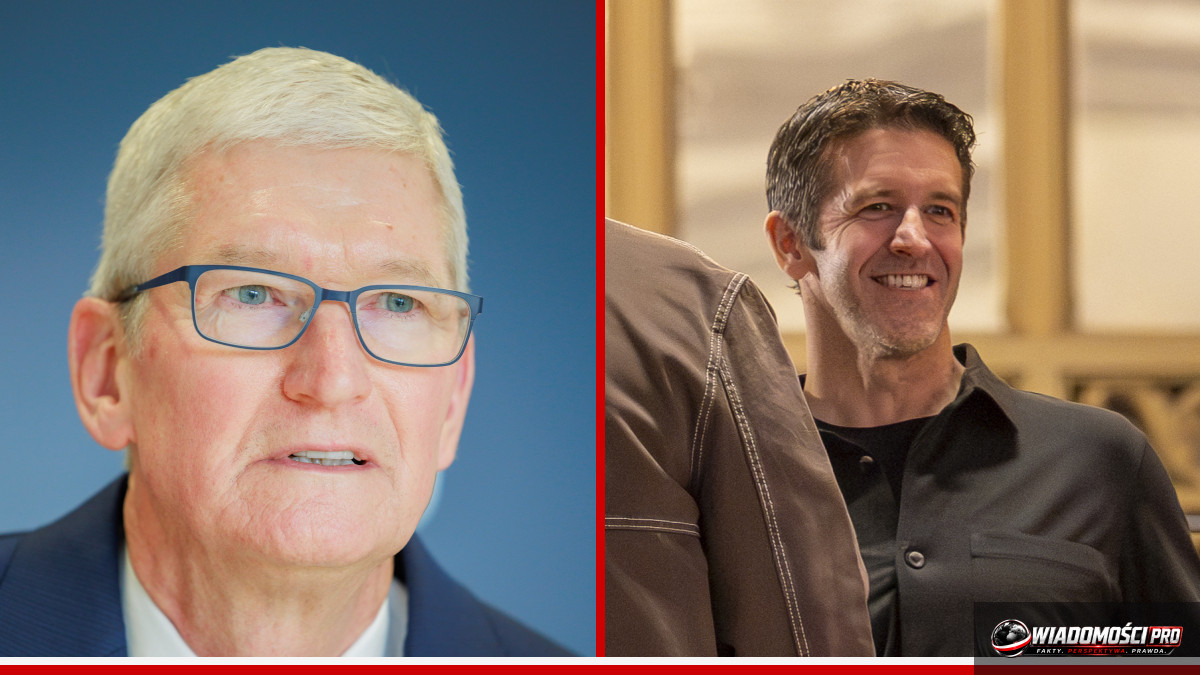
After 15 years of Tim Cook's reign, which brought the company 1000% growth in value, investors are reacting to John Ternus taking the helm with caution, analyzing today's session on Wall Street as a test of the giant's stability. Will Apple lose on the stock market? In the short term, the market will likely price in the uncertainty resulting from the lack of a charismatic leader; however, the corporation's financial fundamentals remain strong enough to limit the risk of a sharp sell-off. This change is not merely a cosmetic personnel shuffle, but the end of an era in which operational optimization was the main driving force.
The legacy of 15 years: A growth mechanism
When Tim Cook leaves the CEO's office on August 31, 2026, he closes a chapter that began in 2011. Back then, after the death of Steve Jobs, analysts looked with disbelief at the operations engineer who was to replace the visionary. Cook proved that he could turn innovation into a predictable stream of cash. His strategy was to build a supply chain so efficient that Apple's margins became unattainable for the competition. Under his leadership, the company not only survived but became the first entity with a market value exceeding three trillion dollars.
The 1000 percent growth was no accident. Cook focused on services, which today generate billions of dollars in quarterly revenue, shifting attention away from the saturated smartphone market. Apple became an ecosystem from which it is difficult for a user to escape. It is this stickiness of the customer base that builds today's stock value. Every iPhone sold is not just a profit from the device; it is access to Apple Pay, music, cloud, and subscriptions. Investors who bought Apple stock over the years knew they were paying for a "safe haven." Now that Cook is leaving, this definition of safety is being redefined.
The stock market does not like uncertainty, and a CEO change is a signal for trading algorithms to increase volatility. Institutional investors, holding blocks of shares worth hundreds of billions, are analyzing every communication from Cupertino, looking for a shadow of doubt regarding the continuity of the strategy. If Ternus begins with radical cuts or changes to the management structure, the stock price may react with a correction. If, however, he focuses on continuity, the market may ignore the fact that the previous leader has departed.
John Ternus: An engineer in the shadow of a great predecessor
John Ternus is not an outsider. He is a figure from the engineering division, the man who oversaw the development of the M-series processors. His appointment, announced back on April 20, 2026, was accepted as a signal that Apple does not want a revolution. The company is betting on a technocrat who understands the product from the inside out. This is the opposite of a management style that relied on marketing and building the leader's image as the "face of the company."
Ternus faces a challenge that Cook rarely dealt with: the need to prove that he can manage Wall Street's expectations in conditions of slowing sales. An engineer in the CEO chair is often a signal to the market that the company wants to return to its product roots, which may bring long-term benefits, but in the short term, it raises concerns about the ability to maintain financial momentum. Investors are asking whether Ternus has enough charisma to maintain shareholder loyalty when quarterly results stop breaking records.
The history of technology corporations knows cases where a change at the top led to long-term stagnation. Apple under Ternus must avoid the trap of "management by administration." If the new CEO limits himself to maintaining current product lines, Apple will become another boring giant, losing its edge over more aggressive competition. On the other hand, any attempt to go beyond proven frameworks is a risk that the market may not forgive.
Wall Street reaction: Session of August 31, 2026
Today's session on Wall Street is a testing ground for the new leadership. Trading volume in the first hours of trading indicates increased activity from hedge funds, which are trying to gauge sentiment. We are not observing a panic sell-off, which is a signal that the market accepted Cook's departure in advance. Nevertheless, P/E ratios for Apple remain at a level that requires continuous earnings growth to justify the current valuation.
Individual investors, who have accounted for a significant percentage of shareholders in recent years, are reacting to the change more emotionally. There is increased interest in put options, which suggests that some players are hedging against potential volatility. In turn, pension funds, for which Apple's stability was crucial, remain in "wait and see" mode. Their strategy is simple: as long as dividends are paid and buybacks are continued, the CEO change is secondary.
The market, however, does not forgive communication errors. The first earnings call under Ternus will be more important than any new iPhone launch. If the new CEO does not present a clear vision for maintaining margins, investors will start looking for alternatives in the technology sector. Apple under Cook became a machine that could not break. Now that the operator of this machine is leaving, every minor glitch will be interpreted as a symptom of a more serious failure.
Challenges for the new CEO: What awaits Ternus?
Ternus is taking over a company that has reached the peak of its capabilities in the current business model. The smartphone market is saturated, and Apple needs a new growth impulse. Will it be artificial intelligence, or perhaps entering segments that the company has avoided so far? These are questions that Ternus must answer before the end of his first year in office.
The first challenge is managing service margins. This is a segment that has driven growth in recent years, but it is becoming increasingly difficult to scale in the face of antitrust regulations in Europe and the USA. Ternus must balance the need to open up the ecosystem with maintaining its tightness, which was the foundation of Apple's success. Every concession to regulators is a potential blow to revenue.
The second challenge is organizational culture. Cook built a structure that works like a Swiss watch. Changing a leader in such a hierarchical company is a risk of talent drain. If key engineers feel that Ternus's new vision is contrary to their ambitions, Apple could lose its greatest advantage: the ability to create products that set standards. The market is watching to see if Ternus will keep the team together or lead to an exodus.
What's next for Tim Cook? A new role
Cook's departure from Apple does not mean his complete disappearance from public life. Reports of his involvement in projects related to Donald Trump's administration have sparked a wave of speculation. For investors, this is an unusual situation. On the one hand, Cook's experience in trade negotiations with China is invaluable to the US administration. On the other, the political involvement of the former CEO could cast a shadow over Apple's neutrality in terms of image.
Will Cook's cooperation with politicians help Apple avoid sanctions or new tariffs? This is a scenario that optimists are counting on. From a stock market perspective, the former CEO's political lobbying could be seen as "informal insurance" for the company. However, for some investors, it is a signal that the line between business and politics is blurring in a way that could be risky. Apple has always tried to avoid partisan disputes, and Cook's role could make that difficult.
For the market, it is important whether Cook will remain in an advisory role for Ternus. If so, the transition of power will be smooth and unnoticeable for the stock price. If, however, Cook completely cuts himself off from operational matters, investors may feel they are losing the only guarantor of stability they have known for a decade and a half. This will be a test for Ternus: can he build his own authority without using the shadow of his predecessor?
A historic shuffle in the tech sector
Silicon Valley history teaches that succession is the most difficult test for any corporation. The case of Apple is special because the company is not changing its CEO due to a crisis, but at the moment of its greatest power. This is an unprecedented situation. The changing of the guard in April 2026 was just a prelude, and today's assumption of duties is the ultimate test for the corporate structure built by Cook.
Investors are analyzing whether Apple has become a victim of its own success. The company is so large that every subsequent percentage of growth requires huge capital expenditures. Ternus must decide: continue aggressive share buybacks, which keep the price at a high level, or allocate those funds to risky investments in new technologies. The market expects the current financial policy to be maintained, but at the same time demands innovations that will justify further valuation records.
Comparing Apple to other giants that have undergone succession, such as Microsoft after Bill Gates or Google under Sundar Pichai, there are clear differences. Apple under Ternus has a chance for stable evolution, provided the company does not lose cost discipline. Every dollar spent by Apple is analyzed for return. This is Cook's legacy, which Ternus must nurture if he wants to avoid the wrath of shareholders accustomed to results exceeding analyst expectations.
What this means for you
The change at the top of Apple is a moment when investors must verify their approach to the company. If you are looking for a safe haven, Apple will likely remain one for years to come, regardless of who is sitting in the CEO's office. The cash-generating mechanism is too deeply rooted in the ecosystem to collapse overnight. However, if you are counting on rapid growth, you must closely follow Ternus's first decisions.
For the average user of Apple products, the change of CEO does not mean immediate effects on the quality of devices. Production cycles are planned years in advance. However, in the long term, Ternus's management style may affect how the company treats its customers – whether it will be an approach focused on maximizing profit from each user, or perhaps a return to the "utility above all" philosophy.
The stock market will react to Ternus depending on how quickly he can convince the largest investment funds that Apple under his leadership is just as predictable as it was under Cook. Trust on Wall Street is built over years and lost in one session. Today, August 31, 2026, the building of that trust begins anew. Every decision Ternus makes will be weighed on the stock market scale, and quarterly results will become the most ruthless judge of his skills.
The future under a question mark
Looking at today's quotes, there is clear caution. Investors do not want to sell, but are afraid to buy before the announcement of a new strategy. This is a classic state of suspension. Will John Ternus prove that he is the right man in the right place? We will know the answer not today, but in a few quarters, when we see the first financial reports signed with his name.
Apple is entering a new phase. The Tim Cook era was a time of unprecedented financial growth and stabilization. The John Ternus era will be a time of trial: can the giant that dominated the global economy maintain its culture and efficiency in a changing world? Investors who are watching the charts right now are waiting for one signal: that Apple remains Apple, even with a new captain at the helm.
The market always prices in risk, and a change of CEO is one of the greatest corporate risks. Apple, however, has assets that no other company has: a huge base of loyal users and powerful cash flow. This allows the company to go through the succession process calmly, as long as nothing unexpected happens within the organization. Ternus has a task before him that could overwhelm many a manager, but he also has the tools that allow him to work calmly.
Everything indicates that Apple will not lose on the stock market in a violent way, but it may enter a period of a sideways trend, during which the market will test the limits of the new leader's endurance. This is a time for patient investors who understand that 15 years of Cook's reign is a foundation upon which Ternus can build, but cannot completely rebuild without the risk of the structure collapsing. Today's session is just the beginning of a long verification.
Summary of the stock market situation
Analysis of today's market data confirms that Apple remains a company with enormous resistance to economic fluctuations. Although Tim Cook's departure is an event of historical significance, the stock market priced in this risk well in advance. John Ternus is not entering the company in a vacuum, but into a well-oiled structure that is capable of surviving a leadership change without losing liquidity.
Investors who were worried about the giant's future should focus on the fundamentals, not on personal sympathies. The numbers do not lie: Apple generates cash at a rate that allows for the implementation of almost any strategy. If Ternus maintains margins and does not make mistakes in communicating with the market, Apple has a chance for more years of growth. The stability that Cook developed is the new CEO's greatest capital.
For the stock market, the most important signal will be the maintenance of dividend and buyback policies. If Ternus confirms that these mechanisms remain intact, institutional investors will maintain their positions. This is a guarantee that Apple will not become a victim of speculation. The company's future under new leadership will depend on whether it can maintain the balance between innovation and efficiency that was the hallmark of the last decade.
Sources
- Tim Cook steps down as Apple CEO! What awaits the giant's stock? - Comparic.pl
- Apple: Tim Cook steps down, John Ternus is the new CEO - Press.pl
- Revolution at Apple. Tim Cook steps down at the end of August 2026 - Rzeczpospolita
- Historic change at Apple. Tim Cook steps down after 15 years, and the stock price reacts to the new CEO's name - Strefa Inwestorów
- Tim Cook steps down as Apple CEO after 1000% growth; John Ternus is his successor - Investing.com Poland: Currency rates, cryptocurrencies, stock quotes
- The end of the Tim Cook era. A big change at Apple - Money.pl
- Apple has a new CEO. The old CEO got a task related to Trump - Komputer Świat
- Tim Cook resigns as Apple CEO. Who is John Ternus, his successor? - PortalTechnologiczny.pl
Article prepared by the Wiadomości PRO editorial team with the support of artificial intelligence. Facts come from the sources listed above.


Komentarze (0)
Ładowanie komentarzy...