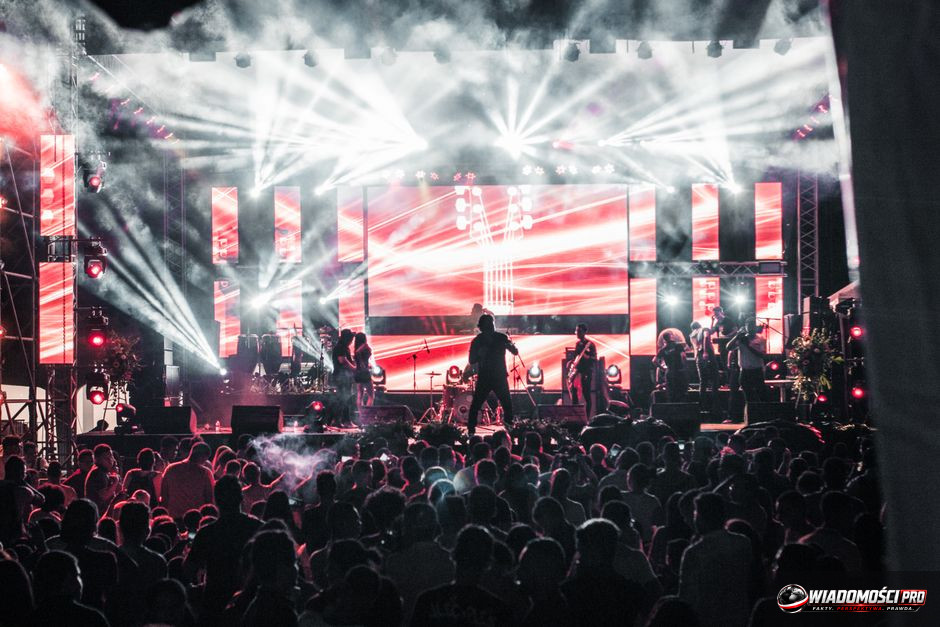
As part of the 'Obrotowy Tour 2026', Dawid Podsiadło performed in cities including Gdańsk, Poznań, and twice at the Stadion Śląski in Chorzów, selling out every single ticket. The ticket sales process, which began in September 2025, ended with the lightning-fast purchase of the entire pool of available seats in almost every mentioned city. Stadiums with capacities exceeding 40,000 spectators became the main points on the artist's concert map, which forced organizers to implement advanced logistical procedures.
Obrotowy Tour 2026 Schedule
The official tour calendar, made public in the first week of September 2025, covered the four largest metropolitan areas in Poland. The central point of the tour turned out to be the Stadion Śląski in Chorzów. Dawid Podsiadło appeared there on the first weekend of June 2026, performing two consecutive concerts. This venue, with a capacity of over 50,000 seats, required full mobilization from the technical team to prepare the rotating stage, which was the heart of the entire spectacle.
Other cities, including Gdańsk and Poznań, hosted the artist during the summer months of 2026. In Gdańsk, due to the enormous interest that appeared as early as the pre-sale stage, it was decided to add a second date at the Polsat Plus Arena Gdańsk. Stadion Poznań was also included in the schedule, filling up completely on the day of the event. Each of these facilities underwent technical adaptation to accommodate the stage structure placed in the center of the pitch. Wrocław completed the list of cities, closing the cycle of performances in the country's most important urban centers.
The logistics of these events were based on a rigorous assembly and disassembly schedule. The rotating stage, the hallmark of the "Obrotowy Tour", forced organizers to give up some seating areas that would have been available to the public in a standard stadium configuration. Despite the reduction in the number of tickets compared to classic concerts, demand remained at a level exceeding supply, which was confirmed by sales system data in the very first hours after the ticket platforms were launched.
The June date in Chorzów was a challenge not only for the performer but also for security and stadium technical staff. Two days of work in conditions requiring full synchronization of lights, sound, and stage mechanics became a maturity test for Podsiadło's staff. Fans in Poznań and Gdańsk, observing the sales successes from 2024, showed determination, buying up tickets at a pace that surprised even experienced concert industry analysts.
Record-breaking ticket sales
The ticket sales mechanism for the 2026 tour was launched immediately after the tour was announced, which took place on September 1, 2025. Industry websites, including Spider’s Web Rozrywka and Kultura Onet, pointed out in their very first publications that it was inevitable that all available seats would sell out. Ticket systems in Poznań recorded an overload at the moment sales opened, and in Gdańsk, an additional pool of tickets, introduced to the market after the first concert sold out quickly, was snapped up in just a few hours.
The numbers leave no doubt about the scale of the phenomenon. The Stadion Śląski, holding about 54,000 spectators, hosted a total of over 100,000 fans over the course of two June evenings. Similar occupancy was recorded in Gdańsk, where the Polsat Plus Arena, which can hold about 41,000 people, was completely full. An analogous situation took place at Stadion Poznań, where the facility's capacity of about 43,000 spectators was fully utilized, and every sector was sold out in official distribution.
The lack of availability in regular sales many months before the concert dates forced fans to look for alternative sources of purchase. The secondary market, operating based on classified ad platforms, recorded a drastic increase in ticket prices. Although organizers repeatedly warned against buying tickets from unofficial sources, the demand was so strong that tickets became a scarce commodity. The strategy adopted by Podsiadło's staff consisted of condensing the dates as much as possible in the June-July period, which further raised the temperature around the event.
Data from September 2025, published by Open FM, indicated that interest in the 2026 concerts was 20% higher compared to the 2024 series of performances. This is a mathematical confirmation of the success of a strategy in which the artist decides on a smaller number of concerts, but in the largest possible venues. Each city where a performance took place was a separate chapter in the history of this tour, with the record-breaking sell-out time in Poznań becoming a benchmark for the rest of the concert industry in Poland.
Dawid Podsiadło's stadium logistics
The scale of the "Obrotowy Tour 2026" forced organizers to use solutions that had previously been the domain of the world's largest musical productions. The rotating stage, placed in the central point of each stadium, required precise planning of the audience. Unlike traditional concerts, where the stage is at one end of the pitch, here the audience surrounded the artist from all sides. This technical layout necessitated a change in the sound system.
Logistics involved transporting dozens of tons of equipment between cities. After each performance, the technical crew had only a few dozen hours to dismantle the structure, transport it to the next city, and recalibrate it at the new facility. The stadium in Chorzów, due to its size, required the largest number of technicians, while in Poznań and Gdańsk, the key element was managing crowd flow within the limited stadium structures. Every element was planned based on technical specifications developed for the tour.
Participant safety was a priority. With capacities exceeding 40,000 people, managing entries and exits became an operation on a city-wide scale. Organizers worked closely with local authorities and emergency services to ensure communication flow. In Gdańsk, at the Polsat Plus Arena, a special transport plan was implemented to clear traffic congestion after the concert. Similar solutions were used in Poznań, where the proximity of the stadium to the city center posed an additional challenge.
It is worth noting that the decisions to choose these stadiums were not accidental. Stadion Śląski, Stadion Poznań, Polsat Plus Arena Gdańsk, and Stadion Wrocław are facilities that are certified to organize mass events of the highest degree of complexity. This choice allowed for the safe implementation of a plan that assumed every spectator would have similar audiovisual experiences, regardless of the seat they occupied in the stands. The rotating technology ensured that the artist was not "trapped" on one front, which changed the perception of the entire concert.
Comparison of concert scale 2024-2026
Analysis of data from 2024-2026 shows a clear upward trend in Dawid Podsiadło's concert reach. If in 2024 stadium performances were treated as an ambitious experiment, by 2026 they had become an obvious choice. Red Bull, in its 2024 reports, emphasized that the artist successfully broke the barrier between alternative music and the mass stadium audience. The 2026 tour only cemented this position, turning potential into measurable attendance data.
In 2024, concert logistics focused on filling standard spaces. Two years later, in 2026, Podsiadło abandoned simple solutions in favor of a rotating stage, which is much more difficult to operate. This is an evolution from a "concert for a crowd" to a "production for a crowd". This change was visible in the way tickets were sold – while in 2024 fans waited for announcements, in 2025 the purchase process was fully automated and based on queue systems that sold out pools in record time.
Comparing the concert map, a clear stabilization is visible. Chorzów, Gdańsk, Poznań, and Wrocław are fixed points that generate the highest demand. This stability allows organizers to better plan budgets, which in the long run translates into production quality. While in 2024 the artist had to prove his stadium value, in 2026 it was the venue organizers who sought to ensure that Podsiadło was the main point of their summer repertoire.
The evolution also concerns the audience itself. In 2024, fans of alternative music dominated the concerts, whereas in 2026, the stadium format attracted a wide cross-section of society, which was visible in the age structure of the participants. This is a phenomenon that goes beyond the music industry, becoming an element of pop culture. Stadium statistics confirm that Podsiadło has reached a level where his every next move is analyzed from an economic perspective by the largest entities in the entertainment industry.
Organizers' position on additional dates
Immediately after the tour was announced in September 2025, organizers faced questions about the possibility of increasing the number of performances. Official statements, published by media such as 4FUN.TV, indicated great caution from the artist's staff. The decision not to extend the tour to other cities was dictated by logistics – every additional day at a stadium means huge operating costs that cannot always be compensated for by ticket sales, even at full capacity.
The exception was Gdańsk, where immense pressure for tickets forced the decision to add a second concert. In other cases, such as the Stadion Śląski, where two performances had already been planned, no attempts were made to increase the number of days. This approach allowed for maintaining the narrative of the event's "exclusivity". Organizers consciously gave up on "encore" shows, which in the concert industry is a risky but effective way to maintain high prices on the secondary market and build the myth of uniqueness.
Behind the scenes, there was talk of the possibility of performing in other cities, but ultimately the schedule was closed at four main locations. The artist's staff prioritized quality over quantity. From a business perspective, this was an accurate decision because it allowed for technical continuity. Changing the location to a smaller facility could have lowered the standard of the show, which Podsiadło's staff could not afford in the context of building the "Obrotowy Tour" brand.
For fans who were hoping for additional dates, this situation was a source of frustration. However, from the organizer's point of view, every subsequent date is a risk of team fatigue and potential loss of interest if the market were to be saturated. Closing the tour in June and July 2026 was a well-thought-out move that allowed avoiding risks associated with autumn weather and lower availability of stadiums, which are used for football purposes later in the year.
Impact of the tour on the music market in Poland
Dawid Podsiadło's dominance in the stadium market in 2026 poses new questions for the industry. Is the success of the "Obrotowy Tour" a signal that the Polish mainstream has shrunk to one exceptionally popular artist? Data from portals such as Onet or Open FM clearly indicate that Podsiadło currently has no competition when it comes to the ability to fill stadiums on a national scale. This phenomenon creates a kind of monopoly in which other performers must look for niches to avoid direct comparison.
The technical requirements imposed by this tour have become the new norm. From 2026, every artist aspiring to play in stadiums must reckon with the fact that the audience will expect quality similar to what Podsiadło offered. This raises the entry threshold for younger musicians. Costs of production, security, and venue rental are rising, which makes the financial barrier insurmountable for most Polish creators.
On the other hand, the success of the tour shows that the Polish market is ready for large investments. Organizers, thanks to Podsiadło's results, can negotiate with stadium owners with greater confidence, which paves the way for subsequent foreign stars. The market has become more professional, and sales processes, which were still imperfect in 2025, have been optimized under the influence of the huge traffic generated by the singer's fans.
The risk mentioned by critics mainly concerns diversity. When one performer takes the majority of entertainment budgets, others must fight for the scraps. This is a process we observe in many European countries, but in Poland, it has gained strength precisely thanks to Podsiadło's stadium strategy. Is this a blessing for the market or a narrowing of it? The answer depends on whether we look at it from the perspective of promoter profits or the condition of the alternative music scene.
What this means for you
If you were planning to attend the "Obrotowy Tour 2026", you probably know that a ticket was a scarce commodity. For the average listener, the success of the tour means that live music has become a luxury product. The desire to purchase is no longer enough; financial and logistical readiness is required. The secondary market, which flourished on the wave of sold-out concerts, has become a permanent part of the landscape, which for many fans means the necessity of paying a margin to intermediaries.
For you, it also means a change in the way you experience music. A stadium concert has ceased to be an intimate meeting with an artist and has become a mass ritual. Technology, including the rotating stage, was meant to bridge the distance, but with 40,000-50,000 people in the audience, the communal experience dominates the musical one. If you are looking for contact with an artist in an intimate atmosphere, Podsiadło's stadium tours are not the place where you will find it.
However, it is worth noting the positives. Poland has become a point on the concert map to which the best lighting and sound professionals come. Organizing a tour at such a level is a signal that we can manage the largest logistical challenges in Europe. As a recipient, you receive a product that is refined in every detail, which was not always the standard in past decades.
Ultimately, if you didn't manage to buy a ticket in official distribution, you have two paths: either accept the prices of the secondary market or come to terms with the fact that the stadium format has its capacity limits. Podsiadło, by selling out all concerts, sent a clear signal: the demand for stadium shows in Poland is huge. As a consumer, you must be faster, better organized, and more aware of the mechanisms that govern today's entertainment market.
Questions and answers
Were there additional concerts in 2026?
Yes, the organizers responded to high interest by adding a second date at the Polsat Plus Arena Gdańsk. In other cities, such as Chorzów or Poznań, the schedule remained unchanged from the original assumptions.
Where did the main concerts of the tour take place?
The tour covered four key stadiums in Poland: Stadion Śląski in Chorzów, Polsat Plus Arena Gdańsk, Stadion Poznań, and Stadion Wrocław. This was a complete set of the most important concert venues in the country.
Did tickets for all concerts sell out completely?
Yes, all tickets for the 'Obrotowy Tour 2026' were sold out. This process, initiated in September 2025, ended with attendance success in each of the mentioned cities.
What were the main logistical challenges of the tour?
The biggest challenge was the rotating stage placed in the central part of the pitch. It required not only specialized assembly but also a change in sound configuration and security systems to ensure comfort for participants occupying seats around the stage.
What was the impact of the tour on the secondary market?
The lightning-fast sell-out of tickets in official sales meant that the secondary market became the main purchase channel for late fans. Prices on this market were significantly higher than the original ones, which was a direct effect of the huge demand that organizers faced from the moment the tour was announced.
Sources
- Dawid Podsiadło in Chorzów to play two concerts at Stadion Śląski - this weekend. "Obrotowy Tour" begins. Tickets sold out quickly... - Chorzów Nasze Miasto
- Dawid Podsiadło and his stadiums. By the numbers - Red Bull
- Dawid Podsiadło and the sold-out OBROTOWY TOUR 2026. Will there be additional concerts? - Open FM
- Dawid Podsiadło returns to stadiums. Announced Obrotowy Tour 2026 - Spider's Web Rozrywka
- Dawid Podsiadło returns to stadiums. "Obrotowy Tour" in 2026 - Kultura Onet
- Dawid Podsiadło will "fill" the stadium again, also in Poznań. Tickets sold out in record time, but there is good news for fans - ePoznan
- Dawid Podsiadło. Tickets sold out! There will be an additional concert at Polsat Plus Arena Gdańsk! - Gdańsk - official city portal
- Dawid Podsiadło returns to stadiums in 2026. Where and when will he play? - 4FUN.TV
Article prepared by the Wiadomości PRO editorial team with the support of artificial intelligence. Facts come from the sources provided above.

Komentarze (0)
Ładowanie komentarzy...