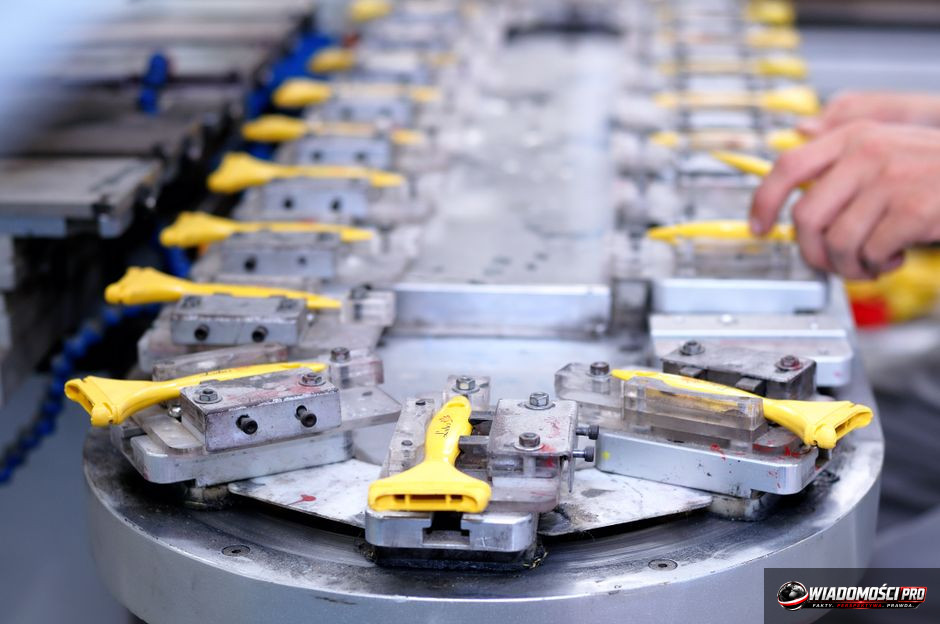
Polish companies cooperating with the German automotive sector are struggling with outstanding liabilities exceeding 310 million PLN, which, in the face of declining orders from across the Oder, means that most of them will not survive without support. The risk of bankruptcy is particularly high for smaller subcontractors operating in the Silesian and Greater Poland regions, who are losing liquidity due to payment bottlenecks and a drastic reduction in production volumes among major contractors. The lack of working capital in these regions is becoming a direct threat to thousands of plants specializing in metal processing, plastic injection molding, and the assembly of small electronic components.
German slowdown and the Polish supplier ecosystem
The German automotive industry has been a pillar of Polish exports for years. Today, this business model has turned into a trap. Poland has become one of the most important links in the European supply chain, providing everything from advanced engine components and body parts to cabin interior finishes. The situation at our western neighbor's, where assembly lines in Wolfsburg or Munich are slowing down, is hitting our companies with a force that many plant owners did not foresee in their budget plans. When a German giant cuts production, a Polish subcontractor working on minimal margins immediately loses liquidity.
Data as of August 29, 2026, indicates that the sum of outstanding liabilities in the industry has exceeded the 310 million PLN barrier. This is not an abstract number, but the sum of invoices that should have been paid on time but have been frozen. For small and medium-sized enterprises, which form the backbone of Polish parts production, this means a lack of funds to pay salaries, cover energy costs, or purchase raw materials. Many entrepreneurs from regions such as Lower Silesia, where production plants cooperating with German brands are concentrated, have no financial cushion.
Dependence on German demand, presented for years as a guarantee of stability, became the greatest weakness of the domestic industry in 2026. Manufacturers lack alternative markets that could absorb production capacity when the main partner cuts volumes. Data confirming whether some of these arrears will be written off as part of restructuring has not yet been provided. It remains to wait for the moves of the boards of large corporations, which are themselves on the defensive. The situation is binary. Without diversifying their order portfolios, these companies are becoming hostages to decisions made in headquarters located hundreds of kilometers from their production halls.
Financial analysis: Why is the debt reaching such high levels?
The debt mechanism of Polish suppliers is systemic in nature. Polish plants, in the hope of fulfilling contracts, must finance their current operational activities. They wait for transfers from contractors while the costs of labor, energy, and raw materials are rising at a pace that original margin calculations did not anticipate. When German giants reduce production volumes, the Polish subcontractor is left with capital frozen in semi-finished products and no cash in the account. Payment bottlenecks become a natural result of this imbalance.
The structure of this debt is not uniform. A recurring pattern is visible that is sinking even solid, long-standing businesses. Financial analyses of suppliers point to three main factors burdening margins: rising operating costs, lack of payments from contractors, and drastic cuts in contracts. However, there is a lack of a detailed breakdown of this debt into specific production segments. It has also not been officially confirmed what percentage of these liabilities consists of receivables overdue by more than 90 days, although voices from the industry suggest that these invoices make up the majority of the pool. The lack of transparency on the part of some principals further complicates the assessment of whether Polish companies still have any room for maneuver in restructuring negotiations.
Analysis of BIG InfoMonitor data regarding the industrial sector confirms that the automotive industry has shown some of the highest insolvency risk indicators in the last six months. These companies are no longer fighting for profits, but for basic financial liquidity. The financial situation of Polish subcontractors for the German automotive sector has become critical. Every day of delay in payments means for a smaller entity the need to take out expensive working capital loans, provided that banks decide to provide support at all in such an uncertain state of the sector.
Threatened subcontractors: Who will feel the slowdown the most?
The SME segment, where a financial safety buffer is practically non-existent, is being hit the hardest. While large plants with foreign capital can count on the support of their headquarters, a local subcontractor, often dependent on one or two contracts from across the Oder, loses its footing the moment payments stop. Lack of diversification is the cardinal sin here, for which the highest price must be paid. If a German contractor cuts orders, a Polish workshop or factory stops earning. There is no alternative market that could absorb production capacity overnight.
Who is most at risk of losing liquidity? An analysis of the current debt structure points to three groups of entities that will be fighting for survival in the coming months:
- Companies specializing in internal combustion engine components: This is the most painful point. The transformation toward electromobility (EV) means that demand for traditional components is fading faster than these companies have managed to retool their production lines.
- SME sector enterprises without a diversified client portfolio: Dependence on one German partner is becoming a death sentence. When the main recipient stops payments or drastically reduces volumes, the company has no way to cover current operating costs.
- Subcontractors with low operating margins: Any downtime in deliveries, even for two weeks, causes immediate payment bottlenecks for them.
There is a lack of hard data on the scale of planned mass layoffs in these specific entities, as many of them are trying to save themselves with quiet staff cuts instead of official procedures. The market is waiting for confirmation of how deep the wave of bankruptcies will be in the fourth quarter of 2026. For now, we only know that the sum of arrears is a burden that cannot be borne alone. Those companies that spent years building their position in the shadow of German giants are today facing the specter of a complete shutdown of operations.
The role of banks and financial institutions in the liquidity crisis
The situation is exacerbated by the attitude of financial institutions. Banks, observing nervous movements in the automotive industry, have significantly tightened credit criteria for entities in this sector. Access to external financing, which could provide a safety cushion during periods of downtime, is currently significantly limited or burdened with costs unacceptable to many medium-sized companies. Entrepreneurs are left in a trap. The reduction of production volumes among major principals means that every subsequent invoice with a deferred payment term brings them closer to insolvency.
There is a lack of official data indicating exactly how many companies have already filed for restructuring for this reason, as manufacturers avoid publicizing problems for fear of losing the trust of contractors and banks. This is a destruction of liquidity that, without systemic intervention, could permanently eliminate many Polish subcontractors from the market. Instead of investing in development or retaining staff, company boards are busy putting out fires in accounting departments. This is not a crisis that will pass after one quarter. It is a process that requires Polish entrepreneurs to make radical decisions regarding the structure of their operations.
The cost of capital that companies trying to stay afloat must bear often exceeds the margins generated on contracts. In practice, this means that production becomes unprofitable the moment it begins. Companies have no choice – they must renegotiate terms, but contractors from across the Oder, themselves fighting for profitability, rarely show a willingness to make concessions. This is a vicious cycle that tightens with every day of delay in payments.
Can Polish companies escape German dependence?
Rescue strategies must be based on hard data, not hopes for a quick return of the economic boom. The directions for diversification are known, but their implementation raises serious financial doubts. Among the paths out of the impasse, experts point to a quick reorientation toward non-European markets, mainly in Asia and the USA, which, however, requires a complete reconstruction of logistics chains. The second path is to focus on other sectors of the economy, such as the renewable energy industry, where demand for components shows growth potential. The third option remains the consolidation of smaller players into larger capital groups, which could increase their resistance to market fluctuations.
The problem lies in entry barriers. Switching to new technologies and obtaining the necessary certifications to enter non-EU markets requires investments that indebted entities cannot afford. The lack of detailed data on the availability of external financing for these companies makes it necessary to approach ambitious expansion plans with great distance. Skepticism is justified here. Most likely, only those who built a financial cushion before the current collapse will survive. The rest, without real capital support, will become victims of the consolidation process or simply disappear from the market.
Escaping dependence requires changes for which many entrepreneurs simply no longer have the capital. The situation requires company boards to have the courage to make decisions about moving away from contracts that generate losses. This is a difficult lesson for the Polish automotive industry, which for decades has become accustomed to the role of a reliable, stable supplier. Today, these rules no longer apply.
Forecasts for the end of 2026 and the year 2027
The last months of 2026 will bring a wave of restructuring proceedings that the Polish auto parts market has never seen before. Industry analysts have no illusions: the number of applications for protection from creditors will increase drastically in the fourth quarter. This is a direct result of payment bottlenecks that have grown to such high levels. Smaller subcontractors, deprived of a financial buffer, are becoming the first victims of the German austerity policy. German automotive concerns are not waiting for an improvement in the economic situation. Instead, they are nervously revising their supply chains.
In their new strategy, there is no room for sentiment or long-term partnerships. Financial stability has become the priority, which means that contracts go only to entities with the highest liquidity, capable of surviving quarters on starvation rations of orders. This is a brutal selection that promotes only the strongest players, pushing the rest to the margins. The outlook for 2027 paints a picture of a market in which only a few will survive. The condition for survival is no longer just the quality of components, but absolute cost efficiency and having a diversified portfolio of recipients.
Companies based solely on German capital or one large contractor are in a trap. If they fail to attract clients from other markets or industries in a short time, bankruptcy will become a matter of time, not choice. However, there is a lack of concrete government support plans for the sector, which further worsens the mood among subcontractors. No one has officially confirmed any government aid programs dedicated strictly to Polish automotive companies that have found themselves in this financial clinch. What remains is the pure economics of survival, where the winner is the one with the lowest unit cost and the largest reserve capital. The rest must reckon with the closure of production lines.
What this means for you
The crisis in the German automotive industry is a warning signal for the Polish economy. Companies that have already opted for diversification will gain, while those that have become hostages to German capital will lose. The catch is that the current debt is only the tip of the iceberg. If German demand does not rebound in 2027, we are facing a wave of bankruptcies that will not be limited only to subcontractors, but will hit local labor markets in industrial cities.
For the employee, this is a real risk of staff reductions, and for investors, it is a signal that the automotive industry in its current form requires a complete overhaul. There is no room for sentiment when the survival of entire production groups is at stake. Companies that cannot adapt to the new financial realities will be replaced by players with greater flexibility, perhaps from other regions of the world.
Questions and answers
Does the current level of debt mean an imminent wave of bankruptcies in Poland?
This is an amount indicating huge liquidity problems. A wave of bankruptcies in the fourth quarter of 2026 is very likely, unless banks change their approach to financing the sector or contractors accelerate payments.
Why don't Polish companies have other clients?
Many companies entered into close cooperation with German concerns decades ago. This provided stability and certainty of orders, but in the current crisis, it has become a trap of high dependence. The lack of diversification was the result of many years of focusing on one, very absorbent market.
What actions are Polish subcontractors taking to survive?
Entrepreneurs are cutting operating costs, renegotiating agreements with banks, and trying to look for orders in alternative industries, such as the warehousing sector or energy. Some companies are also considering consolidation to increase their bargaining power in negotiations with large contractors.
Is the government planning help for automotive companies?
At this moment, no government aid programs dedicated strictly to Polish automotive companies have been confirmed. Entrepreneurs are left to fend for themselves in the fight for financial liquidity, which forces them to look for ways out of the crisis on their own.
Will 2027 bring improvement?
The outlook for 2027 suggests that the market will undergo a process of brutal selection. Only those companies that demonstrate absolute cost efficiency and have a diversified portfolio of clients will survive. Other entities will have to reckon with the closure of production lines or takeovers.
Article prepared by the Wiadomości PRO editorial team with the support of artificial intelligence. Facts come from the sources provided above.



Komentarze (0)
Ładowanie komentarzy...