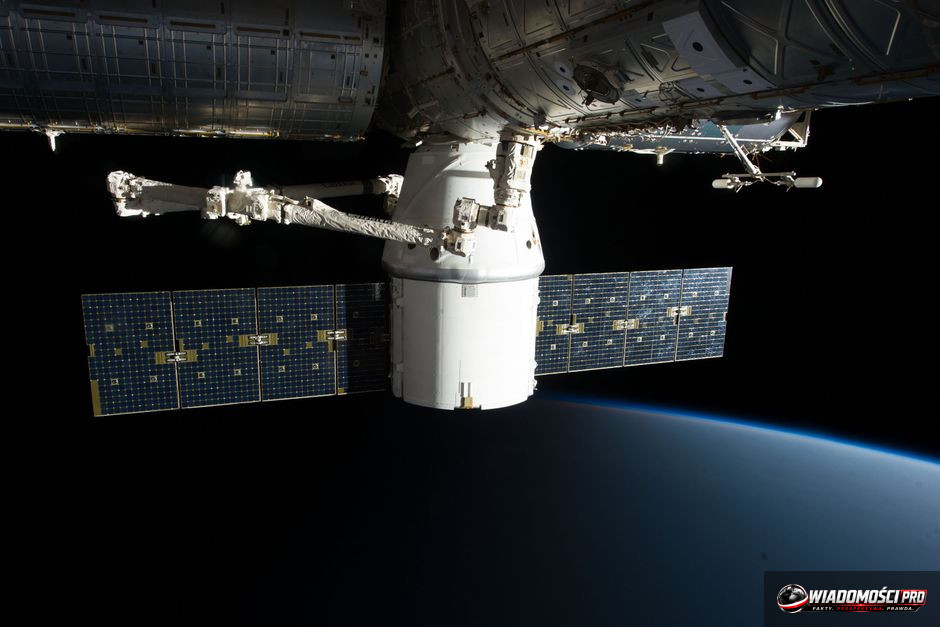
Yes, a Polish startup has developed a microwave system designed for the active defense of satellites, which will allow for the neutralization of threats in outer space using non-kinetic technology. SpacePulse Dynamics presented the solution on August 26, 2026, in response to the growing militarization of Earth's orbit. The project enables the paralyzing of enemy object electronics without generating a cloud of dangerous debris.
The technology operates in the high-frequency band known as HPM – High Power Microwave. Engineers used high-gain phased array antennas that form a precise energy beam. The pulses have a peak power in the gigawatt range, yet their duration is measured in nanoseconds. This characteristic allows for a reduction in the onboard power requirements of the defender satellite. The device uses advanced high-power-density supercapacitors, which enable multiple shots during a single mission. The system operates at the molecular level in semiconductor circuits, inducing surges that permanently destroy the opponent's processors and optical sensors.
The development of non-kinetic technology became a necessity after the events of January 2025. At that time, China conducted a series of tests on pulse systems whose parameters were similar to the effects caused by nuclear explosions in the ionosphere. These observations caused deep concern within NATO structures, as weapons of this type can disable entire constellations of spy and telecommunications satellites without the use of conventional missiles. Poland, as a country increasing its commitment to the space sector, decided to invest in its domestic defense infrastructure.
The budget for this venture has not been fully disclosed in the public financial registers of the Ministry of National Defense. Estimates based on personnel involvement and the costs of flight-ready components indicate expenditures in the range of hundreds of millions of zlotys over the last three years. The ministry supports research into microwave systems as part of the technical modernization of the Armed Forces. Representatives of the Ministry of National Defense treat this project as the foundation of "active protection of orbital infrastructure." This is a significant paradigm shift – moving from passive threat monitoring to active counteraction. The cooperation of SpacePulse Dynamics with research units subordinate to the ministry allowed for the integration of the system with Polish observation satellites.
Market interest in this solution grew rapidly in July 2025. Private investors and foreign contractors recognized the potential of non-kinetic technologies in the face of a real technological race. The Polish company outperformed many competitors from Western Europe thanks to a unique approach to the miniaturization of microwave emitters. The main barrier remained heat dissipation in vacuum conditions. SpacePulse Dynamics used innovative radiators based on carbon nanostructures, which increase the heat dissipation surface while maintaining minimal device mass.
The effectiveness of the system on the battlefield depends on the precision of guidance. It uses advanced artificial intelligence algorithms that analyze the trajectory of an opponent's object in real-time. In an orbital environment, where objects move at speeds of thousands of kilometers per hour, the margin of error is almost zero. The manufacturer declares the ability to neutralize a threat from a distance of several dozen kilometers. This is a promising result, considering the operational scale of outer space.
The issue of the "Kessler syndrome" was the main argument for choosing microwave technology instead of kinetic. The use of anti-satellite missiles generates thousands of pieces of debris that remain in orbit for decades, creating a threat to the entire global satellite infrastructure. Polish microwave technology completely eliminates this risk. An opponent's satellite does not disintegrate after receiving a pulse. It becomes a "dead" object that continues its flight along its existing orbit, yet loses all operational capabilities. It is a solution that is safe for the orbital environment.
The presentation on August 26, 2026, confirmed the full scalability of the system. Microwave modules can be mounted both on large military satellites and on smaller microsat-type platforms. This allows for the construction of a distributed orbital defense network. Such a configuration makes it significantly harder for an opponent to carry out an effective attack, as it forces them to neutralize dozens of independent defensive points. Each of them has its own detection and microwave response system. This approach removes the burden of protection from a single, expensive device, shifting it to a flexible network of cooperating satellites.
However, SpacePulse Dynamics faces serious certification challenges. Every device launched into space must undergo rigorous testing for resistance to cosmic radiation and extreme temperature fluctuations. Microwave systems are particularly sensitive to self-interference, which forced engineers to put a huge amount of work into shielding the electronics controlling the emitter. Unofficial data confirms that the Polish solution has passed initial tests in vacuum simulators, demonstrating stability during multiple discharges.
The change in approach to space security stems from a series of incidents in 2025. As late as the middle of that year, most NATO countries treated orbital threats as hypothetical. Only the Chinese pulse tests forced decision-makers to change their priorities. Poland, thanks to the agility of its technology startup sector, managed to quickly consolidate knowledge in the field of microwave engineering and astronautics. The final product changes Poland's negotiating position within the alliance. Possessing its own defensive technology gives Warsaw a strong bargaining chip in talks about the joint defense of NATO's satellite infrastructure.
International law experts point to the risks associated with the use of microwave weapons. Even a defensive application could be considered an act of aggression in light of treaties concerning the peaceful use of outer space. The Polish company argues that the system is defensive by nature, serving solely to neutralize threats directly aimed at Polish assets. The line between defense and attack, however, is extremely thin. It is enough for the system to be used to blind a reconnaissance satellite to trigger a serious diplomatic incident. Therefore, work on a doctrine of use that precisely defines the rules of military engagement in space is necessary.
Power supply is also a technical challenge. Standard solar panels will not provide the power required for a powerful voltage spike in a fraction of a second. SpacePulse Dynamics had to develop a buffer system that accumulates energy continuously to release it in a single pulse. The use of high-efficiency supercapacitors allows for the maintenance of the system's compact size. This is crucial, as every kilogram of mass launched into orbit is associated with huge logistical costs.
The development of the situation in the coming years will force the intensification of work on threat detection systems. The microwave weapon itself is only one piece of the puzzle. To be effective, a satellite must know when and in what direction to emit a pulse. This requires advanced Space Situational Awareness (SSA) systems. The Polish company, by developing a defense system, is entering the field of orbit monitoring. This allows for the creation of a complete ecosystem in which Polish satellites become intelligent guardians of their own infrastructure.
The issue of resistance to counterattacks remains a priority. If an opponent learns of the presence of a microwave system, they may attempt to destroy the satellite before the defense is activated. Therefore, SpacePulse Dynamics focuses on the secrecy of operational parameters and modular construction. Emission antennas can be hidden inside the satellite's housing and extended only when a direct threat is detected. Such a "stealth" approach in space is a novelty that could revolutionize the design of future military satellites.
The question of the ability to mass-produce remains open. We will know the answer within the next 24 months. Until now, Polish companies in the space sector have specialized mainly in providing individual components or software. Moving to the production of complete weapon systems is a challenge requiring rigorous military certification and quality control. If, however, SpacePulse Dynamics maintains its current pace of work, Poland will become a key supplier of defense technologies in the region. This will significantly strengthen our importance in NATO structures.
An important element of the whole is cooperation with Polish technical universities, such as the Warsaw University of Technology or the Military University of Technology. It is there that the staff forming the foundations for advanced space projects are educated. The startup's success is the success of the entire innovation ecosystem. It allows the most talented engineers, who previously chose career paths in foreign corporations, to be retained in the country. Having the opportunity to work on projects that change the face of national security, they gain a strong motivation to remain in the Polish defense sector.
The microwave system of the Polish startup is a demonstration of technological capabilities and a step towards sovereignty in outer space. In a world where orbit is becoming a theater of war, possessing one's own defensive tools is a matter of survival. Many tests and challenges related to implementation into operational service still lie ahead. Poland is ceasing to be just a passive user of space and is becoming an active player taking care of the security of its orbital assets. It remains to wait for the first results of tests in space range conditions, which will finally confirm whether Polish technical thought is able to match the challenges posed by global powers.
For the Polish taxpayer, this means increased security for digital services, such as satellite communications, GPS navigation, or financial systems. An attack on satellite infrastructure could paralyze key areas of the state. Possessing a microwave shield drastically raises the threshold of profitability of a potential attack for an opponent. We also gain in technological prestige, which makes it easier to attract foreign partners in the high-tech sector. The catch lies in the costs – maintaining and continuously developing such advanced systems requires constant, high funding, which must compete with other defense needs of the state.
Questions and answers
Is this weapon safe for other satellites?
Yes, microwave technology is precisely directed and serves to neutralize only the selected target, without creating clouds of debris, which makes it safer than traditional kinetic methods.
When will the system enter full operational use?
Following the announcement on August 26, 2026, the project is in the phase of intensive system tests. Operational implementation into the Polish satellite constellation is planned within the next few years.
How does Polish technology compare to Chinese technology?
Poland focuses on the defensive use of microwaves to protect its own assets, while the Chinese systems from 2025 raise concerns due to the generation of pulses with the destructive force of a nuclear explosion, which is an offensive approach.
Currently, the situation in orbit is constantly changing. Every month we observe an increase in the number of objects sent by state and private entities. This density makes outer space increasingly crowded, and consequently, more susceptible to incidents. In such an environment, possessing defensive technology is no longer a choice, but a necessity. Poland, entering the game with a microwave system, is betting on solutions that do not destabilize the orbital environment. This is a pragmatic approach.
The added value of the Polish system is also the possibility of its continuous improvement. The architecture of the software controlling the emitter allows for remote updates, which is a standard in modern defense systems. Engineers from SpacePulse Dynamics are already planning subsequent versions of the system, which are to offer a greater range of destruction and even more effective cooling systems. Each of these steps brings Poland closer to self-sufficiency in the field of space asset defense.
Of course, not everything goes according to plan. Problems with the availability of space-certified components are the bane of every manufacturer in this industry. SpacePulse Dynamics must deal with long delivery times for radiation-hardened semiconductors, which affects the pace of production. Nevertheless, the determination of the team and government support allow for the maintenance of the fluidity of work.
Poland, as a member of NATO, must also take into account the requirements of its allies. Integration of Polish systems with NATO's defense architecture is a necessary condition for this technology to be useful in a broader context of collective security. Talks with partners from the USA and Germany are already underway. Their goal is to develop common standards for the exchange of data on space threats. Without such an exchange, even the most advanced microwave weapon will be merely a gadget with a limited operational range.
From an operational perspective, these systems also require appropriate personnel preparation. Operating microwave devices in space differs from operating ground-based systems. It requires an understanding of orbital dynamics and the specifics of electronics operation in a vacuum. The Military University of Technology is already adapting its curricula to train future operators of space defense systems. This is an investment in human capital that will pay off in the future.
From an economic point of view, Polish success in this field can become a flywheel for the entire defense sector. Successes in space projects attract the attention of venture capital funds that are looking for innovations with global potential. If SpacePulse Dynamics manages to commercialize its solution, it could open doors for other Polish companies in the space industry. This industry, although still niche, has the potential to become one of the pillars of Polish exports of highly specialized technologies.
Ultimately, the most important test for the Polish solution will be its use in range conditions. So far, the system has been tested only in simulators. Simulation, although advanced, never fully reflects the conditions prevailing in orbit. Therefore, the first test flights on board dedicated satellites will be crucial. If the results confirm the design assumptions, Poland will be able to officially announce full operational capability in the protection of its own space assets.
In summary, the microwave system is the result of many years of efforts by engineers and a strategic decision to develop our own defensive capabilities. It is a project that combines science, engineering, and security policy into one coherent whole. Will this system defend our satellites? The answer is: it gives us a tool that we did not have before, and its effectiveness will depend on further development and integration with other defense systems. In a world where outer space is ceasing to be a zone of peace, Polish microwave technology is proof that we can take care of our own interests in a modern and responsible way.
Looking to the future, other threats must also be taken into account. Cyberattacks on satellite control systems are just as dangerous as physical attacks. SpacePulse Dynamics announces that subsequent versions of their system will integrate advanced quantum encryption, which is intended to secure the system against unauthorized takeover. This shows that the company thinks about security in a comprehensive way, not limiting itself to only one type of threat.
International cooperation within European programs, such as those conducted by the ESA (European Space Agency), also plays a role in the development of this technology. Although Poland funds its own startup, participation in European research projects allows for access to the latest research results on aerospace materials. This is a synergistic approach that allows for faster progress of work than in the case of isolated development.
One cannot forget about ethical aspects. The use of microwave technologies raises controversy, just like any new form of weaponry. The public debate on this topic is only just beginning. It is important that the public understands why we are investing in such solutions and what threats they are intended to neutralize. The transparency of the Ministry of National Defense's actions in this regard will be crucial for maintaining social support for the program.
Events of recent years show that the world is changing faster than experts predicted. The year 2026, in which the Polish system was presented, is a breakthrough year. Poland has proven that it can react to threats at a time when others are still debating strategy. This is exactly what distinguishes leaders from observers on the international arena.
Finally, the entire undertaking is proof that Polish technical thought can aim high – literally and figuratively. From concept to prototype, from laboratory to vacuum simulator, from theory to real defensive capabilities – this is the path that Polish engineers have traveled. Now it is time for a test in real conditions. If this system proves to be as effective as the data so far indicates, Poland will become one of the leaders in the field of non-kinetic space defense.
Thus, all the pieces of the puzzle seem to be in their place. A team of engineers, state support, an innovative approach to microwave physics, and a clear development strategy. All these factors indicate that the Polish startup's microwave system has a real chance of success. Will it become a standard in satellite defense? Time will tell. For now, it is the most serious Polish response to the challenges of modern space geopolitics.
Every subsequent test, every subsequent improvement brings us closer to the moment when we will be able to feel safer in orbit. For a country whose economy increasingly depends on space technologies, this is a foundation for development. Investment in SpacePulse Dynamics is not just an investment in a weapon; it is an investment in the security of Poland's digital future. We are left to keep our fingers crossed for the further successes of Polish engineers and wait for the first reports from the operational use of the system in orbit.
So, will the Polish microwave weapon defend our satellites? All signs in the sky and on the ground indicate yes – provided that we can maintain the pace of work and overcome the certification challenges. Poland has entered the game in outer space and intends to stay in it, betting on its own, innovative solutions. This is a story that we will follow with attention over the coming years.
Sources
- Polish company created a microwave weapon. Ours will arm space - Spider's Web
- Speed and precision. Non-kinetic technologies for space warfare - Space24.pl
- China has developed a new weapon. Pulses comparable to a nuclear explosion - Money.pl
- Microwave weapon enters a new level. The queue of those interested is already forming - Spider's Web
- China's new weapon. It generates pulses similar to a nuclear explosion - Space24.pl
- Polish startup created a microwave weapon to defend satellites - Wykop
Article prepared by the Wiadomości PRO editorial team with the support of artificial intelligence. Facts come from the sources listed above.


Komentarze (0)
Ładowanie komentarzy...