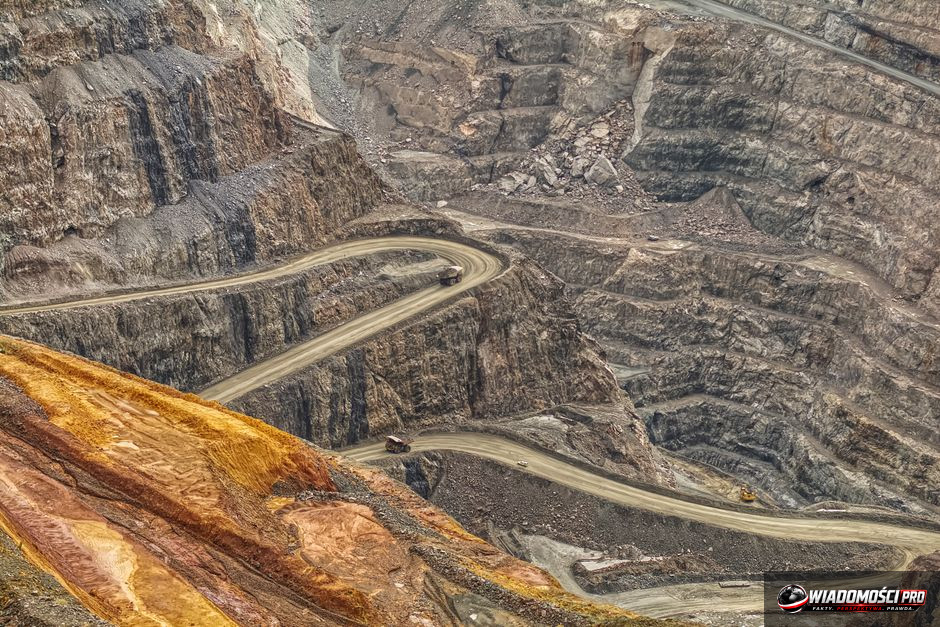
KGHM plans to invest PLN 32 billion in its 2055+ strategy, which, through the construction of new mines on four continents, is intended to diversify production and permanently strengthen the company's foundations, which in the long term is expected to be a key factor in stock valuation growth. However, the 2055+ strategy is a balancing act for the stock: such massive CAPEX amid current market volatility will significantly burden the balance sheet, making operational success the only way to avoid the erosion of shareholder value. Investors must prepare for a period of increased financial pressure, where the final verdict will be delivered not by management's promises, but by the ability to maintain margins while servicing debt.
Strategy 2055+: A gigantic capital burden
The announcement of an investment program worth PLN 32 billion defines a new era in KGHM's history. This is an amount that shifts the company's center of gravity from the current exploitation of domestic deposits toward aggressive global development. The first stage, scheduled for 2026–2030, represents a hard test of financial liquidity. Management does not hide the fact that the business model requires restructuring. Instead of relying solely on resources located in the Copper Basin, the company intends to spread its operational network across four continents.
For the stock market investor, the most important question remains the issue of bearing such a high CAPEX ratio. The company's current debt-to-EBITDA ratio is a parameter that the market will follow with increasing attention. Every zloty spent on a new mine abroad is a zloty that does not go into working capital or into the pockets of shareholders in the form of dividends. The scale of the investment suggests that management assumes high copper prices in the long term, which is intended to justify the incurred expenses. However, if the commodity market slows down, the company's balance sheet may come under pressure, which will not be helped by maintaining the dividend policy.
Financing such extensive projects requires either high cash generation from current assets or an increase in net debt. In an environment of high interest rates, the cost of debt service becomes a significant factor reducing net income. Investors must therefore assess whether PLN 32 billion is an optimal capital allocation or rather an attempt to escape the depletion of deposits in Poland.
Geography of mining: Four continents within KGHM's reach
KGHM is breaking out of the tight corset of European assets, opting for a distributed model. Expansion on four continents is not just a change in logistics, but above all a change in risk management philosophy. The company, which until now was strongly tied to Polish geological law and EU regulations, is entering the game in markets with completely different characteristics.
Diversification of production sources is theoretically intended to smooth out earnings volatility. When copper prices fall in one region or when energy supply disruptions occur there, other mines are supposed to take on the burden of generating revenue. Practice shows, however, that every new jurisdiction brings new challenges. KGHM will have to manage mines in places where energy infrastructure, transport, or the availability of skilled labor significantly deviate from the standards developed domestically.
Geographic dispersion means that KGHM ceases to be a "Polish company with foreign assets" and becomes a global mining concern. For shareholders, this is a change in the company's profile – from a safe, domestic dividend investment toward an aggressive market player. Such a transformation always carries the risk of underestimating the costs of building mines, which is an endemic phenomenon in the mining industry. Building a mine from scratch, from the exploration phase to commercial extraction, takes years and is susceptible to inflation in the costs of materials, energy, and engineering services.
Operational risk: What does this mean in practice?
The operational risk repeatedly raised in the report is not just a theoretical construct. In the context of the 2055+ strategy, it means specific threats that management must face. The first is currency risk. KGHM's revenues are denominated in dollars, while a significant portion of fixed costs in Polish mines is incurred in zlotys. Foreign expansion introduces a new variable – operating costs in the local currencies of the countries where the new mines will be built. Exchange rate fluctuations can either increase the margin or drastically reduce it, regardless of mining efficiency.
The second, equally important aspect is political and regulatory instability. By entering developing countries, KGHM becomes a hostage to local mining and tax laws, as well as social sentiment. A change of government in a region where the company plans to build a mine is enough for the introduction of new mineral taxes or stricter environmental requirements to negate the assumed profitability of the project.
Another example of operational risk is logistics. Copper mining is not just the exploitation of the deposit itself, but also the transport of ore from hard-to-reach places to ports or smelters. In many jurisdictions where KGHM intends to appear, rail or road infrastructure may require accompanying investments. These are additional costs that are often not included in initial valuations and which can significantly strain the PLN 32 billion budget. Managing mines on four continents also requires creating extensive management structures on-site, which increases general administrative costs and dilutes central control.
How will investments affect stock valuation?
The capital market is ruthless toward companies that finance development at the expense of cash flows if it does not see an immediate return. In the case of KGHM, investors will evaluate the 2055+ strategy through the prism of the debt-to-EBITDA ratio. If this ratio starts to rise dangerously, the market may discount the shares, fearing for the company's liquidity.
Long-term stock valuation growth depends on whether the company can increase the scale of production in a cost-effective manner. If new mines generate copper at lower unit costs than current assets, the operating margin will increase, which will become fuel for the share price. If, however, foreign mining costs turn out to be higher, the 2055+ strategy will become a burden that will pin the valuation to low levels for decades, despite an increase in sales volume.
A key element of the assessment for analysts will also be the efficiency of capital utilization. Investors will ask: could these PLN 32 billion have generated a higher rate of return if invested in optimizing current processes or in new processing technologies, rather than in risky exploration in unknown markets? We will only know the answer to this question after the first reports from foreign projects, when we see whether the assumed production levels are realistic or remain merely in the realm of management's wishes.
Dividend policy in the face of record expenditures
Maintaining a dividend policy while simultaneously spending PLN 32 billion on investments is a declaration that requires extraordinary financial discipline from management. In the world of mining, one usually either invests in development or pays a dividend. Attempting to reconcile both these goals is a signal to the market that the company feels confident about its current cash flows.
For the individual investor, the dividend is often the only tangible profit from the stock. If KGHM maintains payouts, the market may forgive temporary profit declines caused by capital expenditures. If, however, the company is forced to cut the dividend due to the costs of building mines, we can expect capital outflows, especially from pension funds and income-oriented investors.
The question of the sustainability of this policy is valid. Does management have sufficient cash buffers so that in the event of a collapse in copper prices, it does not have to choose between the dividend and continuing the 2055+ strategy? History shows that in times of crisis, it is precisely foreign investments that are the first to fall victim to budget cuts. If KGHM actually implements the strategy without compromising the dividend, it will be a phenomenon on a European scale, testifying to the exceptionally high margins of current operations. If not – the market will judge it as a lack of realism in financial planning.
Schedule 2026–2030: Key dates for investors
The 2026–2030 period is defined as the first stage of the 2055+ strategy. During this time, the company should move from the planning phase to the implementation phase, which means launching the first mining projects outside of Europe. For investors, this is a time to observe whether schedules are being delayed. In mining, every year of delay is a loss counted in billions of zlotys of lost revenue.
The approval of the strategy for 2026–2030 at the end of the second quarter of 2026 was a signal to the market that KGHM is no longer just talking about changes, but is starting to implement them. Investors should track quarterly reports for two indicators: the pace of spending from the PLN 32 billion pool and progress in obtaining concessions on new continents.
Below is a summary of the key parameters that will define the coming years at KGHM:
- Capital expenditures under the 2055+ strategy – PLN 32 billion.
- Horizon of the first stage of the plan – 2026–2030.
- Date of strategy announcement – end of Q2 2026.
These dates and numbers represent the framework within which the share price will move. If KGHM delivers operational results on time, market confidence will grow. If, however, schedules begin to stretch and costs rise, investors will begin to price the company with a higher risk premium. The coming years are a time for building management's credibility in the eyes of foreign capital, which until now has treated KGHM as a local player.
Risks and opportunities: Is the 2055+ strategy a safe direction?
Is the 2055+ strategy an opportunity for growth, or rather risky fuel for the stock? The answer is not unambiguous. On one hand, diversifying production on four continents is the only way for the long-term survival of a mining company whose domestic deposits are not inexhaustible. On the other hand, the scale of PLN 32 billion in investments amid current macroeconomic challenges is open-heart surgery.
The opportunity here is to create a global concern that, thanks to its scale and geographic dispersion, will become more resistant to local shocks. If KGHM manages to repeat its mining successes in new locations, the stock valuation may permanently detach from current levels. This, however, requires perfect execution from management. The market does not forgive mistakes in projects of this scale. Foreign adventures of Polish companies have often ended in the necessity of writing down the value of assets, which drastically reduced equity.
The threat is a loss of cost control in distant jurisdictions. Investors should keep a close eye on management, especially in the context of currency and political risk management. If PLN 32 billion is spent on low-profitability projects, the company's balance sheet will be burdened for decades, and the share price may remain stagnant. The 2055+ strategy is therefore a bet on the future of the concern. Will KGHM become a global leader, or will it have to face the costs of a failed expansion? The answer to this question will only come after a thorough analysis of results after the completion of the first stage in 2030. At this moment, we are dealing with a very ambitious plan that requires huge capital and even greater operational determination.
What this means for you
For the individual investor, the 2055+ strategy means KGHM is entering a phase of high risk and high expenditure. Those who believe in management's effectiveness in managing a global portfolio of mines may gain. The risk remains the periodic pressure on cash flows, which may hinder dividend payments or force the company to increase debt. Before deciding to commit capital, it should be taken into account that the coming years will be a period of construction, not profit consumption.
Questions and answers
Does KGHM plan to limit dividends in favor of investments?
The company has officially confirmed the maintenance of its dividend policy, even though planned capital expenditures exceed PLN 32 billion.
Where does KGHM intend to build new mines?
The strategy assumes expansion on four continents, with an emphasis on locations outside of Europe, which is intended to ensure production diversification.
What is the total value of the planned investments?
The total value of capital expenditures under the 2055+ strategy exceeds PLN 32 billion, with the first stage of implementation covering the years 2026–2030.
What is the main operational risk for KGHM?
Key risks are currency fluctuations, political instability in new jurisdictions, and logistics related to transporting ore from distant regions.
Why is KGHM focusing on geographic diversification?
The goal is to make financial results independent of local political and economic conditions and the depletion of deposits in Poland.
Has KGHM provided a detailed schedule of acquisitions?
The company has defined the horizon of the first stage as 2026–2030, but detailed dates for individual acquisitions have not been publicly announced.
How will investments affect the company's balance sheet?
Such high CAPEX means the necessity of closely monitoring the debt-to-EBITDA ratio to avoid liquidity problems in the event of a collapse in copper prices.
What is the role of 2030 in the 2055+ strategy?
The year 2030 concludes the first stage of investments, which will be a testing ground for the efficiency of KGHM's foreign mining projects.
Is the 2055+ strategy a chance for stock growth?
In the long term, operational success abroad can permanently raise the valuation, but in the short term, the strategy is a heavy burden on the balance sheet and requires patience from investors.
When did KGHM announce the directions of the strategy?
The formal announcement of the development direction took place at the end of the second quarter of 2026, followed by the approval of the plan for 2026–2030.
Does the company plan only to build new mines?
The strategy assumes both building mines from scratch and the possibility of foreign acquisitions of existing assets, which is intended to quickly increase the scale of production.
What challenges does KGHM face in connection with the new mines?
The main challenges are differences in energy and transport infrastructure and the need to build new management structures in distant countries.
Does KGHM already have the capital for these investments?
The company operates based on an investment plan that will be financed by current cash flows and, if necessary, external debt financing.
Is this a change in the company's profile for shareholders?
Yes, KGHM is undergoing a transformation from a domestic champion toward a global player, which involves greater exposure to international risks.
Is PLN 32 billion the final amount?
This is the budget set in the 2055+ strategy, but in the mining industry, final investment costs often depend on market variables such as commodity inflation or energy costs.
Sources
- KGHM 2055+ Strategy: new mine, foreign acquisitions, and over PLN 32 billion for investments - PAP MediaRoom portal.
- KGHM revealed a plan for decades. PLN 32 billion and new mines in play - Rzeczpospolita
- KGHM approved the strategy for 2026–2030 - stockwatch.pl
- Will KGHM conquer the world? A plan for over PLN 32 billion and new mines outside Europe begins - Super Biznes
- KGHM with plans for expansion on four continents. The 2055+ strategy assumes production diversification - stockwatch.pl
- KGHM maintains dividend policy in the 2055+ strategy - stockwatch.pl
- New KGHM strategy to be announced at the end of Q2 - stockwatch.pl
Article prepared by the Wiadomości PRO editorial team with the support of artificial intelligence. Facts are derived from the sources provided above.

Komentarze (0)
Ładowanie komentarzy...