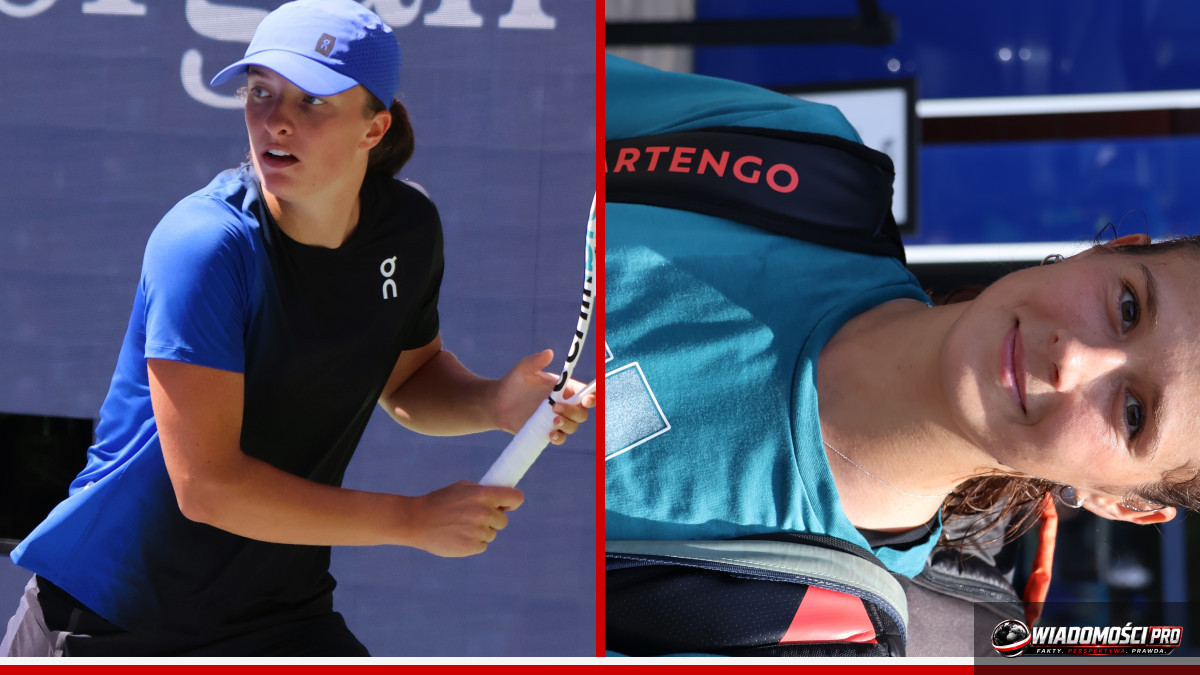
Iga Świątek needed just 61 minutes to defeat Daria Kasatkina with a score of 6:1, 6:0 in her final group stage match of the WTA Finals in Riyadh. This result served as a direct seal on her advancement to the knockout stage, putting an end to discussions about the Pole's form. Riyadh became a place where determination translated into pure statistics for the Raszyn native, leaving her opponent no margin to seize the initiative.
Dominance in Riyadh: Technical execution
The match against Daria Kasatkina in Saudi Arabia exposed the difference in physical and mental preparation between the two players. From the first rally, Świątek took control of the game's tempo, forcing the Russian into a defensive stance that, in the conditions prevailing in Riyadh, proved doomed to failure. There was no room for accidental errors or momentary lapses in concentration that often accompany the final stages of the group phase. The Pole operated her serve with the precision of a surgeon, and her return made it impossible for Kasatkina to build any rhythm.
For observers, this match was a tennis lesson. Świątek didn't just win points; she managed the court space in a way that made every one of her opponent's shots seem late. The 6:1, 6:0 score reflected how the world number one treats her tasks in the championship tournament. Instead of calculation, a strategy of maximum intensity was chosen, which allowed for energy conservation before the upcoming high-stakes duels. Kasatkina, known for her ability to read the game and solid defensive work, was relegated to the role of a spectator. Such victories build an aura that is essential in Riyadh to withstand the pressure of a round-robin tournament.
Toronto as the foundation of the comeback
To understand why the performance in Riyadh looked so one-sided, one must go back to August 13, 2026. That was when Iga Świątek won the title in Toronto, which became a turning point for her confidence. The triumph in Canada was not just adding another trophy to the cabinet, but a signal that the coaching staff had found the right settings in working on the stability of her game. After more difficult moments in the first half of the season, the victory in Toronto restored her dominant style, in which the Pole dictates the terms and her opponents must adapt to them.
An analysis of that tournament shows that Świątek eliminated lulls during matches. Each set was a well-thought-out strategy, not a series of random rallies. The success in Canada built the foundation for the August series, which ultimately led her to Riyadh. The player regained what is most important in tennis – automatism in executing finishing shots, which was especially visible in the match against Kasatkina. Toronto proved that her tennis is ready for any surface, provided tactical discipline is maintained.
Cincinnati: A test of strength and a ranking lesson
After the success in Canada, the calendar imposed a murderous pace. On August 20, 2026, Świątek faced another challenge in Cincinnati. The match against Elena Rybakina was an exam in resilience against power tennis. Rybakina, possessing one of the strongest serves on the tour, required maximum concentration from the Pole on her own serve. The competition in Ohio provided valuable data to the coaching staff, showing that even in clashes with players presenting an extremely aggressive style, Świątek can maintain her assumptions.
Two days later, on August 22, 2026, came the clash in the Cincinnati semifinals against Jessica Pegula. Although this match did not end in a victory for the Pole, her mere presence in this stage of the tournament was confirmation of maintaining a high level for nearly two weeks without a break. Comparing this to earlier stages of the season, a clear improvement in energy management is visible. Świątek did not fall out of rhythm, even though the intensity of the matches in Cincinnati was significantly higher than during standard 1000-level tournaments. The semifinal loss to Pegula became just a lesson before the autumn starts, forcing adjustments that later resulted in dominance in Riyadh.
WTA Ranking: Math without mercy
The situation in the WTA ranking after the August starts became complicated. On August 22, 2026, after the night hit in Cincinnati, it became clear that the Pole had to face the loss of 610 points. This mathematical cut was a direct result of regulatory recalculations resulting from defending points in the calendar. For a tennis player of this class, such a correction in the classification is not just a matter of numbers, but also a warning signal. The margin of error in the fight for the number one position became minimal, which forced the staff to plan starts even more meticulously.
It is worth noting that the point drop did not affect Świątek's mental attitude. On the contrary, the necessity of fighting for every point in Riyadh seems to mobilize her to ruthlessly enforce her advantage on the court. Previous updates, including the one from August 19, 2026, showed that every round of a tournament weighs on maintaining the position. Opponents, sensing blood, tried to exert pressure, but Świątek responded to this in the best way she could – with a quick victory over Kasatkina. This match was an answer to ranking calculations. The 6:1, 6:0 result showed that for the Pole, the quality of tennis matters most, and the ranking is merely a derivative of the form she is currently presenting.
Technical analysis: Why does Świątek win so quickly?
Iga Świątek's effectiveness in Riyadh stems from her ability to shorten rallies. While many players on the tour aim to drag out points in the hope of an opponent's mistake, the Raszyn native imposes a tempo that makes it impossible for opponents to set up comfortably for a shot. In the match against Kasatkina, the key element was the return. The Pole attacked almost every one of her opponent's serves from deep in the court, taking the initiative in the second second of the rally.
Świątek's shot technique is based on spin, which in Riyadh, with the specific surface, was extremely difficult to counter. Kasatkina tried to find solutions by changing the spin, but Świątek was prepared for it. Every shot from the Pole was directed to places that forced the Russian to run along the baseline, which, given the intensity imposed by the Raszyn native, quickly led to the opponent's physical exhaustion. The ability to close out games in a lightning-fast manner also results from improved footwork. Iga is at the ball faster, which allows her to hit at the peak point of the ball's flight, which in turn shortens the opponent's reaction time. This is not a matter of chance, but the effect of hundreds of hours spent on the court automating these specific patterns.
August 2026 challenges
August 2026 went down in the calendar as a time of intense form verification on the women's tour. It all started with the success in Toronto, where on August 13, Świątek proved that she can win 1000-level tournaments even with a very strong field. This victory was the backbone of her confidence in the following weeks. Then, after a short break, it was time for Cincinnati. On August 19, an update was published that for many commentators was proof of how tight it is getting at the top of the ranking.
August 20, 2026, is an important date in the context of building a mental advantage over power players. The clash with Elena Rybakina in Cincinnati showed that Świątek can withstand a physical clash with tennis players who have a powerful serve. Although she did not manage to win the title in that tournament, the road to the semifinals (August 22) was a valuable experience. Each of these matches, played in heat and high humidity, prepared the player's body for the effort she faced in Riyadh. August showed that Świątek does not look for excuses in difficult conditions, but adapts to them in real time.
Prospects for the end of the season
The end of the 2026 season for Iga Świątek is a period in which every decision to start must be dictated by cold calculation. After successes in Canada and experiences from Ohio, the Pole's staff is certainly focusing on regeneration. Riyadh is the culmination of the year, and the style in which the player advanced to the knockout stage suggests that her physical form is optimal. The lack of "lulls" in her game, visible in the match against Kasatkina, is the best proof that work on endurance has brought results.
For the competition, this means one thing – Świątek does not intend to let go of a single game. Her approach to the game in Riyadh is ruthless. There is no room for courtesy here, which was visible in the way she closed the match at 6:1, 6:0. Opponents who still have matches against the Pole ahead of them must be prepared for the fact that every ball will be played with the same intensity, regardless of the score in the set. Such an attitude is a trait of champions who can maintain concentration even when the advantage over the opponent is crushing. The decisive phases of the tournament are ahead of us, and Świątek seems to be the best-prepared player to fight for the title in Riyadh.
What this means for the fan
For Świątek's fans, the 61-minute victory over Kasatkina is a clear signal that the Raszyn native has returned to her best tennis. It is not just a matter of the result, but the way the Pole moves around the court. You can see the confidence that disappeared for a short moment during the season. Fans can count on Świątek maintaining the same ruthlessness in the knockout stage.
It is worth noting that for the player herself, saving energy in the group stage is crucial. Short matches mean less strained joints and faster regeneration, which in a tournament of such high intensity as the WTA Finals is a necessary condition for success. The Pole proves that she can win not only thanks to talent, but above all thanks to excellent logistical and physical preparation. For tennis observers in Poland, this is a time when it is worth carefully following every subsequent match. Świątek is in peak form, and her game in Riyadh is confirmation that the leader position is not a matter of chance.
Q&A
How long did the Świątek vs. Kasatkina match last?
The match ended after just 61 minutes of play.
What was the result of the match in Riyadh?
Iga Świątek won 6:1, 6:0, ensuring her dominance in the group.
What successes preceded the trip to Riyadh?
Iga Świątek won the tournament in Toronto on August 13, 2026, and reached the semifinals in Cincinnati, which prepared her for the end of the season.
What was the impact of the ranking on Iga's situation before the tournament?
After the tournament in Cincinnati, 610 points were deducted from Świątek's total, which forced her staff to plan starts in Riyadh even more precisely.
Did the defeat in Cincinnati affect Świątek's form?
The defeat to Jessica Pegula in the Cincinnati semifinals was a valuable tactical lesson that allowed for adjustments in her game visible during her performance in Saudi Arabia.
Why does Świątek win so quickly in Riyadh?
The Pole focuses on shortening rallies, aggressive returning, and maintaining high serve effectiveness, which prevents opponents from catching a rhythm of play.
Is Świątek the ranking leader?
Yes, despite the loss of points after Cincinnati, Świątek maintained her position thanks to solid performances in August and a confident attitude in the WTA Finals group stage.
What challenges await the Pole in the knockout stage?
The most important task will be maintaining the intensity from the match against Kasatkina and regenerating after the intense August starts.
Does the surface in Riyadh favor Świątek's game?
The way the Pole moves around the court and operates with spin suggests that the conditions in Riyadh perfectly suit her style, which is visible in the group stage results.
How does the staff assess her form after the August tournaments?
The August successes and failures allowed for building stable form, which in Riyadh translates into flawless execution of tactical assumptions from the first ball.
Who was Świątek's opponent in her last group match?
Iga Świątek faced Daria Kasatkina, whom she defeated in 61 minutes.
Did Świątek have to defend a large number of points in August?
Yes, ranking recalculations after Cincinnati forced the Pole to lose 610 points, which increased the pressure before the start in Riyadh.
What is the key to Świątek's success in Riyadh?
Above all, tactical discipline, a fast pace of play, and skillful energy management, which allows her to dominate opponents in short, intense sets.
Does Świątek have a chance for the title in Riyadh?
Thanks to her dominance in the group stage and maintaining high form after her August successes, Świątek is one of the main candidates for the final victory in the WTA Finals.
What was the most important conclusion from the match against Rybakina in Cincinnati?
This match showed that Świątek is able to effectively compete with power-playing tennis players, which was an important stage of preparation for the championship tournament.
Sources
- Iga Świątek - Elena Rybakina. Check the match result - Przegląd Sportowy
- WTA in Cincinnati: Iga Świątek - Elena Rybakina. Live coverage and live result - www.polsatsport.pl
- Minus 610 pts. Here is the WTA ranking after Iga Świątek's night hit in Cincinnati - Przegląd Sportowy
- Power show in the final. Świątek the queen of Toronto - Eurosport Polska
- Iga Świątek – Jessica Pegula. See who won the semifinal in Cincinnati. Live result - Przegląd Sportowy
- Back on the winning path. Iga Świątek won the WTA tournament in Toronto - www.polsatsport.pl
- Lightning-fast victory for Świątek in the WTA Finals! 61 minutes was enough - www.polsatsport.pl
- Change. This is what the WTA ranking looks like after Iga Świątek's match in Cincinnati - Przegląd Sportowy
Article prepared by the Wiadomości PRO editorial team with the support of artificial intelligence. Facts come from the sources provided above.


Komentarze (0)
Ładowanie komentarzy...