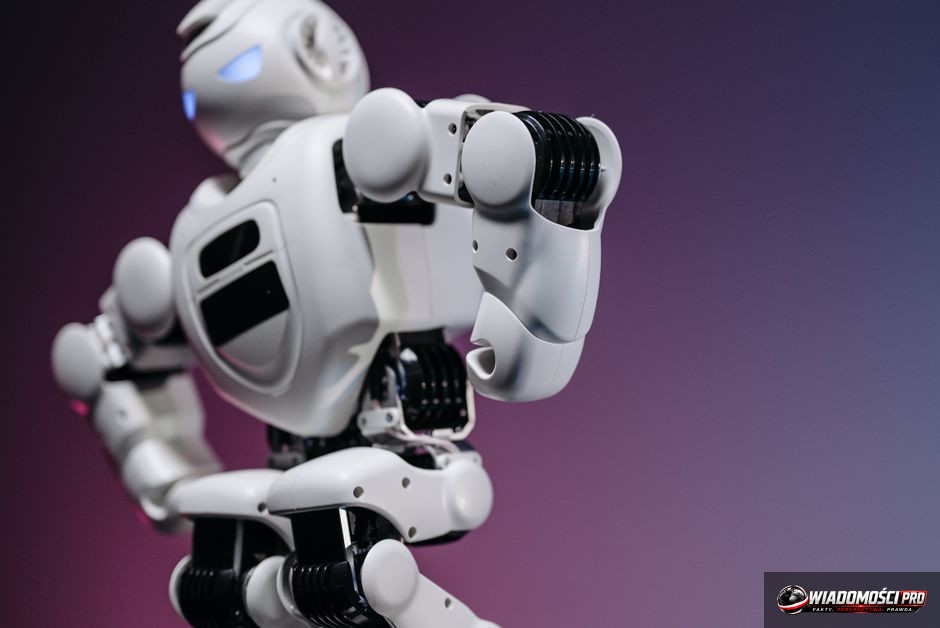
Yes, with a price tag of 16,000 USD for the G1 model, Unitree Robotics will genuinely revolutionize the market, displacing more expensive competitor solutions and making humanoid robotics accessible to a wide range of industrial and research users. The company is building its position thanks to the G1 and H1 models, which set new standards for affordability in robotics.
In brief
- The G1 and H1 models represent a breakthrough in humanoid robot accessibility thanks to an aggressive pricing strategy.
- Unitree Robotics remains a private company, which means that data regarding 500 percent stock growth is currently unconfirmed market speculation.
- Competition with companies like Tesla or Figure AI is driving a global technological race in the humanoid sector, in which the Chinese manufacturer focuses on production scalability.
The evolution of Unitree: From robot dogs to humanoids
The history of Unitree Robotics is a journey from the precise mechanics of quadrupedal platforms to complex bipedal systems. Wang Xingxing, the company's founder, focused on motion dynamics from the very beginning of his operations in Hangzhou. The Go1 series, followed by the more refined Go2, set standards for mobility in difficult terrain. Engineers from Hangzhou rejected the business model based on projects for the military or large corporations, focusing instead on engineering centered on movement repeatability and drive efficiency.
The transition to humanoid designs was a natural step resulting from mastering stabilization technology. The H1 model, unveiled in 2023, became a testing ground for balance algorithms. It uses proprietary actuators that allow for dynamic reactions to changes in the environment. This is not a remote-controlled toy, but a machine capable of maintaining an upright position in the face of physical disturbances.
In 2024, the company introduced the G1 model. This design differs from its predecessor in its production philosophy. While the H1 was a research platform, the G1 was designed with rapid assembly in mind. A price point of 16,000 USD changes the balance of power in a sector where, until now, an advanced humanoid cost as much as a luxury sports car. For universities and small robotics labs, the G1 model opens doors that were previously closed by financial barriers.
Unitree engineers do not use high-end external components that drive up costs. Instead, the company produces its own motors and gearboxes, which allows for a radical reduction in unit costs. As a result, instead of building one prototype for a million dollars, Unitree releases hundreds of units onto the market that undergo testing in real-world conditions. This method allows for faster elimination of design flaws, which at competitors often only emerge after years of laboratory research.
The focus on physical hardware, rather than virtual simulations, defines the current direction of Unitree's development. Each subsequent iteration of motion control software is tested on the physical G1 model. This engineering approach eliminates the risk of errors resulting from differences between a digital twin and the actual machine. The company proves that in humanoid robotics, hardware is the bottleneck, not artificial intelligence algorithms.
H1 and G1 technology: Is this the beginning of a new era?
The technology behind the H1 and G1 models is based on energy efficiency and drive response speed. The H1 model uses a stabilization system that allows the robot to move at speeds exceeding 3 m/s, which is a high result in the humanoid category. However, the key is how the robot handles obstacles. Thanks to advanced vision sensors and force sensors in the feet, the machine can correct its step in real-time.
The G1 model, the younger brother of the H1, introduces a new quality in terms of servo ergonomics. The casing has been simplified to facilitate maintenance and component replacement. Unlike robots built in US laboratories, where every element is unique, the G1 consists of interchangeable modules. This approach makes robotics similar to the world of consumer electronics, where replacing a damaged arm or drive takes minutes, not days.
The application of these robots extends beyond laboratories. In light industry, where repeatability of movements is required for "pick and place" tasks, the G1 offers efficiency that stationary robotic arms cannot match. The humanoid form allows for the use of existing infrastructure designed for humans. There is no need to rebuild the production floor if the robot can walk through doors and operate a standard workstation.
Regarding power, both models use high-energy-density lithium-ion batteries. However, the manufacturer does not provide official data on operating time under full load, which remains one of the biggest unknowns. In industrial conditions, where an eight-hour shift is required, current power technologies may be insufficient. This is where the biggest challenge lies for Unitree engineers in the coming months.
The control system is based on a hierarchical structure. At the lowest level are motor torque control algorithms that react in milliseconds. Above that is the path planning layer, which is responsible for obstacle avoidance. This architecture allows for rapid software updates without the need to interfere with the physical construction of the machine. If the manufacturer improves gait stability, a network update is enough to make all sold G1 units more efficient.
Private market vs. stock market speculation
Unitree Robotics operates as a private company, which completely excludes the possibility of buying its shares on the public market. Any information about 500 percent stock growth is market speculation that has no reflection in official financial reports. The company does not publish audited results, as it has no legal obligation to do so. The capital driving the development of the G1 and H1 models comes from venture capital funds, which gives the board full freedom in decision-making without pressure from shareholders.
The lack of financial transparency is a conscious part of the strategy. Instead of dedicating resources to preparing prospectuses and reports for stock market investors, Unitree invests every unit of currency into research and development. This approach allows for maintaining the pace of innovation, which in public companies is often hampered by the need to demonstrate quarterly profits. Private investors supporting Unitree accept high risk in exchange for a stake in a company that could revolutionize the automation market.
Verification of data regarding Unitree Robotics:
- Legal status: Private company, no stock market listing.
- Market value: No official valuations, speculation about 500% growth is baseless.
- Capital sources: Venture capital funds and private technology investors.
- Financial reports: No publicly available audited data.
For a market observer, the lack of an IPO is a signal that the company does not need external capital to survive, but to expand. If Unitree actually achieved such a scale of growth as rumors suggest, an IPO would only be a matter of time. Currently, however, the priority is delivering hardware to the market, not worrying about stock prices. Investors looking for contact with the company must target technological partnerships or VC-type investments, which are available only to a narrow group of professionals.
Unitree's strategy is to dominate the market with a product. If the price of 16,000 USD for the G1 model holds during mass production, the company will become a monopolist in the affordable humanoid sector. In such a scenario, the company's valuation could increase drastically at the moment of a potential IPO. However, until that happens, any news about financial success should be treated with great caution, as a marketing element rather than an economic fact.
The global race: Unitree versus global giants
The robotics market is currently a battlefield of two different philosophies. On one hand, we have Western players like Tesla with the Optimus project or Figure AI. Those companies focus on advanced AI models, integrating robots with large language and vision models. On the other hand, there is Unitree, which focuses on physical agility and a low barrier to entry. In this race, Tesla has capital counted in billions of dollars, while Unitree has an efficient supply chain in China.
The Chinese advantage in this industry stems from the proximity of component manufacturers. Motors, gearboxes, sensors – all of this is available in Hangzhou and the surrounding area within a radius of a few hundred kilometers. This allows for shortening the production cycle from months to weeks. While American startups wait for parts deliveries from all over the world, Unitree orders them locally, often within its own production lines. It is this logistics that allows them to offer the G1 model at a price of 16,000 USD.
Competition with Figure AI is particularly interesting. This American company has bet on a partnership with OpenAI, which gives it an advantage in the cognitive capabilities of machines. However, the Figure robot still remains an expensive prototype. Unitree, on the other hand, delivers a machine that is ready to work in a factory, even if its cognitive capabilities are limited compared to Silicon Valley solutions. For industry, stability and the availability of spare parts matter, not whether the robot can hold a conversation with a human.
Another player is Boston Dynamics, a pioneer in the industry. Their machines, like Atlas, set the direction for development, but their price has always been prohibitive for the commercial sector. Unitree is not trying to build a robot that will jump over obstacles like Atlas. They are building a tool that is meant to perform useful work. This shift of the center of gravity from "showing capabilities" to "industrial utility" makes Unitree a real threat to the position of industry leaders.
This race will be decided on factory floors, not at press conferences. The company that is the first to deploy thousands of humanoids to work in logistics will win the standard. For now, Unitree has the best chance for mass deployment, precisely because of the price. If the G1 model proves durable, the competition will have to drastically lower their margins or change their business model. Otherwise, they will remain in the niche of high-budget research, while Unitree takes over the industrial labor market.
The impact of innovation on emerging markets
The democratization of access to advanced technology is changing the rules of the game in developing countries. The G1 model, costing 16,000 USD, allows smaller companies from Asia or Latin America to automate production lines without the need to take out multi-million dollar loans. This means that countries that have previously relied on cheap labor are gaining a tool to increase productivity without a drastic increase in operating costs. Unitree is unknowingly (or very knowingly) opening up a new sales market.
This impact is visible in the pace of technology adoption. In China, Unitree robots are already being used in logistics centers to sort packages. The success of these deployments is attracting the attention of entrepreneurs from other regions. If a robot that does the work of two employees costs as much as a used car, the return on investment is counted in months, not years. This is a key paradigm shift in the manufacturing business.
This does not mean, however, that the road to full automation is simple. The challenge remains integration with production management systems (ERP). The robot must not only move but also communicate with the rest of the system. Unitree provides programming interfaces that allow for such integration, but this requires the buyer to have their own engineering department. This is a barrier that still excludes the smallest entrepreneurs, but it is no longer insurmountable for medium-sized companies.
It is worth noting that this innovation also hits the labor market. The introduction of humanoids at a price of 16,000 USD means that tasks previously performed by unskilled workers are becoming threatened. This is a sociological challenge that governments will have to face in the coming decade. Unitree provides the technology, and the consequences of its implementation will depend on local policy. The company does not take responsibility for the social aspects of automation, which is typical for technology entities focused on the product.
The long-term perspective assumes that the price of 16,000 USD will continue to fall. As production volume increases, unit costs of components will decrease. If Unitree reaches a production scale of tens of thousands of units per year, the price of the G1 model could fall to the 10,000 USD level. At that point, humanoid robotics will cease to be a luxury good and will become standard equipment for a modern factory. This is the moment when Unitree could dominate the market for decades.
The future of robotics: Challenges and prospects
Deploying humanoids for widespread use requires solving technical problems that still plague the H1 and G1 models. The first is power autonomy. Current cells allow for a few hours of intensive work, after which the robot requires a long charge. In industrial conditions, this forces unit rotation or the possession of docking stations, which complicates logistics on the floor. Replaceable battery modules could be a solution, but this increases the weight of the design and affects the center of gravity.
The second challenge is safety in the presence of humans. Humanoids move in a way that is unpredictable for untrained people. Collision avoidance systems must be extremely precise to avoid accidents. Unitree uses LiDAR sensors and depth cameras, but in an environment full of people, where forklifts and other devices are moving, the risk of error remains high. The lack of legal regulations regarding the safety certification of humanoids working alongside humans is the biggest obstacle to mass adoption in the EU or USA.
Ethical issues are equally important. Should robots be equipped with systems that monitor employee performance? Should they collect data about the environment that could be used for surveillance? Unitree does not provide answers to these questions, focusing on pure engineering. However, the moment robots reach thousands of companies, the public debate on privacy and surveillance will become inevitable. The company that is the first to impose ethical standards will gain a branding advantage in Western markets.
The future of humanoid robotics depends on the ability of manufacturers to create machines that are not only efficient but also maintenance-free. The G1 model is a step in that direction, but it still requires engineering supervision. Ultimately, the robot should diagnose its own faults and report the need for service. This is a level of operational intelligence that is still missing in current designs. Unitree must invest in diagnostic software so that robots become "plug and play" devices.
These challenges, however, do not negate the optimism stemming from Unitree's achievements. The company has proven that the price barrier was artificially maintained by industry leaders. The price of 16,000 USD for the G1 model is proof that the technology is ready for mass production. Now everything depends on the durability of the components in daily work. If Unitree maintains its pace of development, by 2030 we will witness the widespread presence of humanoids in logistics and industry. Will this be the dominance of a Chinese giant? It depends on whether the company can build a global service network and adapt to the legal requirements of Western markets.
What this means for you
As a robotics market observer, you should look at Unitree Robotics not through the prism of stock market rumors, but through the prism of the physical presence of their machines in industry. Investors looking for quick profits may feel disappointed by the lack of an IPO. However, for entrepreneurs and engineers, Unitree offers something much more valuable: accessible technology that realistically changes the cost of labor. The catch lies in the lack of transparency, which requires every potential buyer to thoroughly verify the equipment before purchasing.
Questions and answers
Can I buy Unitree Robotics shares on the stock exchange?
No, Unitree Robotics is a private company and currently does not trade shares on public capital markets. There is no information about plans for an IPO.
Why is there talk of 500% growth?
This information is speculation that is not confirmed by official financial reports or stock market data. These values are not supported by any documents.
In what way are Unitree robots better than the competition?
The key advantage of Unitree is aggressive production cost optimization and high motion dynamics. Thanks to its own supply chains in China, the company can offer the G1 model at a price of 16,000 USD, which is unrivaled compared to Western prototypes.
When did the G1 and H1 models go on sale?
The H1 model was presented in 2023, while the G1 model was introduced to the offer in 2024 as a unit focused on mass production and affordability.
Is Unitree Robotics a threat to Boston Dynamics?
Unitree focuses on scalability and price, while Boston Dynamics focuses on technological advancement and unique movement capabilities. Unitree is a threat to the industrial segment, where price and repeatability are key, and not to the research segment, where Boston Dynamics dominates.
Article prepared by the Wiadomości PRO editorial team with the support of artificial intelligence. Facts come from the sources provided above.


Komentarze (0)
Ładowanie komentarzy...