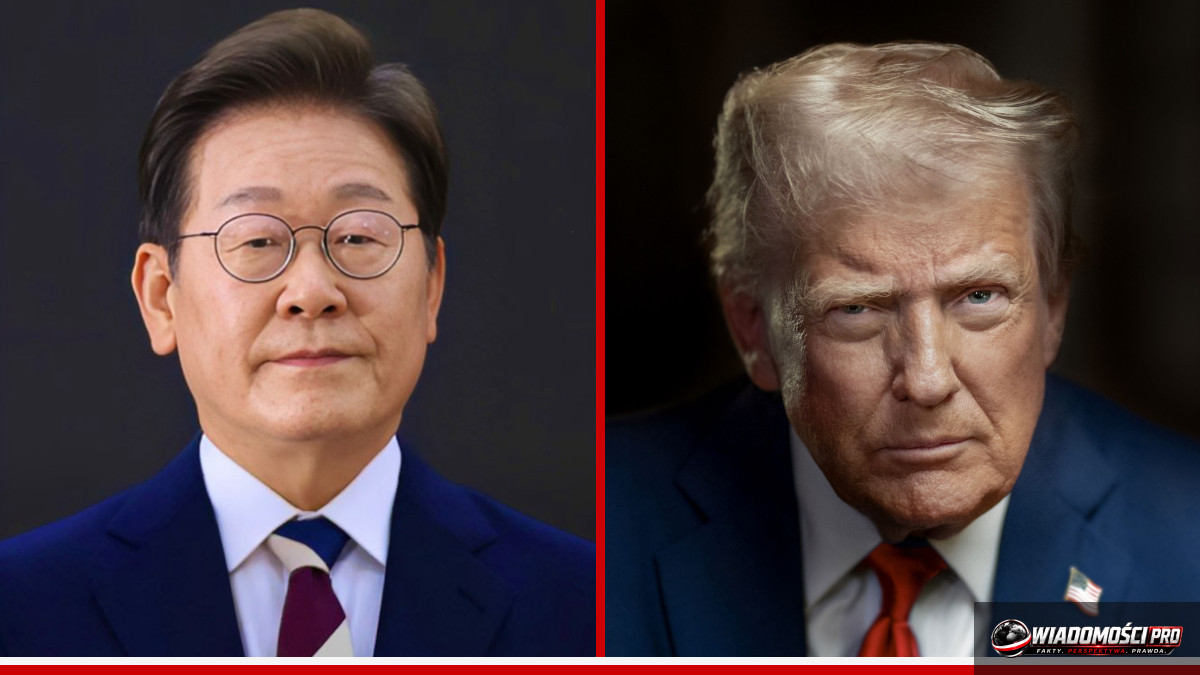
Yes, the limitation of exercises by the Trump administration has prompted President Lee Jae-myung to officially demand full command independence, which fundamentally changes the dynamics of defense cooperation with the US. Is the alliance at risk, or are we merely witnessing political theater? In the face of the withdrawal of American forces from maneuvers, Seoul's current move is not just an attempt at political pressure, but a response to the dismantling of security guarantees, which makes the alliance with Washington a hostage to President Trump's transactional policy.
Facts: Washington's decision to limit exercises
The White House has made the decision to drastically limit the involvement of American forces in military maneuvers on the Korean Peninsula, as confirmed by the Defence24.com service in a statement on August 18, 2026. This decision includes the withdrawal of units from a portion of planned operational activities that for decades have formed the backbone of the deterrence strategy against Pyongyang. American personnel, instead of acting as active participants on training grounds, are becoming observers, which in practice means a break with the existing doctrine of joint response to conventional and nuclear threats.
Military maneuvers, such as those held as part of annual training cycles, have previously been a signal of unity and combat readiness for both nations. Now, as the American command withdraws key components of its forces from these exercises, Seoul is losing access to logistical support, electronic reconnaissance, and air support that were integrated with South Korean units. This limitation is not just a matter of the scale of operations, but above all a political signal sent by Washington to regional partners.
The US is focusing on cost optimization, abandoning the maintenance of high combat readiness on the Peninsula at the previous level. This decision strikes at the foundations of mutual defense agreements, which assumed the presence of an American protective umbrella under all conditions. The scale of the withdrawal of forces from exercises goes beyond the framework of typical budget savings. It is a deliberate shift in Washington's strategic priorities, which is read in Seoul as opening the way to a renegotiation of the entire defense treaty.
Consequences for Seoul: The postulate of full command independence
President Lee Jae-myung responded to Washington's move by demanding the transfer of full operational control (OPCON) over the South Korean armed forces. For decades, it was an American general who held the final say in the event of an armed conflict on the peninsula. This model, although it ensured close coordination of actions, was becoming increasingly archaic in the face of changing geopolitical realities. Lee Jae-myung is striving to take full responsibility for his own army, arguing that South Korea can no longer rely on decisions made in Washington if those decisions can be changed overnight under the influence of US internal politics.
The assumption of full operational control by Seoul involves a gigantic technological and doctrinal challenge. The South Korean general staff must quickly implement command systems that have hitherto been largely operated by American specialists. This concerns satellite reconnaissance, early warning systems, and integrated combat data exchange networks. Lee Jae-myung is aware of the risks, but recognizes that the loss of sovereignty in defense matters is too high a price compared to the benefits flowing from the US presence.
In South Korea's internal politics, this postulate has become a tool for consolidating support. Voters, concerned by Pyongyang's rhetoric and uncertainty regarding the White House's intentions, expect decisive action from the government. President Lee is betting everything on one card, showing that Seoul is ready for self-reliance. However, if the South Korean army fails to fully replace American capabilities in terms of reconnaissance and strategic support, the country may find itself in a security gap that its northern neighbor will easily exploit.
US Perspective: The transactional model of the alliance
The Trump administration views relations with Seoul through the prism of costs and benefits, which is characteristic of Washington's current foreign policy. Limiting military exercises is part of a broader strategy that assumes a reduction in American involvement in regions where local partners do not participate in protection costs to the extent expected by the US Department of Defense. For Trump, stability on the Korean Peninsula is an important matter, but it cannot come at the expense of American resources if Seoul is unable to work out satisfactory financial terms.
Washington does not hide the fact that the priority is to avoid direct involvement in a long-term conflict that could burden the US budget. Withdrawing units from exercises is a signal to Seoul that American security guarantees are not unconditional. Such an attitude forces South Korea to increase defense spending and accelerate the modernization of its own army. From the Pentagon's perspective, forcing allies to be more self-reliant is beneficial, as long as it does not lead to the total collapse of military ties that have kept China and Russia in check for years.
However, there is a risk that the Trump administration underestimates the psychological dimension of these actions. By withdrawing from maneuvers, Washington undermines the trust of other allies in the region, such as Japan, who may also begin to question the durability of American commitments. If the alliance with Seoul transforms into a purely transactional relationship, where every military operation is a subject of financial negotiation, Washington will lose its main tool of influence on the Korean Peninsula.
Pyongyang's reaction: Strategic gain for the regime
The Kim Jong Un regime is observing the current rift in US-South Korean relations with growing satisfaction. For Pyongyang, the limitation of American presence on training grounds is a measurable diplomatic and military success. Every day that joint exercises are reduced or canceled gives the North space to develop its own weapons program without fear of an immediate, integrated response from US-South Korean forces.
For North Korean propaganda, the current situation is proof of the effectiveness of nuclear deterrence. Kim Jong Un has argued for years that only the possession of atomic weapons would force the US to make concessions. Now, as Washington limits exercises, the Pyongyang regime can present this to its citizens as a victory over the "imperialist aggressor." This strengthens Kim's position internally and allows for a more aggressive policy toward Seoul, which in the eyes of its northern neighbor is becoming increasingly isolated.
Uncertainty regarding the American nuclear umbrella is forcing Seoul to consider options that were previously taboo. In the South Korean parliament, there is increasingly loud talk about the need to possess one's own nuclear weapons, which would be a final break with the existing security model. For Pyongyang, such a situation is ideal – a destabilization of the region in which the US loses control over its allies, and South Korea begins to act in a way that may provoke even greater tensions.
Social sentiment: A crisis of trust in South Korea
South Korean society is deeply divided on the future shape of the alliance with the US. On one hand, traditional military elites and older generations still view the American presence as an essential pillar of security. On the other hand, the young generation, which does not remember the times of post-war reconstruction, is increasingly asking about the sense of such deep dependence on Washington. The Trump administration's decision to limit exercises has become a catalyst for these sentiments, sparking a wave of public debate about sovereignty.
Social organizations and part of the political opposition in parliament are demanding that the government in Seoul take tough steps toward full military independence. They argue that relying solely on decisions from the White House is too risky in the face of the unpredictability of American politics. Nationalist sentiments are gaining strength, which puts President Lee Jae-myung in a difficult situation. On one hand, he must look after the state's security; on the other, he cannot ignore the voice of citizens demanding agency on the international stage.
The rise in distrust toward the US is translating into concrete social demands. People want to be sure that their country will not become a battlefield in someone else's conflict, while at the same time they do not want to be left at the mercy of the North Korean arsenal. This instability of sentiment is fuel for politicians who promise "security based on one's own forces." In this way, security has ceased to be a technical issue and has become a hot topic of political disputes that could lead to deep changes in the Seoul government.
Analysis: Does the alliance still have a future?
The US-ROK alliance is at a turning point that can no longer be reversed merely by diplomatic assurances. History proves that relationships based on asymmetric dependence are stable only as long as both sides have convergent interests. Currently, these interests are beginning to diverge. Washington is striving for cost reduction and global force reorganization, while Seoul wishes to maintain the status quo that guaranteed peace.
If the Trump administration maintains its course of limiting involvement, Seoul will have no choice and will be forced to accelerate the development of its own defense capabilities. This may lead to the emergence of a regional power that will not need an American umbrella, but at the same time, it may trigger an arms race with Japan and China. The question about the future of the alliance is therefore a question about the future of the entire balance of power in East Asia.
The catch in this whole situation is that neither side wants a formal break of the alliance, but both sides are acting as if they are preparing for life after its end. Washington does not want to lose influence on the peninsula, and Seoul does not want to lose protection. The lack of trust that has crept into the relations between the commands, however, is difficult to remove. If a new model of cooperation – based on equal partnership rather than dependence – is not worked out in the coming months, the current friction may turn into a permanent rift.
Ultimately, the decision to limit exercises is the beginning of the end of the era in which America was the sole guarantor of security in this region. Seoul must learn to live in a world where an ally may turn out to be absent at a key moment. This is a lesson in brutal geopolitics that South Korea is learning at an express pace.
Questions and answers
Why is President Lee Jae-myung demanding command independence?
The President is reacting to the unilateral US decision to limit joint military exercises, which he views as a threat to South Korea's defense sovereignty and a signal of Washington's weakening commitment.
What is the main risk for the US-South Korean alliance?
The main risk is the loss of trust and the weakening of deterrence capabilities, which leads to a permanent crack in the region's security structures and forces Seoul to seek new defense strategies, perhaps even outside the framework of the current alliance.
Is Kim Jong Un actually winning in this situation?
Many analysts point out that the limitation of US military activity is interpreted in Pyongyang as a strategic success, as it weakens the credibility of American deterrence and gives the regime greater freedom in developing its weapons program.
What does the change in command mean for Korea's daily security?
It means the necessity for the South Korean army to take full control over reconnaissance and command systems, which is a gigantic logistical challenge and a technologically risky process that may temporarily lower the country's defense readiness.
Sources
Article prepared by the Wiadomości PRO editorial team with the support of artificial intelligence. Facts are derived from the sources provided above.


Komentarze (0)
Ładowanie komentarzy...