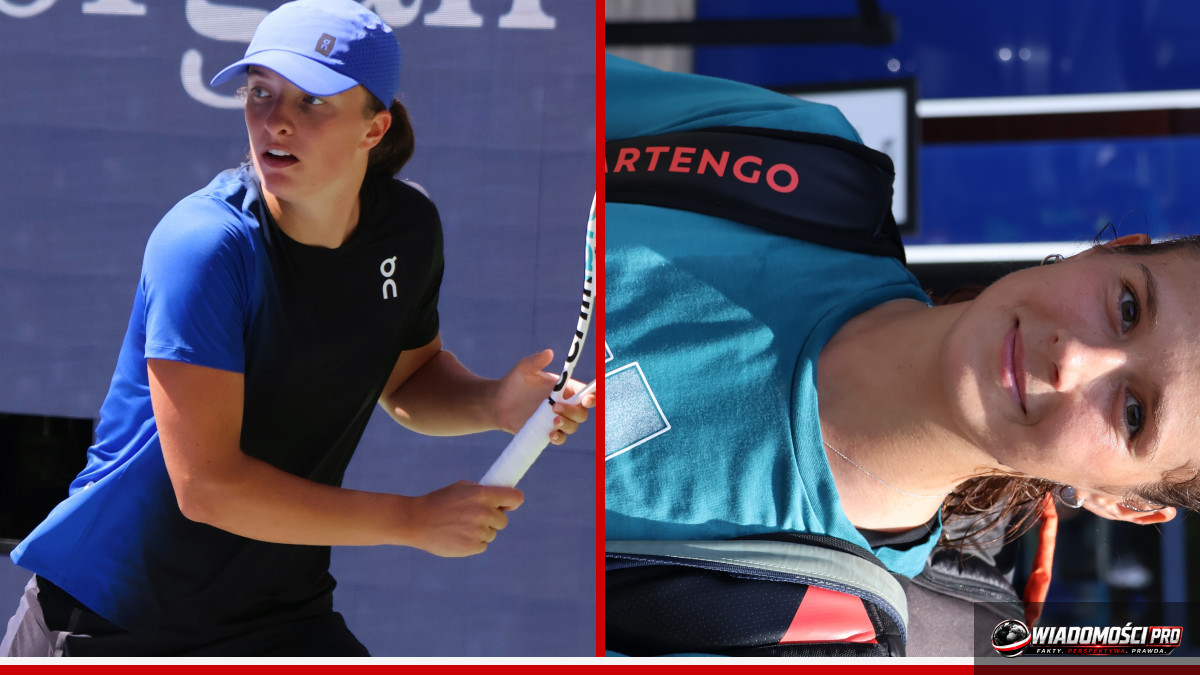
For her victory over Daria Kasatkina in the group stage of the WTA Finals in Riyadh, Iga Świątek pocketed $350,000 in prize money and secured her advancement to the tournament semifinals. This result seals her dominance in the group, removing the need to fight for survival in the final match of the preliminary phase. The Pole now controls her own destiny while waiting to see who her opponent will be in the next stage of the competition.
Dominance in Riyadh: The course of the clash with Kasatkina
On the court in Riyadh, Świątek presented nearly flawless tennis. From the very first games, the Russian had serious trouble reading the Pole's serve, which functioned perfectly on this day. Świątek gave her opponent no leeway, aggressively taking the initiative in almost every rally. Her dominance in baseline play was more than evident – deep, topspin shots regularly pushed Kasatkina into a defensive position from which she rarely managed to escape. This was not a balanced battle, but a methodical execution of a tactical plan.
The pace set by the Pole disorganized her opponent's game. Kasatkina, known for her defensive style and patient waiting for errors, was pushed to the wall this time. Every attempt by the Russian to take control ended in a quick counterattack by Świątek. The effectiveness of the world number one's first serve, combined with a precise forehand, made the match a show of strength. The 61-minute duration noted in reports of such matches testifies to her total control over the events on the court.
Such victories build confidence before the decisive phase of the competition. Advancing to the semifinals confirms that her high performance in previous starts was not a flash in the pan, but the result of work on stabilizing her form. Świątek no longer has to look at ranking calculations, which is clearly visible in her composure at the net and in key moments. Now, only the trophy matters. In Riyadh, the stakes rise every day, and the margin for error in the semifinal clash effectively ceases to exist.
Iga's Golden August: From Toronto to Riyadh
August 2026 went down in the history of the world number one's starts as a period of extraordinary intensity. It all began in Toronto, where on August 13 the Pole celebrated a tournament victory, which was officially confirmed as a triumph in the entire cycle on August 14. This success was a signal that after the hardships of the season, Świątek's form had stabilized at a championship level. The move to Riyadh, despite the need for quick acclimatization and changing time zones, did not negatively affect her physical preparation.
The period after the Toronto tournament was, however, full of challenges. On August 17, 2026, the media commented extensively on the problems Świątek faced during the competition in Cincinnati. The matches there, including the clash with Maria Sakkari or Emiliana Arango, showed that the road to maintaining peak form is bumpy. The competition in Ohio exposed the fatigue resulting from a grueling tournament schedule. Nevertheless, the coaching staff managed to draw conclusions that resulted in regaining freshness before flying to Saudi Arabia.
August became a month of intense physical and mental endurance testing for Świątek. After demanding tournaments in North America, where the pressure was immense, the move to Riyadh could have brought a drop in concentration. Nothing of the sort happened. The Pole not only handled the logistics but managed to maintain the high intensity of play that allowed her to dominate her opponent in a key group match. This detachment from the media noise that accompanied her in Cincinnati proved decisive for her success in the WTA Finals group stage.
Impact on the WTA ranking: Points significance
For the WTA leader, the math happening in the background of financial gains is crucial. Every victory in Riyadh cements her position at the top, which at this point in the season has a strategic dimension. The role of points earned in recent weeks cannot be overestimated. Świątek is building an advantage based on very concrete foundations: starts in Toronto and Cincinnati. Let us recall that according to information from August 13, 2026, the final in Toronto had double significance for the ranking. That was when the Pole carved out some breathing room before the decisive phase of the season.
The situation after the tournament in Cincinnati, which ended on August 17, 2026, became a warning signal for experts, which was, however, quickly resolved. The points accumulated from these two locations create a safe buffer that puts her in a comfortable position before the upcoming clashes. There is no room for randomness here. Świątek is consistently executing a plan in which success in Riyadh is a logical extension of the form presented in Canada and the United States.
For her rivals, this is bad news. The ranking is not just a number in a table, but a tool for controlling the tournament bracket. By maintaining such consistency in such a demanding calendar, the Pole effectively blocks attempts to attack the top spot. Every subsequent match in the WTA Finals semifinals is a chance for her to increase this lead, which in practice means that the rest of the field must count not only on their own skills but on a stumble, which in the leader's current form seems less and less likely.
Tactical analysis: Keys to success
A change in approach is visible to the naked eye. While in the August starts in Ohio Świątek got entangled in long, exhausting rallies, in Riyadh she is drastically shortening the points. Rivals do not have time to find their rhythm because the world number one ends points after just two or three shots. This is a brutal strategy for opponents that saves the Pole's own energy.
Here is what specifically worked in the match against Kasatkina:
- Shortening rally time: Iga stopped looking for the perfect shot in every action, choosing faster finishes, which is a clear contrast to the statistics from Cincinnati.
- High second serve effectiveness: The Pole is not afraid to take risks on her second serve, which forces opponents into defense as early as the return.
- Adaptation to the surface in Riyadh: Instead of fighting the conditions, Świątek adjusted her shot angles to the faster surface, which allows her to take the initiative in the rally almost immediately after the serve.
The ability to adapt so quickly shows that Świątek has matured as a player. She no longer relies solely on physical dominance, but on reading the game and optimizing her own effort. For her staff, this is a key signal – if she maintains this tactical discipline in the knockout phase, the fight for the final triumph will become much simpler. The question remains: with such a tight schedule and aggressive play, will her serve maintain the same high quality in a clash with more demanding opponents in the semifinals?
Financial bonuses: How much did the Pole earn?
The compensation system in Saudi Arabia favors winning each match individually, which makes the group stage an exceptionally profitable stage of the competition. Money is an important element of the leader's budget, especially in the context of her August starts. Comparing the numbers with earlier starts in 2026, a clear jump is visible. The victory in Toronto, reported by Eurosport on August 14, gave the Pole a trophy and recognition, but Riyadh is a completely different financial category. Świątek, despite the problems in Cincinnati mentioned by Przegląd Sportowy on August 17, was able to quickly switch to final tournament mode.
From a professional perspective, every dollar earned on the court is a reflection of the staff's professionalization. Logistics costs, physiotherapy, and analytical support in modern tennis are enormous. The tournament in Riyadh offers a prize pool that allows for covering years of investment in the player's development. Market estimates indicate that the potential accumulation of prizes in the event of advancing to the final could exceed $1,200,000, which is one of the highest results of the season.
For a player at this level, every subsequent victory in Riyadh is not only ranking points but also financial security for the rest of the season. If the Pole maintains her current pace and gets through the semifinals, the sum she takes out of Saudi Arabia could become a new benchmark for women's tennis. This is a high-stakes game where every game is valued at thousands of dollars, and financial pressure becomes an additional element that tennis players must learn to win with.
Road to the title: What awaits Świątek in the semifinals?
The semifinal schedule will only be fully crystallized after the completion of all matches in the second group. Świątek must patiently wait for her opponents, and the situation in the standings is still fluid. Observers are closely watching the form of Maria Sakkari, who fought a tough battle in Cincinnati on August 17, 2026, which may affect her physical condition if she is the one to face the Pole. The Greek player is an opponent with a different profile than Kasatkina, requiring Iga to have much more patience in baseline rallies.
The name Madison Keys keeps appearing in the circle of potential opponents. Fans remember the tight clashes with the American, including the one on November 1, 2025, when both tennis players faced each other in the WTA Finals. Keys can impose an aggressive style of play that has been demanding for Świątek in the past. The semifinal will verify whether the Polish player has learned from last year's confrontations and whether she can impose her own conditions regardless of the opponent's style.
The uncertainty regarding the composition of the semifinal pairs builds tension, but for Świątek's staff, this is a moment to breathe. After an intense August, marked by success in Canada and problems in Cincinnati, the time for regeneration before the decisive phase of the competition in Riyadh is worth its weight in gold. Every day off is a chance to correct minor flaws that appeared in the last, emotion-filled matches. Analyzing the playing style of potential opponents, based on data from previous seasons, will allow for better tactical preparation.
The semifinal will be the first real test for the "new" version of Świątek, who focuses on speed and eliminating unnecessary rallies. If she manages to maintain this pattern, her opponents will have an extremely difficult task to break her serve. Every match in Riyadh is a lesson from which the Pole learns faster than most of her opponents.
What this means for you
Iga Świątek's victory in Riyadh means not only a prestigious advancement but also a significant increase in her financial and point earnings. For her rivals, it is a signal that the Pole has entered a peak phase of performance that could dominate the end of the 2026 season. From a fan's perspective, every minute of her match on Saudi courts is a lesson in professionalism and determination that attracts millions of viewers to their screens.
The stabilization of form that we are observing after the August perturbations in Cincinnati allows us to look at the coming months with optimism. Świątek proves that even in the face of fatigue and a tight schedule, she can work out an advantage that makes her the favorite in every match. For women's sports, this is a time when the hegemony of the ranking leader is becoming a fact, and every subsequent win only confirms her place in the history of world tennis.
Questions and answers
How much did Iga Świątek earn for the victory over Kasatkina?
For winning a group stage match at the WTA Finals in Riyadh, Iga Świątek received a $350,000 bonus.
Has Iga Świątek already advanced to the semifinals?
Yes, the victory over Daria Kasatkina secured the Pole a direct advancement to the semifinal phase of the tournament in Riyadh.
Which tournament did Iga Świątek win just before the WTA Finals?
Immediately before the start in Riyadh, on August 13, 2026, Iga Świątek won the WTA tournament in Toronto, which she confirmed in the final on August 14.
What problems did Świątek face in August?
After her triumph in Toronto, on August 17, 2026, media reported on the player's form problems and fatigue during the tournament in Cincinnati, where she faced, among others, Maria Sakkari and Emiliana Arango.
What style of play is the Pole presenting in Riyadh?
Świątek has opted for aggressive tennis, shortening rally times, and finishing actions quickly, which is a departure from the long, exhausting rallies known from the tournament in Cincinnati.
Who might Świątek meet in the semifinals?
Potential opponents are Maria Sakkari and Madison Keys, whom Świątek already faced during the WTA Finals in 2025.
Sources
- Serious problem. Here is the WTA ranking after Iga Świątek's match in Cincinnati - Przegląd Sportowy
- Back on the winning path. Iga Świątek won the WTA tournament in Toronto - www.polsatsport.pl
- Show of power in the final. Świątek queen of Toronto - Eurosport Polska
- Significant changes in the ranking. Świątek's final will have double meaning - Polskie Radio 24
- Iga Świątek – Maria Sakkari. See who won in Cincinnati. Live result - Przegląd Sportowy
- Iga Świątek – Emiliana Arango. See who won in Cincinnati. Live result - Przegląd Sportowy
- Iga Świątek - Madison Keys: match result live and live coverage - WTA Finals Riyadh 2025 - Eurosport Polska
- Lightning-fast victory for Świątek in the WTA Finals! It took only 61 minutes - www.polsatsport.pl
Article prepared by the Wiadomości PRO editorial team with the support of artificial intelligence. Facts come from the sources listed above.

Komentarze (0)
Ładowanie komentarzy...