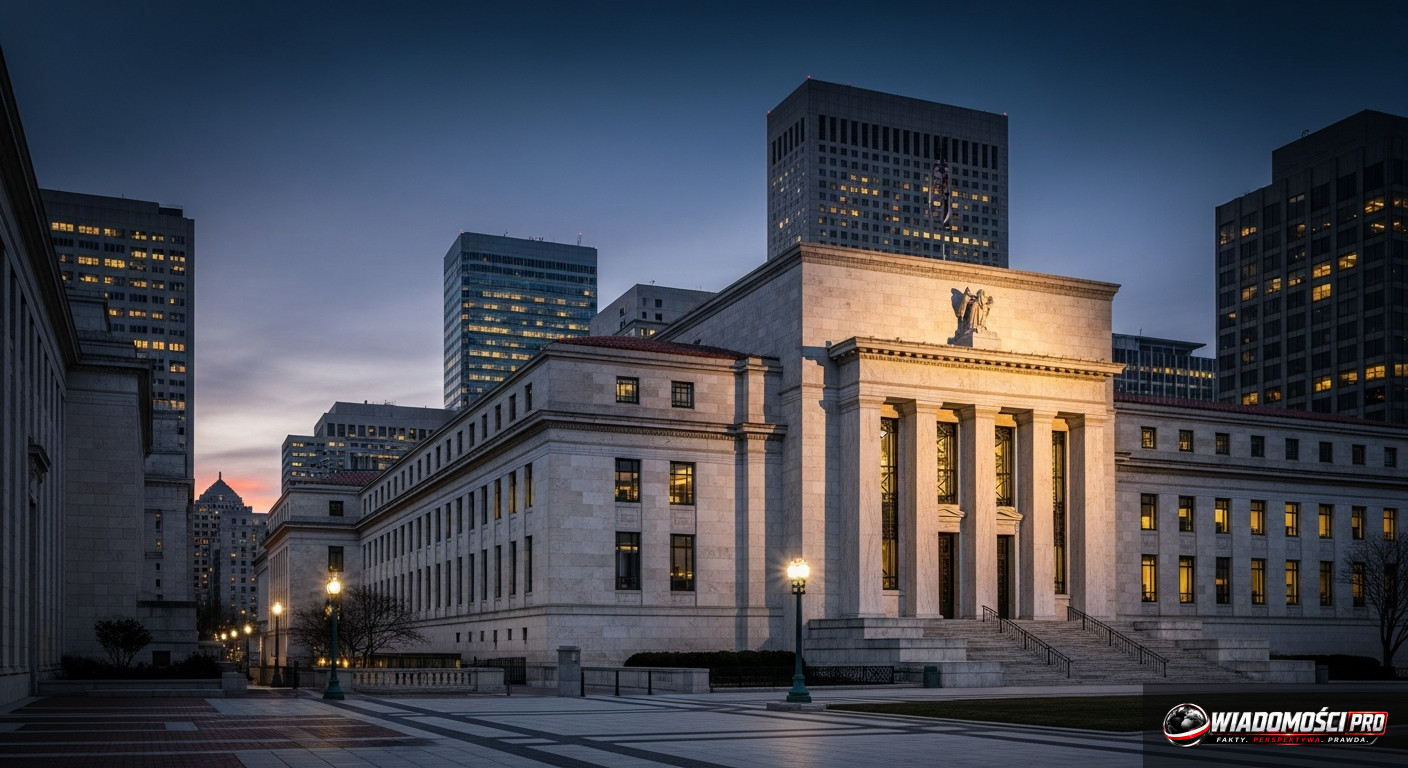
The Fed's decision to lower rates to the 4.75-5.00% range led to an approximately 12% annual increase in the S&P 500 index, while Treasury bond holders gained an average of 7-9% due to the decline in their yields. This September 2025 move defined a new market dynamic, ending the period of the most restrictive monetary policy in recent decades. Investors, who had spent months analyzing every statement by Jerome Powell, finally received a clear signal to restructure their portfolios.
The mechanism of the September adjustment
The aggressive start to the rate-cutting cycle, announced on September 17, 2025, was the result of growing pressure on the Federal Open Market Committee. Policymakers had to balance two conflicting vectors: still-worrying inflation and the first clear symptoms of weakness in the US labor market. The choice of the 4.75-5.00% range was not merely a technical adjustment of the cost of money. It was a political and economic reset. The market received confirmation that the Fed views economic slowdown as a greater threat than a temporary rebound in consumer prices.
Analysts who had previously predicted cautious 25-basis-point cuts had to revise their models. The 50-basis-point move acted as a catalyst for liquidity. Capital that had previously remained trapped in safe money market instruments began seeking higher returns. Hedge funds and individual investors rushed to buy stocks, which dominated the investment landscape for the following quarters.
However, there was no shortage of dissenting voices within the FOMC. Meeting minutes indicate that some committee members feared declaring victory over inflation prematurely. Nevertheless, the majority opted for stimulation. They understood that keeping rates above 5% in the face of a global slowdown could lead to a recession that the US economy would not be able to easily digest. This decision became the foundation upon which twelve months of asset valuation growth were built.
Stock market optimism and its beneficiaries
The 12% annual growth of the S&P 500 index is a result that proved unattainable for many portfolio managers. Stock market optimism had its specific source in the mechanism of discounting future cash flows. When the cost of capital falls, valuations of growth companies automatically rise. This applies primarily to the technology sector, which became the main engine of the index in 2025.
Large-cap companies benefited from the Fed's decision disproportionately to the rest of the market. Access to cheaper financing allowed these giants to continue investing in artificial intelligence and digital infrastructure without the need for drastic operational cost-cutting. Investors appreciated this resilience, allocating increasing funds to these entities. This sector became a safe haven, even though its valuation multiples were often at historical highs.
Not every industry shared this enthusiasm. Smaller companies, grouped in the Russell 2000 index, reacted to the rate cut with a delay. Their dependence on short-term debt meant that the improvement in financial conditions reached their balance sheets more slowly. The stock market priced in the success of the giants, but the broader market needed much more time to fully feel the relief flowing from the Fed's monetary policy. This divergence in performance became one of the most interesting investment phenomena of the past year.
The mathematics of bond market gains
For Treasury bond holders, the last twelve months were a period in which financial theory met hard market reality. A gain of 7-9% did not come from nowhere. It results directly from the inverse correlation between bond prices and their yields. As the market began to price in further rate cuts, yields on 10-year and 30-year bonds began to fall systematically.
Investors who held long-term maturity bonds in their portfolios recorded the largest capital gains. The mechanism is simple: in an environment of falling interest rates, the coupon offered by "old" bonds becomes more attractive than what the market offers. It is this increase in the market value of debt securities that generated the aforementioned 7-9% gain. Many debt funds, which had struggled with write-downs for years, finally breathed a sigh of relief.
It is worth looking at this result in a broader context. In an environment where inflation still oscillates around the central bank's target, bonds have ceased to serve only as a "safe haven." They have become an active portfolio component that generates a real rate of return. For retail investors who withdrew funds from deposits, Treasury bonds became the main alternative to the volatile stock market. The stability of this gain, despite periodic volatility caused by labor market data, attracted record inflows into bond funds.
The dollar as a victim of its own policy
The US dollar's reaction to the rate cut decision was immediate and brutal. Currency pairs with the USD as the main component reacted with weakness, which is a direct consequence of the narrowing interest rate differential relative to other reserve currencies. Foreign investors, who had kept capital in dollars for years due to attractive interest rates, began looking for alternatives.
This weakening of the dollar created unique conditions for emerging markets. Many countries that previously struggled with capital outflows and inflationary pressure imported by a strong US currency saw their exchange rates stabilize. For global players, this means the need to rebalance currency portfolios. The dollar has ceased to be a one-sided bet upward. Now its value is closely correlated with the pace at which the Fed will continue to ease policy.
The decision to cut rates by 50 basis points sent a clear message: the US currency will no longer be supported by record-high interest rates. This changes the strategy for investors holding USD-denominated assets. Every position must now be evaluated through the prism of currency risk, which has become significantly more important than in the 2023-2024 period. The calm observed in the currency market in 2026 is a result of the market pricing in the current rate path, but any deviation from this plan could again trigger a wave of volatility.
An institutional view on the fight against inflation
The Federal Open Market Committee, led by Jerome Powell, faced a challenge that can be described as walking a tightrope. On one hand, we have macroeconomic data showing a cooling economy; on the other, inflation that refuses to fall to the 2% level. The decision to cut to the 4.75-5.00% range was an attempt to avoid the stagflation that economists warned about in mid-2025.
Financial institutions, such as investment banks and pension funds, reacted to this situation with a great deal of skepticism. Their analysts emphasized that the Fed had not yet won the fight against prices. Every employment report or CPI reading is now analyzed to see if it will force central bankers to pause the cutting cycle. This uncertainty keeps volatility in the interest rate futures market at an elevated level.
It is worth noting that the Fed's stance is assessed as "defensive." Instead of waiting for inflation to be fully crushed, the committee decided that the cost of recession was too high. This approach was met with approval from the stock market, which always prefers cheap money over a hard fight against inflation at the expense of growth. However, for bond holders, the situation is more complicated. If the Fed has to stop the cuts, bond yields could spike again, wiping out the gains of the past year. The market is currently in a wait-and-see phase, and every statement by Fed representatives is treated with the utmost attention.
2026 Outlook: Soft landing or trap?
Looking toward the coming quarters of 2026, investors are asking one key question: will the US economy actually avoid a hard landing? The consensus assumes a stabilization of rates at a level that does not stifle growth but also does not allow for a renewed outbreak of inflation. However, history teaches that central banks rarely hit the perfect equilibrium point.
The labor market remains the most important variable. If the unemployment rate begins to rise sharply, the Fed will be forced to make further, perhaps even deeper, cuts. This, in turn, could lead to a weakening of the dollar but could simultaneously worsen stock market sentiment if investors conclude that a recession is inevitable. The current 12% gains on the S&P 500 and 7-9% on bonds are the result of belief in a soft landing. If this belief is undermined by weak real economy data, investment portfolios face a period of high volatility.
Individual investors should prepare for the fact that the era of easy bond gains may be coming to an end. If yields have already reached their lows, further gains from rising bond prices will be limited. In such a scenario, diversifying the portfolio with alternative assets or companies with strong cash fundamentals becomes the only logical strategy. Stabilization does not mean a lack of risk. It only means that volatility is shifting from the level of central bank decisions to the level of company earnings and labor market data.
Q&A
How did the rate cut decision affect consumer loan interest rates in the US?
The rate cut to the 4.75-5.00% range translated into a gradual reduction in debt financing costs. In the mortgage and consumer loan sector, the market reacted with a drop in reference rates, which directly affected the increased availability of credit for households and businesses.
Why did the Fed decide on such an aggressive move when inflation was still a concern?
The committee made the decision based on an assessment of the risk to the labor market. They concluded that keeping interest rates high for too long poses a greater threat to economic stability than persistent, but slowly fading, price pressure.
Is a 7-9% bond return repeatable in 2026?
Historical data and current valuations indicate that such high bond returns were the result of a sharp drop in yields caused by the change in monetary policy. In 2026, assuming interest rate stabilization, investors should expect more moderate gains, based mainly on paid coupons rather than a sharp rise in market prices of securities.
Which sectors of the economy are currently least exposed to risks related to the uncertain macroeconomic situation?
Analysts point to companies in the consumer staples and healthcare sectors as those that show the greatest resistance to cyclical fluctuations. These entities, having stable cash flows, are less dependent on external financing, which makes them more predictable in times of uncertainty regarding further Fed decisions.
Should investors still keep cash in their portfolios?
The rate cut has made cash in low-interest accounts less attractive. Most investment strategists suggest shifting funds toward debt instruments or dividend stocks to protect capital from the effects of inflation, which, despite the Fed's actions, remains a factor reducing the purchasing power of money.
What is the biggest fear of investors in the context of the FOMC decision?
The biggest risk remains a return of high inflation, which would force the Fed to stop the cutting cycle or even reverse it. Such a scenario would negatively affect both the stock and bond markets, leading to a sharp sell-off of most asset classes.


Sources
- Trump got his way. Fed resumed interest rate cutting cycle - Bankier.pl
- Fed holds its breath. Market expects rate stabilization in the US - Money.pl
- Why the Fed lowered interest rates despite US inflation still causing concern - Business Insider Polska
- September Fed decision may disappoint stock markets. Debate over possible US interest rate cut - Strefa Inwestorów
- MPC did not change interest rates in September '24 - Miesięcznik Finansowy BANK
- Half the world was waiting for this decision. Fed indicated US interest rates - Money.pl
- Fed cuts interest rates sharply. Economists were wrong, however - Bankier.pl
- FED will decide on interest rates today. What decision will the FOMC make? - Strefa Inwestorów
Article prepared by the Wiadomości PRO editorial team with the support of artificial intelligence. Facts are derived from the sources listed above.


Komentarze (0)
Ładowanie komentarzy...