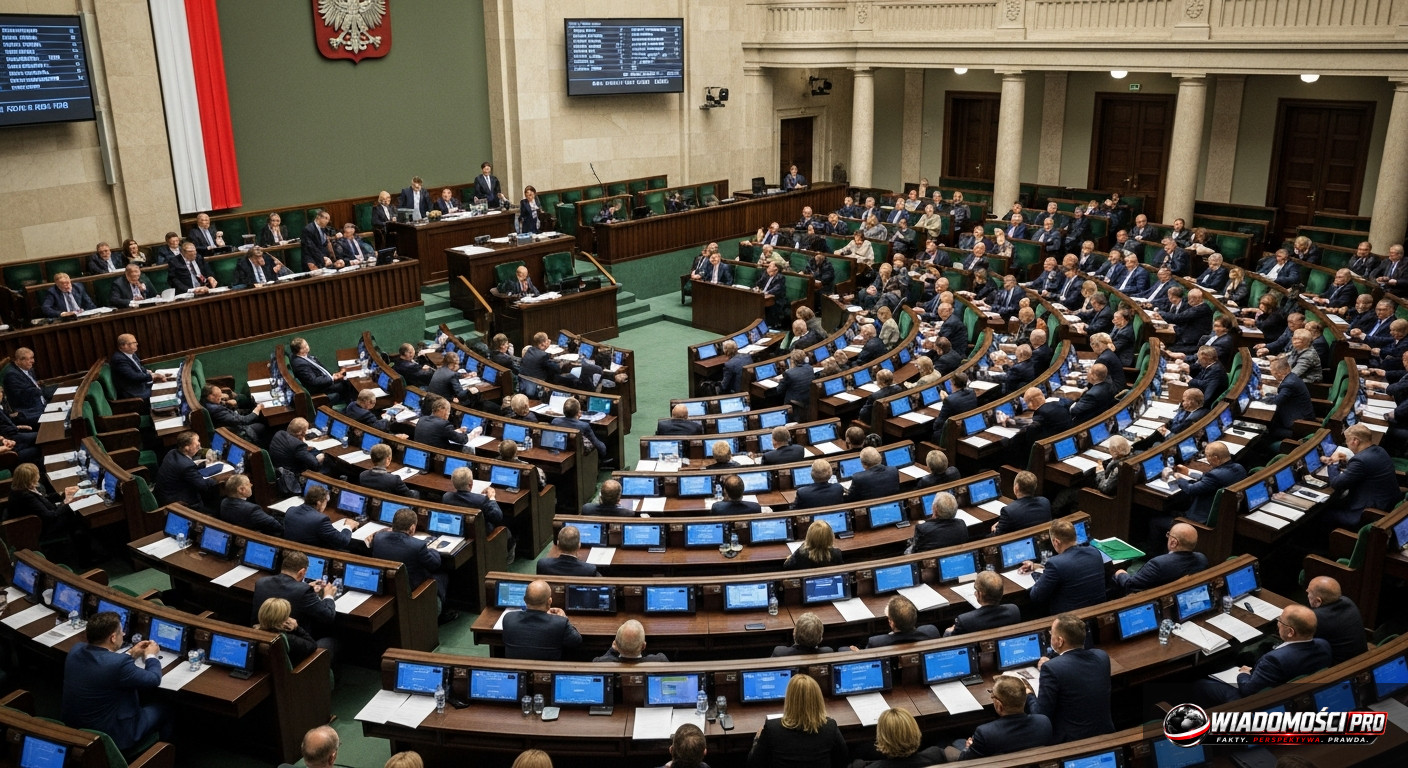
The 2025 budget assumes a deficit of 289 billion PLN, which the government justifies by the need to fund investments, while the opposition labels this amount as "financial vandalism." This level of debt sets a new threshold for fiscal security, forcing the market to revalue the yields of Polish treasury bonds. Citizens will feel the effects of these decisions through pressure on interest rates and real cuts in healthcare spending, which will directly impact the availability of medical services.
289 billion PLN deficit – the financial foundations of 2025
A budget deficit of 289 billion PLN is not merely a technical entry in the budget act. It is a sum that changes the architecture of the Polish economy. Those in power argue that such high debt results from the necessity of modernizing critical infrastructure, including the expansion of energy networks and the financing of defense projects. In this narrative, 289 billion PLN serves as fuel for GDP growth. The parliamentary opposition rejects this argument, pointing to a lack of discipline in current expenditures and the burdening of future generations with debt servicing costs.
An analysis of the structure of these expenditures shows that a significant portion of the money is directed toward servicing obligations incurred in previous years and maintaining a wide range of social benefits. When the state plans such a massive deficit, financial markets react with an immediate increase in treasury bond yields. Investors demand a higher risk premium, which in practice means more expensive credit for the state. Poland currently pays higher interest on its debt, which in turn limits the room for any investments in the budgets of subsequent years.
From a macroeconomic perspective, a 289 billion PLN deficit acts as a strong pro-inflationary impulse. If the government pumps this amount of money into the economy, the National Bank of Poland finds itself in a corner. Maintaining high interest rates is the only way to fight the price pressure generated by excessive liquidity. For the citizen, this means more expensive mortgage and consumer loan installments. The financial stability that is currently being disputed has ceased to be a given and has become a subject of negotiation with financial markets. Every fluctuation in the zloty exchange rate reflects uncertainty as to whether the Polish economy will be able to generate growth fast enough to bear the weight of such gigantic debt.

Discharge for the government – the result of the Sejm vote
On July 31, 2026, the Sejm granted the government a discharge. While this vote formally closes the process of settling finances for 2025, it does not end the political debate. For the ruling coalition, the result was a confirmation of the effectiveness of the chosen path. For the opposition, it was proof of ignoring warnings about the impending financial collapse. In this case, the discharge is a political certificate that does not change the hard data on budget execution.
During the parliamentary debate, accusations were made regarding the deliberate inflation of expenditures outside the state budget, in special-purpose funds, intended to mask the real scale of the deficit. The discharge thus became a tool for the government to protect itself against allegations of mismanagement. However, the fact of obtaining formal parliamentary support does not influence the assessment of rating agencies, which carefully analyze every zloty of debt. During the vote, the opposition consistently used the argument of "financial vandalism," pointing to the lack of real structural reforms that could balance revenues with expenditures.
For the citizen, the vote in the Sejm is usually a distant event. However, in this specific case, granting the discharge means a green light for the continuation of current fiscal policy. It is a signal that the government does not intend to withdraw from ambitious, albeit costly, projects, which in practice determines the shape of the budget for the coming years. The lack of consensus in parliament on such a fundamental issue weakens the credibility of the state as a payer and contractor in international markets. The discharge did not extinguish emotions; it merely shifted the focus from the debate over the act to a debate over the way funds that have already been borrowed are being spent.
The President's position: Healthcare and legal dispute
Throughout 2026, the President of Poland actively reviewed the budget, pointing to the dramatic situation in healthcare. The term "collapse budget" became a key element of his communication. The President argued that the prioritization of infrastructure investments is happening at the expense of patients, who face extended queues for specialists and a lack of modern equipment in many medical facilities. This position was a direct response to data on the underfunding of the healthcare sector.
The Presidential Chancellery analyzed legal paths that would allow challenging the budget before the Constitutional Tribunal. Such a move would have blocked the execution of budget plans, plunging Poland into a state of financial provisionality. Although a formal motion was not filed, the mere discussion of the topic was enough to create an atmosphere of uncertainty. The President argued that the government has no right to prioritize political goals over the health security of citizens.
This conflict highlighted a deep rift between the executive branch and the head of state. The budget ceased to be a technical document and became a tool of political struggle over the shape of national priorities. For the healthcare system, this dispute meant decision-making paralysis. Hospitals operated on the basis of rigid contracts that did not account for the inflation of labor and energy costs, which in 2026 led to an accumulation of debt in the medical sector. The President pointed out that a state unable to provide basic medical care loses the right to call its finances stable, regardless of how high the amounts allocated to investments in other sectors are.
Political dispute over the shape of state finances
The dispute over the 2025 budget dominated the Polish political scene. On one side of the barricade stood the government, which treats the deficit as a necessary cost of economic transformation. On the other – the opposition, which sees a threat to the country's financial sovereignty in every billion of debt. This polarization made the debate on public finances completely unreadable to the average taxpayer.
During public finance committee meetings, clashes occurred in which economic arguments were replaced by personal attacks. The government accused the opposition of wanting to stop the country's development; the opposition responded with accusations of violating constitutional principles of budgetary discipline. Each side dug into its own rhetoric. Those in power argued that without such a huge deficit, Poland would plunge into recession. The opposition countered that this deficit itself is the source of a crisis that will occur with a delay.
This political stalemate affects every decision of the Ministry of Finance. When data on budget execution appears, it is immediately interpreted by both sides in a mutually exclusive way. For the government, every zloty spent is a development success. For the opposition, it is another item on the list of losses. In such an environment, there is no room for a cool analysis of risks. The citizen, observing these squabbles, loses a sense of security, not knowing whether the economy is being managed responsibly or if it is merely a field for political experimentation. The discharge for the government did not end this process, but merely formalized a division that will determine Polish politics for years to come.
The role of budget decisions in the life of a citizen
The government's budget decisions of 2025 are not an abstraction, but a direct factor affecting the quality of life of Poles. Faced with a deficit of 289 billion PLN, the government had to make a series of decisions regarding spending priorities. The most noticeable effect for the citizen is the inflationary pressure, which did not disappear with the end of the year but became entrenched in the prices of essential services and products.
The aforementioned conflict over healthcare has a practical dimension: patients felt it through more difficult access to specialists and through rising costs of medicines, the prices of which are not always fully reimbursed in a way that compensates for inflation. The government, wanting to maintain the pace of infrastructure investments, had to limit spending in other areas, and the public sector – education and healthcare – became a natural place to look for savings.
For people with mortgage loans, the situation is equally unfavorable. A high deficit forces the central bank to keep interest rates at a higher level, which means that the costs of servicing household debt remain at a level that significantly limits consumption. The citizen is therefore in a trap: the state spends record sums, which stimulates prices upward, while simultaneously forcing citizens to tighten their belts due to higher credit costs. This is a vicious cycle that makes it so that, despite declared development, the real purchasing power of wages in 2026 is stagnant.
Indexation of benefits: Pensions and annuities 2026
The regulation on the indexation of pensions and annuities for 2026, announced on December 25, 2025, was one of the most important tests for budget stability. In conditions of a 289 billion PLN deficit, every decision to increase social benefits is burdened with huge fiscal risk. The government had to decide: either protect seniors from inflation, which increases the deficit, or limit indexation, which would cause massive social dissatisfaction.
The chosen indexation rate was the result of a compromise that satisfied few. Pensioners received benefits that, in their view, did not cover the real increase in food and medicine prices, while the opposition criticized the government for "extravagance" during a financial crisis. The technical nature of the document should not be misleading – this was a purely political decision. Maintaining the purchasing power of pensions in a state that is accumulating debt at a rate of nearly three hundred billion annually is becoming increasingly difficult.
The result of this policy is the systematic burdening of the budget with future obligations. Indexation, although necessary, is financed mainly from loans in the current structure of public finances, not from earned profits. This means that every subsequent decision on raises must be financed with increasingly expensive debt. For seniors, this means a sense of uncertainty – will the state be able to maintain the pace of indexation in future years when the costs of servicing the 289 billion PLN debt begin to consume an increasing portion of tax revenues? The answer to this question was not provided in any government statement, leaving millions of Poles in a state of permanent waiting for subsequent decisions regarding their wallets.
Perspectives and threats to the financial market
The financial market watched the 2025 budget with a mixture of disbelief and fear. The 289 billion PLN deficit was read by investors as a signal that Poland had entered a phase of loose fiscal policy that contradicts the need for macroeconomic stabilization. The yields of Polish 10-year bonds remained at high levels for almost the entire year of 2026, which is clear evidence that the market does not buy the government's narrative of "investment in the future."
Foreign investors show particular sensitivity to the issue of off-budget deficits. Suspicions that the real debt is higher than the officially declared 289 billion PLN keep the valuation of the zloty under pressure. Every piece of information about legal disputes, whether with the President or about the shape of the budget, causes an immediate reaction from speculative capital. The zloty reacts with weakening, which in turn imports inflation into the country through the higher cost of purchasing energy and raw materials abroad.
In this situation, financial stability becomes an illusion. The government, defending its spending, ignores the fact that the financial market is not a political institution and does not succumb to persuasion. If the deficit is not limited in subsequent budgets, Poland may face the necessity of drastic spending cuts in conditions of economic slowdown. This is a scenario that investors fear most, pricing in increasingly higher risk for Polish assets. The 2025 budget, instead of being a foundation of stability, has become a symbol of risk for the market, which Poland will have to face for many years to come.
What this means for you
For the average citizen, a budget with a 289 billion PLN deficit means, above all, a loss of predictability. When the state spends significantly more than it earns, the costs of this operation are passed on to consumers through inflation and high interest rates. The uncertainty of whether the healthcare system will work in a situation of sudden need is becoming the new norm, resulting directly from political decisions to shift funds to other goals.
It is worth following economic indicators, such as consumer price inflation (CPI) and the decisions of the Monetary Policy Council regarding interest rates. These will inform in the coming months whether the government's budgetary strategy is beginning to bear fruit or if it is leading to further erosion of the purchasing power of money. Every announcement of a budget amendment should be read through the prism of whether it increases the deficit or tries to limit it. The 2025 budget is a new stage of the Polish economy, in which the line between investment and debt has become very fluid. The citizen, although rarely participating in debates about billions, bears the final costs of every decision made in the parliamentary benches.
Questions and answers
What is the budget deficit for 2025?
The budget deficit was planned at the level of 289 billion PLN, which is a record value in the history of Polish fiscal policy.
Did the government receive a discharge in the Sejm?
Yes, the Sejm granted the government a discharge on July 31, 2026, which formally closed the stage of settling the budget for 2025, despite the sharp opposition of the opposition.
What main objections did the President raise to the budget?
The President pointed primarily to the dramatic situation in the healthcare sector, calling the budget a "collapse budget" and sounding the alarm about the lack of funds for the basic needs of patients.
What role did financial markets play in the budget debate?
Financial markets reacted to the scale of the deficit with an increase in treasury bond yields and increased pressure on the zloty exchange rate, treating such high debt as a significant risk factor for Poland's macroeconomic stability.
What does the announcement of the pension indexation rate from December 25, 2025, mean?
This decision determined the amount of raises for benefit recipients for 2026, being the result of a compromise between social expectations and the state's very limited budgetary possibilities.
Did the dispute over the budget end after the vote in the Sejm?
No. The vote formalized support for the government, but the debate about the effects of the high deficit, inflation, and debt remains a central point of political dispute and economic analysis.
What is the main concern regarding the future of state finances?
The biggest concern is whether such a high deficit will not permanently shake the country's economic stability and whether it will lead to a situation in which debt servicing costs limit the ability to fund key public services in future years.
Sources
- Government granted discharge. Opposition speaks of "financial vandalism" - Business Insider Polska
- Sejm made a decision on the budget. Government granted discharge - Polskie Radio 24
- Sejm voted on the budget. What about the discharge for the government? - Dziennik.pl
- President made a decision on the budget. "This is a healthcare collapse budget" - Rynek Zdrowia
- Polish budget in the hands of Karol Nawrocki. The decision could shake markets even without a veto - wnp.pl
- Budget in the hands of the President. An unexpected scenario on the table? - Money.pl
- Since it's the end of the year, it's time for a budget dispute. All options are on the table - including the Constitutional Tribunal - Wyborcza.biz
- Government announced regulation on setting the pension indexation rate for 2026. How much will it be? - Forsal.pl
Article prepared by the Wiadomości PRO editorial team with the support of artificial intelligence. Facts are derived from the sources listed above.


Komentarze (0)
Ładowanie komentarzy...