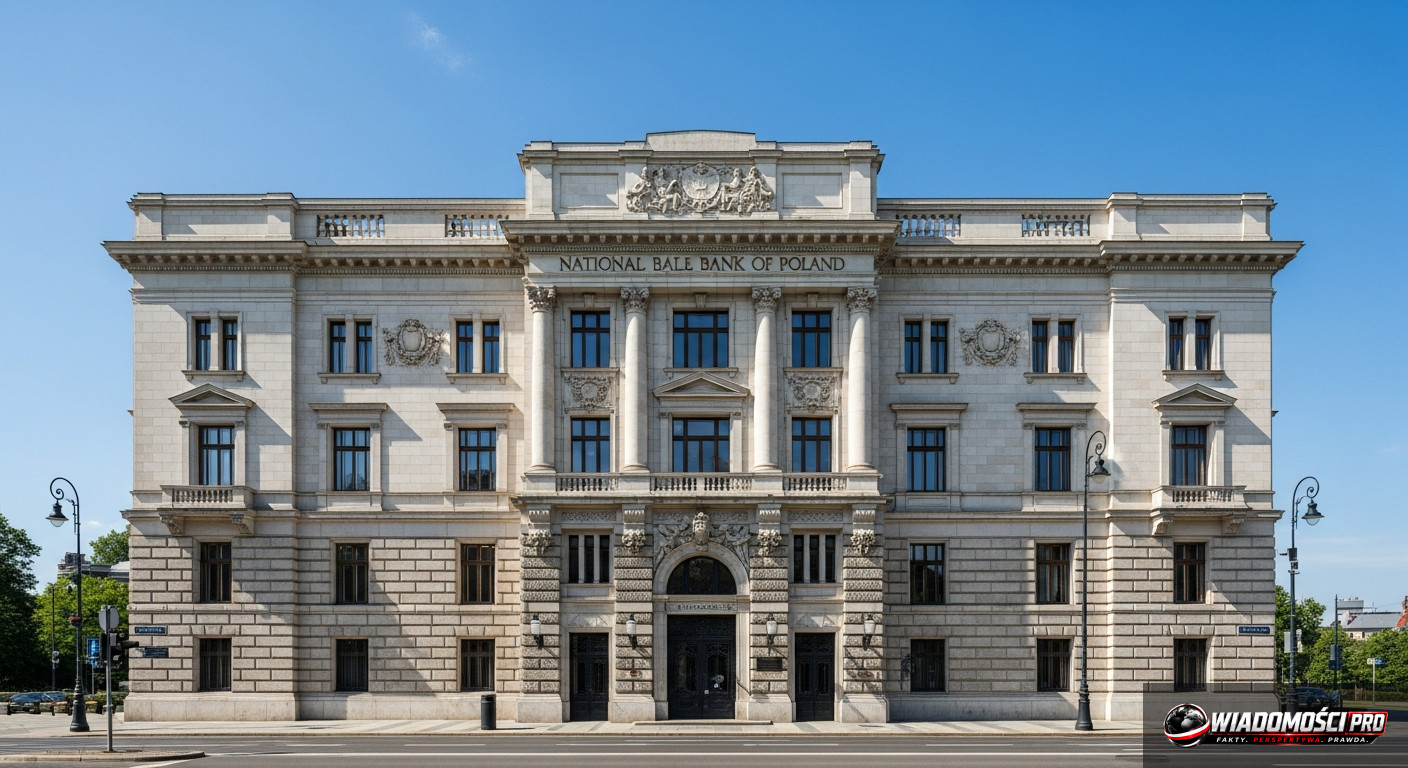
In July 2026, the MPC kept interest rates unchanged, which means that the cost of loans remains at the stable, yet still high level established after the last adjustments. The main NBP reference rate is 5.75%. This decision definitively ends borrowers' hopes for a quick reduction in monthly installments in the third quarter of this year.
July 2026: Mechanisms behind the MPC decision
During its meeting on July 8, 2026, the Monetary Policy Council decided to maintain interest rates at their current level. For the Polish banking system, this is a signal that protecting the value of the national currency in the face of unpredictable external shocks remains the priority. Policymakers in Warsaw have chosen a wait-and-see strategy, ignoring pressure to stimulate the economy through cheaper money.
The main factor determining this move is the international situation. Tensions between the USA and Iran, which escalated in July 2026, triggered an immediate reaction in commodity markets. Rising oil and natural gas prices translate into the risk of imported inflation. Under such conditions, lowering interest rates could lead to a sharp depreciation of the zloty. The central bank cannot afford a scenario in which currency weakening further fuels price pressure within the country.
The decision of July 8, 2026, is not an isolated case. It is a continuation of a defensive policy that replaced the short-lived optimism of autumn 2025. Back then, in November, the MPC made the second rate cut in the cycle, which the market perceived as the beginning of a long-term trend. Currently, reality has verified those assumptions. Stabilization at the 5.75% level for the reference rate means that commercial banks have no justification to reduce credit margins or expect a drop in WIBOR rates in the near future.
Monetary policy in mid-2026 has become a hostage to geopolitics. Investors in the currency market are pricing in the risk of an escalation of the conflict in the Middle East, which forces the MPC to maintain a so-called "high cost of money." For citizens, this means no changes in mortgage interest rate tables. The zloty, which is under pressure, requires protection, and the only tool available to the Council remains keeping rates at a level that makes capital in Poland still relatively expensive compared to expectations from half a year ago.
Loan mathematics: How much are you really paying in 2026?
To understand the scale of the burden, let's look at specific data. A mortgage of 300,000 zlotys taken out for a period of 25 years, based on a variable interest rate, is valued today based on the WIBOR 3M rate plus the bank's margin. Assuming the average bank margin is 2.00% and the WIBOR rate hovers around 5.75% (reflecting the NBP reference rate), the total interest rate on the loan is 7.75%.
In such a scenario, the monthly principal and interest installment is approximately 2,280 zlotys. It is worth noting how this amount is distributed over time. In the first year of repayment, a huge part of the installment – over 1,900 zlotys – is solely interest for the bank. The principal is repaid to only a small extent. Keeping rates at 5.75% means that for the coming months, the structure of this installment will remain almost unchanged. The borrower will not feel any budgetary relief, as the cost of capital remains frozen at a high level.
If there were a rate cut of 0.25 percentage points, the installment for such a loan would fall by about 50–60 zlotys. Although this amount seems small on a monthly scale, on an annual scale, the savings would amount to over 700 zlotys. The lack of this decision in July 2026 means that this money remains in the banking system, not in household wallets. This situation hits especially hard those who took out loans at the peak of their financial capabilities. Every month without a rate cut is for them a necessity to maintain rigorous financial discipline, with no margin for error.

Impact on WIBOR and the interbank market
WIBOR (Warsaw Interbank Offered Rate) is an indicator that anticipates MPC decisions because it reflects banks' expectations regarding the price of money in the future. If the market believes in quick cuts, WIBOR falls faster than official NBP rates. In July 2026, the situation is the opposite. Banks, observing geopolitical tensions and uncertainty regarding the zloty's exchange rate, are keeping WIBOR at a high level, seeing no room for its reduction.
This mechanism is simple: banks lend money to each other at a certain interest rate. If there is risk in the economy (e.g., imported inflation caused by a weak zloty), banks demand a higher interest rate for lending to another bank. This translates into the WIBOR rate, which is the base for your loan. In July 2026, the interbank market is extremely cautious. The lack of announcements of monetary easing from the MPC has caused WIBOR to stabilize around the reference rate, which prevents a drop in borrowing costs.
This means that even if consumer inflation in Poland began to show a downward trend, borrowers would not feel it immediately. WIBOR needs a clear signal from the NBP to move down. Currently, that signal is "defense." The MPC communicates that as long as global risks do not disappear, there will be no "gifts" for the financial market. For a mortgage holder, this means a long-term continuation of high costs. Commercial banks have no interest in lowering borrowing costs as long as the WIBOR rate remains high.
This dependency is the foundation of the current cost crisis for borrowers. WIBOR does not react to the individual needs of indebted Poles, but to a cold calculation of the risk of the entire banking system. Since we did not receive a rate cut in July 2026, WIBOR has no foundation to fall. It is a vicious circle, the exit from which can only be a lasting stabilization of the exchange rate or a calming of the situation in the Middle East.
Evolution of monetary policy: From hope to stagnation
The history of monetary policy in Poland in 2025–2026 is a record of great hopes that collided with a brutal reality. Autumn 2025 was a time of euphoria. The Monetary Policy Council, seeing the first signs of inflation fading, decided on the so-called "autumn quarter." It was a series of cuts that was supposed to start a cycle of returning to more affordable debt costs. At that time, many analysts predicted that by mid-2026, interest rates could fall even to the level of 4.50–5.00%.
Reality, however, turned out to be different. Already in April 2026, forecasts published by Direct Money began to point to upcoming difficulties. Experts warned that the path of rates in 2026 would be extremely complex. The reason was not the weakness of the Polish economy, but exogenous factors. The USA–Iran conflict, which intensified in the middle of the year, changed the balance of power in commodity markets. The MPC had to change its rhetoric from "easing" to "risk monitoring."
July 2026 is the best proof of this. The decision to keep rates at 5.75% is an expression of capitulation to geopolitical uncertainty. The zloty, which was strong in the autumn of 2025, found itself under strong selling pressure in July 2026. Foreign investors are withdrawing from emerging markets, which automatically weakens the Polish currency. In this situation, rate hikes are not on the table, but cuts are excluded. The Council therefore chose a safe variant, which is the least favorable for borrowers.
One cannot ignore the fact that every MPC decision is a balancing act on a tightrope. On one hand, we have consumers with loans who pay higher installments, on the other – the stability of the banking system and the exchange rate. In July 2026, the scale tipped in favor of stability. For the average Pole, this means that dreams of a cheaper loan must be postponed at least until the end of the year. The current situation is a continuation of a state in which the high cost of debt servicing becomes an element of everyday life, not a temporary anomaly.

Geopolitics as the main economic brake
Tensions between the USA and Iran, which dominated headlines in July 2026, are the most important factor limiting the central bank's decisions. In the global economy, Poland is perceived as an open economy, strongly linked to European markets, but also susceptible to commodity shocks. When the price of oil rises, transport and production costs rise, which automatically fuels inflation. If the MPC were to lower rates at such a moment, it would fuel the inflationary fire.
The Monetary Policy Council must therefore act in a very conservative manner. Keeping interest rates unchanged is a signal to investors that Poland has a "hard" monetary policy that will not bend under the influence of momentary mood swings. However, the price for this policy is paid by borrowers. High interest rates mean a higher WIBOR, and a higher WIBOR means a higher loan installment. This is a situation where the country's macroeconomic security is financed from the pockets of indebted citizens.
It is worth noting that this situation does not only apply to mortgages. The rise in the cost of money also limits corporate investment. Companies, fearing high financing costs, are holding back on new projects. This leads to an economic slowdown, which is visible in the data published in mid-2026. The Polish economy, instead of developing dynamically, has entered a phase of stagnation. Stabilization of rates at 5.75% is one of the reasons why GDP growth remains below potential.
An additional problem is the zloty exchange rate. In the face of the conflict in Iran, investors are fleeing to safe currencies such as the dollar or the Swiss franc. The Polish zloty is losing value, which makes imported goods more expensive. The MPC, by keeping rates at a high level, is trying to stop this capital outflow. This is a high-stakes game: either we maintain a stable currency at the cost of high loan installments, or we allow the zloty to weaken, which could lead to capital flight and further inflation growth. The Council's choice seems clear, although for borrowers it is extremely painful.
Forecasts for the second half of 2026
The second half of 2026 is marked by pessimism regarding debt costs. Reports flowing from the market, including TotalMoney.pl analyses from July 13, 2026, indicate that the room for interest rate cuts in the coming months is minimal. Experts emphasize that the volatility of forecasts is extremely high, which results directly from the lack of geopolitical stability. No one is able to predict how the situation in the Middle East will develop over the next three months.
Here are the key factors that will shape MPC decisions until the end of the year:
- Energy commodity prices: If oil remains at a high level, the MPC will not dare to make any cuts.
- Zloty exchange rate: Any weakening of the currency below certain thresholds will result in verbal intervention or keeping rates at a high level.
- Core inflation: If wage pressure within Poland does not fade, the central bank will have to maintain a restrictive policy.
Borrowers must prepare for a variant in which interest rates remain at their current level until the beginning of 2027. Any announcements of a "quick thaw" should be treated as wishful thinking, not as a realistic economic scenario. The financial market currently prices in a zero probability of a rate cut before October 2026. This is a time when every holder of a loan with a variable interest rate should verify their expenses.
The outlook for those repaying loans is therefore clear: there will be no cheap money in 2026. Stabilization at the 5.75% level is the new "normal," which is intended to protect the country from the effects of global chaos. Borrowers who were counting on a quick return to 2024 installments must come to terms with the fact that those market conditions were the result of a completely different geopolitical arrangement. The current decade poses challenges for them that require much greater financial flexibility.
Summary: What to expect from the next meeting?
The July MPC decision definitively closed the stage of hope for a quick improvement in the situation for borrowers. The cost of loans remains at a stable, yet still high level established after the last adjustments. Subsequent Council meetings in August and September 2026 will likely not bring a change of course. The MPC will wait for moods in global markets to calm down, which in current conditions is a long-term process.
There are no rational premises to believe that the central bank will take the risk of loosening monetary policy in an atmosphere of armed conflict in the Middle East. Interest rate stabilization is a "safe haven" for the MPC. Even if the economy begins to slow down, protecting the zloty and fighting inflation will remain the primary goals. Borrowers are in a difficult situation, being, in a sense, "hostages" to global processes over which they have no influence.
For mortgage holders, the only real way to lower costs is currently overpaying the principal. Since interest rates are not falling, the only way to reduce interest is to decrease the capital base on which the cost of money is calculated. This is a strategy that in 2026 is becoming the most effective form of fighting high credit costs. Waiting for MPC decisions has ceased to be an effective strategy for managing a household budget.
Questions and answers
Were interest rates lowered in July 2026?
No, the Monetary Policy Council kept the main reference rate at 5.75%, reacting to global geopolitical uncertainty.
How does the situation in Iran affect my installments?
The conflict in the Middle East is destabilizing commodity prices and weakening the zloty. To counteract inflation and defend the currency's value, the MPC is forced to keep interest rates high, which translates into a high WIBOR and unchanged loan installments.
When were interest rates last falling?
The last significant interest rate cuts took place in the autumn of 2025, followed by a period of stabilization that has lasted until July 2026.
Should we expect cuts in the coming months?
Given the current geopolitical pressure and market forecasts, cuts before the end of 2026 are unlikely unless there is a sharp improvement in the international situation.
What can I do to lower loan costs at current rates?
With high interest rates persisting, the only effective method of reducing interest is regular overpayment of the loan principal, which directly affects the reduction of the cost base for calculated interest.
Sources
- See what's happening with your loan! MPC made a decision - wGospodarce
- The Monetary Policy Council lowered interest rates. This is already the second autumn quarter - Bankier.pl
- MPC keeps rates unchanged – will the escalation in Iran bring hikes? (ANALYSIS) - Parkiet
- Interest rate forecasts in 2026 - Direct Money
- Interest rate value August 2026. Forecasts and current information about interest rates in Poland - TotalMoney.pl
- USA and Iran are at daggers drawn, and the MPC is not cutting rates. Zloty under pressure - INNPoland.pl
- MPC decision on interest rates is in. It is already known what's next for loan installments - Business Insider Polska
- Interest rates down again. But too early to rejoice. When is the next MPC decision? - Forbes
Article prepared by the Wiadomości PRO editorial team with the support of artificial intelligence. Facts come from the sources listed above.


Komentarze (0)
Ładowanie komentarzy...