
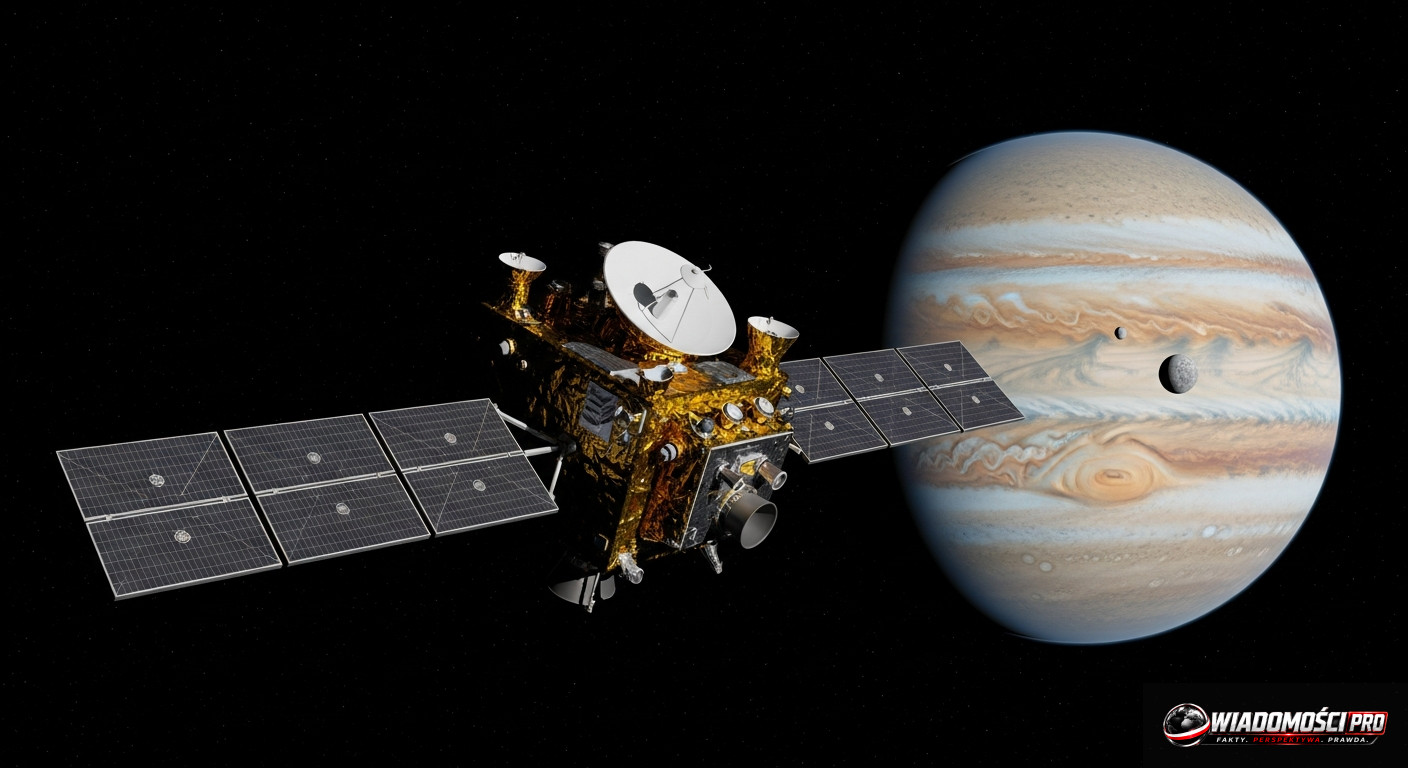
The Europa Clipper mission costs 5 billion dollars, and its main goal is to check whether conditions conducive to supporting life exist beneath the icy crust of Jupiter's moon. This is the most expensive planetary endeavor in the history of the American space agency. The probe, which left Earth in October 2024, is beginning a multi-year journey toward the most fascinating satellite of the gas giant. NASA engineers face the challenge of safely reaching the Jovian system and conducting a series of precise flybys that will allow them to peer beneath the thick layer of ice without the need to land on the hostile surface.
The power of the Falcon Heavy rocket and launch logistics
In October 2024, the Europa Clipper probe left the Kennedy Space Center in Florida, carried by a SpaceX Falcon Heavy rocket. The choice of this specific design was dictated by the mass of the probe, which, including fuel, is approximately six tons. The Falcon Heavy, featuring three main boosters with twenty-seven Merlin engines, provided the necessary thrust to give the craft an escape trajectory from Earth's gravitational field.
The probe's launch took place within a strictly defined time window, which is standard for interplanetary missions. The flight schedule was planned with clockwork precision, as every second of delay at the moment of rocket engine ignition affects fuel consumption during the gravity-assist phase. NASA opted against a direct flight toward Jupiter, which would have been energetically inefficient given such a large payload mass. Instead, Europa Clipper will perform gravity assists – in February 2025, it will fly near Mars, and in December 2026, it will approach Earth again. These maneuvers will allow the probe to gain the necessary speed to reach its destination in April 2030.
Unlike lander missions, where a soft touchdown on the surface is critical, Europa Clipper is a typical flyby probe. Its design had to account for not only the mass of the research equipment but also the enormous solar panels. Once deployed, the probe's wingspan is over 30 meters. This is necessary because, at a distance of 780 million kilometers from the Sun, the light intensity is too weak to power such advanced instruments using smaller photovoltaic cells.
Research instruments: The probe's eyes and ears
The mission's effectiveness depends on a set of nine scientific instruments integrated inside an armored hull. The choice of equipment was not accidental – every element must operate in the extreme radiation environment generated by Jupiter's magnetosphere. The most important device is the REASON radar (Radar for Europa Assessment and Sounding: Ocean to Near-surface). Its task is to "X-ray" the moon's icy crust. The radar will send radio waves toward Europa, recording signals reflected from the boundaries between ice layers and a potential ocean of liquid water. Thanks to this, scientists hope to determine the thickness of the ice cover and locate places where water might be closest to the surface.
Another key instrument is MISE (Mapping Imaging Spectrometer for Europa). This is an imaging spectrometer that will allow for the creation of precise maps of the moon's surface chemical composition. MISE will focus on searching for traces of salts, organic molecules, and other chemical compounds that could indicate an exchange of matter between the ocean and the surface. Understanding what is on the outside is essential for inferring the processes occurring inside the globe.
Complementing these studies is EIS (Europa Imaging System), a set of high-resolution cameras that will take photos of the surface in visible and infrared light. These data will allow for the creation of geological maps, on which scientists will look for traces of so-called "chaos" – areas where the ice has been cracked and displaced by Jupiter's tidal forces. Additionally, there is the ECM magnetometer, which will measure changes in the magnetic field in Europa's vicinity. If there is a salty ocean beneath the moon's surface, it should induce its own magnetic field, reacting to Jupiter's variable field while moving in orbit.
The geology of Europa: A tidal energy source
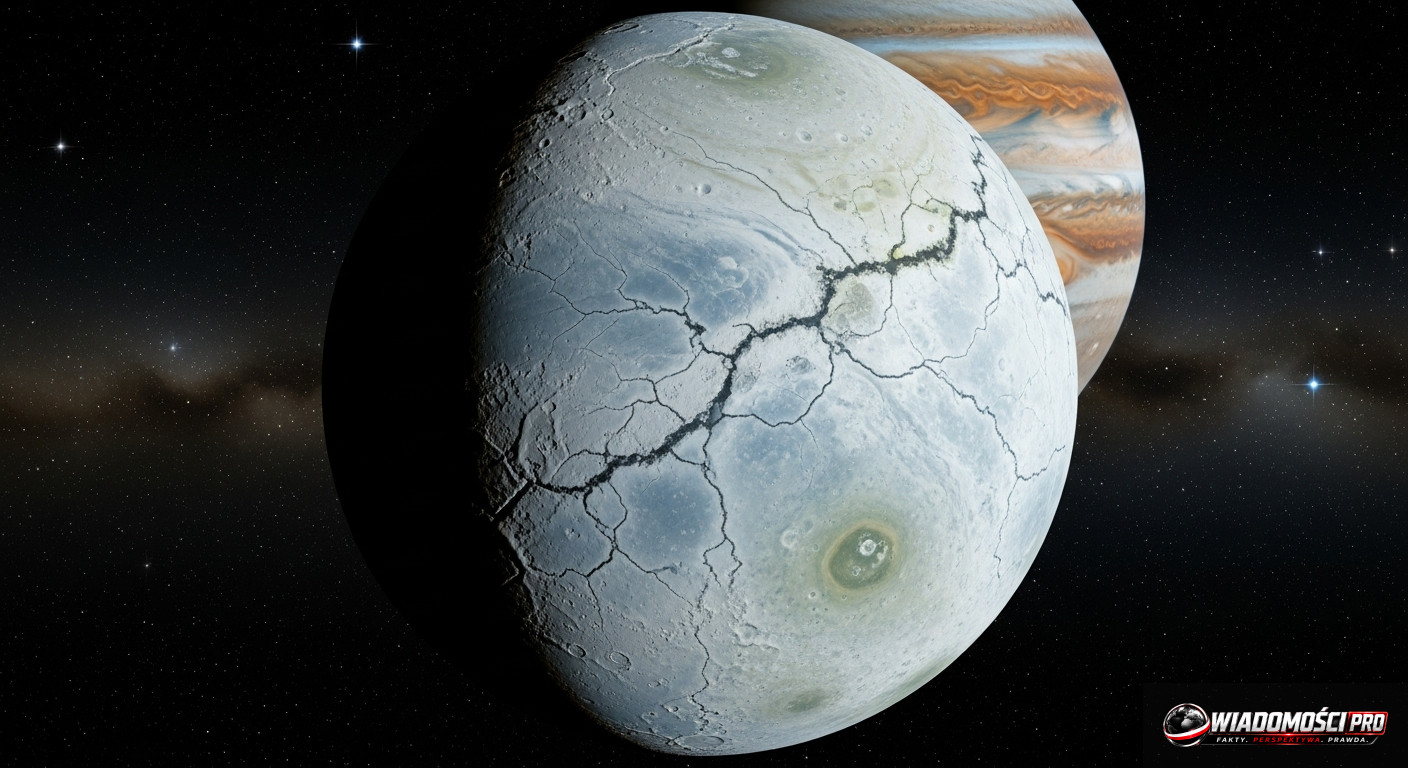
Europa is an object that has ignited the imagination of planetary scientists for years. Although the moon's surface is frozen solid, the temperature there is significantly lower than on Earth, making it completely hostile to organisms as we know them. However, the source of heat is not the Sun, but tidal forces caused by Jupiter's gravity and interaction with other moons, such as Io and Ganymede. Jupiter constantly "kneads" Europa, which causes internal friction and generates heat. This phenomenon allows water to be maintained in a liquid state even at a vast distance from the center of the Solar System.
Scientists hypothesize that beneath ice ranging from a few to several dozen kilometers thick, there is an ocean up to one hundred kilometers deep. If this hypothesis is confirmed, it would mean that Europa possesses the three necessary ingredients for life: access to liquid water, a source of chemical energy, and the presence of biogenic elements. However, the Europa Clipper probe is not looking directly for bacteria or simple organisms. Instead, it focuses on verifying whether the chemical environment of this ocean is stable enough for potential biological processes to occur within it.
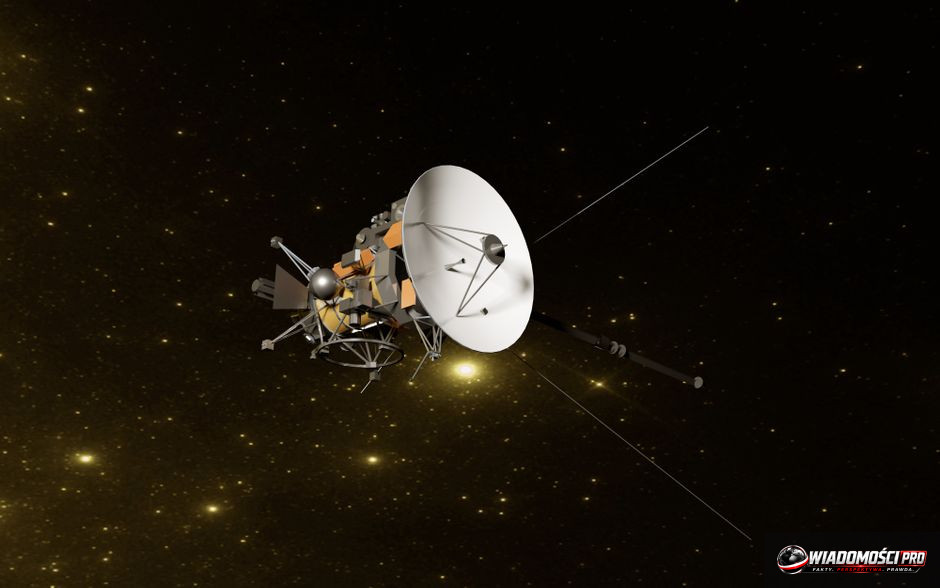
From the point of view of planetary physics, Europa is a unique laboratory. Observations from the Galileo mission suggested the existence of water vapor plumes ejected from the moon's interior. If Europa Clipper manages to record such a phenomenon during a flyby in 2030, the probe could move through the cloud of matter and analyze its chemical composition using a mass spectrometer. This would be a unique window into what is hidden in the sub-ice ocean, without the need to drill into the ice sheet.
Engineering challenges: The titanium vault
Designing a probe intended to survive for years near Jupiter required NASA engineers to use unconventional solutions. Jupiter is surrounded by an extremely strong magnetosphere that accelerates charged particles to speeds close to the speed of light. This radiation is lethal to silicon electronics. In the case of the Europa Clipper mission, traditional lead shielding was not used, as it would have been too heavy.
Instead, the most sensitive electronic components were placed in a special vault made of thick titanium and aluminum plates. This construction acts as a Faraday cage and radiation shield, allowing the processors to work even during the most extreme phases of the mission. The cost of this solution was one of the factors that influenced the final project valuation. Every gram of material launched into space costs money, and the additional mass of the shields had to be compensated for by optimizing fuel and propulsion systems.
The radiation issue also forced a specific orbit model for the probe. Europa Clipper will not orbit Europa directly, as staying in the strongest radiation belt would destroy it within a few months. Instead, the probe will orbit Jupiter, performing a series of 49 flybys near Europa. After each flyby, the probe will move away from the moon, giving its electronic systems time to "rest" and regenerate, and engineers time to transmit data to Earth. This is a strategy of avoiding direct danger, which maximizes the lifespan of the research equipment.
Finance and politics: Is the game worth the candle?
The 5 billion dollar amount spent on the construction and implementation of the mission sparks discussions in circles dealing with science funding. From the perspective of the space agency, this expenditure is spread over more than a decade of design work, testing, and production. Critics point out that in an era of budget constraints, every cent or dollar should be spent on goals that bring immediate results. However, supporters of the mission argue that the knowledge gained thanks to Europa Clipper goes beyond pure science. The development of radiation-resistant technology and deep-space power systems has a direct impact on future crewed missions, including the Artemis program, which assumes the return of humans to the Moon, and in the further future – to Mars.
Competition for primacy in deep space exploration is another factor shaping the narrative around this mission. Although NASA officially invites scientists from around the world to cooperate, Europa Clipper remains a project with a distinct American pedigree. After the success of the James Webb mission, NASA needed another "big" project that would maintain public interest and justify further funding for the space sector. Europa Clipper fits this role perfectly, offering a fascinating question about extraterrestrial life that is understandable to every taxpayer.
If the mission does not provide evidence for the existence of an environment conducive to life, NASA will have to face the question of whether it was worth investing such huge resources in a single project. There is a risk that a lack of spectacular discoveries could dampen the enthusiasm of decision-makers to fund further expeditions toward the moons of Jupiter or Saturn. On the other hand, science does not always provide answers at the moment we expect them. Often, negative results – proof that Europa is a dead globe – are just as important as confirming the theory about the existence of oceans. This allows for the elimination of false assumptions and better allocation of funds in future research programs.
Research schedule: What awaits us in 2030?
The mission schedule is divided into phases, the most important of which falls in the years 2030-2034. After entering Jupiter's orbit, the probe will begin the braking process, using the gravity of the moons to enter the target flyby path. The first months after arrival will be devoted to calibrating the instruments. Equipment such as REASON or MISE must be tested in real conditions to ensure that no electronic components have degraded during the multi-year flight through radiation belts.
The actual research stage will consist of collecting data during each of the 49 flybys. The probe will fly over Europa at various altitudes, from a few hundred kilometers to about 25 kilometers above the surface. This will allow for a diverse set of data – from global magnetic maps to detailed geological scans of selected craters and ice cracks. These data will be transmitted to Earth via the Deep Space Network, consisting of giant radio antennas located at different points around the globe.
Waiting for the results will be a challenge for patience. Due to the vast distance, a radio signal takes over an hour to reach Earth. Each data transmission session will require precise positioning of the probe's antenna. Scientists will have to wait for the raw data to be processed, which means that the first scientific publications may appear only many months after the main research phase begins. This is a process that requires long-term commitment and confidence in the correctness of the chosen strategy.
Perspective for the reader: Are we alone?
For the average observer, the Europa Clipper mission is not just numbers and charts. It is an attempt to answer one of humanity's most fundamental questions: is life a common phenomenon, or perhaps a unique case that happened only on Earth? If Europa's ocean turns out to be an environment capable of supporting life, the definition of the "habitable zone" in the Solar System will change radically. Instead of limiting ourselves to planets orbiting at the right distance from a star, we will have to include icy moons, which, thanks to tidal forces, may hide oases of life in the depths of their oceans.
It is worth remembering that Europa Clipper is not flying into space with a ready-made answer. The probe is a tool intended to provide the data necessary to formulate further questions. Regardless of the final result, the 5 billion dollars invested in this project is the price for progress in space engineering, the effects of which we will observe in the coming decades. From the materials used to build the vault to the algorithms for processing radar signals – the technologies developed for this mission will become the foundation for future generations of engineers.

Questions and answers
Why was Europa chosen, and not another of Jupiter's moons?
Europa has a sub-ice ocean that may contain more water than all of Earth's oceans combined. Additionally, the moon's geological activity suggests that this water is in contact with rocky minerals, which creates conditions conducive to the formation of complex organic molecules.
When will the probe reach its destination and when will we receive the first photos?
The probe will reach the Jovian system in April 2030. The first photos and data from the research instruments will begin to flow to Earth after the equipment calibration phase, which will occur shortly after entering Jupiter's orbit.
Is the Europa Clipper mission the most expensive mission in NASA's history?
Although the cost of 5 billion dollars is huge, it is not the most expensive mission in the agency's history. For example, crewed programs such as Apollo or the construction of the International Space Station consumed significantly greater resources. However, it is one of the most expensive uncrewed missions sent into deep space.
What will happen to the probe after the mission ends?
After the planned research period ends, the probe will most likely be directed toward Jupiter, where it will burn up in its dense atmosphere. This is intended to eliminate the risk of an accidental collision of the probe with Europa, which could lead to contamination of the moon with Earth microbes that might have survived on the hull despite sterilization.
What specific instruments will allow for the study of the ocean under the ice?
The key instrument is the REASON radar, which, by sending radio waves, will allow for mapping the structure of the icy crust and detecting liquid water. These data will be supplemented by the ECM magnetometer, which will confirm the existence of a conductive ocean by measuring induced magnetic fields.
Sources
- Launch of the Europa Clipper mission to Europa - AstroNET – Polish Astronomical Portal
- Europa Clipper launches. A key task ahead of them - Geekweek Interia
- Europa Clipper probe to search for life on Europa - Urania - Polish Astronomical Portal
- Launch of the Europa Clipper mission [BROADCAST]. Americans will overtake Europeans in the search for life on Europa - Wyborcza.pl
- NASA sends a probe to Europa. The Europa Clipper mission has launched - WP Tech
- Europa Clipper has launched. It will investigate whether there are conditions for life on Jupiter's moon - Polskie Radio 24
- Europa Clipper probe to search for life on Jupiter's moon, Europa - wszystkoconajwazniejsze.pl
- Flight to Jupiter for 5 billion dollars. Launch of Europa Clipper aboard Falcon Heavy - Benchmark.pl
Article prepared by the Wiadomości PRO editorial team with the support of artificial intelligence. Facts are derived from the sources listed above.

Komentarze (0)
Ładowanie komentarzy...