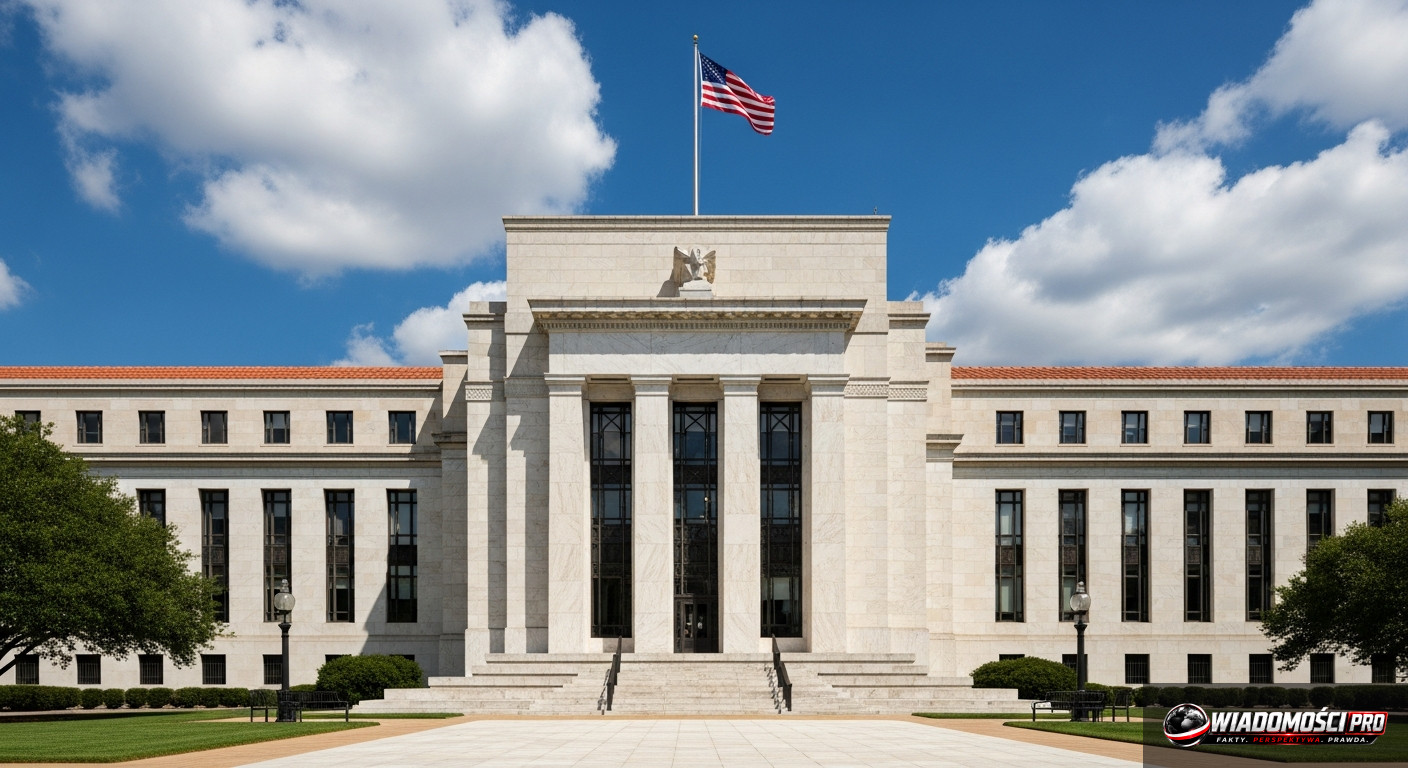
The decision to lower rates to the 4.75-5.00% range reduces the cost of capital in the US, which historically stimulates stock market growth and impacts the valuation of the dollar. This move defines a new reality for capital, forcing investors to adjust their portfolios immediately. The market has received a concrete asset pricing parameter for the new monetary cycle.
Details of the Fed's decision: 50 basis points down
The Federal Reserve has officially opened a new chapter in American monetary policy. The Federal Open Market Committee (FOMC) has cut interest rates by 50 basis points. This is a move investors have been waiting for for months, definitively ending the period of uncertainty regarding the direction of US monetary policy.
The new interest rate range is 4.75-5.00%. A half-percentage-point move signals a shift in the Fed's priorities. The institution is not only reacting to current macroeconomic readings but is also accepting the necessity of directly stimulating the economy. For the market, this means an immediate reduction in the cost of capital, which changes the structure of investment portfolios. Investors have finally received a concrete parameter for their long-term strategies.
Enthusiasm on the trading floors does not exempt one from cool-headed analysis. Such decisions fuel a bull market but simultaneously hit the valuation of the dollar. The US currency, which for years benefited from high interest rates as a safe haven, is losing some of its appeal to foreign capital. For the average investor, this is a double-edged sword. Stock gains are rising, but the purchasing power of the dollars held in relation to other currencies is becoming less predictable. The market has already priced in the Fed's move, but this is only the beginning of a chain reaction that will test the resilience of the American financial system to cheaper money in the coming weeks.

Market reaction: Were investors ready for this?
The valuation of financial instruments after September 17, 2025, shows how much the market needed a clear signal. The decision to cut to the 4.75-5.00% level brought relief, although analysts still point out errors made by the financial community in the past. The memory of September 2024 remains vivid. Back then, the market feared disappointment, and mood volatility was almost palpable. Many experts did not foresee the scale of the Federal Reserve's move, as confirmed by headlines from that period reporting on inaccurate economist forecasts.
The situation from a year ago, when debates around a possible cut raised concerns about the stock market, shows how much investors fear uncertainty. Even if today's move fits into the expected cycle, market hypersensitivity remains a fact. Investors who counted on a precise feel for the central bank's intentions often found that the Fed can surprise—even in conditions of theoretical stabilization. Today, the question is no longer whether the cut was needed, but how quickly the market will be able to fully price in this new cost of money without falling into extreme optimism. Ultimately, it is not the interest rates themselves that determine trends, but how far ahead of them the expectations of market participants run.
Shares of technology companies, financed by debt, gain from the lower cost of servicing obligations. Treasury bonds, which offered yields of around 5% in the era of high rates, are losing their appeal as risk-free assets. Investors who want to maintain their rate of return must shift capital toward dividend-paying blue-chip companies, which become an alternative to bank deposits in an environment of falling rates. This is a paradigm shift that forms the foundation of every portfolio strategy in 2025.
Political pressure vs. the independence of the American central bank
The decision to lower interest rates was not made in isolation from the political environment. For months, the Federal Reserve had been under open pressure from Donald Trump, who did not spare criticism of the decision-makers in Washington. Political tension surrounding the institution was palpable, and as early as July 2025, the media warned that the Fed was facing one of the most difficult tests in its history.
For market observers, this was not just a technical correction of monetary policy, but a high-stakes political game. The debate over the timing and the real scale of the cuts had been dragging on since mid-2025, sparking speculation about whether Jerome Powell would bend under the administration's pressure. There are many indications that the September 2025 move is a response to this external pressure, although officially the central bank points to macroeconomic conditions. However, it is difficult to maintain full independence when political rhetoric becomes so aggressive.
This turn of events raises skepticism about the long-term autonomy of the Fed. When a central bank begins to harmonize its decisions with political expectations, it loses its role as an impartial arbiter. Despite this, market mathematics remains ruthless. A rate cut realistically lowers the cost of capital in the US economy. Historically, such a scenario has been fuel for stock market bull runs, stimulating investment at the expense of a weakening dollar. Investors, looking at the charts, may celebrate cheap money, but they should remember that there is more behind this easing than just a cold analysis of inflation or unemployment data. It is the result of a political chessboard where the condition of the American economy before key decisions was at stake.
Europe in the shadow of American monetary policy
The US Federal Reserve, by cutting rates to the 4.75-5.00 percent range, is setting the pace for global financial markets. This decision directly lowers the cost of capital in the US, which impacts the valuation of the dollar. Investors around the world, fixated on Jerome Powell's moves, must, however, confront this optimism with a completely different reality on the other side of the Atlantic. The European Central Bank has chosen a different path, ignoring the pressure to loosen monetary policy, which creates a clear divergence in central bank strategies.
While Washington is reacting to signals from the economy, Frankfurt remains on the defensive. The discrepancy in these actions is not just an academic dispute over inflation, but a real factor shaping exchange rates and capital flows. Investors who counted on a synchronous move by the major players must recalculate their portfolios. The ECB is clearly distancing itself from the American path, which in practice means that capital seeking higher returns may flow toward the dollar faster or seek safe havens, provided emerging markets do not offer a sufficient risk premium.
Here is a summary of current monetary policy parameters:
- Interest rates in the eurozone — unchanged for the second time in a row according to data from September 11, 2025.
- Fed stance (September 2025) — resumption of the rate-cutting cycle.
- MPC (Poland) — in September 2024, rates were kept at an unchanged level, illustrating the conservative approach of Central and Eastern European central banks.
This asymmetry of actions makes Europe a hostage to American decisions. If the Fed continues to loosen policy, the ECB may eventually be forced to react to protect European exports from an overly strong euro. The current ceasefire in Frankfurt is more of a tactical calm than a long-term strategy. The market prices in that this divergence will not last forever, because the costs of maintaining a rigid rate against American easing are becoming increasingly painful for the European economy. For the investor, this means the necessity of closely monitoring not only Fed decisions, but above all the moment when the ECB finally breaks its current resistance.
Perspectives for investors: Stock market and currencies
The decision to lower rates to the 4.75-5.00% range is a signal that the Federal Reserve is changing its priorities. A lower cost of capital in the US directly impacts asset valuations. Historically, such a move has been an impulse for growth, reducing the discount applied to future company earnings. Investors are already pricing in cheaper money, which translates into higher multiples for broad market indices.
Technology is the main beneficiary here. This sector lives on debt, which finances innovation and aggressive growth. When interest rates fall, the burden of servicing obligations decreases, which immediately improves projected operating margins. Companies in this segment usually react first to changes in the macroeconomic environment.
The capital market is switching from a restrictive policy to one supporting growth. This is a fundamental change in attitude, which is visible in the debt market. US Treasury bond yields, reacting to the Fed's decision, must adjust to the new reality. For holders of bond portfolios, this means the need to redefine strategies, as the era of high, safe interest is slowly becoming a thing of the past.
The impact on the dollar cannot be ignored. Cuts often weaken the American currency, which creates a specific situation for foreign investors. Gains from stock market valuation may be partially offset by exchange rate fluctuations. The market looks optimistically at cheaper money, however, every such intervention carries the risk of fueling inflation. The Fed has chosen growth, but the price for this—in the form of potential pressure on the currency—is written into the profit and loss account of every investor.
Forecasts for dividend stocks in this environment are promising. In the face of falling bond yields, companies paying regular dividends become a safer alternative to Treasury bonds. Investors seeking passive income in 2026 will likely redirect a significant portion of capital from money market funds toward stocks with an established market position. This is a classic capital rotation that always accompanies the beginning of an interest rate-cutting cycle.
What's next for the easing cycle?
The decision to bring interest rates to the 4.75-5.00% range opens a new chapter in US monetary policy, which directly lowers the cost of capital. Historical data show that such a move is an impulse for stock indices, while forcing investors to revalue the dollar, which loses its status as a safe haven in an environment of cheaper money.
Investors are asking: is this a one-time gesture, or the beginning of a long-term retreat from restrictive policy? The resumption of the cutting cycle suggests that the Federal Reserve has not said its last word, and the coming quarters will bring further downward corrections. However, there is no talk of automatism. Jerome Powell and his associates remain in "wait and see" mode, where every decision is a hostage to upcoming macroeconomic readings.
Further easing will proceed based on specific parameters, which the market must now watch more closely than political promises:
- The Fed is monitoring labor market data and inflation indicators, which will determine the pace of subsequent moves.
- The role of Fed communication for financial stability in 2026 will become the main tool for managing investor expectations.
- The cutting cycle has been resumed, which in practice means permission for further, gradual policy easing in subsequent quarters, provided the data confirm a lasting slowdown in price pressure.
The catch lies in the nature of this data. The US economy, after a period of political pressure that was widely discussed in the summer of 2025, still shows signs of imbalance. The market expects precision, but the Fed this year has been balancing on the edge more often than setting clear trends. If inflation starts to rise alarmingly again, the central bank will have to quickly withdraw from its dovish rhetoric. Investors who too optimistically assumed a quick return to cheap money may experience disappointment. Financial stability in the coming months depends more on labor market data than on the announcements of decision-makers.

What this means for you
The Fed's rate cut means "cheaper money." Borrowers and companies needing financing will gain, the dollar may lose in the short term, and stock investors can count on gains, provided the economy does not fall into a recession. For a portfolio, this means the need to increase exposure to risky assets at the expense of cash.
The real estate market will feel the effects almost immediately. A lower cost of mortgage loans in the US, being a direct consequence of the Fed's decision, may revive the construction sector, which was stagnant during the period of high rates. Investors looking for diversification should look at REITs, which usually react positively to falling interest rates. If, however, the rate cuts are not enough to stimulate demand and unemployment begins to rise, the real estate market could become another flashpoint for the economy.
For the individual investor, the most important lesson from 2025 is to avoid overreacting to headlines. The market discounts information in advance. Often, when a decision becomes a fact, buying based on rates is already too late. Instead of racing against algorithms, one should focus on the fundamentals of companies that have a high capacity to generate cash regardless of the economic cycle.
In the context of a currency portfolio, having exposure to the dollar becomes risky in the short term, but in the long term, the dollar remains the world's reserve currency. Instead of selling off the dollar, hedge your position using derivatives. This approach is more professional than pure speculation on the decline of the American currency.
The final piece of the puzzle is inflation. If the Fed cuts rates too quickly, the market may react with a rise in commodity prices. Gold, often overlooked in stock market analyses, gains importance in such a scenario. A portfolio composed of tech stocks, selected dividend stocks, and gold as a hedge against inflation is likely the safest strategy for the rest of 2025 and the beginning of 2026. On Monday morning, check your exposure in the financial sector and reduce positions in instruments that lose margin as the credit spread narrows.
Questions and answers
Why did the Fed cut rates by 50 basis points?
The decision aims to support the economy by lowering the cost of capital in the face of slowing growth momentum and in response to changing macroeconomic conditions.
How does the Fed's decision affect a Polish investor?
The change in US rates affects the dollar exchange rate and sentiment in emerging markets, which translates into asset valuations in global portfolios and changes the attractiveness of assets denominated in foreign currencies.
Does this mean the end of high inflation?
The cut suggests that the Fed feels more comfortable regarding inflation trends, allowing itself to stimulate economic growth, however, inflation risk remains at the center of the central bank's attention.
Which sectors may gain the most?
The technology sector, construction, and companies paying regular dividends are the main beneficiaries of the decrease in the cost of capital, while the financial sector may experience pressure on interest margins.
What should investors watch out for in 2026?
Labor market data and subsequent Fed communications will be key, as they will indicate whether the central bank will continue the easing cycle or refrain from further cuts in the face of a potential inflation rebound.
Will ECB decisions matter for an American investor?
Yes, the divergence in monetary policy between the Fed and the ECB affects currency pair exchange rates (e.g., EUR/USD) and capital flows between Europe and the US, which may affect the valuations of global corporations operating in both markets.
Will political pressure affect the Fed's long-term strategy?
Although the Fed officially maintains independence, aggressive political rhetoric may force faster bank reactions, which for investors means the necessity of including political risk in their asset valuation models in the US.
How to prepare a portfolio for a potential recession?
In the event of an economic slowdown, investors usually increase the share of defensive assets, such as high-rated Treasury bonds, gold, and stocks of companies from the consumer staples sector, which show less sensitivity to economic cycles.
Was September 2024 a lesson for investors?
Yes, the errors in economists' forecasts from 2024 taught the market greater humility toward central bank communication and showed that market volatility is a derivative of uncertainty regarding institutional decisions.
What is the role of the dollar as a safe haven?
The status of the dollar as a safe haven is the foundation of the global financial system, however, in an environment of cheap money, its attractiveness relatively falls, which forces investors to seek alternatives in other asset classes.
What strategy to adopt toward bonds in the face of falling rates?
Falling interest rates mean an increase in the prices of already issued bonds, which favors investors holding long-term debt securities, however, future issues will offer lower coupons, which forces portfolio rebalancing.
Can the Fed withdraw from cuts?
If macroeconomic data, particularly regarding the labor market and inflation, show that the economy is overheating, the Fed may halt the easing cycle, which would be a signal for the market to correct expectations.
What does "wait and see" mean in practice for an investor?
It means that every subsequent Fed decision will be made based on the latest data, which increases market unpredictability and requires investors to have greater flexibility in managing portfolio risk.
How to monitor labor market data?
Investors should track monthly Non-Farm Payrolls reports and the unemployment rate, which are key indicators for the Fed when assessing the condition of the American economy and determining the interest rate path.
Is gold a good choice in 2025?
Gold acts as a hedge against inflation and political uncertainty, which, in the face of monetary policy easing by the Fed, makes it an important element of a portfolio for many investors seeking stabilization.
What impact does monetary policy divergence have on a portfolio?
Divergence forces a broader look at global markets, as differences in interest rates between central banks determine capital flows and the attractiveness of individual stock and bond markets.
Is it worth investing in companies with debt in 2026?
Companies with high debt that survived the period of high rates may benefit from a decrease in financing costs, which will improve their financial results and may lead to an increase in valuations, provided operational stability is maintained.
How to interpret statements by Fed decision-makers?
Statements by Fed members should be analyzed for consistency with the official communication, as minor changes in rhetoric may signal significant turns in monetary policy.
Why is 50 basis points a significant move?
A cut of 50 basis points is considered a more decisive move than a standard 25-point correction, which testifies to the central bank's strong determination to quickly support the economy in the face of a slowdown.
Should investors fear inflation?
Inflation remains a risk whenever monetary policy becomes too expansive, therefore monitoring CPI and PCE indicators is crucial for assessing the long-term effects of current Fed decisions.
Sources
- Trump gets his way. Fed resumes interest rate cutting cycle - Bankier.pl
- Fed holds its breath. Market expects rate stabilization in the US - Money.pl
- September Fed decision may disappoint stock markets. Debate around possible US interest rate cut - Strefa Inwestorów
- Eurozone rates unchanged for the second time in a row - Analizy.pl
- MPC did not change interest rates in September '24 - Miesięcznik Finansowy BANK
- Half the world was waiting for this decision. Fed indicated US interest rates - Money.pl
- Federal Reserve under pressure from Donald Trump. Time for a key decision - Business Insider Polska
- Fed cuts interest rates sharply. Economists were wrong, however - Bankier.pl
Article prepared by the Wiadomości PRO editorial team with the support of artificial intelligence. Facts are derived from the sources listed above.



Komentarze (0)
Ładowanie komentarzy...