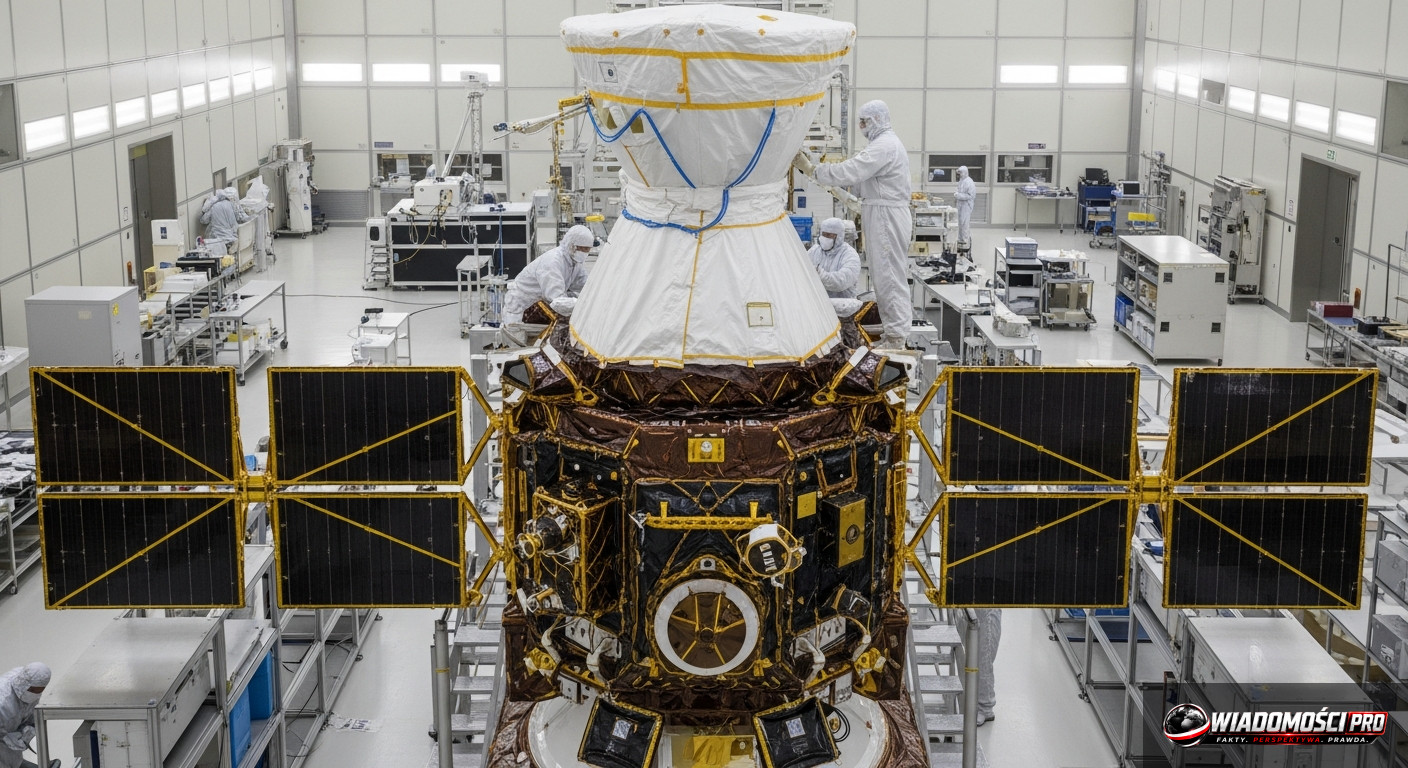
The Europa Clipper probe, launched on October 14, 2024, is analyzing the chemical composition and structure of Europa's icy shell using a suite of advanced scientific instruments, including an ice-penetrating radar. The mission aims to determine whether the moon's subsurface ocean possesses the conditions necessary to support life. It is the most expensive undertaking in the history of NASA's planetary exploration, valued at $5 billion, representing the technological pinnacle of modern astrobiology.
Hurricane Milton and the mission launch: logistical challenges
The mission was originally scheduled to launch in October 2024, but atmospheric phenomena forced engineers to change the schedule. Hurricane Milton, which struck the coast of Florida, forced a halt to operations at the Kennedy Space Center. For the technical team, this meant securing the probe, which had taken many years to build, against the destructive force of wind and rain. The precise onboard electronics, enclosed in sealed housings, had to survive the storm period without losing system stability.
The Europa Clipper probe left Earth in mid-October, beginning a multi-year journey toward the Jupiter system. Currently, the device is in interplanetary space, where control systems are undergoing a calibration phase. Upon reaching its destination, the probe will begin a cycle of flybys over Europa. Each close approach to the surface will allow for the collection of data that will answer the question of the presence of liquid water under a kilometer-thick layer of ice. Scientists are focused on searching for traces of organic substances and analyzing the energy that could power potential biological processes.
For NASA engineers, keeping the probe in a state of readiness throughout the duration of the flight is crucial. The distance between us and Jupiter means that every operational decision must be planned well in advance. The delay caused by the hurricane was merely a technical interruption in a process that had been in preparation for years. The probe is now speeding through the vacuum, and its instruments remain in a dormant state, waiting for the first contact with Jupiter's strong magnetic field. It is there, in the harsh radiation environment, that the research equipment will face its most important test.
Why is Europa the key to the search for life?
Europa, the fourth-largest moon of Jupiter, has fascinated astrobiologists for decades. This object does not resemble the dead, rocky celestial bodies we know from Earth's neighborhood. Hidden beneath a thick, icy shell is an ocean of liquid water. It is estimated that the volume of this reservoir is twice that of all Earth's oceans combined. The interaction of water with the rocky seafloor, enhanced by tidal forces caused by Jupiter's gravity, creates an environment where water remains in a liquid state.
The probe is not looking for direct evidence of the existence of organisms, but is focusing on verifying the ingredients necessary for life. Scientists are checking whether the water contains the appropriate chemical compounds and whether it has energy sources, such as geothermal heat. Analysis of the surface will allow for an assessment of whether organic matter is escaping from the moon's interior to the outside. These processes may be crucial for understanding whether Europa is a habitable environment.
Skeptics note that the presence of water is only the beginning of a long list of requirements. Even if Europa possesses the necessary raw materials, it is not certain that chemical processes have led to the emergence of life. NASA is investing $5 billion to verify these hypotheses. If the instruments confirm the presence of complex organic molecules in the icy shell, it will be a signal that the boundaries of the "habitable zone" in the Solar System must be moved much further from the Sun. Data from the mission will allow for the creation of a map of potential biosignatures. For now, however, we remain in the realm of calculations and advanced computer simulations.

Europa Clipper technology in numbers
Europa Clipper is the most powerful probe built by NASA to study celestial bodies beyond Earth. Its dimensions, once the solar panels are deployed, are comparable to the size of a basketball court. Such a surface area of cells is necessary because, at Jupiter's orbit, the intensity of sunlight is many times weaker than near our planet. The probe must draw energy from the minimal amount of arriving photons to power all onboard research systems.
The suite of instruments includes, among others, REASON, an ice-penetrating radar. This device sends radio waves that bounce off structures within the icy shell. Thanks to this, scientists will create a three-dimensional model of Europa's interior. Another key element is MISE, an imaging infrared spectrometer. This instrument searches the moon's surface for traces of ice, salts, and organic compounds that may be crucial for biology. ECM, a magnetometer, will measure the magnetic field induced by the ocean, which will allow for the determination of its depth and salinity.
In addition, there is the EIS camera system, which will take high-resolution photos of the surface, and E-THEMIS, which records heat emitted by the moon. PIMS, MASPEX, and SUDA are instruments involved in the analysis of plasma, gas composition, and dust particles. Each of them performs a different function, and their combined work is intended to provide a complete physicochemical picture of Europa. NASA has opted for system redundancy, knowing that in Jupiter's environment, the failure of a single element could negate years of work. The American agency treats this project as a priority, building its position as a leader in the exploration of the outer planetary system.
Here is a summary of the technical parameters:
- Mission cost: $5 billion.
- Main goal: assessment of the habitability of the subsurface ocean.
- Power supply: solar panels with a total area exceeding 90 square meters.
- Number of flybys: a series of close flybys over the moon's surface is planned.
The political dimension of the mission is undeniable. The Americans have allocated huge resources to the project, outpacing European research initiatives regarding Jupiter's moons. The scale of engineering involvement is a demonstration of NASA's technical capabilities. Europa Clipper is a manifestation of dominance in the space sector, where primacy is determined by the ability to operate in the most difficult radiation conditions that electronics must face.
Schedule of the journey toward Jupiter
The Europa Clipper probe is currently in a long-term interplanetary flight operation. After the launch, which took place on October 14, 2024, the device began gravitational maneuvers. Using the gravitational assist of other planets is necessary to gain the speed needed to reach the vicinity of Jupiter. NASA manages the trajectory with surgical precision, monitoring every degree of deviation from the planned course.
In 2026, the probe remains in the cruise phase, during which onboard systems are regularly checked for radiation resistance. Although the main phase of research will begin only after reaching Jupiter's orbit, data about the interplanetary environment is already being collected. Every month of flight is a test for the electronics, which must withstand years in a vacuum. The mission schedule assumes the implementation of subsequent stages of research in accordance with the adopted operational strategy.
The implementation of such a complex project requires not only financial resources but also extraordinary patience. NASA does not publish daily updates, focusing on the stable operation of the probe's life support systems. Skeptics point out that the long duration of the mission poses the greatest risk to the research equipment. Cosmic radiation degrades electronic components, which could affect the precision of the instruments upon arrival. Nevertheless, the progress of the mission so far confirms the effectiveness of the safeguards used.
Competition and cooperation in space research
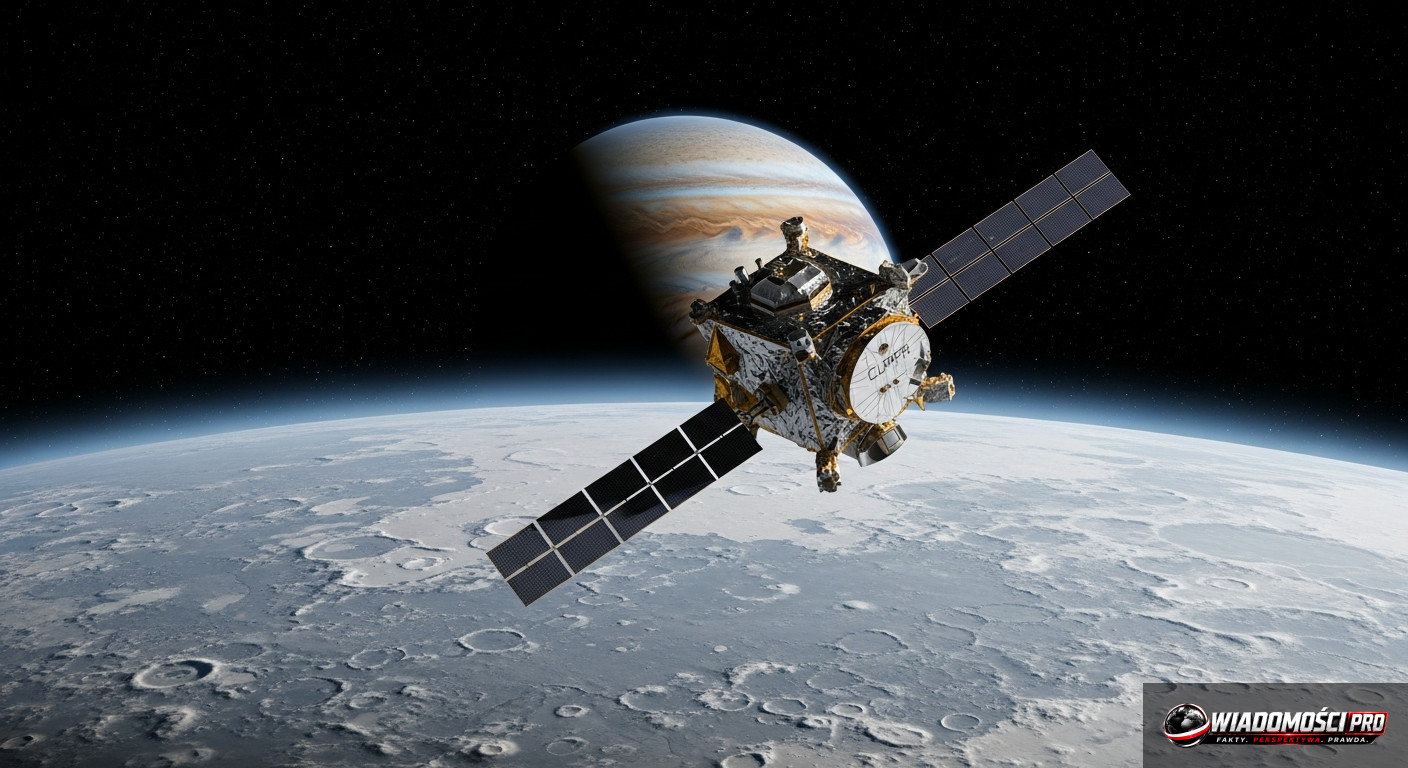
The Europa Clipper mission is an expression of the competition for primacy in scientific discoveries. The American agency has outpaced European programs that also planned to study Jupiter's moons. The choice of research tools, such as the REASON radar or the MISE spectrometer, shows that NASA has bet on the most advanced technologies. The Americans have left no room for interpretation, investing $5 billion in equipment that is intended to provide an unambiguous answer to questions about life beyond Earth.
International cooperation in science, however, does not disappear in the face of national competition. Data obtained by Europa Clipper will be analyzed by research teams from all over the world. The Americans' success will become the foundation for future missions, regardless of which agency leads them. Europe as a continent remains an active player, having its own ambitions in space research, but it is NASA that currently possesses the instruments that will be the first to "touch" the secrets of the icy globe.
Competition in this field drives innovation. Space agencies race in the efficiency, reliability, and precision of their probes. Europa Clipper, thanks to its scale and advancement, sets new standards for future deep space missions. It remains an open question whether in the coming decades we will witness a division of tasks or rather further competition for priority in discoveries. For now, it is the American probe that is blazing the trail toward Jupiter, implementing the most ambitious research plan of our time.
What do we know about the mission in 2026?
In August 2026, the Europa Clipper probe continues its journey toward the Jupiter system. According to the plan, all onboard systems are operating within the assumed parameters. NASA maintains the project's priority status, treating it as the foundation of its search for extraterrestrial life. The agency is not slowing down in its operational preparations, knowing that this is one of the most expensive expeditions in the history of exploration.
On board the device is a set of advanced instruments that, upon arrival, will allow for a detailed analysis of the chemical composition and structure of the icy shell. Instruments such as MASPEX, used to study the composition of molecules, or SUDA, analyzing tiny dust grains, are ready to work in difficult conditions. Scientists are not looking there for direct evidence of the existence of organisms, but rather for physicochemical conditions that could favor the support of life. The mission is to check whether the subsurface ocean hidden under kilometers of ice possesses the necessary ingredients: water, energy, and the right chemistry.
Skepticism in the scientific community, however, remains alive. Success depends on whether the instruments can withstand the extreme radiation near Jupiter, which is the greatest engineering challenge of this decade. Each flyby near the planet is a brutal endurance test for the electronics. NASA cannot afford a mistake. If the mission confirms that Europa is a habitable environment, it will change our understanding of biology, moving the boundaries of the search beyond Earth. For now, however, we remain in a waiting phase, observing the probe's flight toward its target.

What this means for you
The Europa Clipper mission is a huge leap for astrobiology. Scientific institutions and all of humanity benefit from this, receiving an answer to the question of whether we are alone in the universe. The catch remains the enormous distance and the waiting time for data from Jupiter. This requires patience from the taxpayers funding the mission and the scientific community.
Modern science is based on long-term planning, where the results of the work of many generations of engineers become visible only after years. The $5 billion investment in the probe is a cost that is significant on a global scale, but in the context of obtaining evidence for the existence of life beyond Earth, it is an expenditure that could redefine our place in the cosmos. The lack of quick answers does not mean failure. On the contrary, every piece of data sent by the probe will be a brick building our knowledge of the universe.
If the Europa Clipper mission confirms that the ocean under Europa's ice is a place where life could survive, it will change the approach to exploring other moons of Jupiter and Saturn. Scientists will have concrete arguments in their hands that life in the universe may be a more common phenomenon than we previously assumed. What is only a hypothesis today, after 2026 and subsequent years of research, may become a hard scientific fact.
Questions and answers
Has the Europa Clipper probe already reached its destination?
No, the probe launched on October 14, 2024, and is in a long-term flight phase toward the Jupiter system.
Why was Europa chosen specifically?
Europa is one of the most promising places in the Solar System due to the presence of an ocean under its icy shell, which possesses the necessary ingredients to support life.
Was the mission launch threatened?
Yes, the launch had to be postponed to October 14, 2024, due to a weather threat caused by Hurricane Milton.
Which instruments are most important for the mission?
The REASON radar for studying the interior of the icy shell, the MISE spectrometer for analyzing surface composition, and the ECM magnetometer, which will measure the ocean's magnetic field, are key.
How much did the construction of the probe cost?
The total cost of the Europa Clipper mission is $5 billion.
Why is Europa Clipper such a large probe?
Its size results from the need to use huge solar panels, which must provide enough energy in the distant and poorly lit Jupiter system.
What exactly are scientists looking for on Europa?
Scientists are looking for biosignatures, i.e., traces of chemical compounds and physical conditions that could support life in the subsurface ocean.
What threats await the probe near Jupiter?
The biggest challenge is extreme radiation, which can damage the probe's electronics during flybys near Jupiter.
Do we already know in 2026 if there is life on Europa?
No, in 2026 the probe is still in flight, and research on the surface and ocean of Europa will begin only after it reaches its destination in future years.
Is the mission international in nature?
Although the project is entirely funded and implemented by NASA, data from the mission will be available to the international scientific community.
How will the probe deal with the thick layer of ice?
The probe will not drill into the ice, but will use the REASON radar to "X-ray" the shell and analyze its structure, which will allow for inferences about the conditions prevailing in the ocean.
When can we expect the first results?
The first scientific results will appear only after the probe reaches Jupiter's orbit and conducts a series of flybys over Europa.
Is this the most expensive mission in NASA's history?
It is one of the most expensive planetary missions, valued at $5 billion, which places it at the forefront of the agency's most advanced research programs.
Why were so many instruments used in the mission?
The use of various instruments, such as cameras, spectrometers, and dust detectors, allows for a multidimensional analysis of Europa's environment, which increases the chance of detecting traces of life.
What role does Jupiter's gravity play in the research?
Jupiter's gravity is responsible for the tidal phenomenon that heats Europa's interior, keeping the water in a liquid state, which is crucial for the moon's potential habitability.
Will the probe land on Europa?
No, the mission only assumes flybys over the moon's surface, during which the instruments will collect data from orbit.
Did Hurricane Milton affect the equipment on the probe?
No, thanks to the safeguards applied by engineers at the Kennedy Space Center, the equipment remained intact during the hurricane's passage.
What is the significance of dust analysis by the SUDA instrument?
The SUDA instrument will allow for the identification of the chemical composition of particles ejected from Europa's surface, which may provide direct information about the chemistry of the subsurface ocean.
Is NASA planning further missions after Europa Clipper?
The future of subsequent missions depends on the results collected by Europa Clipper, which will set new directions for research in the Jupiter system.
Why is studying Europa more difficult than studying Mars?
Exploration of Europa requires operating in a much more difficult radiation environment and at a greater distance from Earth, which hinders communication and technical support for the probe.
What role does E-THEMIS play in the mission?
E-THEMIS allows for the detection of thermal anomalies on the surface, which may indicate places where water or organic compounds are escaping from the moon's interior.
Is the probe fully autonomous?
The probe has advanced computer systems that allow for partial autonomy during flight and the execution of maneuvers, but key operations are supervised by a team from Earth.
What is the significance of Jupiter's magnetic field for the probe?
Jupiter's magnetic field is extremely strong and creates radiation belts, which pose the main threat to the probe's electronics during its operation in the moon's orbit.
Is chemical composition analysis sufficient to detect life?
Chemical analysis will provide evidence for the existence of conditions favorable to life, but final confirmation of the presence of organisms would likely require more direct research in the future.
Why is the race to discover life so important for NASA?
The discovery of life beyond Earth would be one of the most important achievements in the history of science, changing our understanding of biology and the place of humans in the universe.
How does the probe send data to Earth?
The probe uses high-throughput radio communication systems that allow for the transmission of large amounts of measurement data over vast distances in space.
Is $5 billion a large amount in NASA's budget?
It is a significant investment that shows how high a priority it is for the agency to explore the secrets of Europa and potentially answer the question about life in space.
What is the significance for science of data on ocean salinity?
Ocean salinity is a key indicator of geochemical processes occurring inside the moon, which affects the assessment of its ability to support biological processes.
Is the PIMS instrument used during the flight?
The PIMS instrument is key to studying the plasma environment that the probe will encounter near Jupiter, which is necessary for calibrating research systems before the start of the main phase of the mission.
Why is this mission described as the "largest" in history?
This concerns both the physical size of the probe and the complexity of its equipment, as well as the scale of the scientific ambitions behind this project.
What is the risk of total instrument failure?
The risk always exists, especially in Jupiter's radiation environment, which is why the mission designers opted for high reliability and redundancy of key systems.
Is there a chance of discovering "aliens" during this mission?
The mission is not aimed at searching for intelligent beings, but at studying the chemical conditions that could support the development of simple forms of life.
Will Europa Clipper change the rules of the game in astrobiology?
The collected data may provide groundbreaking evidence that conditions for the emergence of life exist beyond Earth, which in itself would be a scientific revolution.
How long will the probe collect data?
The mission assumes a multi-year period of work after reaching the Jupiter system, during which the probe will perform a series of close flybys over Europa.
Why did NASA choose the MASPEX instrument?
MASPEX allows for extremely precise analysis of the composition of gas molecules, which is crucial for understanding the chemistry of the moon's atmosphere and surface.
Is Europa Clipper the only mission studying Jupiter's moons?
No, other space agencies are also conducting programs to explore the Jupiter system, but Europa Clipper stands out for its dedicated focus on studying conditions favorable to life on Europa.
If biosignatures are detected, is NASA planning another mission?
Confirmation of the existence of conditions favorable to life on Europa will certainly spark a discussion about sending subsequent, more precise research missions to this moon.
What are the biggest technical challenges facing the probe in 2027?
In the coming years, the probe will continue its flight, and the challenges will mainly concern maintaining system efficiency during long-term exposure to the harsh conditions of outer space.
Will data from the probe be publicly available?
Yes, NASA makes scientific data from its missions available, which enables the analysis of results by the scientific community from all over the world.
Why is the ice-penetrating radar so important?
It allows for "peering" under Europa's surface without the need for landing, which provides direct evidence of the structure of the icy shell and the depth of the ocean.
Does Europa Clipper have a chance of finding evidence of life in 2026?
No, in 2026 the probe is in flight, and scientific research on-site will begin only after reaching Jupiter.
Is the Europa Clipper mission a "cosmic manifesto" of the USA?
Many experts point out that the scale and advancement of the project confirm the leading role of the United States in the exploration of the outer planetary system.
Why is studying Europa so expensive?
The high cost results from the need to develop radiation-resistant technologies, the construction of a huge probe, and the logistics of a multi-year flight through space.
Can the probe change its flight path?
The flight trajectory is precisely planned, but NASA has the ability to make course corrections to optimize the mission's progress.
What is the significance for science of the discovery of water on Europa?
This discovery confirmed that liquid water can exist beyond Earth, which forms the foundation for further searches for life in the Solar System.
Is Europa Clipper NASA's greatest achievement?
It is one of the agency's most ambitious undertakings, which combines state-of-the-art engineering with fundamental questions about the nature of life.
Does the probe have systems for detecting radiation?
Yes, the probe is equipped with instruments monitoring the radiation environment, which is necessary to protect its onboard systems while working near Jupiter.
What is the significance of dust analysis by SUDA in the context of the ocean?
Dust particles may contain samples of matter originating from the interior of the ocean, which gives a chance to study its chemical composition without the need to penetrate under the ice.
Can Europa Clipper survive longer than planned?
The duration of the mission depends on fuel consumption and the resistance of components to radiation, but NASA tries to design the probe so that it can work as long as possible.
What is the biggest risk associated with flybys over Europa?
The biggest risk is damage to the equipment by radiation during multiple flybys in Jupiter's strong magnetic field.
Does the probe conduct research during the flight to Jupiter?
The main research phase will occur after reaching the destination, but the probe can collect limited data on the interplanetary environment during the journey.
Why is Europa a better target than other moons of Jupiter?
Europa has an ocean of liquid water in direct contact with the rocky seafloor, which makes it the most promising place to search for life in the entire Jupiter system.
Sources
- Launch of the Europa Clipper mission to Europa - AstroNET – Polish Astronomical Portal
- Europa Clipper launches. A key task ahead of them - Geekweek Interia
- Europa Clipper probe to search for life on Europa - Urania - Polish Astronomical Portal
- Launch of the Europa Clipper mission [TRANSMISSION]. Americans to outpace Europeans in the search for life on Europa - Wyborcza.pl
- NASA sends a probe to Europa. The Europa Clipper mission has launched - WP Tech
- Europa Clipper has launched. It will study whether there are conditions for life on Jupiter's moon - Polskie Radio 24
- Hurricane Milton delays the launch of NASA's largest space probe, Europa Clipper, to October 14 - Notebookcheck.pl
- Europa Clipper probe to search for life on Jupiter's moon, Europa - wszystkoconajwazniejsze.pl
Article prepared by the Wiadomości PRO editorial team with the support of artificial intelligence. Facts come from the sources provided above.

Komentarze (0)
Ładowanie komentarzy...