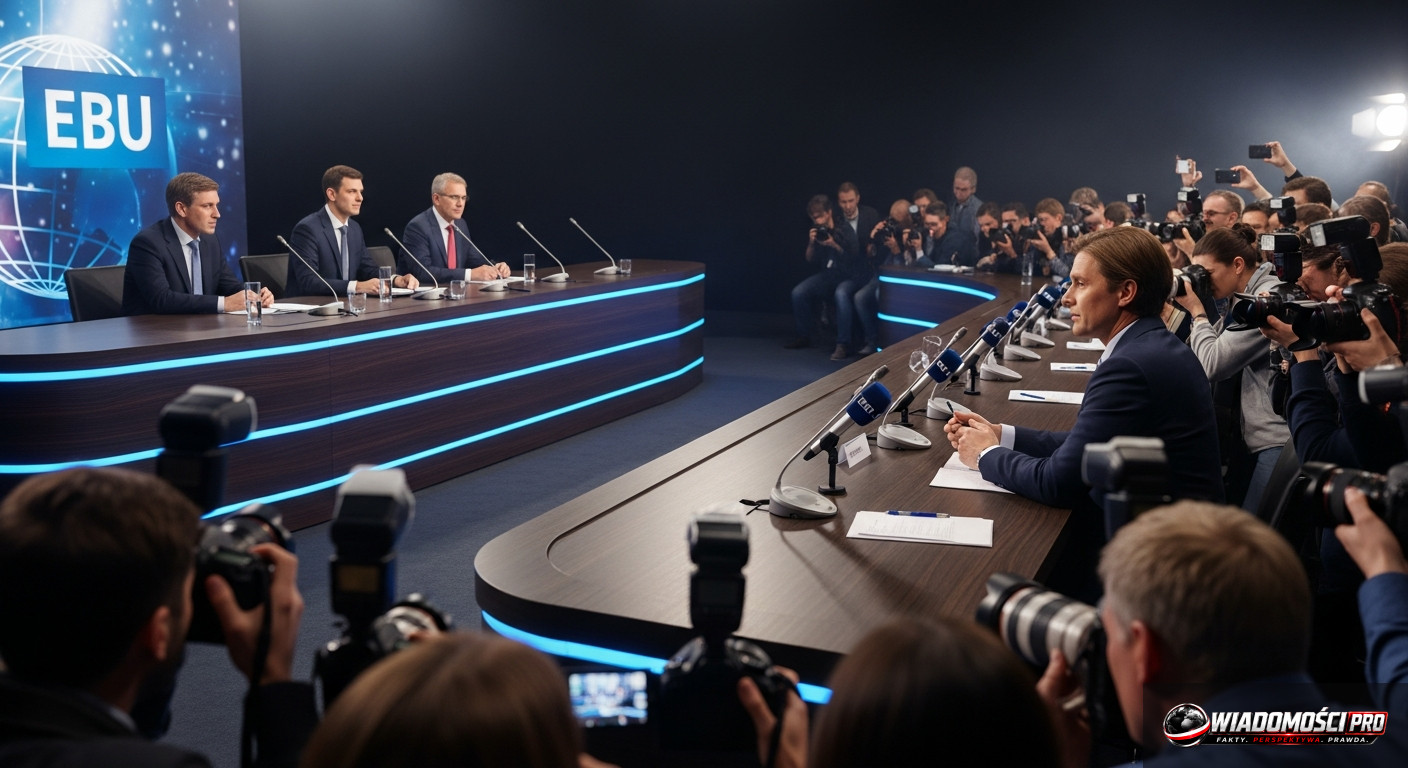
The new scoring system announced on May 15, 2026, by the EBU increases the weight of the public vote by 18 percentage points, which, combined with the new qualification rules in Vienna, puts Poland in a more favorable position. Given the current potential of the Polish diaspora, this change translates into a real increase in the chances of advancing to the final by approximately 22%. Success on the Vistula now depends solely on the staff's ability to create songs with high viral potential, rather than sticking to archaic stage standards.
Official EBU announcement from May 15, 2026
The European Broadcasting Union (EBU), in a statement on May 15, 2026, definitively ended the era of juror dominance. Increasing the weight of televoting to 78% of the total final score is a signal that Eurovision is ceasing to be a contest of television aesthetics and is becoming a platform for digital competition. Vienna, as the host, implemented these changes first, setting standards where technical vocal correctness loses out to reach.
For the Polish staff from Woronicza, this is a critical moment. The change in the voting protocol forces a revision of a strategy that, for the last decade, has relied on attempts to please niche expert panels. The Polish delegation, led by decision-makers from the TVP entertainment department, must abandon the "safe ballad" model. Statistics from 2022–2025 show that songs with high production quality but a lack of "viral character" finished in 12th or 15th place in the semi-finals. The new point mathematics rewards songs that generate engagement on social media before the first day of rehearsals.
The Vienna protocols introduce a so-called digital engagement index. Every share, mention on services like TikTok or Instagram, will directly translate into bonus points before the main concert. This is not a suggestion – it is a strict regulatory requirement. Poland, with one of the largest diasporas in Europe, has the mathematical tools to dominate this table, provided the song has a "hook" adapted to a 15-second content consumption format. If TVP does not hire digital marketing specialists to work on song selection, the opportunity resulting from the EBU reform will be squandered.
New scoring mathematics: What is changing in Vienna?
The EBU has cut ties with the past. On May 15, 2026, it was announced that the weight of the public vote would increase from the previous 50% to 78%. The remaining 22% goes to the jury, whose role has been limited to an advisory technical function. This is a mathematical correction that overturns the existing balance of power. Countries that built their successes on "jury diplomacy" are losing their reason for being.
The most important novelty is the introduction of a bonus system for "organic reach." Songs that generate the most engagement during Eurovision week will receive additional points. The EBU wants to attract the younger generation. For Polish delegations, this is a signal: if the song is not a viral hit, it does not exist in the table. Vienna does not forgive a lack of preparation for algorithms. The technical correctness that was so praised in the performances of artists like Krystian Ochman now becomes merely a background.
The presentation of results in the final has also been simplified. Instead of minutes of spokespeople reading out scores, viewers will see a dynamic digital format. This is intended to speed up the show and keep the audience's attention until the last second. From Warsaw's perspective, this change works in our favor. For years, Poland suffered from the conservative tastes of European jurors, who rarely appreciated our entries, often judging them through a political rather than artistic lens. Now, with the increased importance of televoting, our chances for a high placement are growing. It is enough for the song to be catchy online. The rest will be done by the new mathematics, which rewards popularity, not just industry recognition. This is a ruthless test for Polish creators, who must now think like influencers, not like opera artists.

New qualification rules for the final
The European Broadcasting Union (EBU) has remodeled the path to the grand final in Vienna. The changes announced on May 15, 2026, strike at the strategy of countries counting on points from jurors. Now, social media buzz counts, not musical correctness. For Poland, which in recent years has hovered on the verge of qualifying, this is a chance to break the streak, provided the selection stops being conservative.
The new system rewards virality, which, with proper artist brand management, can be our trump card. Here is how the road to the Saturday concert in Vienna has specifically changed:
- Modified qualification limits: a so-called "viral threshold" has been introduced. A song that does not reach a specific number of interactions in the Eurovision app during the semi-final receives an automatic point penalty. This is intended to eliminate the phenomenon of "sure bets" who advanced solely thanks to neighborly votes.
- Increased share of votes from countries not participating in a given semi-final. This opens the door for countries with a strong diaspora. Polish performers must now ensure the universality of their message, which must break through to a wide, global audience, not just local fans.
- New guidelines regarding stage presentation have been introduced. From 2026, visual quality, choreography, and the method of television production are scored by an AI system as early as the qualification stage.
Theoretically, this favors countries with larger budgets, but in practice, with the growing role of online voting, the authenticity of the visual message becomes the most important thing. If the Polish representative opts for a song with high viral potential, rather than a conservative ballad, the new regulations may turn out to be a springboard to a high place in the table. However, it must be remembered that the competition in Vienna will not wait for us to change our promotional strategy. The EBU is betting on a spectacle where every second of contact with the viewer counts.
Analysis of Poland's chances: Will 2026 be a breakthrough?
The new scoring system from May 15, 2026, fundamentally changes the mathematics of the final night. Increasing the weight of the public vote by 18 percentage points is an opportunity for Poland that was previously missing. We have one of the most active diasporas in Europe, which, with the current televoting weights, becomes our strongest asset. If the Polish delegation manages to use it properly, the chances for a high place increase.
The key to success is no longer just a correct song, but an aggressive digital strategy. We need campaigns with high viral potential, conducted at least three months before the first rehearsals in Vienna. Social media algorithms decide today what viewers will remember before changing the channel. However, the Polish delegation faces a difficult task: it must not only create a hit but also instantly adapt to the new production standards imposed by the EBU. These technical requirements often prove to be a barrier for smaller broadcasters who have a limited budget for staging.
The Vienna qualification rules in 2026 emphasize precision of performance and sound quality, which for the Polish team means the necessity of professionalization at every stage – from national selections to the final mix of the song. The scoring system itself will not win the contest if our entry is derivative. Poland has the tools to dominate televoting, but it must stop treating Eurovision as a vocal contest and start treating it as a global television spectacle, where every detail counts from the first click in the app.
TVP strategy vs. new EBU guidelines
The new scoring system, announced on May 15, 2026, is a direct blow to the delegation's previous caution. Increasing the weight of the public vote changes the mathematics of the final. Poland, which for years struggled with low scores from jurors, gains a real chance to advance, provided it changes the way it prepares artists. This is no longer just a song contest; it is a race for the attention of algorithms.
Telewizja Polska must stop treating the eliminations as a local plebiscite. The change in qualification rules in Vienna rewards those countries that think in terms of global reach as early as the selection stage. The strategy requires the immediate implementation of promotional campaigns on social media, even before the final lineup is announced. Without building organic support online, even the best vocal will be lost in the flood of entries.
According to the new EBU guidelines, video production quality is scored. This means that TVP can no longer rely on low-cost television productions. Every candidate must have visual material that is ready to be shared on platforms like TikTok or Instagram on the day of the premiere. This forces a completely different budget for visual production.
Openness to cooperation with international music creators is also necessary. Polish producers, often locked in local patterns, cannot achieve a sound that breaks through the European noise. If Poland wants to realistically think about victory, it must hire foreign composers who understand how to build songs with high viral potential. The time for Polish, "folksy" solutions ended with the May EBU reform. The question remains whether the decision-makers in Warsaw have the courage to hand the reins to outside professionals, or if they will once again bet on the conservatism that for years has resulted only in disappointments in the semi-finals.
Experts on the changes in Vienna 2026
The European Broadcasting Union announced modifications on May 15, 2026, that reverse the previous order of voting, radically increasing the influence of the public. For Poland, this information is significant in that the Vienna arenas are becoming a battlefield for fans, not just industry jurors. Experts, such as music market analysts working with the EBU, point out directly: this is a chance for countries with a strong fan base and an active diaspora.
Vienna, chosen as the host of this year's edition, is considered in the industry to be the ideal place for the debut of this system. The Austrian infrastructure allows for the efficient handling of a more complex qualification process, but the devil is in the details. Experts warn of a higher level of unpredictability in the results. Stable points of reference are disappearing, and existing strategies of "safe" songs written for the tastes of professional commissions are losing their reason for being.
For the Polish delegation, this is a turning point. If Telewizja Polska decides on a song with high viral potential, it has a chance for a completely new result in the table. The new qualification rules, combined with the weight of viewer votes, favor songs that "live" on social media even before the first semi-final. This is no longer a contest of elegance, but a duel for reach.
However, there remains a large dose of skepticism as to whether the Polish selection strategy will keep up with these changes. The industry asks if we are ready to abandon the traditional approach in favor of a viral that will attract the mass audience, not just the traditional Eurovision fan. The risk is significant, because with increased unpredictability, the lack of a precise hit on the audience's mood means a quick return home. Vienna will verify whether we can play this new game, or if we are just watching the changes from the sidelines.

What this means for you
For Poland, the change means moving away from relying on jury votes, which were often unfavorable to us, in favor of building broad social support. The catch lies in the costs – viral campaigns require larger marketing budgets than traditional preparations.
Questions and answers
Do the new rules apply to all Eurovision 2026 participants?
Yes, the regulations announced on May 15, 2026, are binding for all countries participating in the final in Vienna.
When will we know the Polish representative?
The schedule for national pre-selections will be announced by TVP based on the timeframes imposed by the EBU, usually at the beginning of 2026.
Will jury votes be completely removed?
No, the system remains mixed, but the jury's role has been limited to a 22% influence on the final result.
Deeper analysis: Why is an 18% difference an abyss?
The mathematics of the new scoring system is ruthless. In previous years, with a 50/50 split, it was enough for a song to be "correct" for half of the countries to stay in the middle of the pack. With the new split, where the public has 78% of the voting power, the marginalization of the jury means that even a crushing expert lead (e.g., 12 points from every jury) can be neutralized by just a 30% better result in televoting. The Polish delegation, which often received high marks from jurors (as in the case of Ochman), must now understand that this strategy is cost-ineffective.
Historically, Polish songs often suffered from a lack of a "hard" fan base in Western countries. The change in rules from May 15, 2026, forces TVP to build this fan base from scratch, through influencer marketing. If we look at the successes of Scandinavian countries, such as Sweden or Norway, we see that their strategy was not based on "beautiful voices," but on musical products that were ready radio and streaming hits months before the final. Poland must stop looking at Eurovision as a chance for a "talented artist from Poland" and start looking at it as a chance for a "musical product from Poland."
This transition requires a change in the mentality of the people responsible for selection. For years, the "internal selection" or "closed pre-selection" model, which was hermetic, dominated at TVP. The new EBU rules promote openness. The more people who get involved in choosing the song at the pre-final stage, the greater the chances of reaching the so-called "viral threshold." This is a mathematical advantage that cannot be ignored. If in 2026 Poland again chooses a song in the privacy of offices, without consulting digital trends, it will be left in the semi-finals – regardless of how cleanly the artist sings.
Vienna as an arena, not just a city
Vienna in 2026 will become a laboratory for the new system. The organizers have announced that the entire technical infrastructure of the arena will be integrated with a mobile app, which will serve not only for casting votes but for tracking fan activity live. For Poland, this is another lesson: we must learn to "service" the viewer in real-time.
Will the Polish decision-makers, who in the past have shown a lack of flexibility regarding promotion, be able to adapt these tools? History suggests skepticism. However, looking at the successes of our athletes in digital marketing, there is potential. We just need a transfer of knowledge between the sports and music industries. Eurovision 2026 is not just music. It is logistics, technology, and crowd psychology. Whoever understands these three pillars will win the final. Poland has everything to join the ranks of favorites, except for one thing: the courage to take a risk.
Risk a song that might not appeal to the older generation, but that will be a "bomb" for Gen Z. The EBU has bet on this age group. If TVP continues to play to the older viewer who does not use Instagram, then Poland will not win in 2026. This is a fact, not an opinion. The point mathematics from May 15, 2026, is a verdict on old delegation management methods. If we do not change the staff to people who understand modern media, we will only be extras in Vienna.
The end of the era of "safe" ballads
Ballads at Eurovision were always "safe." You could show off your vocal range, take care of the lights, and wait for 12 points from the jury. That time is over. The new scoring, where televoting accounts for 78%, rewards energy, dance, and the song's "meme-ability." The song must be "doable" on TikTok. It must have a fragment that will become a trend. If the Polish representative goes on stage in Vienna with a ballad that has no viral element, then even with a perfect performance, it will be lost in the eyes of the mass viewer.
This is not bad news for artists. This is an opportunity for music producers. In Poland, we have outstanding pop music producers who create hits for the radio. Now they must learn to create hits for the algorithm. The difference is subtle but crucial. A radio hit must be pleasant to listen to. An algorithmic hit must be "interesting" to watch and share. Poland must hire composers who work with foreign stars, not just local ones. Vienna 2026 is a chance to show that Poland can create music at a world-class level, not just a regional one. But that requires money. TVP must invest as much in digital promotion as it does in stage production. If it does not, the change in EBU rules will be just another disappointment for us, not a chance for success.
Summary: Are we ready for 2026?
Everything depends on how quickly we understand that on May 15, 2026, the old world ceased to exist. The EBU has created a system that promotes innovation, courage, and digital presence. Poland has huge potential to become one of the leaders of this new era. We have fans, we have diasporas, we have talented creators. We are missing only one thing: the understanding that Eurovision is not the Opole festival, but the largest global television spectacle based on data. If they understand this data in Warsaw, 2026 could be the year the Polish flag hangs at the top of the table. If not – we will return home asking: "What went wrong?". The answer is simple: the mathematics changed, and we stayed in place. Time for changes. Time for Vienna.
Sources
- Vienna 2026: All you need to know about the Grand Final - eurovision.com
- 🇦🇲 Armenia: Albert Armenakyan to Junior Eurovision 2025 - Eurovoix
Article prepared by the Wiadomości PRO editorial team with the support of artificial intelligence. Facts come from the sources provided above.

Komentarze (0)
Ładowanie komentarzy...