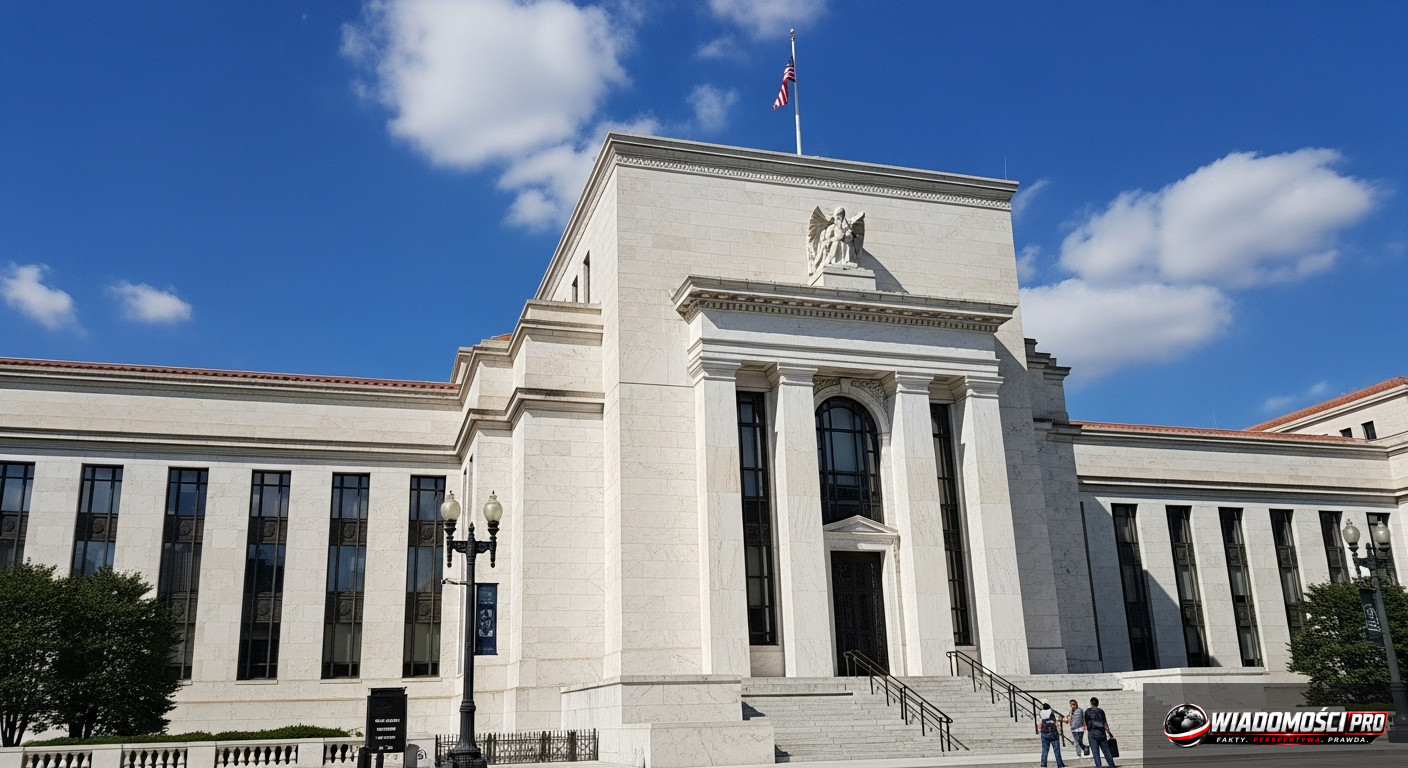
The Federal Reserve has lowered interest rates by 50 basis points to a range of 4.75-5.00 percent, marking a key turning point in the fight for US economic stability. For your wallet, this primarily means cheaper financing for consumer and mortgage loans, but it also carries the risk of dollar exchange rate fluctuations, which will directly affect the costs of purchasing imported goods. Lower interest rates offer a chance for cheaper debt, but for savers, they mean a gradual decline in the attractiveness of deposits and treasury bonds, forcing a revision of investment strategies.
The evolution of Fed policy: From 2024 to 2026
The history of American monetary policy over the last two years is a record of a nervous search for balance. September 2024 brought a wave of speculation in which analysts completely missed the mark regarding the central bank's actions. At that time, financial media outlets, such as Bankier.pl, openly admitted that experts were wrong in their forecasts, which paralyzed investor decision-making for many months. The US economy operated in a fog of uncertainty, observing every communication from Washington.
It was not until 2025 that real changes occurred. According to reports from Money.pl and Bankier.pl on September 17, 2025, the Fed initiated a cycle of cuts intended to be a remedy for the slowdown. However, this was not a simple process. In March 2026, the institution suddenly halted easing, which the portal Vietnam.vn noted as a turning point. The yield on US bonds exceeded 4.3 percent at that time, triggering panic on trading floors. Today's decision to cut by 50 basis points is therefore a return to the strategy that the market had been trying to force for a very long time.
Jerome Powell had to face the fact that pressure on the labor market had become more dangerous than persistent inflation. Instead of a smooth transition to cheaper money, we received a series of erratic decisions. Such a model of operation forces investors to be highly vigilant. The return to cuts after the March pause suggests that central bankers deemed the previous restrictions too costly for US GDP. However, the open question remains whether this step is enough to permanently stabilize the condition of the dollar without reigniting price pressure.

Why is 50 basis points such a significant change?
The decision to cut by 50 basis points to the 4.75-5.00 percent range is not just cosmetic. It is an aggressive cut that breaks away from earlier forecasts assuming a more conservative approach. The scale of the move indicates that policymakers in Washington considered the previous credit conditions to be stifling. The mechanism is simple: higher rates mean a higher cost of capital, which in the business model of many American corporations meant halting investments and limiting hiring.
Many analysts following debates at Strefa Inwestorów expected a move of 25 basis points. Choosing the doubled rate is a clear signal to the market: fear of recession currently outweighs concerns about inflation. Financial institutions do not make such decisive gestures without hard data indicating the need for rapid intervention. If the US economy needed a boost, it just got one, although the long-term inflationary effects remain a big unknown.
For stock market investors, such an amplitude of change is a warning signal. The mathematical models on which hedge funds rely must be recalculated within a few hours. Is this a one-time liquidity injection or the beginning of a long-term strategy? History teaches that the Fed does not always steer sentiment with the precision that Wall Street expects. Volatility is therefore becoming the new norm, not the exception to the rule.
Reaction of financial markets and bonds
Wall Street accepted the Fed's move with clear relief, although previous weeks were marked by nervous anticipation. Bond yields, which were dangerously exceeding 4.3 percent as recently as March 2026, are now under immense pressure. Portfolio managers are forced into rapid rebalancing. Capital that had been trapped in safe bonds for years is starting to flow toward riskier assets, which explains today's index gains.
However, one must remember that bull market enthusiasm may be short-lived. Experiences from 2024-2025 show that the Fed does not always steer sentiment as precisely as official communications would suggest. The memory of the erroneous forecasts by economists from September 2024 is still alive. The market has not forgotten how financial media announced back then that economists were wrong. Now, with rates at the 4.75-5.00 percent level, investors are asking one question: is this enough to avoid a recession, or does it merely delay the inevitable reckoning with inflation?
In this game of trust, every subsequent communication from Washington will be more important than dry data on rates. Bond yield is a barometer that does not lie. If yields do not start to fall significantly after today's decision, it means that the bond market is still worried about long-term US debt. This, in turn, casts a shadow over the entire easing process.
Comparison with the actions of the European Central Bank
American policy clearly contrasts with the approach in Frankfurt. While Jerome Powell is opting for easing, the European Central Bank is choosing a wait-and-see strategy. As reported by Analizy.pl, the ECB consistently kept rates unchanged in 2025. Such a divergence has direct consequences for global financial markets. Investors see a clear asymmetry, which forces funds to revise currency strategies.
When money in the US becomes cheaper and the cost of credit in the eurozone remains frozen at a high level, capital begins to look for new flow paths. This phenomenon affects exchange rates, forcing European exporting companies to struggle with a strong euro. The dilemma is clear: will the ECB have to react to the American move to prevent the common currency from strengthening too much? Some analysts argue that Frankfurt has no choice and will eventually copy Washington's policy. Others point out that Europe has completely different inflation problems that cannot be solved with cheap money.
This asymmetry creates an interesting environment for emerging markets. Theoretically, American easing should favor investments in riskier assets. However, the stability of the eurozone, resulting from the ECB's conservative policy, currently serves as a safe haven for capital that fears the inflationary seesaw across the Atlantic. In the coming months, we will observe whether this difference triggers serious turbulence in the dollar-euro pair.

Impact on sectors: Who will gain and who will lose?
The change in US interest rates affects different sectors of the economy unevenly. Enterprises that rely on external financing will feel relief, but not all to the same extent.
The technology sector and "growth" companies are the first beneficiaries. These firms often operate on high debt, investing in development that was unprofitable at high rates. A lower cost of credit allows them to finance projects more cheaply, which directly translates into stock valuations. Startups that had huge problems raising capital over the last two years can now count on the return of venture capital investors.
On the other hand, the banking sector may feel pressure. A rate cut means a narrowing of the net interest margin – banks earn less on the difference between interest on loans and deposits. Although loan volume may increase, the long-term profitability of the financial sector in a falling-rate environment is sometimes in question.
The real estate sector is another player for whom the change is crucial. The mortgage market in the US is very sensitive to Fed decisions. A drop in mortgage interest rates from the levels we have seen in recent years could revive real estate trading. Developers and companies involved in housing market services will benefit from this. However, if the economy falls into a recession, demand for commercial real estate may remain weak despite cheaper money.
Energy and commodities are sectors that react to rate changes through the dollar exchange rate. A weaker dollar usually supports the prices of commodities priced in that currency. Mining companies may therefore benefit from higher margins, provided that global demand remains at a stable level. Entrepreneurs who had to cut costs and optimize liquidity over the last year now face a dilemma: increase debt to grow, or wait for a more certain downward trend? Capital does not like uncertainty, and recent decisions show that the global economy is still looking for a point of equilibrium.
Forecasts for the end of 2026
Investors on Wall Street, who were uncertain about the direction of monetary policy until recently, have begun to price in this move as a definitive opening of the door to further actions. The market currently expects the cost of money to stabilize in this very range of 4.75-5.00 percent by the end of the current year. However, optimism is mixed with clear reservation. Analysts look at these forecasts through the prism of bitter experiences from nearly two years ago.
The memory of September 2024, when the market completely missed reality, hangs over investors like a sword of Damocles. Today's declarations of stabilization in the 4.75-5.00 percent range may prove as unstable as the expectations of that time. The memory of the March strategy, when the Fed clearly signaled a halt to the rate-cutting cycle, means that the narrative of "cheap money" is treated with a large dose of skepticism. Financial institutions that were predicting a hard landing just a few months ago must now revise their models.
For the average borrower, this means one thing: the predictability of Fed policy is a myth. The winner is the one who prepares for volatility, not the one who blindly believes in official forecasts for the coming quarters. If history is to teach us anything, it is above all that the American central bank can surprise at the most unexpected moment. The current situation requires investors to diversify, which will allow them to survive periods of high bond yield volatility and fluctuations in the currency market.
What does this mean in practice for an individual investor?
A rate cut is a signal that the Fed is prioritizing support for economic growth. Borrowers and the technology sector will gain, but investors must reckon with dollar volatility. The strategy of building a portfolio in such an environment requires moving away from simple assumptions about ever-rising stocks. It is worth observing the reactions of US bond yields, as they are the best indicator of whether the market believes in the effectiveness of Powell's actions.
For those with savings in dollars, the coming months will be a test period. The weakening of the American currency, often accompanying rate-cutting cycles, may deplete the real value of capital held in that currency unless it is invested appropriately. Conversely, for those planning mortgage loans in a foreign currency, the current moment may be an opportunity to refinance debt on better terms, although currency risk remains a factor that cannot be ignored.
All these movements take place against a backdrop of global uncertainty. We are not in a vacuum. Every Fed decision echoes in Europe and emerging markets. An investor who wants to win in this environment must track not only communications from Washington but also the reactions of the ECB and data from the American labor market, which remains the main driver of Jerome Powell's decisions.
Questions and answers
What does a 50 basis point cut mean for my portfolio?
It means a drop in the cost of money, which usually favors gains in technology stocks, but at the same time reduces the profitability of new deposits and bonds. In the short term, it may weaken the dollar, which will affect the valuation of your foreign assets.
Will interest rates in the US continue to fall in 2026?
After setting the 4.75-5.00 percent range, further moves will be strictly dependent on upcoming inflation data and the condition of the labor market. The Fed has not declared a downward path, which means that every subsequent meeting will be analyzed by the market for potential pauses or further cuts.
How does this decision affect the situation of borrowers in Europe?
The direct impact is limited because rates in the eurozone remain independent of Fed decisions. However, the difference in monetary policy between the US and the ECB affects exchange rates, which can change the costs of importing goods and services, and consequently affect general inflation in Europe and the decisions of local central banks.
Why did the bond market react so nervously in March 2026?
The market reacted to the signal of halting rate cuts, which pushed bond yields above 4.3 percent. Rising yields mean falling bond prices, which hit the portfolios of investors counting on rapid policy easing by the Fed. This shows how dependent financial markets are on clear signals from the central bank.
Sources
- Trump got his way. The Fed resumed the interest rate cut cycle - Bankier.pl
- Half the world was waiting for this decision. The Fed indicated US interest rates - Money.pl
- The September Fed decision may disappoint the stock markets. Debate over a possible US interest rate cut - Strefa Inwestorów
- Eurozone rates unchanged for the second time in a row - Analizy.pl
- Fed cuts rates for the first time this year. What will be the effects? - Subiektywnie o finansach
- The Monetary Policy Council did not change interest rates in September '24 - Miesięcznik Finansowy BANK
- Fed signals a halt to interest rate cuts, and US bond yields exceed 4.3%. - Vietnam.vn
- Fed cuts interest rates sharply. However, economists were wrong - Bankier.pl
Article prepared by the Wiadomości PRO editorial team with the support of artificial intelligence. Facts are derived from the sources listed above.


Komentarze (0)
Ładowanie komentarzy...