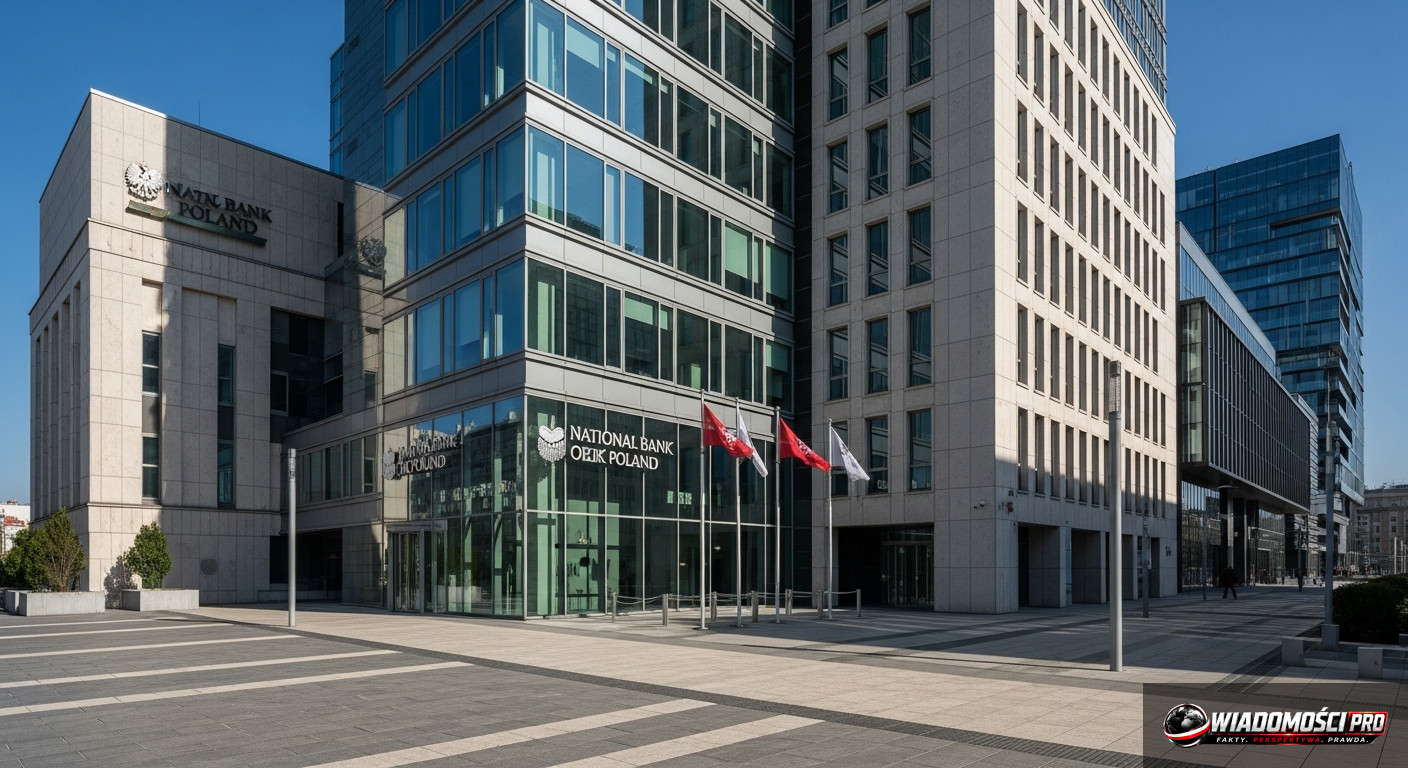
In July 2026, the Monetary Policy Council (MPC) kept interest rates at an unchanged level of 5.75%, which is a direct result of pressure on the zloty caused by the escalation of tensions between the USA and Iran. This decision definitively ends hopes for a rapid easing of monetary policy in the third quarter of the current year. Investors and borrowers must come to terms with the fact that the global conflict is destabilizing the national monetary strategy and forcing policymakers onto the defensive.
The Monetary Policy Council, despite earlier suggestions from the market in April 2026, did not decide to make a downward move. Instead of relief for borrowers, we received a precautionary signal. Maintaining rates at 5.75% is the result of a calculation of currency risk. At a time when capital is fleeing emerging markets toward safe havens, the Polish zloty is losing value. The central bank concluded that easing monetary policy under such conditions would trigger a wave of currency sell-offs, which would directly translate into an increase in the prices of imported raw materials and goods. This, in turn, would fuel the inflation that the MPC has been fighting for months.
For a mortgage holder with a loan of 500,000 PLN, taken out for 30 years with a bank margin of 2%, the decision from July 2026 means no change in the installment. With an unchanged reference rate of 5.75% and a 3M WIBOR rate oscillating around the same level, the monthly burden remains at approximately 3600–3700 PLN. Each subsequent decision to maintain rates extends the period of paying high installments for borrowers, which were supposed to fall with the autumn cycle of cuts announced even before the escalation of the conflict in the Middle East. The market received no impulse for optimism.
Geopolitics has become the main factor shaping monetary policy in Poland. Tensions between Washington and Tehran are no longer just a topic for news services, but a hard economic parameter. The MPC does not operate in a vacuum. When uncertainty breaks out in commodity markets and oil prices skyrocket, the National Bank of Poland must protect the value of the zloty. Cutting rates with a weak currency is a direct path to losing control over the pace of price growth. Members of the Council are aware that in the current market atmosphere, any downward move would be interpreted as weakness.
The Council's rhetoric after the July meeting is unambiguous. Instead of openness to further cuts, a wait-and-see attitude dominates. A few months ago, in April 2026, analysts' forecasts were much more favorable for debtors. It was expected then that the summer months would bring at least one cut of 25 basis points. Reality has brutally verified these assumptions. The conflict between the USA and Iran has permanently changed the vector of the MPC's actions. Currency stability has won out over the need to stimulate economic activity.
MPC decision of July 2026: stabilization instead of cuts
The Monetary Policy Council decided in July 2026 to keep interest rates at 5.75%. This is a disappointment for the market, which, in the face of an economic slowdown, was counting on at least a symbolic downward move. The main architect of this stagnation is the geopolitical situation. The escalation of tensions between Washington and Tehran effectively blocked the Council's room for maneuver. If the MPC had decided on a cut at a time when global capital is fleeing from risk, we would have witnessed a sharp weakening of the zloty. The Polish currency found itself under strong pressure, and the central bank concluded that additional monetary easing would only fuel the sell-off of the PLN.
This is a classic macroeconomic dilemma. On one hand, we have an internal need to support borrowers and stimulate investment through cheaper money, and on the other – the brutal reality of financial markets, which do not forgive mistakes during global crises. Maintaining rates unchanged in this situation is not so much a purely economic decision as it is a safeguard against a speculative attack on the zloty.
There was no room for the optimism that accompanied some forecasts just a few months ago. If the conflict in the Middle East does not subside in the coming weeks, dreams of cheaper loan installments in the third quarter of 2026 can be put into the realm of fairy tales. The MPC is playing for time, waiting for moods in currency markets to calm down. In the current balance of power, the stability of the zloty exchange rate is more important to the NBP than stimulating the economy through rate cuts. For the wallets of Poles, this means a continuation of costly stagnation. Borrowers who were counting on a quick breather must prepare for their household budgets to be burdened for some time longer with installments based on rates from before the conflict escalation.
The stability of interest rates at 5.75% is a message sent to the markets: we are not risking currency stability for a short-term political effect. Such a strategy has its supporters among economists, who emphasize that the fight against inflation, although it seems won, still remains sensitive to supply shocks caused by rising energy costs. If maritime transport costs and oil prices rise as a result of blockades of trade routes in the Middle East, imported inflation will hit Polish stores. In that case, maintaining high rates will prove to be the only effective defensive tool.
Geopolitics and the zloty exchange rate: why is the MPC not cutting rates?
The July decision of the Monetary Policy Council to keep interest rates at 5.75% is not a surprise only to those who ignored reports from the Middle East. The escalation of the conflict between the USA and Iran in practice excluded the scenario of easing monetary policy. Financial markets do not like uncertainty, and the current turn in geopolitics hits the foundations of trust in Central and Eastern European currencies.
The valuation of emerging market assets, including the Polish zloty, is now directly linked to the temperature of the dispute between Washington and Tehran. When capital flees to safe havens, such as the dollar or the Swiss franc, our currency loses value. This is not a matter of a momentary fluctuation, but a systemic risk that the MPC had to take into account. The weakening of the zloty directly translates into import costs, which fuels inflation. In such conditions, a rate cut would be a signal for a further sell-off of the Polish currency, which from the point of view of the National Bank of Poland would be political suicide.
Analysts who were counting on cheaper credit must arm themselves with patience. The MPC has found itself in a trap: on one hand, the economy needs an impulse, on the other – the exchange rate leaves no room for maneuver. If the conflict between the USA and Iran escalates, pressure on the zloty will become a permanent element of the macroeconomic landscape. There is no talk of cuts as long as the exchange rate remains so sensitive to external events. Price stability, understood as the fight against imported inflation, has become a priority for the Council, even at the cost of slowing down credit dynamics. For borrowers, this means one thing: freezing installments at the current, high level for the foreseeable future. Stabilization in these conditions is the only safe choice for the MPC.

The mechanism is simple: a weak zloty means more expensive fuels and components imported from abroad. More expensive imports mean higher consumer inflation. Higher inflation requires maintaining higher interest rates to encourage saving and limit consumption. This is a vicious circle from which the MPC cannot escape as long as the international environment does not become more predictable. Foreign investors are watching every move of the NBP. If the Council cuts rates at a time when the dollar is strong, foreign capital will begin to withdraw from Poland en masse. This would lead to a drastic drop in the PLN exchange rate, which for the economy would be much more costly than maintaining high loan installments for another few months.
Balance sheet of MPC actions: from cuts in 2025 to wait-and-see in 2026
The July decision of the Monetary Policy Council to keep interest rates at an unchanged level of 5.75% definitively closed the period of hope for quick and cheap loans. Today's situation stands in clear contrast to the moods that accompanied the markets half a year ago. At that time, analysts competed in forecasts regarding the scale of monetary policy easing, and borrowers impatiently waited for subsequent installment cuts. Today, these predictions have given way to a cold calculation of geopolitical risk.
The zloty exchange rate, which in recent weeks has become a hostage to the escalation of tensions between the USA and Iran, has effectively tied the hands of decision-makers at the National Bank of Poland. The stabilization of rates in July 2026 is not a choice, but a necessity forced by the currency's reaction to the growing risk of conflict in the Middle East. The Council concluded that any easing in such unstable conditions could lead to an uncontrolled weakening of the zloty and send inflation skyrocketing.
In November 2025, the MPC decided to cut interest rates, which was a continuation of the autumn easing cycle. The decisions made then by the Council were widely described by economists as the "second autumn quarter" of cuts. That time was a period of optimism, in which subsequent MPC meetings brought real relief to borrowers' wallets. Today, that path has been interrupted. Instead of further easing, we are dealing with a defensive stance. For the average loan holder, this means one thing: freezing installments at the current level, which in the current market uncertainty is the only stable point in this complicated puzzle. The market no longer expects miracles, only protection against further turbulence.
Comparing November 2025 to July 2026, a clear paradigm shift is visible. Back then, the priority was fighting recession and stimulating investment. Today, the priority is protecting the currency from speculation. This is a 180-degree turn, which is extremely difficult to accept for people paying off mortgages. However, the MPC cannot act in isolation from reality. If the zloty is attacked in international markets, the costs of servicing public debt will also rise drastically, which will force the government to cut spending. The stability of rates is therefore protected not only by the NBP, but by the general interest of the state budget.
What's next for loan installments? Outlook for the second half of 2026
The lack of interest rate cuts in July 2026 means one thing for borrowers: debt servicing costs remain at the current, high level of 5.75%. The Monetary Policy Council decided on stabilization. This decision is a direct effect of the sharp sell-off of the zloty, caused by the escalation of tensions between the USA and Iran. The currency market reacted nervously, and the MPC concluded that in the face of such great geopolitical uncertainty, any monetary policy easing could lead to dangerous destabilization of the domestic currency.
Borrowers who were counting on quick relief in their household budgets must arm themselves with patience. The prospect of falling installments is being pushed further into the future for now. Records from April 2026 clearly indicated that the economic situation would require constant monitoring for the rest of the year, and the current data from July only confirm the validity of this conservative approach. Rate stability is currently the only certainty that mortgage holders can count on.
Expectations for cheaper money have collided with the hard reality of global conflicts. The question of when a breakthrough will occur remains open. Some analysts point out that if the tension in the Middle East does not subside, the Council will have limited room for maneuver not only in July but also in the subsequent autumn months. For households, this means continuing to maintain high financial reserves for debt repayment. Hopes for quick cuts this year are becoming less and less realistic, unless the situation in international markets improves rapidly. The wallets of Poles must withstand the pressure of credit costs at least until the geopolitical situation calms down.

It is worth paying attention to the forecasts of commercial banks. Most of them have revised their plans for the second half of 2026. Back in April, most institutions expected that rates would fall below 5.5%. Today, those same banks are communicating to clients that 5.75% may be a ceiling that will stay with us for longer. This is bad news for the construction sector, which was counting on a revival in demand for mortgages in the third quarter. Without cheaper money, the real estate market will remain in a wait-and-see phase, and the number of new loan agreements will grow very slowly.
Economic forecasts: what are analysts waiting for?
The financial market collided in July with a brutal reality. Although many experts, after a series of autumn cuts in November 2025, were counting on a continuation of monetary policy easing, the MPC slowed down. The Monetary Policy Council kept interest rates at 5.75%, which is a direct result of pressure on the zloty caused by the escalation of tensions between the USA and Iran. Geopolitics has dominated the domestic economic backyard, pushing into the shadows local inflation indicators that, as recently as spring, gave hope for cheaper credit.
Analysts who for months had been drawing scenarios for further cuts had to verify their models. The situation in 2026 turned out to be much more complex than predicted in the April forecasts. Today, market expectations are divergent and depend on one factor: exchange rate stability. Foreign capital reacts nervously to reports from the Middle East, which forces the central bank onto the defensive.
Specialists observing the Council's moves point to three main aspects:
- Zloty exchange rate stability has become a priority outweighing economic stimulation. The MPC cannot afford to weaken the currency, which would additionally fuel imported inflation in the face of global turmoil.
- The influence of the external environment, in particular energy commodity prices and the security of trade routes, remains the main unknown for decision-makers on Świętokrzyska Street.
- Despite earlier cuts from November 2025, the credit market must arm itself with patience. Hopes for a quick return to the monetary policy easing cycle have been postponed to an indefinite future, depending on the extinguishing of the conflict.
Loan installments should not be expected to fall anytime soon. Volatility in international markets, caused by the clash between the USA and Iran, has effectively locked Polish monetary policy in a stalemate. The optimism from the end of last year has evaporated, giving way to a hard risk calculation. Analysts note that in the current conditions, any attempt to cut rates would be perceived by investors as a signal of a lack of care for the value of the currency.
This uncertainty hits the valuations of stock exchange companies that are sensitive to the cost of debt financing. Many of them have halted investment plans, waiting for a signal from the MPC. Since the central bank is not deciding on a cut at 5.75%, it means that the level of systemic risk is assessed as high. This makes capital expensive and slows down company development. For the economy, this is a stagnation scenario that may last until the situation between the USA and Iran is resolved diplomatically or militarily.
Summary: can interest rates still fall?
In July 2026, the Monetary Policy Council decided to leave interest rates at 5.75%. This is a conservative, even cautious decision, but in the current macroeconomic conditions – the only one possible. The main brake on any downward moves is the geopolitical situation. The escalation of tensions between the USA and Iran directly hit the Polish currency, putting the zloty under strong pressure. In such circumstances, members of the Council could not afford to ease monetary policy, which could only deepen the weakening of the domestic currency.
The Monetary Policy Council is clearly opting for caution, placing emphasis on stability in the face of uncertain international conditions. A "wait and see" strategy dominates the central bank's communication. There is no room here for over-optimism or quick cuts, which borrowers were dreaming of just a few months ago. Any more sudden move could trigger uncontrolled turmoil in the currency market, and that is the last thing the Polish economy needs in the middle of the summer season.
Further decisions will depend on the development of the situation in USA-Iran relations and the condition of the Polish currency. If the tension in the Middle East does not ease and the zloty remains weak, dreams of cheaper loan installments in 2026 must be put off for later. The MPC shows no desire to take unnecessary risks. For households, this means one thing: debt servicing costs remain frozen at the current, high level of 5.75%. Investors should not set themselves up for a quick turn in monetary policy until the dust on international arenas settles. Stability is now the price we pay for the safety of the zloty.

Looking at long-term forecasts, a clear stratification is visible within the Council itself. Some members are in favor of supporting economic growth, but their voices are currently suppressed by the faction taking care of the exchange rate. This internal struggle over what is more important – inflation or growth – will last throughout the second half of 2026. If inflation starts to rise again, which is possible at current energy prices, the MPC may even be forced to hike, which would be a black scenario for borrowers. For the moment, however, keeping rates at 5.75% is a solution meant to buy time and peace.
What this means for you
For borrowers, this means no relief in mortgage installments in the near future. Saving a household budget at a 5.75% rate requires flexibility, because hopes for cheap loans have been sent into oblivion. For savers – maintaining the current deposit interest rates, which still do not fully protect against real inflation. The catch is geopolitical uncertainty, which may force the MPC to maintain a restrictive policy longer than assumed as recently as spring 2026. This situation is most painful for people who took out loans for the maximum available amount, based on optimistic assumptions about quick interest rate drops.
Questions and answers
Why did the MPC not decide to cut rates in July 2026?
The main reason is the escalation of tensions between the USA and Iran, which exerts pressure on the weakening of the zloty and forces the MPC to exercise caution so as not to lead to an outflow of foreign capital and an increase in imported inflation.
Will my loan installments rise after this decision?
No, interest rates remained at an unchanged level of 5.75%, so the amount of installments for variable-rate loans should not change directly for this reason, however, the lack of a drop means no relief in the household budget.
When can subsequent MPC decisions be expected?
The schedule of MPC meetings is published by the NBP and assumes monthly meetings, however, each subsequent decision will depend on the current macroeconomic situation and the development of the conflict in the Middle East, which remains a key risk factor for the Polish economy.
Sources
- See what's up with your loan! MPC made a decision - wGospodarce
- MPC keeps rates unchanged – will the escalation in Iran bring hikes? (ANALYSIS) - Parkiet
- Forecasts of interest rate levels in 2026 - Direct Money
- Interest rate value August 2026. Forecasts and current information on interest rates in Poland - TotalMoney.pl
- There is an MPC decision on interest rates. It is already known what's next for loan installments - Business Insider Polska
- USA and Iran are at daggers drawn, and the MPC is not cutting rates. Zloty under pressure - INNPoland.pl
- The Monetary Policy Council cut interest rates. This is already the second autumn quarter - Bankier.pl
- Interest rates down again. But it's too early for joy. When is the next MPC decision? - Forbes
Article prepared by the Wiadomości PRO editorial team with the support of artificial intelligence. Facts come from the sources provided above.

Komentarze (0)
Ładowanie komentarzy...