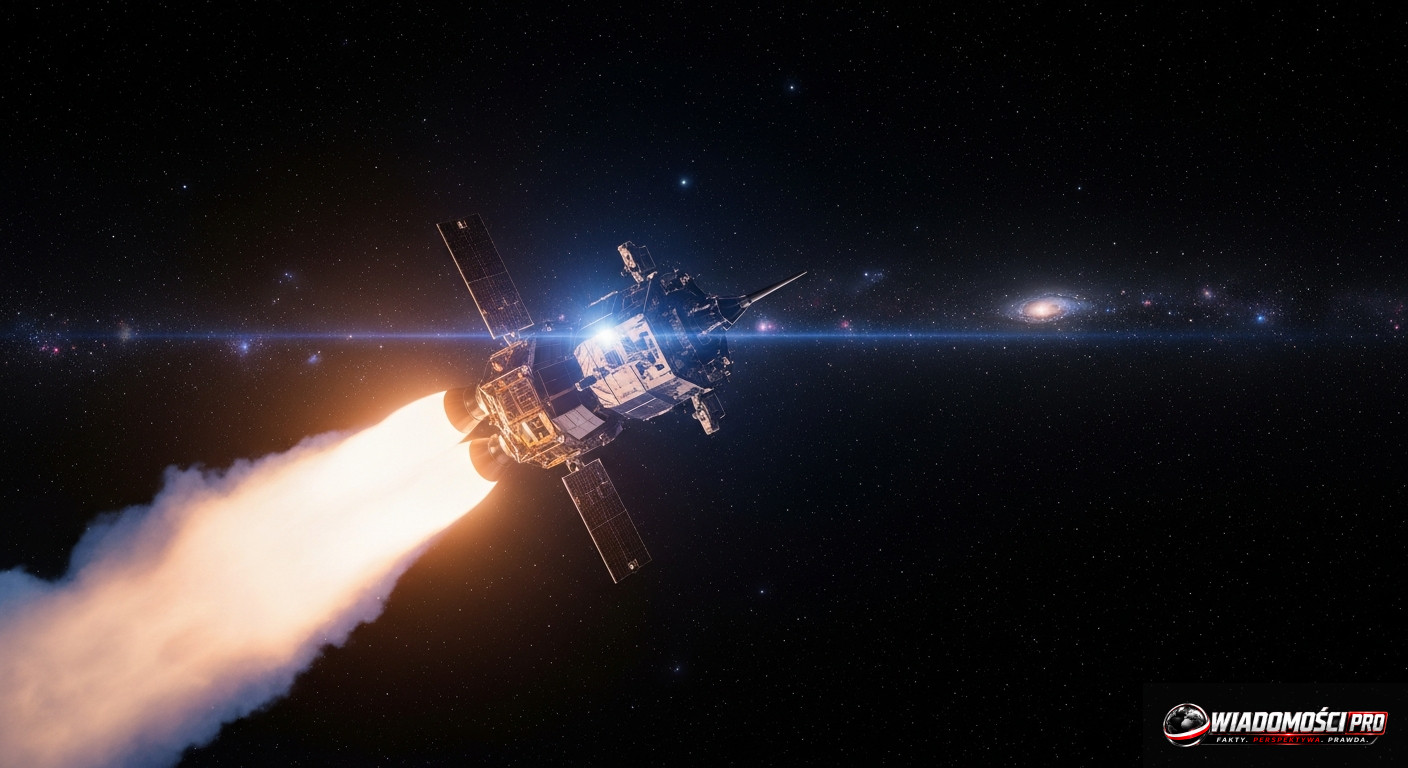
The budget for the Europa Clipper mission is approximately 5 billion dollars, and the probe, which launched on October 14, 2024, will reach its destination in 2030. This mission represents one of the most expensive and complex endeavors in NASA's history of planetary exploration, aimed at determining whether environments conducive to biological processes exist beneath the thick ice layer of Jupiter's moon. The probe will not orbit Europa itself, but will instead perform 49 close flybys, a decision dictated by the need to protect its equipment from Jupiter's lethal radiation.
Launch schedule and reasons for delays
The launch of the Europa Clipper mission was the result of years of preparation, which concluded on October 14, 2024. The original schedule was disrupted by Hurricane Milton. The storm forced NASA engineers to suspend operations at the John F. Kennedy Space Center in Florida. The necessity of securing the probe, which weighs over six tons, and its gigantic solar panels was a top priority. Every hour of delay in the launch window carried the risk of pushing the mission back by months due to the specific planetary alignment required to perform gravity-assist maneuvers.
NASA managed this process under high pressure, where the margin for technical error was minimized to zero. Hurricane Milton forced the team to verify safety procedures that are not normally applied to such expensive research units. The probe was designed to survive in space, but the ground infrastructure in Florida had to withstand the force of the wind, which it ultimately did. After the weather front passed and systems were checked, engineers made the decision to launch, which opened the path to executing the primary research task.
The probe's flight is proceeding according to plan, and the trajectory has been corrected to utilize gravity assists from Earth and Mars. These maneuvers are necessary to give the craft the appropriate speed with a limited fuel supply. Each stage of this journey is supervised by operations centers that constantly monitor the status of photovoltaic cells and onboard instruments. The probe is currently in the active flight phase, heading toward the Jovian system. The design team is now focusing on calibrating systems that will operate in deep cold and minimal sunlight for the next several years.
Funding and probe technology
The 5 billion dollar budget covers not only the construction of the device itself but also the development of radiation shielding technology. Jupiter generates a powerful magnetic field that accelerates charged particles to speeds near the speed of light. This radiation destroys the atomic structure of semiconductors and degrades electronics. Engineers developed a special "vault" made of aluminum and titanium, in which the most sensitive components of the onboard computer were enclosed. This structure weighs hundreds of kilograms and forms the heart of the probe's resistance to the Jovian environment.
The scale of the project exceeds the standard sizes of planetary missions. Once the solar panels are fully deployed, the probe reaches a span of over 30 meters, making it the largest vehicle NASA has ever sent to explore another celestial body. The surface area of the panels is necessary because, at a distance of 800 million kilometers from the Sun, light intensity is over 25 times lower than in the vicinity of Earth. The power system must be extremely efficient to enable the simultaneous operation of multiple research instruments during flybys of Europa.
The research instrumentation is a set of high-precision devices. The probe possesses an ice-penetrating radar that will allow for mapping the thickness of the icy shell and detecting potential water reservoirs within its interior. Spectrometers were also used to analyze the chemical composition of the surface, along with high-resolution cameras that will take geological photos of the terrain. This data will be processed by advanced algorithms, allowing for the creation of a model of the moon's interior. The cost of this research and development work constitutes a significant part of the budget, and the effectiveness of the instruments depends largely on the quality of the shields that protect the electronics during flybys through radiation belts.
Project funding sparks debates in the US Congress regarding the efficiency of public spending. Supporters point to the historical importance of discoveries that may result from this mission, while skeptics argue that these funds could have bolstered lunar exploration programs under the Artemis mission. Nevertheless, NASA maintains priority for Europa Clipper, recognizing astrobiological research as a foundation of planetary science. These expenditures also include the construction of the Deep Space Network ground communication system, which ensures connectivity with the probe over vast distances.
Why is Europa crucial for science?
Europa is considered one of the most intriguing objects in the Solar System due to the presence of a global ocean beneath the ice surface. Astronomers estimate that the volume of water in this subsurface reservoir is twice that of all Earth's oceans combined. The primary goal of the mission is to assess the habitability of this environment, i.e., to check whether this water possesses the appropriate chemical conditions to support life.
Research focuses on three pillars:
- Analysis of the ice shell composition: The probe will examine whether the ice contains organic compounds and salts that may originate from the interior of the ocean.
- Study of geological activity: Europa shows signs of tectonic movements, and cracks and ridges are visible on its surface, suggesting an exchange of matter between the ocean and the surface.
- Measurement of the magnetic field: The probe will check how Europa interacts with Jupiter's magnetic field, which will provide information about the electrical conductivity of the subsurface ocean.
Unlike Mars, which is a dry and geologically dead object on a modern scale, Europa is a dynamic body. Tidal energy, resulting from Jupiter's gravitational interaction, heats the moon's interior, which may lead to the existence of hydrothermal vents on the ocean floor. It is these formations that are crucial in astrobiology, as on Earth they constitute habitats for microorganisms living in extreme conditions. The Europa Clipper mission is tasked with verifying this hypothesis by providing data that could not be obtained during the Galileo mission in the 1990s.
Galileo provided the first evidence for the existence of an ocean, but its instruments were limited by the technology of the time. Europa Clipper uses next-generation sensors that will allow for much more accurate chemical composition analysis. Scientists expect answers to the question of whether the water in the ocean is saturated with compounds necessary for life, such as carbon, hydrogen, nitrogen, oxygen, phosphorus, and sulfur. The lack of these ingredients would mean that life in the form known to us from Earth is unlikely there, despite the presence of water in a liquid state.
The race to discover life: USA vs Europe
The space sector is experiencing a period of intense competition for primacy in planetary system research. The American Europa Clipper mission is part of a broader NASA strategy aimed at dominance in the study of Jupiter's icy moons. In parallel, the European Space Agency is conducting the JUICE (JUpiter ICy moons Explorer) mission, which is also studying this system but focuses on slightly different scientific aspects, such as Ganymede. The Americans opted for a dedicated probe that is intended to be a specialized tool for studying Europa specifically, which gives them an advantage in measurement precision.
This rivalry is not an open conflict, but a race for scientific priority. Data obtained by Europa Clipper will be of fundamental importance for scientific publications and shaping future exploration projects. Washington treats this research as a way to maintain technological prestige. Successful confirmation of conditions suitable for life on Europa would become the greatest discovery in the history of modern astronomy, changing the paradigm of our understanding of the place of life in the cosmos.
Institutional cooperation exists, but each agency strives to gain full control over raw telemetry data. NASA has invested resources in Europa Clipper that allow for a higher frequency of flybys and more accurate analysis than in the case of European missions. If the probe confirms the existence of an environment favorable to life, it will shift the balance of power in the space sector. The 5 billion dollar investment becomes, in this context, an instrument of foreign policy, where scientific success is directly translated into influence in the global scientific community.
Skeptics, however, point to the risk associated with such a large concentration of resources in a single project. In the event of equipment failure in Jupiter's orbit, NASA will not have the ability to perform repairs, which would make the probe the most expensive object in history that failed to deliver full data. Such a failure would be difficult to accept in the face of tight federal budgets; therefore, engineers have implemented numerous redundant systems intended to ensure the operation of key instruments even in the event of a partial failure.
Probe technology and planned route
The Europa Clipper probe moves along a complex trajectory that was calculated with accuracy to fractions of a second. Interplanetary flight requires the use of gravity assists, which means the probe approaches Earth and Mars to increase its orbital speed. The launch, which took place on October 14, 2024, was the starting point for this multi-year journey. The entire route is designed in such a way as to minimize fuel consumption, which allows for a longer operating time for the probe near Jupiter.
After reaching the Jovian system in 2030, the probe will perform a maneuver to enter orbit around the gas giant. Then it will begin a series of 49 flybys of Europa. Each flyby is planned to minimize exposure to radiation while ensuring maximum measurement time over the most interesting regions of the moon. The probe will not enter a permanent orbit around Europa because the radiation level there would be lethal to the electronics. Instead, it will perform "jumps" toward the moon, after which it will return to safer regions of the Jovian system.
Key mission parameters:
- Launch: October 14, 2024.
- Reaching the destination: 2030.
- Number of flybys of Europa: 49.
- Mission budget: 5 billion dollars.
- Main threat: Ionizing radiation in Jupiter's radiation belts.
Radiation is the greatest engineering challenge. The probe's electronics must withstand a radiation dose equivalent to millions of X-rays. The use of the aforementioned "vault" allows for the protection of processors, but sensors exposed to the outside must be resistant to degradation. If the shields fail, the mission will be terminated prematurely. NASA engineers conducted thousands of simulations to predict the most likely damage scenarios and prepare software that will be able to automatically switch to backup systems in case of failure.
Prospects for the years 2026–2030
In the period from launch until reaching the destination, the NASA operations team focuses on maintaining the efficiency of all systems. Interplanetary flight, although it seems calm, is a time of intense work. Every day brings new telemetry data, which is analyzed for potential anomalies. The probe is in constant contact with Earth, sending statuses of its components. Engineering teams are also preparing software that will manage the sequences of flybys of Europa, which requires extraordinary temporal precision.
Critics of budget expenditures often point to the long wait for research results. Five years of travel is a period in which mission funding must be maintained at a high level, even if the probe is not yet generating scientific data. This is, however, standard in deep space missions. The 5 billion dollar investment is spread over decades, which allows for maintaining the financial stability of the project. During this time, new engineering staff are being trained, who will take over operational management in the future.
Until 2030, the priority remains navigation and ensuring energy efficiency. The probe must be ready to start work the moment it enters the Jovian system. If all systems pass the tests, Clipper will begin collecting data that could forever change our perception of biology. The value of this information is difficult to estimate in financial terms, but from the point of view of Earth science and its place in the cosmos, it is incomparable to any other NASA project.
What this means for you
The success of the Europa Clipper mission will not bring direct benefits to everyday life, but it will significantly influence our worldview. Confirming the existence of an ocean capable of supporting life outside Earth would be one of the most important discoveries in human history. From the taxpayer's perspective, 5 billion dollars is an amount that funds the development of advanced material, computer, and communication technologies, which over time find application in the commercial technology sector. Every such project pushes the boundaries of what is technically possible to achieve in extreme conditions.
For the public, this mission is a symbol of ambition. Although it does not translate directly into an improvement in economic conditions, it builds intellectual capital. If after 2030 the probe sends data confirming the existence of conditions favorable to life, our planet will cease to be perceived as the only place where biological processes could have started. This is a change in the philosophy of science, which influences how we fund future research and how we define the concept of life in the universe.
Questions and answers
When will the probe reach Europa?
The probe will reach the Jovian system and the moon Europa in 2030.
How much did the construction of the probe cost?
The total cost of the Europa Clipper mission is estimated at approximately 5 billion dollars.
Why did the mission launch in 2024 and not earlier?
The launch had to be postponed due to Hurricane Milton, which affected the safety of operations in October 2024.
Will the probe land on the surface of Europa?
No, the Europa Clipper mission focuses on flybys of the moon's surface and remote data analysis, not on landing.
Why was an orbit around Europa not chosen?
The excessively high radiation level in the vicinity of Jupiter would have made long-term operation of the probe's electronics in the moon's orbit impossible.
What research instruments does the probe have?
On board, there is an ice-penetrating radar, spectrometers for chemical analysis, and high-resolution cameras.
What is the main threat to the mission?
The greatest threat is the intense ionizing radiation generated by Jupiter's magnetic field.
Does the mission have foreign partners?
Although Europa Clipper is a NASA project, scientific data will be shared with the global research community, which promotes international cooperation.
Is the discovery of life guaranteed?
No, the mission aims to study conditions favorable to life, not to directly search for living organisms.
What are the chances of finding evidence of life?
The chance depends on whether the necessary chemical ingredients and energy sources are present beneath the ice, which is exactly what Clipper is meant to verify.
Sources
- Launch of the Europa Clipper mission to Europa - AstroNET – Polish Astronomical Portal
- Europa Clipper launches. A key task lies ahead - Geekweek Interia
- Europa Clipper probe will search for life on Europa - Urania - Polish Astronomical Portal
- Launch of the Europa Clipper mission [BROADCAST]. Americans will overtake Europeans in the search for life on Europa - Wyborcza.pl
- NASA sends a probe to Europa. The Europa Clipper mission has launched - WP Tech
- Europa Clipper has launched. It will investigate whether there are conditions for life on Jupiter's moon - Polskie Radio 24
- Europa Clipper probe will search for life on Jupiter's moon, Europa - wszystkoconajwazniejsze.pl
- Hurricane Milton delays the launch of NASA's largest space probe, Europa Clipper, until October 14 - Notebookcheck.pl
Article prepared by the Wiadomości PRO editorial team with the support of artificial intelligence. Facts come from the sources provided above.


Komentarze (0)
Ładowanie komentarzy...