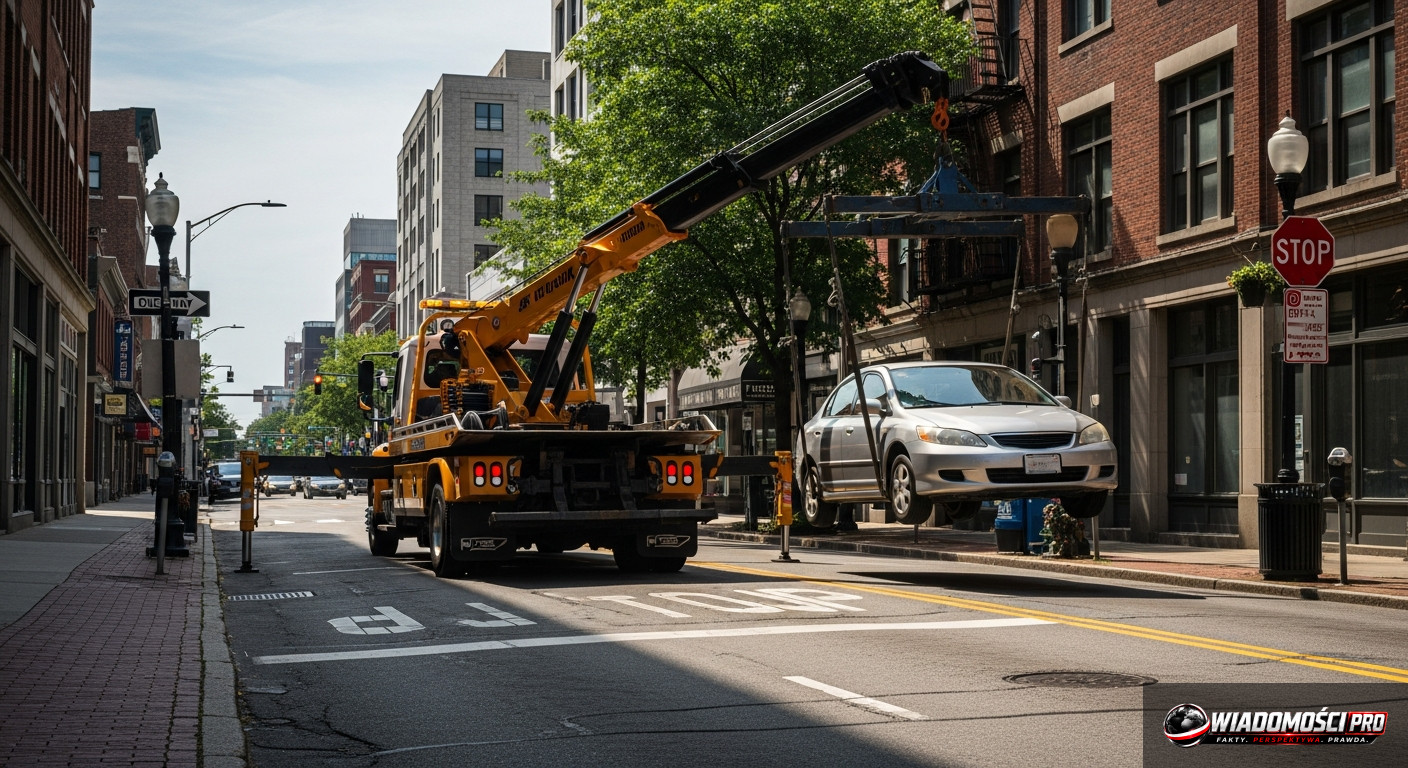
From January 1, 2027, the maximum fee for towing and each 24-hour period of vehicle storage at a guarded parking lot will increase to 837 PLN. This is the upper limit set by the Ministry of Finance, which serves as the basis for setting rates by local governments. The new regulations are coming into effect in response to the rising costs of maintaining specialized fleets and operating parking infrastructure.
Legal and financial mechanism of the increases
The legal basis for the introduced changes is Article 130a of the Act of June 20, 1997 – Road Traffic Law. This provision specifies the situations in which a car may be removed from the road at the owner's expense. The Ministry of Finance periodically updates the upper limits of the rates based on consumer price indices from the previous year. In 2027, this limit will reach the level of 837 PLN.
The ministry's decision does not mean that every driver in Poland will pay exactly this amount. Local governments, acting on the basis of municipal council resolutions, have the right to determine their own price lists, provided they do not exceed the aforementioned limit. In practice, this means that a city council in a large urban center may decide to make full use of the allowable ceiling, while the authorities of a smaller municipality may limit themselves to lower costs. This mechanism is intended to balance municipal expenditures related to towing services and the maintenance of impound lots.
Previous limits did not cover the real operating costs incurred by companies providing towing services commissioned by the police or municipal guard. Rising fuel prices, spare parts, specialized vehicle maintenance, and labor costs have made the previous rates unprofitable for many operators. Municipalities often had to subsidize each vehicle removal operation, which burdened local budgets. The new regulations are intended to eliminate this problem by making the system self-financing.
Comparison table: Scale of cost changes
The table below illustrates the difference between the current maximum limit and the new rate that will take effect from January 1, 2027. It is worth noting that the actual amount of the fee for the driver depends on the local municipal council resolution, however, the 837 PLN ceiling sets a new, higher limit of financial liability.
| Type of fee | Current maximum limit | Limit from January 1, 2027 |
| :--- | :--- | :--- |
| Towing and 24-hour stay | [Previous amount]* | 837 PLN |
*Note: The exact amount of the previous limit depends on the applicable municipal council resolution in a given region, however, the statutory ceiling was in each case lower than the 837 PLN value set for 2027.
The process of vehicle removal in light of the new regulations
The procedure for removing a vehicle from a public road is strictly defined and leaves no room for free interpretation. When a driver leaves a car in a prohibited place, creating a traffic safety hazard or obstructing traffic, services make the decision to tow it. After transporting the vehicle to a designated guarded parking lot, the process moves into the administrative phase.
The vehicle owner, after receiving information about its removal, must first complete formalities at the unit that issued the removal order. Then, it is necessary to pay the fees for towing and storage. Only after presenting proof of payment does the parking lot manager receive authorization to release the keys. Each day of delay in picking up the vehicle generates additional costs, which in 2027 will be significantly more burdensome for the household budget than in previous years.
This system excludes the possibility of negotiating rates at the parking lot. The parking lot manager is merely the executor of an administrative decision, not the entity setting the prices. In the event of disputes regarding the validity of the towing, the owner may pursue their rights through the appeal process, but the obligation to pay the fees before picking up the car remains intact. This is a key aspect that many drivers forget in the heat of the moment regarding the loss of their vehicle.
The role of local governments in shaping prices
Local governments have gained a tool that allows them greater flexibility in managing road traffic. Although the Ministry of Finance imposes an upper limit of 837 PLN, local authorities will decide how high the fee will be in their jurisdiction. Cities struggling with the problem of chronic parking shortages and high traffic intensity may be more inclined to adopt maximum rates, treating them as an element of a deterrent policy.
From the perspective of the municipal budget, raising the limit is a way to reduce losses. If the costs of maintaining an external company that wins the tender for towing services exceed the revenue from parking fees, the municipality must cover the difference from the taxes of all residents. Passing the costs directly onto the drivers who committed the traffic violation is a solution that is gaining support in many local governments.
Drivers should, however, remain vigilant. Not every city will automatically adopt the 837 PLN rate. Some municipal councils may decide to raise prices in stages to mitigate social resistance. Before traveling to an unfamiliar city, especially in larger metropolitan areas, checking local resolutions regarding vehicle removal may prove to be the only way to avoid financial shock. Awareness of local regulations is becoming as important as knowing traffic signs.
Consequences for drivers and household budgets
The increase in costs to 837 PLN per day is a sum that in many cases exceeds the value of minor service repairs. For a person whose car was towed on Friday and pickup is only possible on Monday, the cost of parking for three days could exceed 2500 PLN. To this amount, one must add the fine imposed by the police or municipal guard for the traffic offense.
The total expenditure for one parking mistake can therefore oscillate in the range of several thousand zlotys. Such a situation puts people with lower incomes in a difficult position. A lack of financial liquidity at the time of picking up the car results in the accrual of further fees for each subsequent day, which creates a debt spiral. This system does not provide relief for people in difficult financial situations, which makes it an exceptionally strict tool for law enforcement.
This is not just a matter of money, but also of time. The procedure for recovering a vehicle requires visits to offices, the police, and the parking lot. In many cases, this takes an entire working day. Drivers who do not have the ability to quickly handle the formalities are the most exposed to the accumulation of costs. This is another reason why in 2027, a precise assessment of the parking spot will be an absolute priority before locking the car.
Strategies for avoiding costly mistakes
Avoiding vehicle removal requires, above all, a change in habits. Many drivers fall into the trap of routine, assuming that the place where they have parked for years is still legal. Changes in traffic organization, new prohibition signs, or the designation of restricted parking zones make safe parking a task requiring constant attention.
A key principle is a thorough analysis of the surroundings before leaving the vehicle. In residential zones, parking is permitted only in designated places, not "wherever I am not blocking the passage." Many people do not realize that leaving a car on the sidewalk in a way that hinders pedestrian traffic is sufficient grounds for calling a tow truck.
Modern navigation applications often inform about paid parking zones, but they rarely warn about no-towing zones. Relying solely on technology can prove fatal. Physical verification of traffic signs within a radius of a dozen meters from the parking spot should become second nature to every driver. If you have doubts about whether a given entrance is a garage gate or whether you are standing too close to a pedestrian crossing, it is better to look for a spot a few hundred meters away. A walk to your destination is much cheaper than the fee for an impound lot.
Risk of error in interpreting regulations
The interpretation of traffic regulations is often a source of disputes. Drivers often argue that their car was not bothering anyone, even though it was standing in a prohibited zone. From the point of view of the services, the fact of violating the regulations counts, not the subjective feeling of a lack of harm. From 2027, these subjective beliefs will cost much more.
Doubts are often raised by traffic signs placed in an unclear manner or obscured by vegetation. In such cases, drivers have the right to appeal, but this requires gathering evidence, e.g., photos of the parking spot at the moment of leaving the car. It is worth documenting the state of the surroundings if there is even a shadow of a chance that the signage is illegible. Nevertheless, in most cases, the burden of ensuring the legality of the parking spot rests with the driver.
It is also worth paying attention to the technical condition of the vehicle. Cars with visible signs of long-term parking, with flat tires or broken windows, are removed from roads first as wrecks. In this case, the regulations on vehicle removal are combined with regulations on environmental protection and order in the municipality. Owners of such cars must count on towing costs, which in 2027 will reach the level of 837 PLN, which often exceeds the value of the vehicle itself.
Economic justification for the ministry's decision
The Ministry of Finance argues that making the rates realistic is necessary to maintain the liquidity of the vehicle removal system. Over the last few years, labor costs have risen across the entire economy, and the transport industry has felt this in a special way. Maintaining tow trucks on standby around the clock requires hiring qualified drivers and operators, which generates fixed costs, regardless of the number of orders performed.
For towing companies, the limits set by the ministry are the only source of income in the case of services performed on behalf of municipalities. If these limits are too low, companies withdraw from the market, which leads to the paralysis of the system in crisis situations. Municipalities must offer rates that allow companies to maintain profitability, and this in turn forces increases in statutory limits. It is a vicious circle in which every element of the system — from the finance ministry, through local governments, to the contractors — must strive to maintain the profitability of operations.
However, it should be remembered that the increase to 837 PLN is a signal to the market that services related to traffic law enforcement are becoming increasingly expensive. Municipalities that want to maintain efficient traffic management will have no choice and will have to adjust their resolutions to the new realities. For drivers, this means the end of the era of cheap parking mistakes. Every violation of the regulations will have a measurable financial effect, which on an annual scale can become a significant burden on the household budget.
Car owner's perspective: What to do in case of towing?
The first reaction to seeing an empty space where the car was left is often panic. However, it is worth staying calm and acting according to an established scheme. First, you should check if the vehicle was moved by maintenance services within the same street. If, however, it is not nearby, the next step is to contact the emergency number 112 or the nearest municipal guard unit.
After confirming that the vehicle has been towed, you should ask about the location of the guarded parking lot and which unit you need to pick up the documents authorizing the release of the car. Often this is a police station or the headquarters of the municipal guard. There, a report will be drawn up and a fine for the traffic offense will be issued. Only with such a set of documents can you go to the parking lot.
The most important information is that every hour of delay works to the owner's disadvantage. The fee for a 24-hour stay is charged for every started 24-hour period. This means that if the car is picked up shortly after midnight, another full daily rate will be charged. Therefore, if information about the towing reaches the owner in the evening, it is worth considering whether picking up the car the same day is possible and whether it will allow avoiding costs for the next day.
Questions and answers
Is 837 PLN the fee for just towing, or also for parking?
It is the maximum rate for the removal of the vehicle and each 24-hour period of its parking at a designated guarded parking lot. This fee covers both of these elements, and the municipality, as part of a resolution, may break these costs down into individual stages, without, however, exceeding the total limit.
Will every municipality in Poland introduce the 837 PLN rate?
No. The 837 PLN rate is the upper limit set by the Ministry of Finance. Each municipality, by way of a municipal council resolution, decides whether it will introduce such a rate or decide on a lower amount, adjusted to the local costs of operating the system.
From when exactly do the new rates apply?
The new maximum rates come into effect on January 1, 2027. From that moment on, every municipal council resolution must take this new limit into account if the local government decides to raise fees.
Can I appeal against the towing costs?
You can appeal against the validity of the vehicle removal through administrative proceedings if you believe that the services acted unlawfully. This does not, however, exempt you from the obligation to pay the towing and parking fee in order to recover the car. A refund of costs may only occur after a positive consideration of the appeal.
Who decides whether my car will be towed?
The decision to remove a vehicle is made by a police officer or a municipal guard in situations specified in Article 130a of the Road Traffic Law. These are cases in which the vehicle threatens traffic safety, hinders passage, or has been left in a place where it is explicitly prohibited.
Can I count on a discount if the car stays in the parking lot for a long time?
The regulations do not provide for discounts on parking fees at guarded parking lots for vehicles removed in an administrative mode. The fees are flat-rate and result directly from municipal resolutions, which means that regardless of the owner's financial situation, the fee counter will charge the full amount for each 24-hour period of stay.
Sources
- The cost of towing a car will increase. Up to 837 PLN per day - MotoGuru.pl
- 837 PLN for towing a car. New rates from 2027 - Interia Motoryzacja
- Towing a car from 2027 will be more expensive - otomoto.pl
- Rules for setting fees for towing vehicles from roads - INFOR.PL
Article prepared by the Wiadomości PRO editorial team with the support of artificial intelligence. Facts come from the sources listed above.
Komentarze (0)
Ładowanie komentarzy...