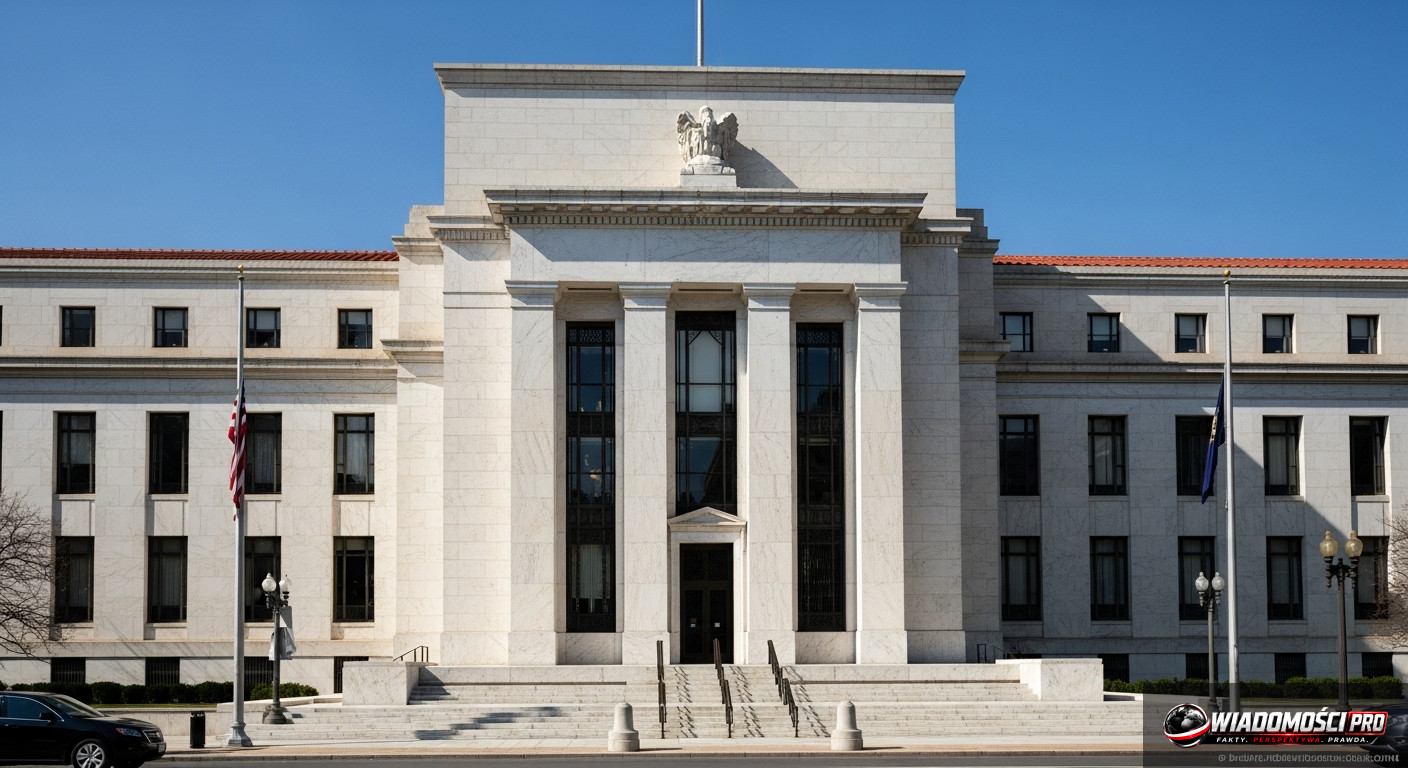
The Federal Reserve has lowered interest rates to the 4.75-5.00% range to stimulate the economy, even though forecasts predict inflation will remain above target until 2028. This decision forces investors to revise their portfolios, as real capital costs will remain significantly higher than a superficial analysis of monetary trends would suggest. The change in Fed policy calls into question existing asset valuation models that assumed a rapid return to the era of cheap financing.
Fed decision: a stimulation mechanism in the shadow of uncertainty
Jerome Powell, facing a slowdown in economic activity, decided on a 50 basis point cut. This action is not merely a technical adjustment of monetary parameters. It represents a turning point in a strategy that has balanced on the edge of restriction for months. Central bankers in Washington have made a move intended to prevent a deeper economic collapse, while simultaneously ignoring warnings from forecasting models.
The macroeconomic situation offers no reason for enthusiasm. Policymakers are consciously accepting higher price dynamics in exchange for avoiding a recession. This approach sparks controversy among economists, who point out that as recently as 2025, policy was focused on firmly crushing wage-price pressure. The current easing suggests that priorities have shifted—employment growth and maintaining liquidity in the corporate sector have become more important than returning to the inflation target in the short term.
Institutional investors in the US find themselves in a new environment. Risk perception has changed. Since the central bank is willing to tolerate elevated inflation for years to come, capital must seek hedges against the erosion of purchasing power. The "soft landing" strategy has ceased to be just a theoretical construct and has become an actual pillar of policy, which, however, creates the risk of anchoring inflation expectations at higher levels.
Every decision to cut the cost of money with such persistent price indicators raises questions about the institution's credibility. The Fed is operating with limited room for maneuver. If the economy does not respond with the expected recovery, policymakers will find themselves in a trap—between the necessity of further supporting the market and growing price pressure that cannot be extinguished by interest rates alone.

Inflation horizon: why 2028 is the cutoff date
The official Fed forecasts from December 2025 are merciless. Maintaining inflation indicators above target until 2028 is not a mere statistical correction. It is a message to the market that the era of easy living and low credit costs is a thing of the past. Consumers in the United States who were counting on a quick breather after years of high prices must revise their financial plans.
Why is the fight against inflation taking so long? The answer lies in the structure of spending and labor market rigidities. Despite aggressive monetary policy moves in previous years, certain components of the consumer basket show high resistance to interest rate changes. The central bank thus admits that its tools have become less effective in the face of global supply and demographic shifts.
For the average household, this means that money in a savings account is losing value faster than banks are able to offer returns. This mechanism hits savings, forcing Americans to seek higher returns in riskier assets. The Fed, consciously accepting this state of affairs, is trying to avoid the shock that a drastic rate hike would cause in an already weakened service sector.
This stalling game has its price. Keeping inflation above target for such a long time permanently changes consumption habits. Companies, accustomed to easily passing costs on to customers, show no will to limit margins. As a result, inflation is becoming a structural element of the American economic landscape, posing a task for the Fed that no strategy in the last two decades has been able to overcome.
Bond market reaction: the 4.3% barrier as a litmus test
The US debt market has read the signals from Washington as a harbinger of the end of the rapid reduction cycle. Bond yields exceeding the 4.3% level are telling evidence that investors do not believe the fairy tale of a quick return to the era of near-zero rates. Bondholders are demanding a higher risk premium, looking at a time horizon in which inflation will remain unruly.
This is not a simple fluctuation on charts. Breaking the 4.3% barrier changes the math of valuations for every investment portfolio. Bonds have ceased to be a safe haven that guarantees a real return. They have become an instrument where valuation volatility is directly proportional to the uncertainty regarding future FOMC committee decisions. The financial market is currently pricing in a completely different scenario than the one debated in 2024, when many analysts mistakenly predicted a sharp retreat from restrictive policy.
Current investor behavior shows deep skepticism. Instead of euphoria after the cut announcement, we are seeing nervousness. Capital is very cautious, withdrawing from long-term treasury securities in favor of short-term instruments, which testifies to a lack of confidence in the stability of monetary policy over the next few years.
It is worth noting the dynamics of yields. When the market "demands" higher interest, it means that even with the Fed lowering base rates, the cost of financing for the economy does not necessarily have to fall at the same pace. This is a phenomenon that central bankers are watching with growing concern. Their influence on the debt market has become indirect and limited by market mechanisms that outpace communications from Washington.

Policy evolution: from political pressure to 2026
The history of recent years is a record of constant changes in strategy. September 2025 was the moment it became clear that Fed policy was no longer isolated from external influences. Decisions to resume the easing cycle were commented on as the result of political pressure, which at the time stirred huge emotions in the markets. Jerome Powell had to face accusations that the central bank had become a tool in the hands of the government administration rather than an independent arbiter of price stability.
The beginning of 2026 brought a wave of disappointment among analysts. Many models predicted a pause in actions that would allow the market to adapt to new conditions. The Fed, however, ignored these forecasts, continuing the cuts. This determination to keep the economy moving at any cost testifies to a profound paradigm shift. It is no longer about the "Chicago school" and hard monetarism, but about pragmatic crisis management that resembles putting out fires with gasoline.
Comparing this with the debate from 2024, a clear divergence between expectations and reality is visible. Economists who at the time built models based on an optimistic fading of inflation had to admit their mistakes. Reality proved stickier. Inflation did not want to fall to the target, and the economy did not want to enter a state of stagnation, which created a hybrid model that is difficult to manage.
Today, in retrospect, it is clear that every Fed move over the last 24 months was a desperate attempt to regain control over a process that was slipping out of the reach of standard tools. Investors who learned to predict central bank behavior had to admit in 2026 that the old rules of the game no longer applied.
Global asymmetry: USA vs. Eurozone
While the Federal Reserve is cutting rates, the Eurozone is following a completely different path. The European Central Bank, despite its own problems with price dynamics, decided on stabilization, ignoring signals from across the ocean. September 2025 brought a decision to keep rates unchanged for the second time in a row, which created a clear contrast in the global financial architecture.
This divergence has real consequences for capital. Investors, looking at both markets, must consider currency risk, which in current conditions is higher than ever. The dollar, reacting to the loosening of policy, is losing its status as a safe haven in the eyes of those who fear the inflationary consequences in the US. Conversely, the euro, despite a weaker economy within the union, is gaining in the eyes of investors looking for stability in monetary policy.
Here is a summary of the parameters that define this division:
* Rates in the US oscillate in the 4.75-5.00% range, which reflects the priority of growth over price stability.
* The European Central Bank maintains a course of stabilization, which is a clear signal for the bond market in the Eurozone.
* The projected inflation horizon until 2028 in the US puts American assets in a completely different light than European assets.
For capital holders, this asymmetry is an opportunity, but also a huge challenge. Capital will flow where the difference in real interest rates and the stability of monetary policy offer greater security. In the coming months, this "divergence" will be the main driver of volatility on currency pairs, which will force investors to change the geography of their portfolios.
What to do? A strategy for a portfolio in times of inflationary stabilization
An investor who wants to survive this period cannot rely on traditional 60/40 models. In conditions where inflation is expected to remain above target until 2028 and interest rates are in a cutting phase, the portfolio must be rebuilt based on three pillars: inflation protection, debt selection, and liquidity.
First, long-term bonds are becoming a trap. With yields exceeding 4.3% and uncertainty regarding the long-term inflation path, their valuations are susceptible to sudden changes. Instead, a safer choice is short-term floating-rate bonds, which react better to market changes, minimizing the risk of capital value decline in the event of a sudden jump in yields.
Second, it is worth increasing exposure to real assets. Gold, commodities, or high-quality commercial real estate—these are assets that in historical periods of elevated inflation protected capital much better than cash or paper debt instruments. If the Fed accepts higher inflation, physical assets become a natural "fuse."
Third, one should avoid highly indebted companies. Although rates are falling, the cost of servicing debt remains high compared to 2020-2021. Companies that do not have healthy cash flows and must roll over debt in conditions where the bond market is skeptical will become the first victims of the "soft landing." Focusing on companies with strong balance sheets, high margins, and the ability to pass costs on to the customer is the only right path in the current reality.
There is no room for allocation errors. Investors who still believe in a quick return to zero rates will be quickly verified by the market. The strategy must assume that inflation is "sticky" and that central banks are no longer able—or willing—to restore the state of the previous decade.

The future: does the easing cycle have limits?
The decision to cut to the 4.75-5.00% range is just one of many that lie ahead. Communications from Washington are becoming increasingly enigmatic. On one hand, there is a desire for stimulation; on the other, a growing awareness that every subsequent move could be the one that finally destabilizes inflation expectations. The market is already pricing in the possibility of halting further cuts, which would be a logical step toward stabilization.
Investors must reckon with volatility. Every subsequent inflation reading will be treated as a test of the Fed's credibility. If macro data do not show a downward trend, the central bank will be forced to slow down, which could cause a shock in stock markets geared toward continuous easing. The margin for error has practically evaporated.
It is worth following signals from the labor market. If unemployment starts to rise at a faster pace than Fed models assumed, the central bank will be backed into a corner. It will be forced to choose between supporting the labor market and fighting inflation, which is expected to be "elevated" until 2028. This is a scenario that no one wants, but for which everyone must be prepared.
Ultimately, the decision to cut rates is an admission of failure in the attempt to quickly restore normalcy. The US economy has entered a phase where old recipes no longer work, and new ones are only just being created. Investors must accept this state of uncertainty and stop looking for guarantees of success in central bank decisions. Success today requires flexibility and the understanding that monetary policy is on the defensive.
Questions and answers
Why did the Fed lower interest rates, even though official forecasts point to persistent inflation until 2028?
The Fed is prioritizing the maintenance of economic growth and market liquidity, accepting higher inflation as the "lesser evil" compared to the risk of a deep recession.
How did the bond market react to the 4.3% yield level?
Investors are showing skepticism toward aggressive easing, demanding a higher risk premium, which shows that the era of cheap money will not return anytime soon.
Does the current 4.75-5.00% range mean that the rate-cutting cycle will end soon?
Signals from the Fed suggest that policymakers are becoming increasingly cautious, and the current level may serve as a base for a period of stabilization, provided that inflation data do not begin to fall drastically.
What is the main difference in the approach to monetary policy between the Fed and the ECB?
The Fed is focusing on stimulating the economy, while the ECB is focusing more on stabilization and adhering to the rigors of monetary policy, which creates a clear asymmetry in currency markets.
How should an investor protect their portfolio in current conditions?
It is recommended to avoid long-term bonds in favor of short-term ones, increase exposure to real assets, and select companies with very strong balance sheets that are resistant to persistent financing costs.
Sources
- Fed signals a halt to interest rate cuts, and US bond yields exceed 4.3%. - Vietnam.vn
- September Fed decision may disappoint stock markets. Debate around a possible US interest rate cut - Strefa Inwestorów
- Trump got his way. Fed resumed interest rate cut cycle - Bankier.pl
- US inflation above target until 2028 – Fed forecast - Rzeczpospolita
- Fed holds its breath. Market expects interest rate stabilization in the US - Money.pl
- Why did the Fed lower interest rates, even though US inflation still causes concern - Business Insider Polska
- Fed cuts interest rates sharply. Economists, however, were wrong - Bankier.pl
- Eurozone rates unchanged for the second time in a row - Analizy.pl
Article prepared by the Wiadomości PRO editorial team with the support of artificial intelligence. Facts are based on the sources provided above.



Komentarze (0)
Ładowanie komentarzy...