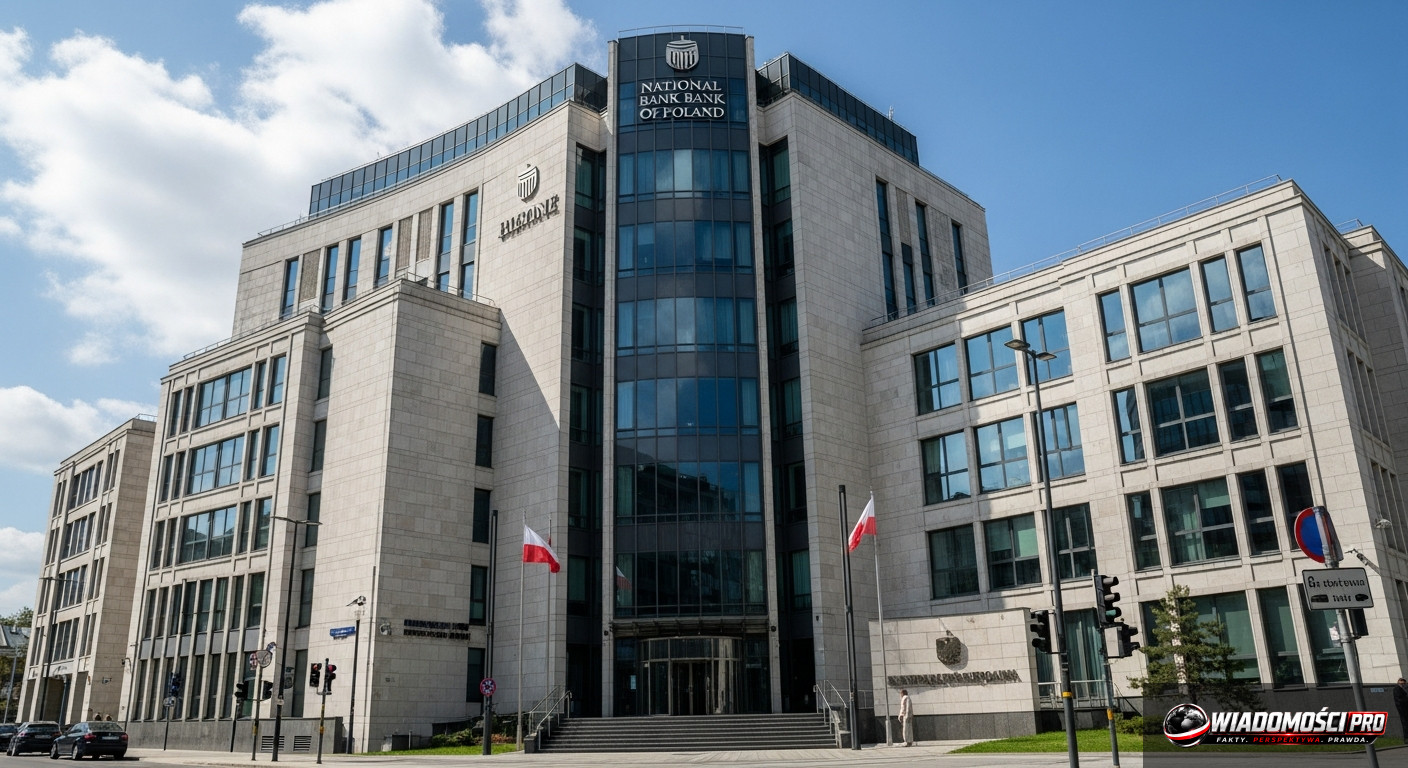
In brief
- NBP interest rates remain at 5.75 percent despite earlier market expectations for further cuts.
- The US-Iran conflict is generating inflationary risks and pressure on the zloty, forcing the MPC to remain cautious.
- Analysts point out that the optimal interest rate level may be reached no sooner than the end of 2026.
The MPC facing geopolitical tensions: why are rates standing still?
The Monetary Policy Council's decision on July 8, 2026, left no illusions. The main reference rate remains at 5.75 percent. Borrowers who were counting on a quick breather in their monthly obligations must arm themselves with patience. Hopes for cheaper money have collided with the brutal reality of global tensions.
The cause of the stagnation is clear to anyone following world reports. The escalation of the conflict between the US and Iran, widely reported by industry media, including Parkiet and INNPoland.pl, is effectively paralyzing the optimism of decision-makers. Financial markets react nervously to every signal coming from the Middle East, and this uncertainty translates directly into the condition of the Polish currency. The zloty has been under pressure for weeks. In such conditions, an interest rate cut would be a risky, even irresponsible move for the National Bank of Poland.
For borrowers, this is a difficult scenario to accept, but a predictable one. The stabilization of rates at this level is not a choice resulting from the domestic economic situation, but a necessity imposed by the international situation. If capital flees to safe havens and the zloty exchange rate is volatile, easing monetary policy could trigger uncontrolled inflation or weaken the currency even further. The Monetary Policy Council is therefore choosing a wait-and-see approach.
In practice, this means that the amount of mortgage installments remains frozen at a high level. There is no talk of cheap credit until the dust settles on relations between Washington and Tehran. Investors and analysts agree: as long as there are sparks on the world map, we can only dream of a return to lower debt servicing costs in the coming months. This is the price that Polish households are paying for the instability of the global order.
Loan cost analysis: what does the decision mean for the household budget?
For thousands of Poles paying off mortgages, today's decision by the Monetary Policy Council is a bucket of cold water. Maintaining interest rates at 5.75 percent means that in the coming months, borrowers' wallets will not feel any relief. The geopolitical situation, including the escalation of the conflict between the US and Iran, has effectively frozen any hopes for cheaper money.
The main problem remains the WIBOR rate. Its value is directly linked to MPC decisions, so the lack of movement up or down in interest rates translates into stagnation in debt servicing costs. Borrowers who were counting on a quick return to installments from before the hikes must arm themselves with patience. The contrast with the situation less than a year ago is striking. In the autumn of 2025, the mood was quite different, and the market was living through a cycle of cuts, which gave real prospects for the gradual slimming of monthly obligations. Now that path has been interrupted.
Loan servicing costs remain high, and uncertainty in international markets discourages the Council from any monetary policy easing. The zloty is under strong pressure, which further limits the room for maneuver for decision-makers. Hopes for an improvement in the financial situation of households in the third quarter of 2026 have proven to be in vain.
Here is how the current financial landscape is shaping up based on available data:
- NBP interest rates — 5.75 percent (wGospodarce, 08.07.2026)
- Debt servicing cost forecast — stagnation (TotalMoney.pl, 13.07.2026)
- Monetary policy status — no cuts despite previous cycles (Bankier.pl, 05.11.2025)
For the average borrower, this means one thing. The household budget must withstand the pressure of high installments for even longer. The optimism of November 2025, when we were counting on a quick return to normalcy, has evaporated. Now, what counts is surviving in an environment of expensive credit, and every subsequent MPC decision, dictated not so much by the situation in Poland as by the storm in the Middle East, shows how dependent we are on events over which we have no influence.

The road to the goal: economists' forecasts for the rest of 2026
The road to the goal: economists' forecasts for the rest of 2026
The Monetary Policy Council remains adamant. Maintaining interest rates at 5.75 percent is a direct result of the escalation of tensions between the US and Iran, which effectively freezes borrowers' hopes for quick installment cuts. The zloty is under constant pressure, and geopolitical uncertainty forces decision-makers into a defensive stance. We can forget about relief in household budgets for now.
The optimism that recently dominated the markets has evaporated. Let us recall the forecasts from April 13, 2026, prepared by Direct Money. At that time, analysts were outlining much milder scenarios, assuming a faster return to a cheap money policy. Today, these predictions are being brutally revised. Reality has surpassed mathematical models that did not take into account such a rapid deterioration of the situation in the Middle East.
For the indebted, this means one thing. The waiting time for an MPC move is extending indefinitely. We must return to the cold analysis of November 6, 2025, when Forbes experts pointed out that the optimal level would be reached no sooner than the end of 2026. At that time, those words sounded like a distant warning. Today, they are becoming a real, painful calendar for anyone paying off a mortgage.
The market leaves no illusions. Instead of a quick cut, a long period of stagnation awaits us. Economists point out that any attempt to ease monetary policy in the face of a global conflict would be a risky gamble for the zloty. The MPC is therefore choosing the status quo. Borrowers must prepare for the fact that the amount of installments will remain at the current, high level for at least the next few months. There is no room here for quick plot twists. Stabilization is the only message coming from the NBP.
The zloty under pressure: are interventions necessary?
The zloty under pressure: are interventions necessary?
The Monetary Policy Council has decided to keep interest rates unchanged at 5.75 percent. This decision from July 8, 2026, effectively cuts off borrowers' hopes for a quick drop in installments. The main brake on any monetary policy easing remains the unstable international situation. The escalation of the conflict between the US and Iran is hitting financial markets, forcing the MPC into a defensive position.
Our currency feels this directly. As INNPoland.pl notes in an analysis from July 8, 2026, tensions in the Middle East translate into nervousness among investors, who are fleeing emerging market currencies. Maintaining high interest rates currently serves primarily to stabilize the zloty's exchange rate. It is a shield that the central bank cannot let go of as long as foreign capital behaves so unpredictably.
For a mortgage holder, this means a stalemate. The lack of prospects for a cut means that monthly burdens will remain at the current, high level. A scenario in which the MPC decides to ease monetary policy would require global unrest to subside. For now, however, the "US and Iran are at daggers drawn" scenario dominates market messaging, effectively blocking space for any decisions stimulating the economy.
Economists point out that any attempt to cut rates with such weakened sentiment toward the zloty could trigger a wave of sell-offs of the Polish currency. This, in turn, would fuel imported inflation. From the NBP's perspective, the choice is brutal: either expensive loans or the risk of a currency crash. The Council has chosen stability, which for borrowers' wallets is the worst of all possible variants. The zloty under pressure is a zloty that is expensive for the economy, but for the average Pole with a loan, it simply means another month with the same high installments. Hope for relief therefore remains only a theoretical forecast.

Balance of gains and losses: who loses out on the lack of cuts?
Balance of gains and losses: who loses out on the lack of cuts?
The Monetary Policy Council's decision to maintain interest rates at 5.75 percent is like a cold shower for millions of Polish families. We are putting hopes for cheaper credit on the shelf because the situation in the Middle East – specifically the escalation of the conflict between the US and Iran – is effectively paralyzing any moves toward easing monetary policy. The zloty under pressure, commodity uncertainty, and global tensions are winning out over the needs of borrowers' wallets.
The effects of this decision are felt almost immediately, although for everyone for completely different reasons. The financial market is clearly reacting to the lack of a "dovish" stance from the MPC. There is no room for optimism when geopolitical risk is priced so high. Here is who is really feeling the freeze on the cost of money:
- Borrowers with variable interest rates, whose installments are still based on the high 5.75 percent rates. For them, this is not a time for planning overpayments or credit holidays, but for desperately holding onto the household budget, because the next installment does not bring the expected relief.
- Savers with bank deposits, who on one hand can enjoy the maintenance of the existing interest rates on their deposits, but on the other hand – are actually losing out. In the face of inflation, which still refuses to give up, the freezing of rates means that earnings from savings at best only protect capital from a rapid loss of value.
This is a stalemate. The MPC is choosing the "safety" of the zloty and exchange rate stability at the expense of the current financial liquidity of households. Central banks rarely admit this directly, but the current strategy is a fight for survival in realities over which the Polish council has no influence. Borrowers are left with "concrete" in their wallets, and savers with uncertainty about whether inflation will eat their profits faster than they can withdraw them.
What's next? Key dates for the Polish economy
The Monetary Policy Council has once again frozen interest rates. The main reference rate remains at 5.75 percent. This decision, contrary to the earlier expectations of some analysts, is a direct consequence of the escalating conflict between the US and Iran. Geopolitical uncertainty has completely overshadowed the arguments for supporting consumption through cheaper credit. For the wallets of Poles, this means one thing: debt servicing costs will remain at a high, unchanged level in the near future.
Memories of the autumn of 2025 have already become just a historical point of reference. At that time, as reported by Bankier.pl, the market had the right to feel optimistic, observing a series of cuts that were supposed to be a prelude to cheaper money. Today, that scenario seems distant. The zloty is under enormous pressure, and every spark in the Middle East effectively blocks members of the Council from easing monetary policy. There is no talk of decision-making comfort.
The eyes of the entire market are now shifting to the next MPC meetings scheduled for the second half of 2026. Investors and borrowers are no longer looking only at domestic inflation data. Now they are following dispatches from Washington and Tehran. It is there, and not in Warsaw, that decisions are made that ultimately determine whether a mortgage installment will fall or remain a painful burden on the household budget. The prospect of a return to cheap credit is receding with every month in which the armed conflict forces the central bank into a defensive stance. Will the situation change before the end of the year? At this moment, the Council is not giving any signals that would allow for such hope.

What this means for you
For the average borrower, the MPC decision means a further 'freeze' of installment amounts at a high level. People with savings in deposits are gaining, but those who were counting on a quick breather in paying off mortgage obligations are losing. The catch lies in geopolitics: as long as the US-Iran conflict drives up commodity prices and builds uncertainty, the MPC will not dare to significantly ease policy so as not to fuel inflation.
Questions and answers
Why is the MPC not cutting rates if inflation seems to be under control?
The main reason is external uncertainty, including the escalation of the conflict in Iran, which forces the Council to remain cautious in order to protect the zloty's exchange rate.
When can I realistically expect a drop in my loan installment?
According to experts, the earliest realistic date for reaching the optimal interest rate level is the end of 2026.
Are my savings in a deposit safe?
Maintaining rates at 5.75 percent means that deposit interest rates will remain at the current, stable level, which protects capital from a further decline in real value.
Sources
- See what's happening with your loan! The MPC has made a decision - wGospodarce
- Interest rate value August 2026. Forecasts and current information on interest rates in Poland - TotalMoney.pl
- The Monetary Policy Council has lowered interest rates. This is already the second autumn quarter - Bankier.pl
- MPC keeps rates unchanged – will the escalation in Iran bring hikes? (ANALYSIS) - Parkiet
- Interest rate forecasts in 2026 - Direct Money
- The interest rate cut cycle continues, but it's too early to rejoice. Economist: "We will reach the optimal level no sooner than the end of 2026" - Forbes
- The MPC decision on interest rates is in. It is already known what's next for loan installments - Business Insider Polska
- USA and Iran are at daggers drawn, and the MPC is not cutting rates. The zloty under pressure - INNPoland.pl
Article prepared by the Wiadomości PRO editorial team with the support of artificial intelligence. Facts are derived from the sources provided above.


Komentarze (0)
Ładowanie komentarzy...